300 meters in Gaza: Snipers, burning tires and a fence

drone-image-1200
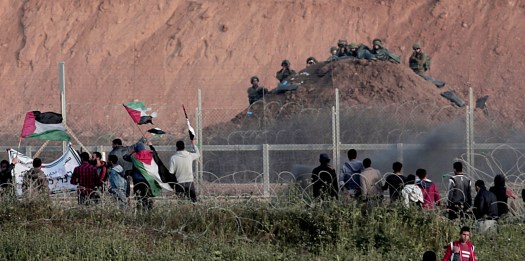
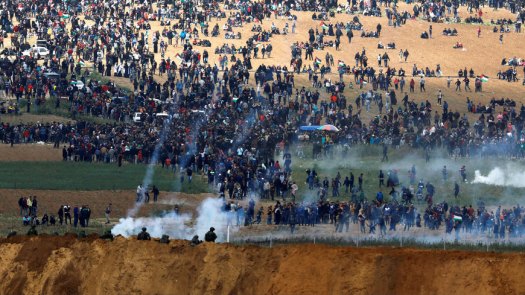
A protest in Khan Younis on Mar 30. The photographer, Yasser Murtaja, was killed by an Israeli sniper in the same location the following week. (photo: Yasser Murtaja, Ain Media)

A fence that divides Israel and Gaza has become the latest flashpoint in the decades-old conflict.

By David Halbfinger, Iyad Abuheweila and Jugal Patel | The New York Times | Apr 13, 2018


Most Gazans are Palestinian refugees or their descendants, and marching on the fence highlights their desire to reclaim the lands and homes from which they were displaced 70 years ago in the war surrounding Israel’s creation.


A fence that divides Israel and Gaza has become the latest flashpoint in the decades-old conflict, with Israeli soldiers unleashing lethal force against mostly unarmed Arab protesters who have been demonstrating every Friday for the past several weeks.

The image above shows how each side is arrayed in Khan Younis, one of five demonstration sites where 34 Palestinians have been killed since the protests began nearly three weeks ago.

The protests resumed on Friday, and the Palestinians plan to keep the weekly protests going with large turnouts until May 15, when many plan to try to cross the fence en masse. The Gazans are protesting Israel’s blockade, which has been choking off the impoverished coastal strip for more than 10 years. They also want to reassert the rights of refugees and their descendants to reclaim their ancestral lands in Israel, 70 years after hundreds of thousands of Palestinians were displaced.

Continue reading “300 meters in Gaza: Snipers, burning tires and a fence”

“Sorry Commander, I Cannot Shoot”

Palestinians Israel
Protesters wave Palestinians flags in front of Israeli solders on Gaza’s border with Israel, east of Beit Lahiya, Gaza Strip, Apr 4, 2018. (photo: Adel Hana / AP)

Israeli human-rights group B’Tselem has launched a campaign titled “Sorry Commander, I Cannot Shoot,” calling on Israeli troops to refuse orders to shoot unarmed demonstrators.

By Elliott Gabriel | Mint Press News | Apr 6, 2018


“Our legitimate protest against Israeli military occupation, colonization and apartheid is granted in international law and must be protected by the international community. . . . The 70-year-old practice of Israel’s shoot-to-kill policy and dehumanization of the Palestinian people must end.”
— Dr. Husam Zomlot, Palestinian ambassador to Washington


Tens of thousands of residents in the besieged Gaza Strip plan on returning to the Israeli-controlled border Friday [Apr 6] in defiance of menacing promises from Tel Aviv to use massive and disproportionate force. The event will occur exactly one week after the Israelis massacred 17 unarmed demonstrators with live ammunition on Palestinian Land Day.

The protest is the latest in a six-week-long set of nonviolent protests meant to commemorate the continuing dispossession of the Palestinian people and the absorption of ancestral Palestinian land by the country now known as Israel.

The series of events will last until the 15th of May, a date making the 70th anniversary of the establishment of the State of Israel — known to Palestinians as Nakba Day, or “The Day of Catastrophe” — when three-quarters of a million Palestinians were brutally displaced by Israeli militia in 1948.

Continue reading ““Sorry Commander, I Cannot Shoot””

I’m not ashamed to be Israeli — but I’m disgusted with having become Pharaoh

730403452
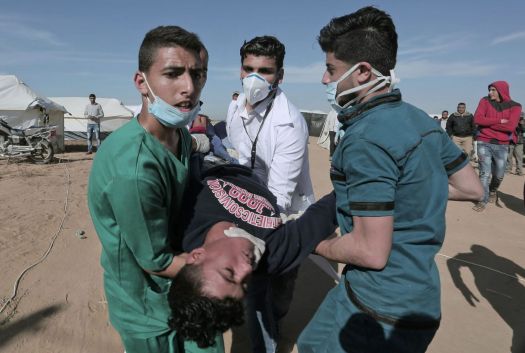
Palestinian paramedics carry a protester injured during clashes with Israeli forces following a tent city gathering at the Israel-Gaza border, Apr 2, 2018. (photo: Said Khatib / AFP)

Living in Israel has turned me into a person who can live with a government that relates to African asylum-seekers and millions of Palestinians as property.

By Bradley Burston | Haaretz | Apr 2, 2018


Living in Israel has hardened my heart. It has made me into a person who cannot believe that Israel will do the right thing. That Israel will make any effort at all to even begin treat the true cancer in our body — the occupation.


The best people I have ever met live in Israel.

They are tireless. They come in all colors and creeds. Their reservoirs of hope, goodness, giving for others, respecting the Other, striving for a better, more human, society — despite everything, despite hatred and graft and incitement and ill-will — are as boundless as they are inexplicable.

Then there is Caroline Glick.

Continue reading “I’m not ashamed to be Israeli — but I’m disgusted with having become Pharaoh”

Israeli forces kill photojournalist at Gaza rally

af9eb61e9daf4750bc3e348a1c1a2f37_18
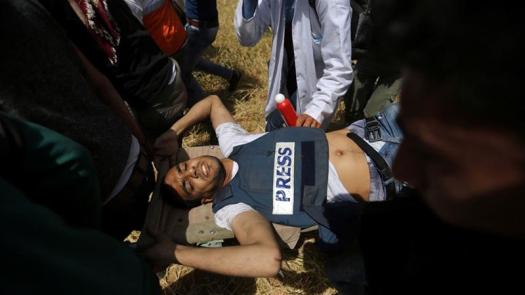
Yaser Murtaja, 30, was shot in the abdomen in Khuza’a in the southern Gaza Strip on Apr 6. 2018. (photo: Ibraheem Abu Mustafa / Reuters)

Seven other journalists were wounded in Friday’s protest.

By Al Jazeera | Apr 7, 2017


The Palestinian health ministry reported that on Friday 491 people were injured by live ammunition after Israeli forces fired on protesters who had gathered near the Israeli border in the besieged Gaza Strip.


A Palestinian journalist shot by Israeli forces during a mass demonstration along the Gaza border has died of his wounds.

Yaser Murtaja, a photographer with the Gaza-based Ain Media agency, was shot in the stomach in Khuza’a in the south of the Gaza Strip on Friday, according to the Palestinian health ministry.

Murtaja, 30, was hit despite wearing a blue flak jacket marked with the word “press,” indicating he was a journalist.

Continue reading “Israeli forces kill photojournalist at Gaza rally”

May is likely to be an ugly month in Gaza

1600x-1
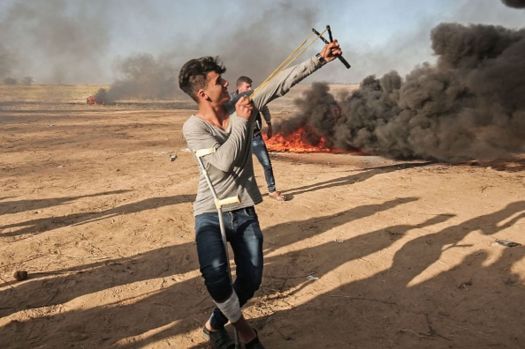
Palestinian using a slingshot at a protest in Gaza. (photo: Said Khatib / AFP / Getty Images)

When an entire people have concluded they have nothing to hope for and nothing to lose — that all their dreams will remain deferred for the foreseeable future — an explosion may be inevitable.

By Hussein Ibish | Bloomberg View | Apr 3, 2018


Both Palestinian Islamists and nationalists are out of options, out of ideas, and out of luck. The Palestinian public is out of patience and nearly out of hope. That’s a combustible formula.


The violence last Friday in Gaza, in which 18 Palestinian protesters were killed by Israeli troops near the border, was the worst since the war of 2014. But everything is in place for a significant escalation in coming weeks, particularly in mid-May.

A series of major tripwires are clustered tightly together: commemorations of the 70th anniversary of Israel’s founding on May 14–15; mourning by Palestinians who regard the same event as their “catastrophe” and observe May 15 as “Nakba Day”; and the scheduled opening of a US Embassy in Jerusalem on May 14, courtesy of the administration of President Donald Trump.

Things are likely to get worse because Palestinians increasingly feel they have nothing left to lose. The “March of Return” last week drew unprecedented crowds of up to 30,000 Palestinians from all parts of Gaza society. In a festive and surreal atmosphere, vendors sold ice cream to picnicking families as young men risked their lives by approaching the border.

Continue reading “May is likely to be an ugly month in Gaza”

Israel’s Gaza nightmare

rtx5f45p-870
Israeli soldiers shoot tear gas from the Israeli side of the Israel-Gaza border as Palestinians protest in Gaza, Mar 30, 2018. (photo: Amir Cohen / Reuters)

The Israel Defense Forces consider “only” 16 casualties a “very significant achievement.”

By Ben Caspit | Al-Monitor | Apr 2, 2018


“Just imagine what could have happened. Picture the outcome if they would have burst through the fence, even at a single point, and begun marching into Israel. It would have ended in a bloodbath. . . . We would have no choice but to employ enormous force, and that would have resulted in dozens, if not hundreds, of casualties. The images would have been a huge victory for the Palestinians.”
— Senior Israeli defense official, speaking anonymously


The March 30 Great March of Return to the Gaza border fence was nothing more than Act 1 of an unfolding drama, a dress rehearsal or possibly a pilot for what one can expect to see in the very near future. The Israel Defense Forces (IDF) are now preparing for April 17, Palestinian Prisoners Day, also the eve of Israel’s Memorial Day for Fallen Soldiers, and for May 15, Nakba Day, also the day after the United States is expected to open its new embassy in Jerusalem. Further complicating matters, the latter event coincides with the start of the Islamic holy month of Ramadan. The Great March of Return was initiated and orchestrated by Hamas in an attempt to change the rules of the game, create a new balance of power and send a message to Palestinian President Mahmoud Abbas that the struggle for the hearts and minds of the Palestinian people is far from over. Hamas is alive and kicking, and it is marching as well.

Hamas is in the process of losing its tunnels as a weapon. The IDF and Egypt have also successfully prevented the group from smuggling into Gaza rockets, missiles and other arms that could break the balance of power. Facing the most threatening dead end ever, Hamas found a way to reinvent itself: a popular, mass march by tens of thousands of people, all heading to the Israeli border at the Erez checkpoint, where they would trample the fence, break the Israeli siege and move on toward Jerusalem or at least to the southern town of Ashkelon. Images of IDF tanks and helicopters firing at civilians marching for their freedom would be Israel’s worst imaginable nightmare.

That is why the IDF has decided not to let that happen.

Continue reading “Israel’s Gaza nightmare”

If Israel were not an ally, the US would be working to overthrow its government

Palestinians Israel
Teargas canisters fired from Israeli drones fall on Palestinians during a demonstration near the Gaza Strip border with Israel, Mar 30, 2018. (photo: Hatem Moussa / AP)

The “humanitarian” concern of the US is all too often a cover for regime change ambitions. It seems to disappear when the victims in need are without strategic geopolitical value to Washington.

By Whitney Webb | Mint Press News | Apr 3, 2018


There are no efforts to hold Israel to account for its recent massacre of civilians. Instead, Israel has rejected UN and EU calls for an inquiry into the killings and a UN Security Council resolution on the matter was blocked by the United States.


Over the weekend, outrage took hold as the state of Israel authorized more than 100 snipers to fire upon the demonstrations of unarmed Palestinians in Gaza. The Palestinians, participating in the “March of Great Return” to demand the right for exiled Palestinians to return to their ancestral lands, were fired upon while fleeing and even praying. 17 Palestinians were killed and over 1,400 were injured. The Gaza Health Ministry stated that most of the reported injuries were bullet wounds to the legs and feet. The Israeli Defense Forces stated on Twitter that they were fully aware of where “every bullet landed” and Israeli Defense Minister Avigdor Lieberman said that the snipers “did what had to be done” and “deserve a commendation.”

The outrage, however, was confined to only a few countries as, throughout the West, the horrific event was the subject of slanted reports — such as those that portrayed the Israeli military firing on unarmed demonstrators as “clashes” — or was not even covered at all. Despite the number of people killed and the flagrant violation of international law, the story didn’t even make the Sunday edition of The New York Times, the US “paper of record.”

Continue reading “If Israel were not an ally, the US would be working to overthrow its government”

Hopeless in Gaza

Mideast Gazas Emergency Room
Palestinian medical personnel treat a wounded girl at the emergency room of the Shifa hospital in Gaza City following an Israeli bombing campaign, Jul 18, 2014. (photo: Khalil Hamra / AP)

A conversation with controversial scholar Norman Finkelstein.

By Eric Gordon | Mint Press News | Mar 30, 2018


When we think “refugees” from war, disaster or oppression, images of large numbers of people come to mind, crossing borders, departing on the last flights out, fording streams, boarding leaky transport ships, washing ashore. That what’s completely different about Gaza: The borders are sealed and there is no place to flee. The population is trapped in a tiny sliver of land equal in size to twice the District of Columbia. Some have named it “the largest open-air prison in the world,” but others claim that implies guilt on the part of the inmates, preferring bluntly to call it a “concentration camp.”


“The nadir of the Palestinian struggle is now,” says distinguished but controversial scholar Norman G. Finkelstein. He spoke on March 26 at the University of Southern California Annenberg School for Communication and Journalism. “Nothing is happening there in Palestine. There is no mass resistance.”

That explains why worldwide the pro-Palestinian cause is not drawing the crowds it once did. It also explains why the USC auditorium was at most half full. As Finkelstein surveyed the audience, he pointed to one college-age man in the front row, observing that he was by far the youngest person in the room. In Gaza today, 51 percent of the population is under 18 years of age. Half of Gaza’s people would be younger than this young man.

However, if the martyrdom of Gaza seems right now to be sealed in the pages of history, “We don’t know what will come tomorrow,” says the author, on a tour to promote his newest book, Gaza: An Inquest into Its Martyrdom. “So we must keep preparing the ground.”

Continue reading “Hopeless in Gaza”

“He had no gun, no Molotov” — he was just running away with a tire

crop_90abdel_fattah
Abdul Fattah Abdul Nabi, a 19-year-old Palestinian, moments before he was killed during Friday’s protests in the Gaza Strip. (photo: Mahmoud Abu Salama / The Washington Post)

An unarmed civilian was shot in the back of the head by an Israeli sniper while running away from the border fence.

By Loveday Morris and Hazem Balousha | The Washington Post | Mar 31, 2018


“These are the predictable outcomes of a manifestly illegal command: Israeli soldiers shooting live ammunition at unarmed Palestinian protesters. What is predictable, too, is that no one — from the snipers on the ground to top officials whose policies have turned Gaza into a giant prison — is likely to be ever held accountable.”
— Amit Gilutz, spokesman for the Israeli human rights group B’Tselem


The morning after burying 19-year-old Abdul Fattah Abdul Nabi, his family gathered in a tent set up to receive mourners, watching and re-watching a video of the moment they say Israeli soldiers shot him in the back of the head.

The video appears to show the teenager, dressed in black, running away from Gaza’s border fence with Israel carrying a tire. Just before reaching a crowd, he crumples under gunfire.

“He had no gun, no molotov, a tire. Does that harm the Israelis, a tire?” asked his brother Mohamed Abdul Nabi, 22. “He wasn’t going toward the Israeli side. He was running away.”

Continue reading ““He had no gun, no Molotov” — he was just running away with a tire”

Gazan Christian do not yet have permits to visit Jerusalem for Easter

FILE PHOTO: A worshipper lights a candle as she visits the Church of the Holy Sepulchre in Jerusalem's Old City
A worshipper lights a candle in the Church of the Holy Sepulchre in Jerusalem’s Old City, Jan 22, 2018. (photo: Ammar Awad / Reuters)

Gaza has only 1,000 Christians among a population of 2 million in the narrow coastal strip.

By Stephen Farrell | Reuters | Mar 27, 2018


“Israel is a sovereign state and it has the right to decide who will enter its gates. No foreign residents have an inherent right to enter Israel, including Palestinian residents of the Gaza Strip.”
— Civil Administration (COGAT) spokesman


The Latin Patriarchate of Jerusalem said church authorities had applied for around 600 permits for Gazans to travel, but had not received any, three days before Good Friday.

Israel tightly restricts movements out of the Gaza Strip, territory controlled by Hamas, an Islamist group that it considers a terrorist organization.

The Israeli military-run authority that operates in the West Bank defended its policy to restrict access as many Palestinians had stayed on illegally in the past, and said it would only issue permits to people aged at least 55.

Continue reading “Gazan Christian do not yet have permits to visit Jerusalem for Easter”