LIVE UPDATES: Israeli troops kill dozens of Palestinians in protests as US embassy opens in Jerusalem

5760
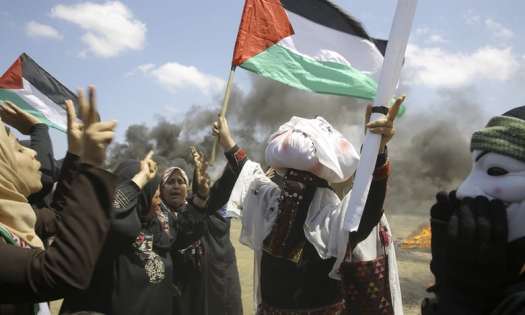
Palestinian women wave national flags and chant slogans near the Israeli border fence. (photo: Adel Hana / AP)

52 Palestinians killed and over 2,400 wounded in protests in Gaza and West Bank over moving US embassy to Jerusalem.

By Amanda Holpuch and Matthew Weaver | The Guardian | May 14, 2018


“We condemn unreservedly the Israeli government for their brutal, lethal and utterly unjustified actions on the Gaza border, and our thoughts are with all those Palestinians in Gaza whose loved ones have been killed or injured as a result.
“These actions are made all the worse because they come not as the result of a disproportionate over-reaction to one day’s protests, but as the culmination of six weeks of an apparently systemic and deliberate policy of killing and maiming unarmed protestors and bystanders who pose no threat to the forces at the Gaza border, many of them shot in the back, many of them shot hundreds of meters from the border, and many of them children.”
— Emily Thornberry MP, Britain’s Labour Shadow Foreign Secretary


Follow latest developments from The Guardian in this continuously updated page.

Read the full article here →

Israel reportedly testing new weapons in Gaza — “exploding” bullets

An example of an “exploding” bullet that expands on impact, creating a massive exit wound. (photo: Black Butterfly Ammunition / Clark Armory)

Demonstrators suffer wounds of “unusual severity” as Israeli forces introduce deadlier weapons in Gaza protests.

By Mersiha Gadzo | Al Jazeera | May 3, 2018


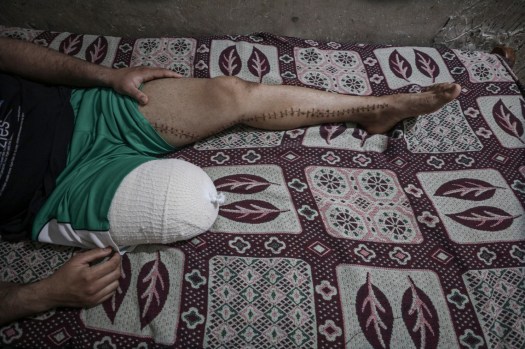
“Normally, a regular bullet breaks the leg [upon impact]. But these bullets create massive wounds, indicating that an explosion happened inside the body. It’s an expanding bullet. It pulverizes the leg, and the leg gets cut off [as a result].”
— Ashraf al-Qedra, Gaza Health Ministry spokesman

“Half of the more than 500 patients we have admitted in our clinics have injuries where the bullet has literally destroyed tissue after having pulverized the bone.”
— Marie-Elisabeth Ingres, Head of Mission of MSF in Palestine


When he was hit by a bullet fired by Israeli forces during demonstrations in Gaza on April 6, Mohammed al-Zaieem lost so much blood, and his left leg was so deformed, he feared he wouldn’t survive. His arteries, veins and a large piece of bone were destroyed. His right leg wasn’t spared either as the round created a massive exit wound and then hit it as well.

By the time he was transferred to Istishari Arab Hospital in Ramallah after undergoing seven surgeries in Gaza, there was nothing doctors could do to save his left leg. It had to be amputated, unbeknown to al-Zaieem, 22, who was unconscious at the time.

“No one dared to tell him [when he woke up from the surgery]. I couldn’t,” said his cousin of the same name, who lives in the occupied West Bank.

Continue reading “Israel reportedly testing new weapons in Gaza — “exploding” bullets”

Second Palestinian journalist dies from sniper fire

Palestinian journalist Ahmed Abu Hussein is seen receiving medical treatment after being shot by an Israeli sniper during a protest on the Gaza border, Apr 13, 2018.

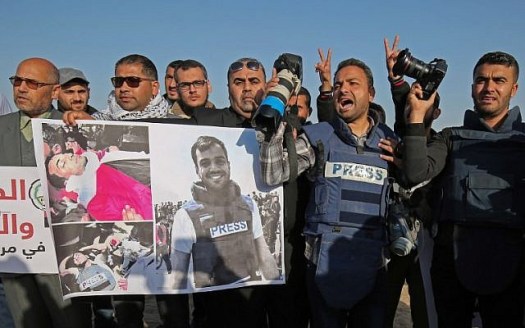
Ahmed Abu Hussein was shot by Israeli snipers during a protest near the Gaza-Israel border two weeks ago. He was standing at a distance from the fence and was wearing a PRESS jacket.

By Haggai Matar | +972 Magazine | Apr 25, 2018


“Ahmed had always expected this could happen to him. The situation in Gaza is difficult. There is no work. But Ahmed always had ambition and he wanted to progress. His friends offered him this job, and he would write and photograph for the agency and send materials for publication.”
— Abu Hussein’s mother


Ahmed Abu Hussein, a Palestinian journalist based in Gaza who was shot by Israeli soldiers two weeks ago, died of his wounds on Wednesday at Tel Hashomer Hospital in central Israel. Abu Hussein is the second Gazan journalist to be killed by IDF snipers over the past month, and one of 40 Palestinians killed during the Great Return March protests.

On Friday April 13, Abu Hussein, a 24-year-old from Jabaliya refugee camp, went to take photographs of the protest next to the Gaza-Israel border fence. His mother told +972 that he had been working with a small photo agency named Bisan, and according to the Committee to Protect Journalists, Abu Hussein had worked for a radio station linked to the Popular Front for the Liberation of Palestine (it is yet unclear whether he worked for both places at the same or separately).

Abu Hussein was wearing a PRESS jacket — and was standing with a group of photographers near a press tent at the Great Return March encampment — when an Israeli sniper’s bullet pierced his abdomen, disrupting the blood flow to his brain . . . . His mother says he was struck by a hollow-point bullet, which expands as it hits its target in order to cause maximum damage. This is the same kind of bullet that has been used against dozens of those who have been killed and maimed during demonstrations in Gaza over the past month.

Continue reading “Second Palestinian journalist dies from sniper fire”

Blasted limbs, broken dreams

gazalegs
Palestinian cyclist Alaa al-Daly, 21, rests at his home in Rafah in the southern Gaza Strip on April 19. Daly’s dream of competing in the Asian Games was shattered after he lost his leg, struck by a bullet fired by an Israeli soldier during a protest along the Gaza border. (photo: Wissam Nassar / The Washington Post)

Israel appears to be targeting the legs of protesters, then denying them access to medical care in Israel.

By Eric Cunningham and Hazem Balousha | The Washington Post | Apr 28, 2018


“The deployment of snipers, careful planning and significant number of injuries to the lower limbs does reflect an apparent policy to target [those] limbs. [Targeting protesters’ legs] does not make the policy any less illegal. The use of live ammunition to any part of the body invariably causes serious injury and even death.”
— Omar Shakir, Israel-Palestine director at Human Rights Watch


Mohammad al-Ajouri is a lanky teenager who loves to run, a medal-winning track star with ambitions to compete abroad.

But last month, while participating in a protest along Gaza’s border, he was struck by a bullet fired by an Israeli soldier. It penetrated his calf, shattering his leg before exiting the shin. Doctors tried to save the limb, but an infection soon spread. The leg had to be amputated.

During the past month of demonstrations along the border between Gaza and Israel, at least 17 Palestinians have suffered gunshot wounds that ultimately cost them their legs, according to the Palestinian Health Ministry in Gaza.

In at least three of the cases, Israeli authorities rejected the transfer of wounded Gazans to the West Bank, where they could receive medical care that might have saved their limbs, according to lawyers and one of the patients’ families.

Continue reading “Blasted limbs, broken dreams”

Pompeo and Palestinians have “nothing to discuss” amid Gaza crisis

Secretary of State Mike Pompeo, left, met with Prime Minister Benjamin Netanyahu on Sunday. (photo: Thomas Coex / The New York Times)

No one at the State Department called Palestinian leaders to ask for a get-together with Mr. Pompeo, according to Palestinian officials.

By Gardiner Harris and Isabel Kershner | The New York Times | Apr 29, 2018


“No meeting in Ramallah on his first visit sets an ominous tone about prospects for any progress, or even dialogue, with the Palestinians.”
— Daniel Shapiro, former US ambassador to Israel


Secretary of State Mike Pompeo came to Israel Sunday in the midst of the worst crisis in relations between Israelis and Palestinians in years, but he did not meet a single Palestinian representative and mentioned them publicly once.

For decades, American diplomats saw themselves as brokers between the two sides, and secretaries of state typically met Palestinian representatives on regional tours like this one. When relations between the two sides deteriorated, the United States sought to bridge the divide.

No more.

Continue reading “Pompeo and Palestinians have “nothing to discuss” amid Gaza crisis”

American Jews have abandoned Gaza — and the truth

gettyimages-950746464-1524683810
(photo: Getty Images)

Israel controls Gaza in the way a prison guard might control a prison courtyard in which he never actually sets foot.

By Peter Beinart | Forward | Apr 26, 2018


The struggle for human decency, Orwell argued, is also a struggle for honest language. Our community’s complicity in the human nightmare in Gaza should fill every American Jew with shame. The first step toward ending that complicity is to stop lying to ourselves.


“In our time,” wrote George Orwell in 1946, “political speech and writing are largely the defense of the indefensible.” British colonialism, the Soviet gulag and America’s dropping of an atomic bomb, he argued, “can indeed be defended, but only by arguments which are too brutal for most people to face.” So how do people defend the indefensible? Through “euphemism, question-begging and sheer cloudy vagueness.” By obscuring the truth.

So it is, more than 70 years later, with Israeli policy toward the Gaza Strip. The truth is too brutal to honestly defend. Why are thousands of Palestinians risking their lives by running toward the Israeli snipers who guard the fence that encloses Gaza? Because Gaza is becoming uninhabitable. That’s not hyperbole. The United Nations says that Gaza will be “unlivable” by 2020, maybe sooner.

Hamas bears some of the blame for that: Its refusal to recognize Israel, its decades of terrorist attacks and its authoritarianism have all worsened Gaza’s plight. Mahmoud Abbas’s Palestinian Authority bears some of the blame too. So does Egypt.

But the actor with the greatest power over Gaza is Israel. Israeli policies are instrumental in denying Gaza’s people the water, electricity, education and food they need to live decent lives.

Continue reading “American Jews have abandoned Gaza — and the truth”

For Gaza protester, living or dying is the “same thing”

Palestinians gathered for a protest at the Gaza Strip’s border with Israel on Friday. (photo: Wissam Nassar / The New York Times)

Hope is a scarce commodity in Gaza, which is little more than an open-air prison.

By Iyad Abuheweila and David Halbfinger | The New York Times | Apr 29, 2018


“It doesn’t matter to me if they shoot me or not. Death or life — it’s the same thing.”
— Saber al-Gerim


No one would ever pick out Saber al-Gerim from the crowds of Palestinians demonstrating against Israel along the heavily guarded fence that has helped turn the Gaza Strip into an open-air prison.

Not for his youthful appearance. At 22, he wears ripped jeans and white sneakers, has a modish haircut and carries a few extra pounds from too many months without work.

Not for his anger. Screaming “Allahu akbar!” and hurling stones with a sling, or straining to pull a cable hooked onto Israel’s barbed-wire barrier in hopes of tearing it apart, he is just one in a fevered multitude, a protagonist in nobody’s drama but his own.

Not even for his willingness to risk death, or his dream of going home to a patch of land he has never seen and cannot really visualize.

Continue reading “For Gaza protester, living or dying is the “same thing””

Natalie Portman refuses to visit Israel to receive the Genesis Prize

Actress Natalie Portman at the premiere “Annihilation,” Feb 13, 2018. (photo: Albert Ortega / Getty Images)

The Israel-born actress says she is “uncomfortable with recent events.”

By Dave Goldiner | Forward | Apr 19, 2018


“Natalie Portman’s cancellation should be a warning sign. She’s totally one of us, identifies with her Jewishness and Israeliness. She’s expressing the voices of many in US Jewry, and particularly those of the younger generation.”
— Rachel Azaria, Kulanu Party member of Knesset


Oscar-winning actress Natalie Portman has refused to travel for Israel to accept a $2 million award known as the “Jewish Nobel” because she is “uncomfortable with recent events” there, apparently referring to the deadly violence directed against Palestinian protesters in Gaza.

“She cannot in good conscience move forward with the ceremony,” a statement from the Hollywood superstar said.

The Genesis Prize quickly announced it was canceling its June prize ceremony for Portman saying it was “saddened” at her decision, which it said could “politicize” the award, which has previously gone to Michael Bloomberg, Itzhak Perlman and Michael Douglas. Continue reading “Natalie Portman refuses to visit Israel to receive the Genesis Prize”

Israel’s defense minister claims slain photojournalist was “Hamas terrorist”

000_13t8gy-640x400
Palestinian journalists take part in a protest after the killing of fellow journalist Yasser Murtaja, near the Israel-Gaza border, on Apr 8, 2018. (photo: Said Khatib / AFP)

Minister provides no evidence; journalist’s colleagues reject the assertion as “ridiculous.”

By Staff | The Times of Israel | Apr 11, 2018


“[Liberman’s claims are] ridiculous comments that are not worth responding to. Yasser has been working for years in the press and making films for the United Nations, China and others. They killed a journalist and should confess it is a crime.”
— Rushdi Al-Serraj, Ain Media director and co-founder with Yasser Murtaja


Defense Minister Avigdor Liberman on Tuesday said a Gaza journalist who was reportedly killed by Israeli gunfire over the weekend was a member of Hamas.

The claim was immediately rejected by one of Yasser Murtaja’s colleagues, who called the statement “ridiculous.”

Palestinians say Yasser Murtaja was shot Friday while covering violent mass demonstrations near the Israeli border. He was reportedly shot in the torso while wearing a vest emblazoned with the word “press” and filming in an area engulfed in thick black smoke caused by protesters setting tires on fire.

Continue reading “Israel’s defense minister claims slain photojournalist was “Hamas terrorist””

Slain photojournalist’s last video captures brutal crackdown on protests

Palestinian photographer Yasser Murtaja’s final images eerily prescient as he documented the rising violence in Gaza before he was shot dead.

By Peter Beaumont | The Guardian | Apr 9, 2018


“Yasser Murtaja was a civilian and a journalist who was wearing clear press identification while he was filming the demonstrations at the Gaza fence with Israel. He was there because he wanted to document civilians exercising their right to peacefully protest.”
— Jan Egeland, Norwegian Refugee Council secretary-general


The drone floats above the farmland at the east of Gaza’s narrow coastal strip where beyond the fence — the transition is almost invisible — Israel’s border communities begin.

The video is among the last footage filmed by Palestinian photographer Yasser Murtaja in Gaza before he was shot dead by Israeli troops last Friday — and it eerily foreshadows his own fate.

Palestinian demonstrators walk through the flat fields, hold signs or sit in the shade of tents in the five border protest camps that dot the landscape from east of Jabaliya in the north to Khuza’a, a short drive from the southern city of Khan Yunis.

Murtaja died on the second of a series of mass Friday protests called the “Great March of Return,” which will culminate on “Nakba” Day (catastrophe in Arabic) on 15 May, which will commemorate the events of 1948 when, following the creation of the state of Israel, more than 700,000 Palestinians were expelled from their homes.

Despite wearing body armour clearly marked with a press sign, Murtaja was shot in the stomach while covering the protests and died later of his wounds. He was one of nine Palestinian men killed in a space of a few hours.

Continue reading “Slain photojournalist’s last video captures brutal crackdown on protests”