U.S. policy has perpetuated the crisis and atrocities in Gaza

200521_AD_1_00-33-1024x668
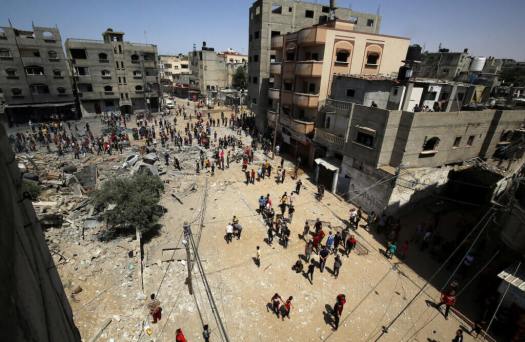
Palestinians gather around rubble following an Israeli airstrike in Rafah in the southern Gaza strip on May 20, 2021. (photo: Abed Deeb / APA Images)
U.S. leaders must now confront their country’s and, in many cases, their own personal complicity in this catastrophe.

By Medea Benjamin and Nicolas Davies | Mondoweiss | May 21, 2021

U.S. policy has perpetuated the crisis and atrocities of the Israeli occupation by unconditionally supporting Israel in three distinct ways: militarily, diplomatically and politically.

The U.S. corporate media usually report on Israeli military assaults in occupied Palestine as if the United States is an innocent neutral party to the conflict. In fact, large majorities of Americans have told pollsters for decades that they want the United States to be neutral in the Israeli-Palestinian conflict.

But U.S. media and politicians betray their own lack of neutrality by blaming Palestinians for nearly all the violence and framing flagrantly disproportionate, indiscriminate and therefore illegal Israeli attacks as a justifiable response to Palestinian actions. The classic formulation from U.S. officials and commentators is that “Israel has the right to defend itself,” never “Palestinians have the right to defend themselves,” even as the Israelis massacre hundreds of Palestinian civilians, destroy thousands of Palestinian homes and seize ever more Palestinian land.

Continue reading “U.S. policy has perpetuated the crisis and atrocities in Gaza”
Tangible change in US public opinion toward Palestinians

2626996-1502273586
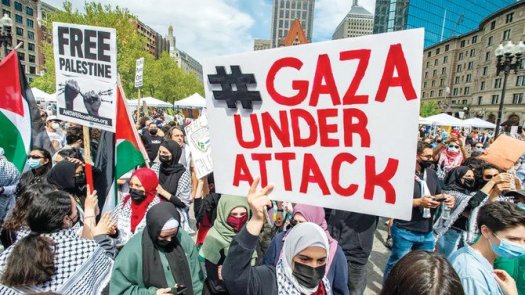
Thousands gathered at Copley Square in Boston, Massachusetts, during a recent demonstration to support the Palestinian struggle for rights and freedom. (AFP)
There are indications of a shift in attitudes on unconditionional aid to Israel.

By Daoud Kuttab | Arab News | May 20, 2021

“Since the events in Ferguson (Missouri), there have been many black-led organizations who have traveled to Palestine and have learned firsthand what the situation is like, and have since networked Palestine with the African American community,
—Sarah Nahar, an African-American activist

PHILADELPHIA, US: A recent headline in the Boston Globe, a leading US paper, which read “US aid to Israel should be a force for peace,” has surprised many readers.

The paper, in its May 19 edition, published it as part of a hard-hitting column by its editorial board, adding: “Ultimately, conditioning aid to Israel should not be controversial.”

Trudy Rubin, a leading columnist for the Philadelphia Inquirer, meanwhile, put Hamas and the Israeli Premier Benjamin Netanyahu on the same level, saying: “By treating Palestinians as irrelevant, Bibi provoked violence that has killed hundreds of mostly Palestinian civilians and threatened Israeli towns and cities.”

Continue reading “Tangible change in US public opinion toward Palestinians”

Peaceful coexistence in Israel hasn’t been shattered – it’s always been a myth

5138
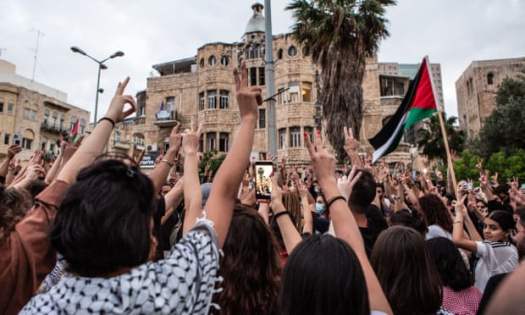
‘In the context of Israel’s rule over us, coexistence is a fiction that conceals a reality of separate and unequal lives.’ Palestinian citizens of Israel demonstrate in Haifa, to mark a nationwide general strike. (photo: Mati Milstein / NurPhoto / Rex / Shutterstock)
A Palestinian citizen in Israel lives as a second-class citizen, denied basic rights.

By Nimer Sultany | The Guardian | May 19, 2021

In the context of Israel’s rule over us, however, coexistence is a fiction that conceals a reality of separate and unequal lives.

On Tuesday, in my hometown of Tira, which is inside Israel’s pre-1967 borders, the shops were closed and the streets were empty. A general strike had been declared in protest over Israel’s policies, whether the ethnic cleansing in Sheikh Jarrah, the storming of al-Aqsa mosque, or the onslaught on Gaza.

As the Palestinian death toll continues to rise, commentators lament the shattering of coexistence inside Israel between Palestinian and Jewish citizens. Yet in my experience as a Palestinian citizen in Israel, no such coexistence existed in the first place. Coexistence implies a background of equality, freedom and mutual respect. In the context of Israel’s rule over us, however, coexistence is a fiction that conceals a reality of separate and unequal lives.

Continue reading “Peaceful coexistence in Israel hasn’t been shattered – it’s always been a myth”

But what about Hamas’s rockets?

GettyImages-1232824101-hamas-rockets-gaza_2
A child mourns while holding the body of Ahmed Al-Shenbari, who was killed during an Israeli air raid in Beit Hanoun city on the northern Gaza Strip, during his funeral on May 11, 2021.  (photo: Ahmed Zakot / SOPA Images / LightRocket via Getty Images)
We must be clear: What started this immediate horror was the intensification of Israel’s ethnic-cleansing campaign against Palestinians in East Jerusalem.

By Jeremy Scahill | The Intercept | May 14, 2021

It is an effort to “both sides” what is an asymmetric campaign of terror waged by a nuclear power against a people who have no state, no army, no air force, no navy, and an almost nonexistent civilian infrastructure.

Warning: This article contains images of violence and death.

The U.S.-backed, armed, and funded extreme right-wing government of Benjamin Netanyahu is currently engaged in a systemic collective punishment campaign against the people of Gaza. More than two million of them are trapped in an open-air prison camp with nowhere to run or hide from this scorched earth operation. Children are being slaughtered. Civilian residential buildings are being razed to the ground. Meanwhile ethno-nationalist militias are rampaging through the streets of Israel and terrorizing their Arab neighbors in a campaign of organized mob violence. We must be clear: what started this immediate horror was the intensification of Israel’s ethnic-cleansing campaign against Palestinians in East Jerusalem, forcibly evicting people from their homes to hand them over to Israeli settlers. The incendiary situation was then exacerbated during a Ramadan siege by Israeli forces at one of the holiest sites in Islam, the Al Aqsa mosque in Jerusalem.

Continue reading “But what about Hamas’s rockets?”

Palestinian refugees deserve to return home. Jews should understand.

12Beinart2-jumbo
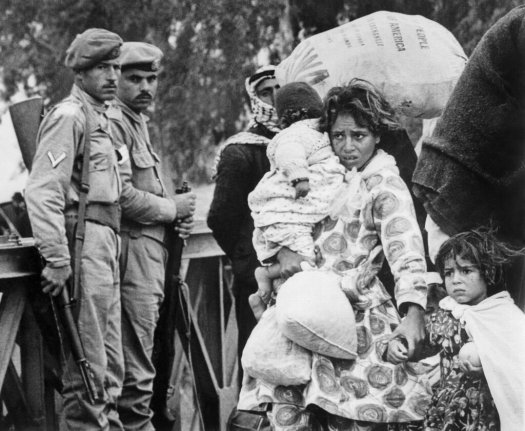
Palestinians from Gaza leaving the occupied West Bank to go to Jordan in 1968. (photo: Agence France-Presse — Getty Images)
A Jewish voice makes the case that the wars will not end until Palestinians can return home.

By Peter Beinart | The New York Times | May 12, 2021

The East Jerusalem evictions are so combustible because they continue a pattern of expulsion that is as old as Israel itself.

Why has the impending eviction of six Palestinian families in East Jerusalem drawn Israelis and Palestinians into a conflict that appears to be spiraling toward yet another war? Because of a word that in the American Jewish community remains largely taboo: the Nakba.

Continue reading “Palestinian refugees deserve to return home. Jews should understand.”

After raid on Aqsa Mosque, rockets from Gaza and Israeli airstrikes

merlin_187546680_ef75e924-fc7c-485e-b89f-6739b00ac17a-superJumbo
The police fired rubber-tipped bullets and stun grenades at stone-throwing Palestinians. (photo: Ahmad Gharabli / Agence France-Presse — Getty Images)
Gaza officials say 20 people were killed in the airstrikes. The escalation followed clashes between the Israeli police and Palestinian protesters at Al Aqsa Mosque in Jerusalem

By Patrick Kingsley & Isabel Kershner | The New York Times | May 10, 2021

The dispute, focused on a single Jerusalem neighborhood, has exploded into a major flare-up in the Israeli-Palestinian conflict, gaining world attention after a period in which the Palestinian cause had been largely marginalized…

JERUSALEM — Weeks of simmering tensions in Jerusalem between Palestinian protesters, the police and right-wing Israelis suddenly veered into military conflict on Monday, as a local skirmish in the decades-long battle for control of the city escalated into rocket fire and airstrikes in Gaza.

After a raid by the Israeli police on the Aqsa Mosque in Jerusalem left hundreds of Palestinians and a score of police officers wounded, militants in Gaza responded by firing a barrage of rockets at Jerusalem, drawing Israeli airstrikes in return.

Continue reading “After raid on Aqsa Mosque, rockets from Gaza and Israeli airstrikes”

Washington elites embrace rights-based approach to the Israel-Palestine conflict

US-ISRAEL-DEFENSE
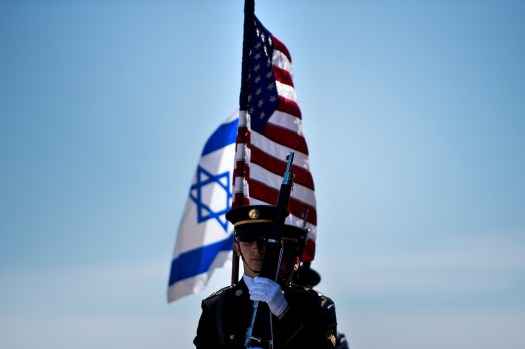
Members of the US military carry the flags of Israel and the United States before the arrival of Israel’s Minister of Defense Avigdor Lieberman during an honor cordon at the Pentagon on April 26, 2018 in Washington, DC.  (photo: Brendan Smialowski / AFP via Getty Images)
A prominent DC think tank has offered a way forward that most in the foreign policy establishment have refused to consider.

By Mitchell Plitnick | Responsible Statecraft | May 4, 2021

If anything has characterized the recent policy discourse around Israel and Palestine, it is despair.

It’s been seven years since the last round of Israeli-Palestinian negotiations collapsed. Since then, Israel’s occupation of the West Bank has become entrenched, its siege on the Gaza Strip has deepened, and a growing number of observers are acknowledging that the two-state solution has failed.

Palestinians, who only recently had hope that they might be able to elect a new leadership, have seen national elections — not held since 2006 — postponed indefinitely, while Israel, facing the prospect of a fifth national election in little more than two years, is less incentivized than ever to find a resolution to its ongoing occupation.

Continue reading “Washington elites embrace rights-based approach to the Israel-Palestine conflict”

J Street goes on offense, carefully

AP_19302281567887-1536x917
Bernie Sanders addresses the J Street conference in 2019, where he endorsed conditioning US military aid to Israel. (photo: Michael Brochstein / Sipa USA via AP Images)
J Street is placing advocacy for restricting aid front and center.

By Mari Cohen | Jewish Currents | May 5, 2021

“I think J Street supporting this initiative does show a type of sea change, not just in terms of what that group is willing to publicly advocate for on the hill, but also about where the Democratic caucus is,”
— former J Street policy staffer requesting anonymity

At the J Street annual conference on April 20th, Sen. Elizabeth Warren took the virtual stage and called for the United States to take “immediate steps” to push for peace negotiations between Israel and Palestine. “If we’re serious about arresting settlement expansion and helping move the parties toward a two-state solution, then it would be irresponsible not to consider all of the tools we have at our disposal,” she said. “One of those is restricting military aid from being used in the occupied territories.”

While there was no audience to applaud, the conference’s virtual chat lit up with approval. “We love aid restrictions!” wrote one attendee. “She’s got a plan for American pressure to end the occupation!” said another. In a session that evening, Reps. Pramila Jayapal, Alan Lowenthal, and Ro Khanna, as well as conference headliner Sen. Bernie Sanders, all echoed Warren’s appeal, calling for the US to ensure that its aid to Israel would not be used for occupation-entrenching projects like home demolitions and settlement expansion.

Continue reading “J Street goes on offense, carefully”

Say Israel is committing apartheid? It’s not a decision we reached lightly

Israeli soldiers
Israeli security forces on a street during clashes with Palestinian youth in Hebron on April 25. (photo: Hazem Bader / AFP via Getty Images)
Fading hope for an end to Israeli military rule compelled HRW to raise the political price for Israel to maintain the status quo of oppression and discrimination.

By Eric Goldstein | Forward | Apr 27, 2021

But hopes for a breakthrough in the peace process obscured the repressive status quo, and the increasingly clear intention of Israeli authorities to perpetuate a system designed to enable the flourishing of Jewish Israelis at the expense of Palestinians — that is, one of domination.

When I arrived in Jerusalem in 1989 as Human Rights Watch’s first Israel-Palestine researcher, I did not imagine the word “apartheid” applying to the Israeli and Palestinian context. But this week, HRW published a report that I edited, as the organization’s acting Middle East director, finding that Israeli officials are committing the crimes of apartheid and persecution — crimes against humanity.

I knew 30 years ago that apartheid had legal meaning beyond its origins in South Africa. For more than a decade there had been an international convention that defined apartheid as a crime committed when officials systematically oppress one group in the territory under their control, and subject it to inhumane acts, with the intent to maintain the domination over that group for the benefit of another group.

Continue reading “Say Israel is committing apartheid? It’s not a decision we reached lightly”

This is apartheid: Jewish supremacy from the River to the Sea

Screen-Shot-2021-01-12-at-9.05.37-AM-668x410
Apartheid Israel: the entire area between the Mediterranean Sea and the Jordan River is organized under a single principle: advancing and cementing the supremacy of one group – Jews – over another – Palestinians.
A report from B’tselem, the respected Israeli Human Rights NGO, calls Israel an apartheid state.

By Israel-Palestine News | Jan 13, 2021

The geographic space, which is contiguous for Jews, is a fragmented mosaic for Palestinians

B’Tselem – The Israeli Information Center for Human Rights in the Occupied Territories believes that the accumulation of policies and laws in Israel are devised to entrench control over Palestinians, and together define Israel as an apartheid regime:

  • Israel’s efforts to Judaize the entire region (land as a resource chiefly meant to benefit the Jewish population)
  • Jews living anywhere in the world are entitled to Israeli citizenship (while Palestinians are removed by any means possible)
  • Israeli citizens enjoy freedom of movement throughout the region – except for the Gaza Strip (Palestinian movement is severely limited)
  • Jewish political participation is ubiquitous, while Palestinians are either sidelined or disenfranchised

Read the full article here →