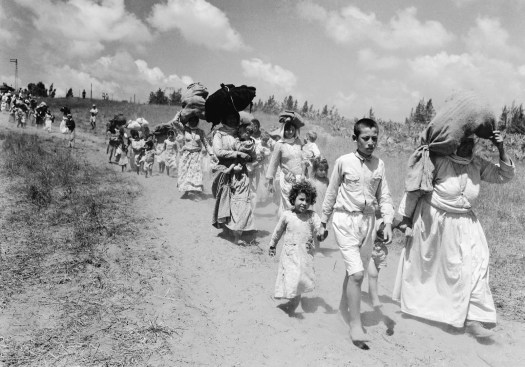
Women and children from a Palestinian village near Haifa hiking, with what possessions they could carry, through no man’s land to Tulkarm in the West Bank during a truce between Israeli and Arab forces, Palestine, June 26, 1948. (photo: Bettmann via Getty Images)
To live under forced exile in the heart of my homeland or to live in voluntary exile as a resident alien—this is my choice. Either way, to be a stranger in a strange land.
By Sayed Kashua | The New York Review of Books | Aug 7, 2021
How can a young refugee forget his homeland if he lives with constant reminders that he is a foreign element, unwanted, even despised?
On the day my brother called, the local news reported a bear sighting in a backyard in Richmond Heights, the Missouri suburb where we live. Another round of fighting had broken out between Israelis and Palestinians, exactly seven years after the bloody cycle of 2014, which was the summer my wife and I decided to leave our home in Jerusalem. We were spurred by political despair and a loss of hope for a better future.
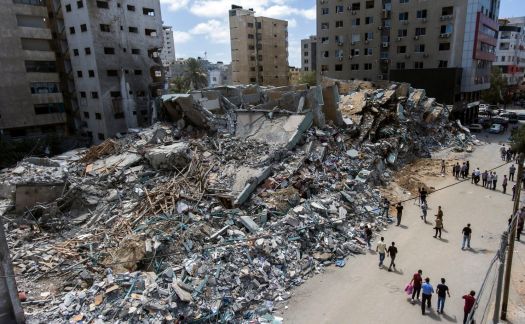
A neighborhood in Beit Hanoun, northern Gaza, destroyed in Israeli attacks, 21 May 2021. (photo: Mohammed Zaanoun ActiveStills)
There’s no equating Palestinian rocket fire and massacres by warplanes.
By Maureen Clare Murphy | The Electronic Intifada | Aug 4, 2021
…the group’s equation of alleged war crimes committed by Israel and Palestinian armed groups in Gaza perpetuates the myth of parity between a colonizing state and its subjects.
Israel used weapons made by Chicago-based Boeing to destroy residential towers in Gaza, massacring families in their homes in May, a new report by Human Rights Watch confirms.
The documentation contained in Human Rights Watch’s investigation is valuable and necessary and will serve those seeking to burst Israel’s bubble of impunity to prevent the next bloodbath in Gaza.
But the group’s equation of alleged war crimes committed by Israel and Palestinian armed groups in Gaza perpetuates the myth of parity between a colonizing state and its subjects.
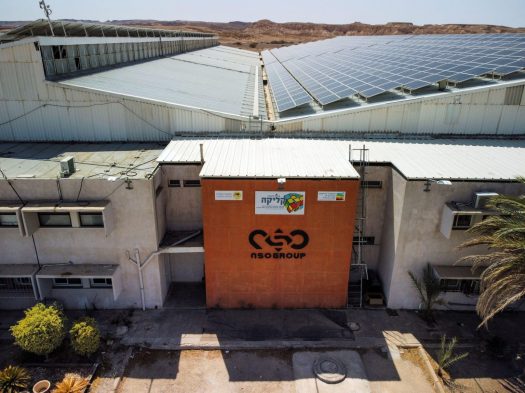
An office of the Israeli intelligence firm NSO Group. (photo: Reuters / Amir Cohen / Alamy Stock Photo)
NSO Group, the Israeli firm that sells its spyware to authoritarian regimes around the world, emerged from a military unit that perfected its surveillance techniques on Palestinians.
By Yousef Munayyer | Jewish Currents | July 26, 2021
With an occupied and stateless population of Palestinians under its rule, to which it has granted no citizenship rights or civil liberties, Israel is free to develop, test, and perfect its surveillance technology on millions of unwilling subjects.
Last week, a joint investigation by 17 media outlets—including The Washington Post, The Guardian, and Haaretz—revealed that Israeli intelligence firm NSO Group had licensed military-grade spyware known as Pegasus to a long list of authoritarian regimes. The report drew on a leaked list of more than 50,000 phone numbers; a close forensic analysis of some of the phones confirmed that they had been hacked by surveillance software capable of monitoring the targets’ movements, listening to their conversations, and accessing their private data.
The list included the phones of several people close to murdered journalist and Saudi dissident Jamal Khashoggi: His wife’s phone was targeted in the months before his gruesome murder, while his fiancée’s phone was hacked in the days after his death. The phone number of Princess Latifa bint Mohammed al-Maktoum was added to the list shortly after her escape from the United Arab Emirates and just days before she was captured on her way to Sri Lanka by Indian commandos, who returned her to Dubai. Numbers belonging to some 14 current or former heads of state were found on the list as well.
Young Palestinian men sit by a section of the separation wall in the West Bank city of Abu-Dis, September 29, 2014. (photo: Miriam Alster / Flash90)
What does it mean to pursue regime change as a path for transformation in Israel-Palestine — and is it enough to bring about justice?
By Diana B. Greenwald | +972 Magazine | July 28, 2021
The state-first approach has, so far, failed to prevent, and, if anything, has enabled the continued abuses of the occupation, asymmetric warfare, authoritarianism within Palestinian institutions, and forcible dispossession and displacement.
As Palestinian demonstrators assembled in the streets of Ramallah, Hebron, and other West Bank cities last month, a familiar, but perhaps unexpected, rallying cry rose from the crowds: “The people want the fall of the regime.” The trigger for the protests was the June 24 killing of Nizar Banat, a prominent activist and frequent critic of the Palestinian Authority, while in the custody of Palestinian security forces. While Banat’s funeral attracted thousands in Hebron, protesters in Ramallah chanted “fall, fall, military regime.” It was PA police officers who shoved fellow Palestinians in the streets, struck protestors with batons, attacked journalists, and harassed female demonstrators and observers.
But regimes are systems, not individuals, and many have argued that the system that enabled agents of the PA to carry out these violations is the same one that targets Palestinians confined in the blockaded Gaza Strip with devastating aerial bombardment; threatens thousands of Palestinians in East Jerusalem with expulsion; repeatedly demolishes the homes, classrooms, and critical facilities of Palestinian Bedouins in the Jordan Valley; and confronts Palestinian citizens of Israel with, alternatively, state neglect or mass arrests. It is one of racial discrimination and gradual ethnic cleansing that has been a dominant feature of Israeli politics since the birth of the state.
A settler, armed with an automatic rifle, aims and opens fire at Palestinian villagers, Urif, May 14, 20201. (photo: Mazen Shehadeh)
A Local Call investigation reveals how on a single day in May, Israeli settlers and soldiers cooperated in attacks that left four Palestinians dead. The unprecedented spate of joint assaults has inaugurated a new era of terror.
By Yuval Abraham | +972 Magazine | July 15, 2021
“While the settlers did all of that, the soldiers covered for them by gunfire,” — Mazen Shehadeh, head of the village council
Nidal Safadi was a quiet man, his neighbors said. He lived in Urif, a Palestinian village of several thousand people in the West Bank. Just 25, Safadi had three children with his wife and a fourth, a girl, on the way.
Urif is not always quiet. With the Palestinian city of Nablus less than 10 miles away, the occupying Israeli military established a base on a nearby hilltop in 1983. A year later, it was turned over to civilian purposes: part of Israel’s illegal settlement program in the Palestinian territories. Since 2000, the settlement, called Yitzhar, has been home to a yeshiva known for its hard-line Jewish nationalist views; the settlement has become known for its extremism. The so-called outpost settlements it has spurred — illegal even by Israeli law, but nonetheless defended by the Israel Defense Forces — have gradually encroached on villages like Urif. Over the past 10 years, settler aggressions have given rise to violent recriminations between the Israelis and Palestinians living nearby.
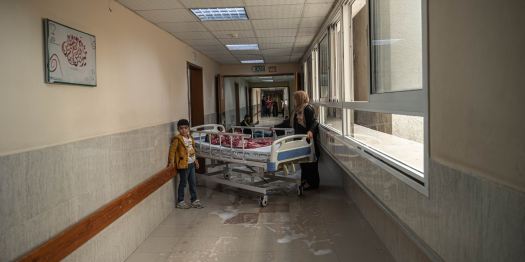
A Palestinian child, wounded by Israeli air strikes on the Gaza Strip, receives treatment at Al-Shifa Hospital on May 19, 2021 in Gaza City, Gaza. (photo: Fatima Shbair / Getty Images)
After right-wing outrage, the esteemed journal removed an opinion piece expressing solidarity with Palestinians under Israeli bombardment.
By Murtaza Hussain | The Intercept | July 1, 2021
“I remembered that there had been an article published in The Lancet in 2014 about health care workers speaking up for Palestine. I thought it was really powerful at the time and remembered that a lot of people in the health care field had responded to it when it was published.” — Sabreen Akhter, MD, Chicago
Sabreen Akhter felt an urge to help in whatever way she could. Like many people around the world this May, Akhter was following news of war in the Gaza Strip, where Israeli bombardment was exacerbating a humanitarian crisis in the territory. Scanning her social media feed, Akhter, a doctor from Chicago, made contact with a few other health care professionals across the United States who had also been posting news online about the crisis.
Akhter set up a call to discuss what they could do, on behalf of their profession, for Palestinians. They settled on the idea of writing an article together as a group of medical workers concerned about the medical situation in Gaza and pitching it to Scientific American, where Akhter had published in the opinion section in the past.
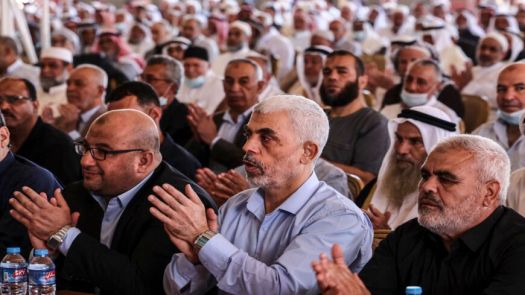
Yahya Sinwar (C), Hamas’ political chief in Gaza, attends a rally organized by the representatives of prominent families (mokhtar) in support of “the Palestinian resistance” in Gaza City, on June 20, 2021. (photo: Mahmud Hams / AFP via Getty Images)
Amid an uptick in popular support for Hamas following recent confrontations in East Jerusalem and the Israel-Hamas war, Fatah and the Palestinian leadership in Ramallah are looking for ways to stay relevant.
By Daoud Kuttab | Al- Monitor | June 21, 2021
“The opportunity is there for the new Israeli government to show they are ready for peace and the end of occupation and not for the continuation of the settlement policies, land confiscations, death and destruction,” — Mohammad Shtayyeh, Prime Minister of the Palestinian National Authority
While the new Israeli government headed by right-wing, pro-settler Naftali Bennett starts to settle in, the Palestinian leadership in Ramallah is hoping to engage with them and with the Biden administration.
Reports that the Palestinian government has established a negotiating team has been denied to Al-Monitor by senior officials in Ramallah, but the fact that a story to that effect was published tends to indicate that certain elements within the entourage of President Mahmoud Abbas are looking for ways to be relevant.
A building in Gaza City housing the offices of the Associated Press and other media organizations was hit by an Israeli airstrike on May 15. (photo: Khalil Hamra / AP)
Data released by the U.N. this week shows that it could take years for Gaza to rebuild after the Israeli bombings in May.
By Dylan Moriarty and Ruby Mellen |The Washington Post | June 11, 2021
“It completely blocked the transportation of the patients to the clinics…It really hindered the access to care. They had to walk.” — Ely Sok, Doctors Without Borders
The destruction to Gaza during the 11-day conflict between Hamas and Israel in May was heavy and widespread, with damage afflicting hundreds of buildings and dozens of roads, an initial United Nations analysis shows.
The data, based on preliminary analysis of satellite imagery taken on May 28, and released by the U.N. Institute for Training and Research this week, underscores warnings from human rights groups and nongovernment organizations that Israeli bombings that the military said targeted Hamas militants severely impaired the territory’s infrastructure, and that it could take years to rebuild.
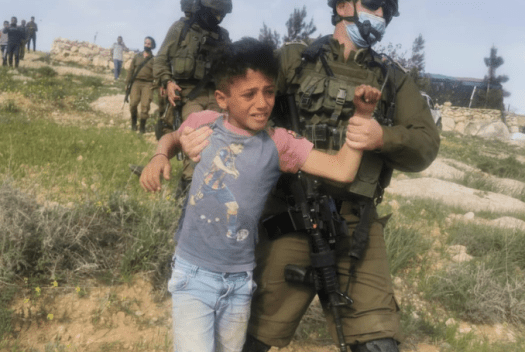
Israeli forces detain five Palestinian children, while they were picking wild vegetables. (photo: via Twitter)
Children everywhere pay the price of our nation state aggression and violence.
By Benay Blend | The Palestine Chronicle | June 6, 2021
Like settler colonial projects everywhere, including the Americas and Palestine, its “objectives…were always a combination of land appropriation, resource extraction and demographic engineering.” — Adel Eskander, Assistant Professor of Global Communication at Simon Fraser University
Yes, I am thinking of Palestinian children and undocumented children as well,” mused Diné activist Melissa Tso. “They are literally being killed daily by these settler governments.” As “an essential part of [her] culture,” running helps to “process things,” and so she did the 2.15 run in memory of the 215 Indigenous children who were found in a mass grave at Kamloop residential school in Canada.
On May 29, 2021, Aljazeera reported that the remains of more than 200 Indigenous children, some as young as three, had been found at the site of a former residential school in the western province of British Columbia.
“To our knowledge, these missing children are undocumented deaths,” Tk’emlúps te Secwépemc First Nation chief Rosanne Casimir explained. They are among the many victims of mental and sexual abuse, neglect and other forms of violence over a period of 100 years during which church-supported boarding schools operated across Canada.
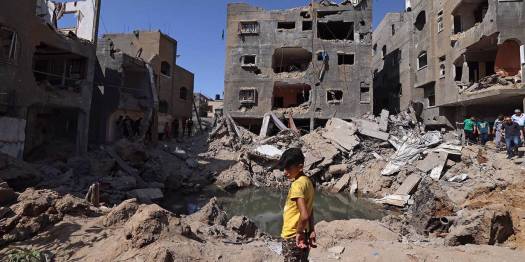
A Palestinian child stands amidst the rubble of buildings, destroyed by Israeli strikes, in Beit Hanun in the northern Gaza Strip on May 21, 2021. (photo: Emmanuel Dunand / AFP / Getty Images)
Human rights are human rights, and they are part of international law under the UN Charter. Whether the case is Xinjiang and the Uighurs, Myanmar and the Rohingya, or Israel and the Palestinian Arabs, the correct way to defend international law is through the United Nations, starting with an independent investigation under the auspices of the UN Human Rights Council.
By Jeffrey D. Sachs | Project Syndicate | May 25, 2021
The truth is that the US government’s uncritical support for Israel has come to depend more on evangelical Christians, such as former US Secretary of State Michael Pompeo, than on American Jews, who are deeply divided by Netanyahu’s actions.
NEW YORK – Israel’s attempt to justify its latest brutal assault on Gaza rings hollow to anybody familiar with events in Israel, where the government of Prime Minister Binyamin Netanyahu, backed by anti-Arab racists, has systematically, cruelly, and persistently violated the basic human rights of the Arab population. Human Rights Watch, a global NGO with many Jewish leaders, has recently condemned Israel for crimes against humanity.
Israel’s behavior puts US President Joe Biden’s administration, which professes a foreign policy based on human rights, under the spotlight. If that commitment is genuine, the administration should support an independent UN investigation of Israeli human rights violations against the Arab population and suspend military aid to Israel until the inquiry is completed and the human rights of the Palestinians are secured.






You must be logged in to post a comment.