J Street goes on offense, carefully

AP_19302281567887-1536x917
Bernie Sanders addresses the J Street conference in 2019, where he endorsed conditioning US military aid to Israel. (photo: Michael Brochstein / Sipa USA via AP Images)
J Street is placing advocacy for restricting aid front and center.

By Mari Cohen | Jewish Currents | May 5, 2021

“I think J Street supporting this initiative does show a type of sea change, not just in terms of what that group is willing to publicly advocate for on the hill, but also about where the Democratic caucus is,”
— former J Street policy staffer requesting anonymity

At the J Street annual conference on April 20th, Sen. Elizabeth Warren took the virtual stage and called for the United States to take “immediate steps” to push for peace negotiations between Israel and Palestine. “If we’re serious about arresting settlement expansion and helping move the parties toward a two-state solution, then it would be irresponsible not to consider all of the tools we have at our disposal,” she said. “One of those is restricting military aid from being used in the occupied territories.”

While there was no audience to applaud, the conference’s virtual chat lit up with approval. “We love aid restrictions!” wrote one attendee. “She’s got a plan for American pressure to end the occupation!” said another. In a session that evening, Reps. Pramila Jayapal, Alan Lowenthal, and Ro Khanna, as well as conference headliner Sen. Bernie Sanders, all echoed Warren’s appeal, calling for the US to ensure that its aid to Israel would not be used for occupation-entrenching projects like home demolitions and settlement expansion.

Continue reading “J Street goes on offense, carefully”

Say Israel is committing apartheid? It’s not a decision we reached lightly

Israeli soldiers
Israeli security forces on a street during clashes with Palestinian youth in Hebron on April 25. (photo: Hazem Bader / AFP via Getty Images)
Fading hope for an end to Israeli military rule compelled HRW to raise the political price for Israel to maintain the status quo of oppression and discrimination.

By Eric Goldstein | Forward | Apr 27, 2021

But hopes for a breakthrough in the peace process obscured the repressive status quo, and the increasingly clear intention of Israeli authorities to perpetuate a system designed to enable the flourishing of Jewish Israelis at the expense of Palestinians — that is, one of domination.

When I arrived in Jerusalem in 1989 as Human Rights Watch’s first Israel-Palestine researcher, I did not imagine the word “apartheid” applying to the Israeli and Palestinian context. But this week, HRW published a report that I edited, as the organization’s acting Middle East director, finding that Israeli officials are committing the crimes of apartheid and persecution — crimes against humanity.

I knew 30 years ago that apartheid had legal meaning beyond its origins in South Africa. For more than a decade there had been an international convention that defined apartheid as a crime committed when officials systematically oppress one group in the territory under their control, and subject it to inhumane acts, with the intent to maintain the domination over that group for the benefit of another group.

Continue reading “Say Israel is committing apartheid? It’s not a decision we reached lightly”

This is apartheid: Jewish supremacy from the River to the Sea

Screen-Shot-2021-01-12-at-9.05.37-AM-668x410
Apartheid Israel: the entire area between the Mediterranean Sea and the Jordan River is organized under a single principle: advancing and cementing the supremacy of one group – Jews – over another – Palestinians.
A report from B’tselem, the respected Israeli Human Rights NGO, calls Israel an apartheid state.

By Israel-Palestine News | Jan 13, 2021

The geographic space, which is contiguous for Jews, is a fragmented mosaic for Palestinians

B’Tselem – The Israeli Information Center for Human Rights in the Occupied Territories believes that the accumulation of policies and laws in Israel are devised to entrench control over Palestinians, and together define Israel as an apartheid regime:

  • Israel’s efforts to Judaize the entire region (land as a resource chiefly meant to benefit the Jewish population)
  • Jews living anywhere in the world are entitled to Israeli citizenship (while Palestinians are removed by any means possible)
  • Israeli citizens enjoy freedom of movement throughout the region – except for the Gaza Strip (Palestinian movement is severely limited)
  • Jewish political participation is ubiquitous, while Palestinians are either sidelined or disenfranchised

Read the full article here →

US firms said using Israeli tech for controversial facial recognition

Israeli startup AnyVision uses artificial intelligence to recognize faces, bodies and objects for security and other purposes. (photo: YouTube screenshot)
AnyVision system touted as improving security and preventing crime, but social rights activists say practice infringes on privacy, could hurt marginalized groups

By TOI staff | Times of Israel | Apr 21, 2021

“Private use of facial recognition by corporations, institutions and even individuals poses just as much of a threat to marginalized communities as government use,”
 open letter from 25 social justice groups calling on governments to ban corporate use of facial recognition.

An Israeli company that makes facial recognition technology has gained several big-name clients in the US, even as rights groups increasingly raise concerns over the use of such surveillance methods, Reuters reported Wednesday.

AnyVision, a Holon-based startup founded in 2015 by Neil Robertson and Eylon Ethstein, uses artificial intelligence technology to recognize faces, bodies and objects for security, medical and business purposes, among others.

Facial recognition technology as a whole has come under fire by civil liberties activists who say the tools are biased against people of color and infringe upon citizens’ privacy.

Continue reading “US firms said using Israeli tech for controversial facial recognition”

In Conversation with Peter Beinart

Screen Shot 2021-04-14 at 10.17.00 AM

Join Jewish Currents Editor at Large Peter Beinart in a conversation with Kenneth Stern, Prof. Susan Neiman, and Prof. Saree Makdisi about how to define anti-semitism.
Date: Friday, April 16, 2021
Time: 9:00 am (PDT) / 12:00 pm (EST)
Location: On-line
Information: Event information here →
Tickets: Free, must register
Event Details

Jewish Currents Editor at Large Peter Beinart will be joined by several panelists to talk about how to define anti-semitism.

The first guest is Kenneth Stern, director of the Bard Center for the Study of Hate, who drafted the controversial International Holocaust Remembrance Alliance’s definition of anti-semitism, but has criticized its misuse. The second guest will be Professor Susan Neiman, Director of the Einstein Forum, one of the signers of the new Jerusalem Declaration on anti-semitism. The third guest will be UCLA Professor of English Saree Makdisi.

More information here →

Israel, Palestine & the Role of Congress: An Accelerated Learning Series

Co-hosted by FMEP’s Lara Friedman and MEI’s Khaled Elgindy, this learning series takes a deep dive into 8 key topics in the U.S. relationship with Israel and the Palestinians. 

By Foundation for Middle East Peace and Middle East Institute | Apr 9, 2021

The Foundation for Middle East Peace (FMEP) and the Middle East Institute (MEI) and are proud to release “Israel, Palestine & the Role of Congress: An Accelerated Learning Series.” Co-hosted by FMEP’s Lara Friedman and MEI’s Khaled Elgindy, this learning series takes a deep dive into 8 key topics in the U.S. relationship with Israel and the Palestinians. These series – which ran during February to March 2021 – was originally presented exclusively for members of the House and Senate and Congressional Staff, and is now being released as an educational tool for the public at large.

You can listen to a podcast with Lara and Khaled introducing the series here.

Continue reading “Israel, Palestine & the Role of Congress: An Accelerated Learning Series”

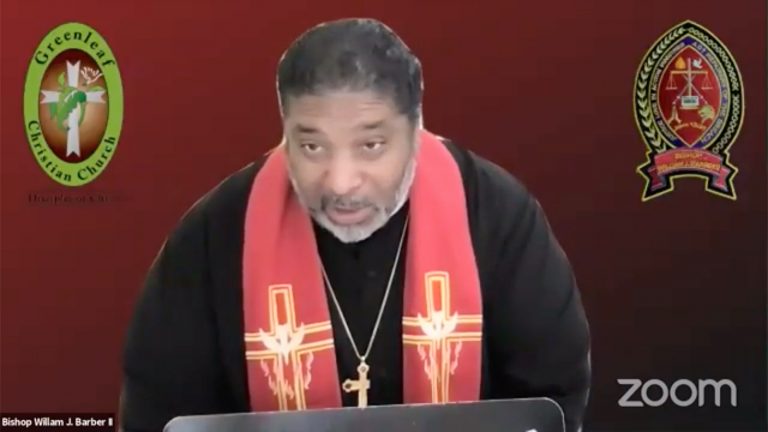
William Barber preaches at Easter vigil service spotlighting Christian Palestinians

The Rev. William Barber II speaks during a virtual Easter vigil service April 3, 2021, titled “Easter in Jerusalem: The Sabeel Community Celebrates Holy Saturday 2021,” led by a Christian activist group in Jerusalem. (photo: Video screengrab)
Barber’s appearance served to recognize Christians in the Palestinian liberation movement, which some American evangelicals paint as an apocalyptic conflict between Christians and Muslims.

By Daoud Kuttab | Religion News Service | Apr 6, 2021

“Jesus, a brown-skinned Palestinian Jew, called us to preach good news to the poor, the broken and the bruised and all those who are made to feel unaccepted,”
— Rev William Barber, co-chair of the Poor People’s Campaign

(RNS) — In a display of solidarity with the Palestinian cause, the Rev. William Barber II participated in a virtual Easter vigil service Saturday (April 3) led by a Christian activist group in Jerusalem.

Though never mentioning Israel, he called on his listeners in Israeli-occupied Palestinian territories, “Get up, my Palestinian brothers and sisters, my Christian and Muslim brothers, we have work to do in his name.”

The webinar, attended by more than 700 people, was broadcast by Friends of Sabeel North America and Sabeel Ecumenical Liberation Theology Center in Jerusalem, allied organizations that call attention to the plight of Palestinians.

Continue reading “William Barber preaches at Easter vigil service spotlighting Christian Palestinians”

The Jerusalem Declaration on Antisemitism

Screen Shot 2021-04-02 at 12.26.26 PM
Strasbourg Chief Rabbi Harold Abraham Weill views the vandalized tombs in the Jewish cemetery of Westhoffen, west of the city of Strasbourg, eastern France, in December 2019. (photo: Jean-Francois Badias / AP)
Why the oldest hatred needs a new definition.

By Brian Klug | The Nation | Apr 1, 2021

People of goodwill look to the IHRA definition for guidance concerning a key question: When should political speech about Israel or Zionism be protected—and when does it cross the line into anti-Semitism? What they need is clarity. What they get is a matzah pudding.

Confronted with the Jerusalem Declaration on Antisemitism (JDA), published on March 25, 2021, it is tempting—especially for Jews at this time of year—to ask: Why is this definition of anti-Semitism different from all other definitions?

Continue reading “The Jerusalem Declaration on Antisemitism”

How we speak about the failure of the PLO

oslo
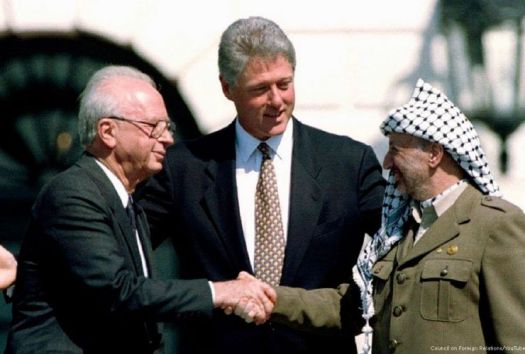
Yitzhak Rabin, Bill Clinton, and Yasser Arafat at the White House, signing the Oslo Accords. I(photo: Wikimedia)
A recent Foreign Affairs article gets history wrong and obscures a robust Palestinian discourse.

By Helena Cobban | Boston Review | Mar 31, 2021

One strong concern about the Oslo Accords was that they said nothing about what would happen if, after the five-year interim period prescribed therein, the two sides failed to arrive at a final peace agreement.

It is hard to believe that it has been fifty years since I used to sit on the floor of drafty college residences in Oxford with Hussein Agha, Ahmad Samih Khalidi, Ahmad’s cousin Rashid Khalidi, and other luminaries of the Oxford University Arab Society, listening to their discussions of the then-parlous state of the Palestinian freedom movement (and voicing an occasional interjection). During the previous year, Palestinian guerrillas earlier chased out of the West Bank by Israel had proceeded to challenge King Hussein’s rule in Jordan; and during “Black” September 1970, Hussein hit back at them hard. In Spring 1971 the guerrillas were still reeling from Black September and were struggling to regroup in the extensive Palestinian refugee camps in Lebanon. In Oxford we eagerly read any scrap of news we could get about their achievements there.

Continue reading “How we speak about the failure of the PLO”

St Marks Mideast Focus Ministry Film Series: ‘TIL KINGDOM COME

Screen Shot 2021-02-15 at 6.49.12 PMPlease join our brothers and sisters at St. Marks Episcopal Church (Seattle) Mideast Focus Ministry group for a series of films in spring 2021.  The next film:

‘Til Kingdom Come

TilKingdomCome-Film-Poster

In this provocative look at strange political bedfellows, Israeli filmmaker Maya Zinshtein (Forever Pure, DOC NYC 2016) investigates the political alliance between American evangelicals and Israel’s right wing, and their influence on the Trump administration’s foreign policy. Why do American church leaders encourage parishioners to make donations to Israel, even from poor communities? Because they believe Israel’s expansion will play a key role in end-times prophecy, when Christians will be saved and others—including Jews—will perish.

The discussion will include special guests: Rochelle Watson and Jonathan Brenneman, of Friends of Sabeel North America

Date: Friday, April 9, 2021
Time: To get a link to watch the film at your convenience, send a message to seattlemideastfocus@gmail.com

You will get the link around 4 p.m. on Wednesday, April 7 and have until 8 p.m. on Friday, April 9, to watch the film. Watch the film on your own and join the discussion on April 9 at 8 p.m. using this Zoom link.

Information: Additional information and list of all films here →
Tickets: Free, must register
Event Details

Summary:

  1. Send an email to seattlemideastfocus@gmail.com to get a link to the film
  2. Watch the film between Apr 7 –  April 9th at 8pm
  3. Join the discussion on 4/9 at 8:00pm via this Zoom link.

More information here →