“Israel is a sovereign state and it has the right to decide who will enter its gates. No foreign residents have an inherent right to enter Israel, including Palestinian residents of the Gaza Strip.”
— Civil Administration (COGAT) spokesman
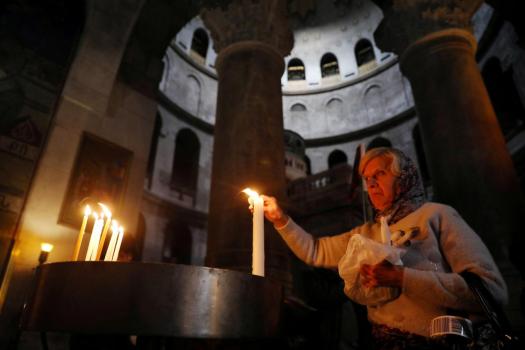
The Latin Patriarchate of Jerusalem said church authorities had applied for around 600 permits for Gazans to travel, but had not received any, three days before Good Friday.
Israel tightly restricts movements out of the Gaza Strip, territory controlled by Hamas, an Islamist group that it considers a terrorist organization.
The Israeli military-run authority that operates in the West Bank defended its policy to restrict access as many Palestinians had stayed on illegally in the past, and said it would only issue permits to people aged at least 55.
Israeli military vehicles are seen Friday next to the border on the Israeli side of the Israel-Gaza border, as Palestinians demonstrate in Gaza. (photo: Amir Cohen / Reuters)
At least 15 people have been killed at the outset of a massive protest expected to last another month and a half.
If the demonstrations continue, and Israel responds the way it did today, there is a significant risk that the death count will rise, and an already complicated situation will get worse.
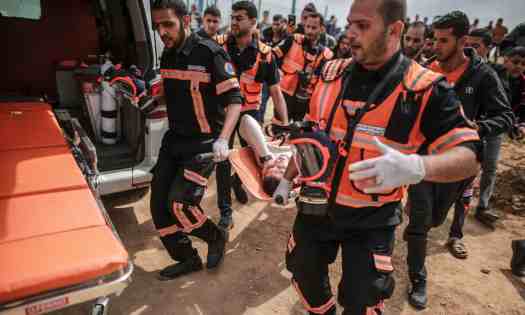
Israeli troops opened fire Friday at Palestinians near the Gaza Strip’s border with the Jewish state, killing at least 15 people and wounding many more. The numbers came from the Palestinian health ministry, which put the number of those injured at more than 1,000.
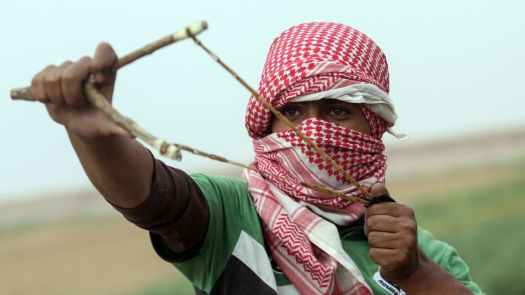
The Palestinian demonstration at the border, dubbed the Great March of Return, was billed as peaceful and nonviolent. Protesters pitched tents near the border with Israel and demanded that refugees be allowed to return to homes they left behind in 1948 during the creation of the state of Israel. Israel, which estimates that 17,000 Palestinians have gathered near the border at six locations, said its troops were enforcing “a closed military zone.” The Israeli army also said it opened fire toward the “main instigators” of what it called rioters who were “rolling burning tires and hurling stones at the security fence and at” Israeli troops. Israel had warned Gaza residents against protesting, and said Hamas, the militant group that governs Gaza, was “cynically” sending women and children “to the security fence and endangering their lives.”
The date the protest began, March 30, is the anniversary of Land Day, a 1976 event in which Israelis killed six Palestinians who were protesting the confiscation of their lands. The protests are expected to last until May 15, the anniversary of the creation of the state of Israel, which the Palestinians view as a “naqba” or “catastrophe” for their people.
“There is fear that the situation might deteriorate in the coming days.”
— Tayé-Brook Zerihoun, assistant UN secretary general for political affairs
Gaza hospitals, running low on blood and overstretched by the huge number of wounded, were reeling after one of the enclave’s bloodiest days outside of open war, in which Israeli soldiers shot 773 people with live ammunition, according to the ministry of health.
Fifteen of the wounded died, said the ministry spokesperson Dr Ashraf al-Qidra. “Most of the dead were aged between 17 and 35 years old,” he said. “The injuries were on the upper part of the body.” He added that the remainder of the wounded, some of whom were in a critical condition, had been “shot with live ammunition.”
The violence erupted on Friday after mass demonstrations took place demanding the right of return for Palestinian refugees and their descendants to land in Israel.
“Between the Jordan River and the Mediterranean there is an equal number of Palestinians and Jews, and that’s nothing new. That’s why the crossroads where we presently find ourselves is clear: either two states based on 1967, or one state that is an apartheid state, or one democratic state in which everyone has the right to vote. There is no other option, and at least this simple truth has to be stated clearly.”
— Knesset Member Ayman Odeh, head of the Joint List
The Israeli army presented data on Monday to a Knesset panel which show that more Arabs than Jews live between the Mediterranean and the Jordan River.
According to Civil Administration’s deputy commander Col. Haim Mendes, five million Palestinians live in the West Bank and the Gaza Strip. This figure does not include the hundreds of thousands of Palestinians living in East Jerusalem, or the 1.8 million Israeli Arabs. According to Israel’s Central Bureau of Statistics, as of September 2017 some 6.5 million Jews live in Israel. . . .
A girl holds a Palestinian flag in front of Israeli troops during clashes in Ramallah, Mar 7, 2018. (photo: Mohamad Torokman / Reuters)
The peace plan contemplated by the Trump Administration will offer Palestinians limited sovereignty over limited territory.
By Uri Saver | Al-Monitor | Mar 25, 2018
The plan is much closer to the Israeli position than the Palestinian:
Two states
Palestine would comprise about half the West Bank
Gaza would be included if Hamas disarms
Israel would control West Bank security and border crossings
East Jerusalem would be part of Palestine, but not the Old City
No right of return
Despite growing tensions with the Palestinians, US President Donald Trump still intends to reveal a US peace plan for the Middle East. The plan will apparently be divulged right after the US Embassy moves to Jerusalem and after Trump’s meeting with North Korean leader Kim Jong Un.
According to a senior US diplomat in Tel Aviv, the fact that Palestinian President Mahmoud Abbas refuses any contact on the matter with US officials and that he had bad mouthed David Friedman, the US ambassador to Israel, has not altered Trump’s determination. Actually, messages on the evolving plans are conveyed nowadays to Ramallah by Egypt, Jordan and Saudi Arabia. More so, the March 20 meeting in Washington between Trump and Saudi Crown Prince Mohammed bin Salman was largely dedicated to two major topics: the common front against Iran in the region (including the Iran nuclear deal issue) and Israeli-Palestinian peace.
Haganah fighters expelling Palestinians from Haifa, May 12, 1948. (photo: AFP / Getty Images)
Today Palestinians in Gaza will take part in the March of Return to mark the 70th anniversary of the Nakba, when some 750,000 Palestinians were expelled from the newly-created State of Israel.
The “Nakba” (“catastrophe” in Arabic) refers to the mass expulsion of Palestinian Arabs from British Mandate Palestine during Israel’s creation (1947–49).
The Nakba was not an unintended result of war. It was a deliberate and systematic act necessary for the creation of a Jewish majority state in historic Palestine, which was overwhelmingly Arab prior to 1948.
The Nakba’s roots lay in the emergence of political Zionism in 19th-Century Europe, when some Jews, influenced by the nationalism then sweeping the continent, began emigrating as colonists to the Holy Land, displacing indigenous Palestinians in the process.
The Nakba did not end in 1948. It continues today, in the form of Israel’s ongoing appropriation of Palestinian land for Jewish settlements in the West Bank and for Jewish communities inside Israel.
Tomorrow, Palestinians in Gaza will take part in the March of Return to mark the 70th anniversary of the Nakba (“catastrophe” in Arabic), when some 750,000 Palestinians were ethnically cleansed to make way for a Jewish-majority state of Israel. Many of the participants will be Nakba survivors and their descendants, who have been denied their internationally-recognized legal right of return to the lands they were expelled from during Israel’s establishment.
A Palestinian demonstrator hurls stones at Israeli troops during clashes along the border fence near Khan Yunis in Gaza, Mar 23, 2018. (photo: Said Khatib / AFP)
Israel has flagged the drones, tear gas, sniper fire, even tanks it will employ against thousands of Palestinians planning to approach the Gaza border. But confronting a PR campaign with the language of force only invites disaster.
Israel needs to prepare for the coming celebration and marching season with an extensive public diplomacy effort, not only to celebrate our own independence, but to give those that wish to mourn, the room to do so.
The Palestinians are planning and producing a huge PR event. The stage is set, and the curtain will be drawn this Friday, March 30th. Organizations in Gaza are initiating a series of events that will challenge Israel on the ground, physically and militarily, but their real intended target is the public arena.
As Israel organizes its own public relations opportunities in celebration of its 70-year anniversary, complete with a bonus additional PR event, the opening of the new American embassy in Jerusalem, the Palestinians plan to march.
Palestinians in Gaza intend to kick off their series of events by erecting “return camps,” tent campsites along the area bordering Israel. Some assessments have suggested Hamas is going to rally around 100,000 people along the border area in a huge show of force. . . .
Over the last few days, reports in the Israeli media have multiplied about how the security forces will confront the oncoming demonstrations and riots. Various means of riot dispersal, dropped from drones; tear gas; water cannons; targeted sniper fire against the main instigators; and even reports of tanks being deployed along the Israel-Gaza border. . . .
What appears to be lacking from the Israeli preparation is the response to the political challenge.
“While Facebook is taking action against Palestinian content, it is not even paying attention to inciting posts by Israelis.”
— Iyad Rifai, coordinator of Sada Social, an NGO documenting Facebook’s actions against Palestinian accounts
Over the weekend, Facebook disabled the account of Safa, a Gaza-based Palestinian news site; it had almost 1.3 million followers.
Safa is widely seen as sympathetic to Hamas, but an employee at the news site said in a phone call that the media outlet is “independent” and “has no relationship with Hamas.”
Facebook disabled Safa’s account, along with the accounts of 10 Safa editors, just after 5 pm on Saturday, without issuing a warning or providing an explanation, a manager of Safa’s social media team told The Jerusalem Post.
“We were totally surprised,” said the social media manager, who asked not to be named. “We are now working to restore the account because 60% of [the] website’s traffic comes through Facebook.”
A demonstrator protests against Trump’s decision to recognize Jerusalem as the capital of Israel, Nablus, Dec 29, 2017. (photo: Mohamad Torokman / Reuters)
Europe told us that only after we Palestinians endorsed non-violence and the 1967 borders would they act on our behalf. We did. Now they refuse to act, because of pressure from a rogue state — America.
By refusing to work with the only established international order to assert Palestinian rights [the United Nations Human Rights Council], the Israeli government gets carte blanche to continue colonizing Palestinian land, while the Palestinian people get the message that international law and diplomacy are useless in their quest for freedom, justice and independence.
This is actually happening. European countries, members of the European Union, itself birthed out of the ashes of the last century’s unprecedented atrocities, are currently putting pressure on Palestine not to demand its rights at the United Nations Human Rights Council.
This Friday, four resolutions on Palestine will be voted on, and some European countries are concerned about the political implications of any calls to hold Israel accountable for its systematic violations of international law.
The very international legal standards Palestine clings to — self-determination, non-acquisition of territory through force, and equality — are the bedrock of the European project.
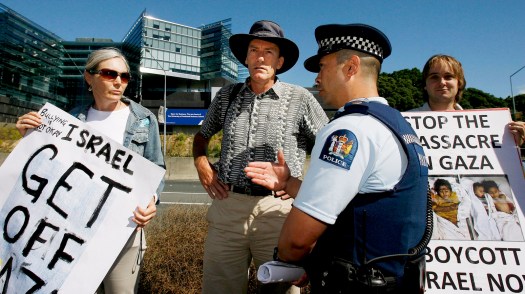
A police officer talks to protesters in Auckland, New Zealand, following Israel’s bombing of a UN school in a Gaza, Jan 8, 2008. (photo: Greg Bowker / AP / New Zealand Herald)
Progress on the Israel question is slowly but surely being made, owing to the strong commitment of places like New Zealand, who continue to move forward unafraid of the consequences.
“New Zealand has and has always had an independent foreign policy — we base our decisions on principle, not being bullied. We will always take a principled foreign policy.”
— Jacinda Ardern, New Zealand’s Prime Minister
If we were to truly honor the late, great Stephen Hawking, perhaps it would pay to remind ourselves of the principles the acclaimed physicist really stood for. One of those principles was Hawking’s commitment to the boycott of Israel in response to Israel’s longstanding policy of egregiously violating the rights of millions of ordinary Palestinians.
In 2013, Hawking publicly withdrew himself from a conference in Jerusalem on the future of Israel — stating that he had decided to “respect the boycott,” having received advice from Palestinian academics.
“A people under occupation will continue to resist in any way it can. If Israel wants peace it will have to talk to Hamas like Britain did with the IRA [Irish Republican Army],” Hawking said in 2009, speaking in regard to Israel’s brutal assault of Gaza during Operation Cast Lead. “Hamas are the democratically elected leaders of the Palestinian people and cannot be ignored.” . . .
However, boycotting Israel is nowhere near as risk-free as boycotting and sanctioning states such as Syria, North Korea or Iran. Boycotting Israel comes with unforeseen consequences that shed light not only on the power and reach of the Zionist lobby and to adherents of the Zionist agenda, but also on how weak the argument in favor of promoting Israel’s human rights-abusing agenda is. If their argument were strong, would they need to actively and forcibly silence those who dissent?





 HolyLandJustice.org
You must be logged in to post a comment.