Palestine files complaint against Israel under anti-racism treaty

6720
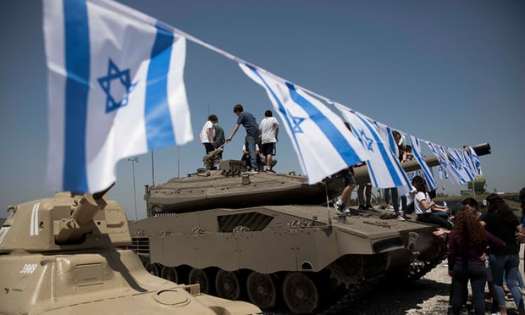
 Israeli teenagers climb on a tank decorated with flags before Memorial Day last week. (photo: Abir Sultan / EPA)

Complaint with UN claims Israel maintains a “system of discriminatory measures.”

By Oliver Holmes | The Guardian | Apr 23, 2018


“Not only is the purpose of the settlement regime discriminatory in itself, it is further maintained by a system of discriminatory measures, severely depriving Palestinians of their fundamental rights.”


Palestinian diplomats in Geneva have filed a complaint against Israel for what they say are breaches of its obligations under a UN anti-racism treaty, triggering what may be a lengthy and high-profile investigation.

The complaint, handed in by the Palestinian ambassador to the UN, Ibrahim Khraishi, to the body that monitors the implementation of the UN convention, accuses Israel of policies and practices that have “the common aim of displacing and replacing the Palestinian people, for the purpose of maintaining a colonial occupation.”

Violations in the occupied territories, which the complaint defined as the West Bank, Gaza and East Jerusalem, sought to maintain “a Jewish demographic majority in the entirety of historic Palestine,” claims the 350-page document, of which the Guardian has seen a summary.

Continue reading “Palestine files complaint against Israel under anti-racism treaty”

France requests that Israel stop banning its elected officials

Gennevilliers Mayor Leclerc Patrice. (photo: Twitter)

Israel denied entry to the mayor of a Paris suburb this week because he is believed to have supported BDS.

By Noa Landau | Haaretz | Apr 17, 2018


“The decision not to let him into the country was made for a series of reasons in connection to his activity in the BDS movement and his promotion of boycotts against Israel.”
— Israeli Strategic Affairs Ministry statement


France requested that elected officials be permitted to enter Israel and the Palestinian territories, its Foreign Ministry said Tuesday, a day after Israel prevented the mayor of a Paris suburb from entering because of his support for the boycott, divestment and sanctions movement.

A spokesperson for the ministry said Patrice Leclerc’s planned visit was part of attempts to supervise implementation of international programs in the Palestinian territories.

Israel’s Interior Ministry said that Leclerc, who is mayor of Gennevilliers, was blocked from entering Israel through Jordan, while the French ministry said Tuesday that he was detained for several hours on the Israel-Jordan border.

Continue reading “France requests that Israel stop banning its elected officials”

Natalie Portman refuses to visit Israel to receive the Genesis Prize

Actress Natalie Portman at the premiere “Annihilation,” Feb 13, 2018. (photo: Albert Ortega / Getty Images)

The Israel-born actress says she is “uncomfortable with recent events.”

By Dave Goldiner | Forward | Apr 19, 2018


“Natalie Portman’s cancellation should be a warning sign. She’s totally one of us, identifies with her Jewishness and Israeliness. She’s expressing the voices of many in US Jewry, and particularly those of the younger generation.”
— Rachel Azaria, Kulanu Party member of Knesset


Oscar-winning actress Natalie Portman has refused to travel for Israel to accept a $2 million award known as the “Jewish Nobel” because she is “uncomfortable with recent events” there, apparently referring to the deadly violence directed against Palestinian protesters in Gaza.

“She cannot in good conscience move forward with the ceremony,” a statement from the Hollywood superstar said.

The Genesis Prize quickly announced it was canceling its June prize ceremony for Portman saying it was “saddened” at her decision, which it said could “politicize” the award, which has previously gone to Michael Bloomberg, Itzhak Perlman and Michael Douglas. Continue reading “Natalie Portman refuses to visit Israel to receive the Genesis Prize”

John Bolton’s extremism is perfectly aligned with the most bellicose Israeli policies

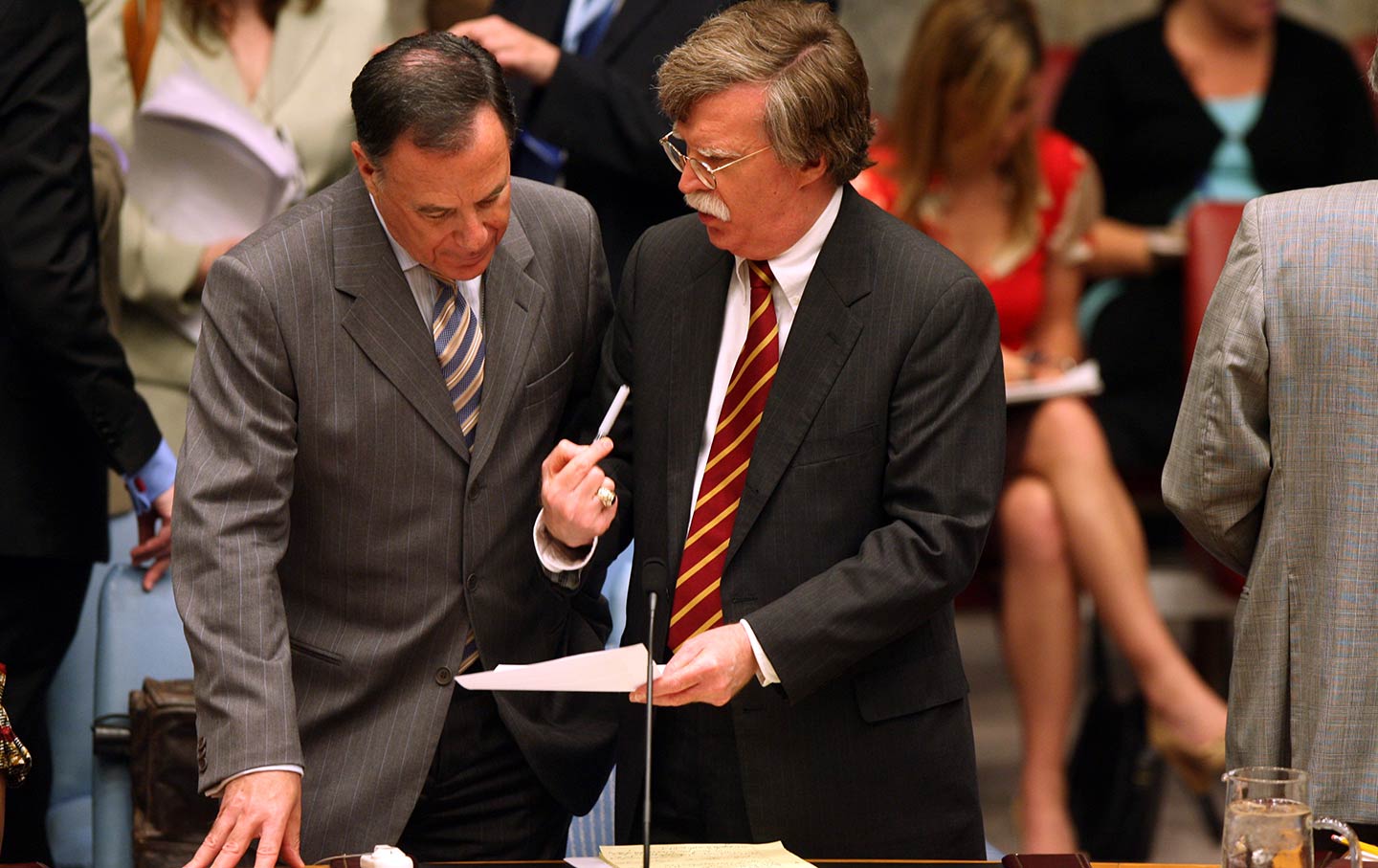
John Bolton, right, speaks to Dan Gillerman, Israeli Ambassador to the UN, prior to a Security Council meeting in 2006. (photo: Mary Altaffer / AP)

Whether he consciously puts Israel’s interests first or whether he believes they are identical to US interests doesn’t really matter — the outcome is the same.

By Mairav Zonszein | The Nation | Apr 13, 2018


“[Bolton is] motivated more by power and opportunity — but he’s got ideology in his back pocket. Part of that ideology is that a good lie, told enough times, will persuade enough people to do what you want them to do. It’s perfectly fine, though it’s a lie, because the end justifies the means.”
— Former Chief of Staff to Secretary of State Colin Powell, Lawrence Wilkerson


In an ominous coincidence of timing, John Bolton assumed his role as national-security adviser on Monday, right as news broke of an air strike on a military airport in Syria operated by Iran, widely assumed to be carried out by Israel, and just two days after 70 Syrians died and hundreds more were wounded in an apparent chemical attack by the Assad regime in Douma. Exchanges of blame and threats between Russia, Iran, Israel, and the White House have overshadowed the consternation and horror with which many in Washington have reacted to Bolton’s appointment.

Representative Brendan Boyle (D-PA) called Bolton a “dangerous radical” who pushes “fringe conspiracy theories”; Senator Bernie Sanders said his appointment “should scare everyone”; and the former chief White House ethics lawyer under George W. Bush, Richard Painter, tweeted that “John Bolton was by far the most dangerous man we had in the entire eight years of the Bush Administration.” In The New Yorker, Robin Wright describes Bolton as “arguably the most abrasive American diplomat of the twenty-first century,” and an opinion piece in The Washington Post calls him the second-most-dangerous man in America.

Continue reading “John Bolton’s extremism is perfectly aligned with the most bellicose Israeli policies”

Israel’s defense minister claims slain photojournalist was “Hamas terrorist”

000_13t8gy-640x400
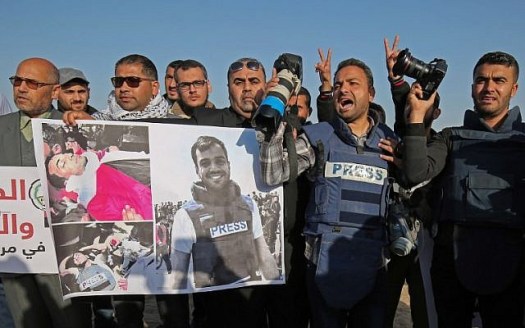
Palestinian journalists take part in a protest after the killing of fellow journalist Yasser Murtaja, near the Israel-Gaza border, on Apr 8, 2018. (photo: Said Khatib / AFP)

Minister provides no evidence; journalist’s colleagues reject the assertion as “ridiculous.”

By Staff | The Times of Israel | Apr 11, 2018


“[Liberman’s claims are] ridiculous comments that are not worth responding to. Yasser has been working for years in the press and making films for the United Nations, China and others. They killed a journalist and should confess it is a crime.”
— Rushdi Al-Serraj, Ain Media director and co-founder with Yasser Murtaja


Defense Minister Avigdor Liberman on Tuesday said a Gaza journalist who was reportedly killed by Israeli gunfire over the weekend was a member of Hamas.

The claim was immediately rejected by one of Yasser Murtaja’s colleagues, who called the statement “ridiculous.”

Palestinians say Yasser Murtaja was shot Friday while covering violent mass demonstrations near the Israeli border. He was reportedly shot in the torso while wearing a vest emblazoned with the word “press” and filming in an area engulfed in thick black smoke caused by protesters setting tires on fire.

Continue reading “Israel’s defense minister claims slain photojournalist was “Hamas terrorist””

Slain photojournalist’s last video captures brutal crackdown on protests

Palestinian photographer Yasser Murtaja’s final images eerily prescient as he documented the rising violence in Gaza before he was shot dead.

By Peter Beaumont | The Guardian | Apr 9, 2018


“Yasser Murtaja was a civilian and a journalist who was wearing clear press identification while he was filming the demonstrations at the Gaza fence with Israel. He was there because he wanted to document civilians exercising their right to peacefully protest.”
— Jan Egeland, Norwegian Refugee Council secretary-general


The drone floats above the farmland at the east of Gaza’s narrow coastal strip where beyond the fence — the transition is almost invisible — Israel’s border communities begin.

The video is among the last footage filmed by Palestinian photographer Yasser Murtaja in Gaza before he was shot dead by Israeli troops last Friday — and it eerily foreshadows his own fate.

Palestinian demonstrators walk through the flat fields, hold signs or sit in the shade of tents in the five border protest camps that dot the landscape from east of Jabaliya in the north to Khuza’a, a short drive from the southern city of Khan Yunis.

Murtaja died on the second of a series of mass Friday protests called the “Great March of Return,” which will culminate on “Nakba” Day (catastrophe in Arabic) on 15 May, which will commemorate the events of 1948 when, following the creation of the state of Israel, more than 700,000 Palestinians were expelled from their homes.

Despite wearing body armour clearly marked with a press sign, Murtaja was shot in the stomach while covering the protests and died later of his wounds. He was one of nine Palestinian men killed in a space of a few hours.

Continue reading “Slain photojournalist’s last video captures brutal crackdown on protests”

Palestinian negotiator says Trump’s envoy Greenblatt has turned Into Israel’s spokesman

Palestinian President Mahmoud Abbas meets with Trump’s Middle East envoy Jason Greenblatt in Ramallah, Mar 14, 2017. (photo: Mohamad Torokman / Reuters)

Since the Gaza border protests began, Trump’s envoy to the peace process has “consistently repeated Israeli talking points.”

By Jack Khoury and Noa Landau | Haaretz | Apr 13, 2018


“It is clear that those who do not consider that the lives of Palestinians and Israelis are of equal value cannot possibly promote any plan that will be remotely close to a just and lasting peace.”
— Palestinian chief negotiator, Saeb Erekat


In an unprecedented move, a senior Palestinian official sent a letter on Thursday to all foreign diplomats stationed in Ramallah assailing the American envoy to the peace process, Jason Greenblatt.

Saeb Erekat, who is the Palestinians’ chief negotiator as well as secretary general of the PLO’s executive committee, also urged the diplomats to back the Palestinians at the United Nations and other international agencies, including the International Criminal Court, in demanding an investigation into “ongoing Israeli crimes against Palestine and the Palestinian people.”

Erekat, who has met with Greenblatt many times since the latter took office, charged that since the mass demonstrations near the Israel-Gaza border began a few weeks ago, the U.S. envoy has “assumed the role of spokesperson of the Israeli Authorities” and “consistently repeated Israeli talking points.”

Continue reading “Palestinian negotiator says Trump’s envoy Greenblatt has turned Into Israel’s spokesman”

ICC chief prosecutor calls for end to violence in Gaza

5754
The Palestinian photojournalist Yasser Murtaja, shot by an Israeli sniper while filming a Palestinian protest, is carried to his burial, Apr 7, 2018. (photo: Samar Abu Elouf / ImagesLive)

Attacks on civilians could be unlawful under international criminal court treaty.

By Owen Bowcott | The Guardian | Apr 8, 2018


“Since 30 March 2018, at least 27 Palestinians have been reportedly killed by the Israeli Defense Forces, with over 1,000 more injured, many as a result of shootings using live ammunition and rubber bullets. Violence against civilians, in a situation such as the one prevailing in Gaza, could constitute crimes under the Rome statute of the [ICC] . . . .”
— Fatou Bensouda, ICC chief prosecutor


The chief prosecutor of the international criminal court has called for an end to violence in Gaza after hundreds of mourners attended the funeral of a Palestinian journalist shot beside Israel’s security fence.

Yasser Murtaja, a 31-year-old photographer, was wearing a clearly marked press vest as he reported on a mass demonstration along the Gaza border, in Khuzaa, on 6 April when he was shot. The area was engulfed in thick black smoke from tyres that had been set on fire.

Murtaja was one of about 30 Palestinians killed by Israeli gunfire over the past 10 days along the border. As many as 491 people were wounded in last Friday’s protest against the founding of the Israeli state in 1948. Mass rallies are due to continue until 15 May.

Continue reading “ICC chief prosecutor calls for end to violence in Gaza”

300 meters in Gaza: Snipers, burning tires and a fence

drone-image-1200
A protest in Khan Younis on Mar 30. The photographer, Yasser Murtaja, was killed by an Israeli sniper in the same location the following week. (photo: Yasser Murtaja, Ain Media)

A fence that divides Israel and Gaza has become the latest flashpoint in the decades-old conflict.

By David Halbfinger, Iyad Abuheweila and Jugal Patel | The New York Times | Apr 13, 2018


Most Gazans are Palestinian refugees or their descendants, and marching on the fence highlights their desire to reclaim the lands and homes from which they were displaced 70 years ago in the war surrounding Israel’s creation.


A fence that divides Israel and Gaza has become the latest flashpoint in the decades-old conflict, with Israeli soldiers unleashing lethal force against mostly unarmed Arab protesters who have been demonstrating every Friday for the past several weeks.

The image above shows how each side is arrayed in Khan Younis, one of five demonstration sites where 34 Palestinians have been killed since the protests began nearly three weeks ago.

The protests resumed on Friday, and the Palestinians plan to keep the weekly protests going with large turnouts until May 15, when many plan to try to cross the fence en masse. The Gazans are protesting Israel’s blockade, which has been choking off the impoverished coastal strip for more than 10 years. They also want to reassert the rights of refugees and their descendants to reclaim their ancestral lands in Israel, 70 years after hundreds of thousands of Palestinians were displaced.

Continue reading “300 meters in Gaza: Snipers, burning tires and a fence”

“Sorry Commander, I Cannot Shoot”

Palestinians Israel
Protesters wave Palestinians flags in front of Israeli solders on Gaza’s border with Israel, east of Beit Lahiya, Gaza Strip, Apr 4, 2018. (photo: Adel Hana / AP)

Israeli human-rights group B’Tselem has launched a campaign titled “Sorry Commander, I Cannot Shoot,” calling on Israeli troops to refuse orders to shoot unarmed demonstrators.

By Elliott Gabriel | Mint Press News | Apr 6, 2018


“Our legitimate protest against Israeli military occupation, colonization and apartheid is granted in international law and must be protected by the international community. . . . The 70-year-old practice of Israel’s shoot-to-kill policy and dehumanization of the Palestinian people must end.”
— Dr. Husam Zomlot, Palestinian ambassador to Washington


Tens of thousands of residents in the besieged Gaza Strip plan on returning to the Israeli-controlled border Friday [Apr 6] in defiance of menacing promises from Tel Aviv to use massive and disproportionate force. The event will occur exactly one week after the Israelis massacred 17 unarmed demonstrators with live ammunition on Palestinian Land Day.

The protest is the latest in a six-week-long set of nonviolent protests meant to commemorate the continuing dispossession of the Palestinian people and the absorption of ancestral Palestinian land by the country now known as Israel.

The series of events will last until the 15th of May, a date making the 70th anniversary of the establishment of the State of Israel — known to Palestinians as Nakba Day, or “The Day of Catastrophe” — when three-quarters of a million Palestinians were brutally displaced by Israeli militia in 1948.

Continue reading ““Sorry Commander, I Cannot Shoot””