Immediate Actions & Upcoming Events for Ceasefire in Gaza

Mark your calendars for upcoming events and actions — meanwhile, keep the pressure on your elected officials by phone, email, letter, and fax.

“Almost 2,000,000 people in Gaza have been thrown out of their homes… 70% of the housing units in Gaza have been damaged or destroyed,” said Senator Bernie Sanders in a recently shared video. “Only 25% of what the people of Gaza need to survive is currently making it through the border checkpoints.”

Our tax dollars are funding this humanitarian disaster. Join us in pressuring our representatives to demand a permanent ceasefire in Gaza, that vital humanitarian aid be delivered to the people of Gaza, and that the United States stop arming Israel’s occupation:

Upcoming Events

Every Thursday | Churches for Middle East Peace Weekly Briefing

Register to attend weekly briefings, which take places on Thursdays from 10 to 10:30 a.m. ET. Hear current news in Palestine and Israel and participate in a Q&A.

Register to attend the weekly briefing on February 1.

February 3 | From Turtle Island to Kashmir to Palestine, Settler Colonialism is a Crime

10:30 a.m. ET / 7:30 a.m. PT

Register Here

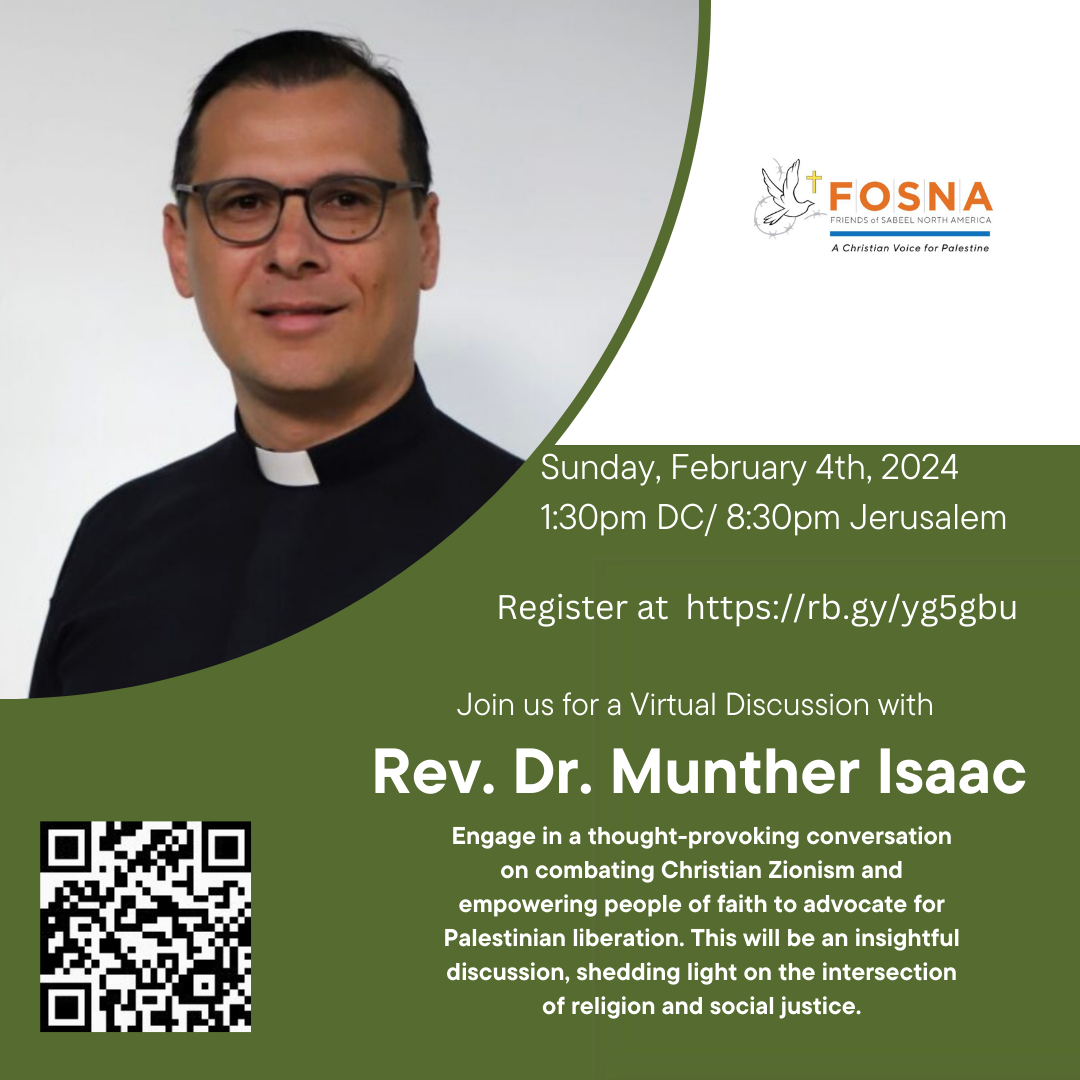
February 4 | Virtual Discussion with Rev. Munther Isaac: Confronting Christian Zionism and Empowering Advocates for Palestinian Liberation

Learn how to combat Christians Zionism and empower people of faith to advocate for Palestinian liberation. This will be an insightful discussion, shedding light on the intersection of religion and social justice.

Sunday, February 4
8:30 p.m. Jerusalem / 1:30 p.m. ET / 10:30 a.m. PT

Register Here

February 14 | Jewish Day of Advocacy for Peace (JVP Seattle)

Join Jewish Voice for Peace (JVP) Seattle and participating groups from around the state for a Jewish-led advocacy day at the State Capitol in Olympia, WA. Participate in a training and then meet with elected officials in support of “the freedom and collective safety of Jewish and Palestinian communities locally and globally.”

Wednesday, February 14
All day, with options to participate remotely.

Learn more & register!

February 15 | Mass Mobilization Call: Christians Against Genocide

This is a call to action to our Christian siblings to use your public voice and collective power to advocate for justice, challenge Christian Zionism, and demand an immediate ceasefire.

Thursday, February 15
8 p.m. ET / 5 p.m. PT
Learn more & sign up!

January 30 | A Conversation with Munther Isaac

In less than one week, we hope you’ll join Kairos USA, Kairos West Michigan, and the Indiana Center for Middle East Peace for a conversation with Rev. Dr. Munther Isaac. Rev. Isaac is Pastor of Christmas Lutheran Church in Bethlehem, Academic Dean of Bethlehem Bible College, and Co-Director of the Global Kairos for Justice Coalition.

Rev. Isaac will speak with Dr. Michael Spath, DMin, founder of the Indiana Center for Middle East Peace. Everyone is invited to join on Zoom.

A Conversation with Rev. Dr. Munther Isaac & Dr. Michael Spath
Tuesday, January 30
2:00 to 3:00 p.m. ET / 11:00 a.m. to 12:00 p.m. PT
Register Here

More Upcoming Events

The Bible & Settler Colonialism in Palestine & Beyond
Webinar presented by the Center & Library for the Bible and Social Justice, featuring Rev. Prof. Mitri Raheb with Atalia Omer and Revelation Velunta.
Saturday, January 27
9:30 a.m. ET / 6:30 p.m. PT
Register Here

MIT Forum on Gaza with Dr. Alice Rothchild & Rabbi Brian Walt
Alice Rothchild joins Rabbi Brain Walt of Rabbis for Ceasefire to share important context for the current conflict. In-person at the Falmouth Public Library (Falmouth, Massachusetts) or online via Zoom.
Tuesday, January 30
7:00 p.m. ET / 4:00 p.m. PT


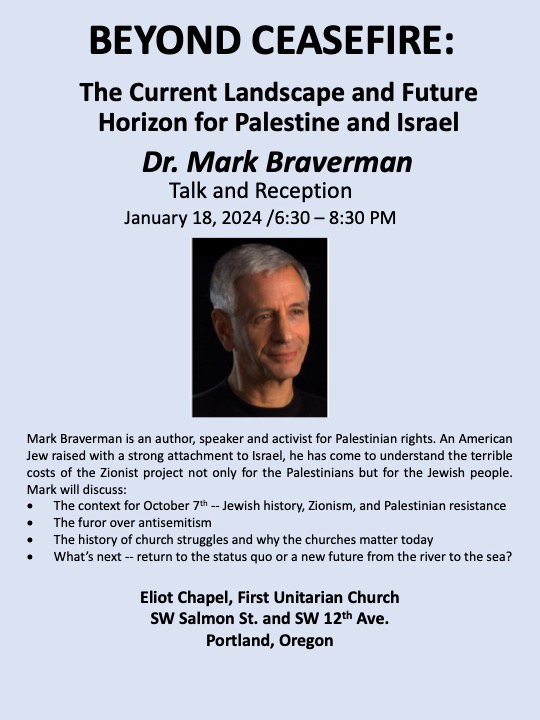
January 18 & 19 | Dr. Mark Braverman in Portland, Oregon

We’re excited to share that Dr. Mark Braverman, Executive Director of Kairos USA, will be speaking in Portland, Oregon on January 18 & 19. Mark’s talks and follow-up Q&A sessions will cover:

  • Jewish history, Zionism, and Palestinian resistance leading up to October 7th.
  • Antisemitism — what it is and why it’s important.
  • The history of church complicity in colonialism, its struggles with equality and human rights, and why the church matters today.
  • The U.S. political landscape — coming to terms with our settler-colonial DNA.
  • What’s next — a return to the status quo, or a new future from the river to the sea?

Thursday, January 18th
First Unitarian Church — Eliot Chapel
SW Salmon St. & SW 12th Ave., Portland, OR
6:30 to 8:30 p.m.
Mark’s talk will be followed by a reception.

Friday, January 19th
Grace Memorial Episcopal Church
1535 NE 17th St., Portland, OR
10 to 11:30 a.m.
Coffee, tea, and snacks provided!

Please share using the fliers below, and invite your friends and family to attend!

Palestinian Episcopal priest and Sabeel founder writes open letter to Biden: “A Prophetic Vision for Justice”

Image: fosna.org

On December 28, Reverend Dr. Canon Naim Stifan Ateek published an open letter to U.S. President Joe Biden outlining what he calls “a prophetic vision for justice.” His vision is “rooted in the spirit of United Nations Security Council resolution 242” and “based on the formula of land for peace for the two peoples that must live together on the land.”

Rev. Dr. Naim Ateek is the founder of Sabeel Ecumenical Liberation Theology Center in Jerusalem.

“Mr. President, let us imagine together the future and let us take bold steps and concrete actions that will actually transform our words into a just peace for all.”

Rev. Dr. Ateek outlines his vision in the letter, in chronological detail. It begins with a permanent ceasefire, recognition of Palestine as a United Nations member state, and a “conclusive end” to Israel’s occupation. He places responsibility for the rebuilding of Gaza with the U.K., U.S., and Israel: “Justice requires that they be found liable and held accountable.” He invites collaboration with the governments and peoples of Ireland and South Africa, and emphasizes the means to establish a sovereign and viable Palestinian state.

“The Palestinians bear no responsibility for the horrors of the Holocaust,” he writes. “But the Palestinian people must now be prepared to live in peace with their Israeli Jewish neighbors. Both peoples may help one another heal from the wounds of the Holocaust, the pain and suffering of the Nakba, and the horrors of the current catastrophe.”

“It was our beloved Archbishop Desmond Tutu, the International Patron of Sabeel, who said, ‘We are prisoners of Hope.’ And so, it is with much hope and anticipation that you will join me in seeing this vision become a reality, one that requires bold actions and a passion for justice, and only justice!”

Take Action

We encourage you to read Rev. Dr. Ateek’s full letter here. You may endorse the letter as an individual or as part of an organization, and easily share the letter with your representatives in the U.S. by filling out this brief form.

International Criminal Court to investigate war crimes in Palestine

5472
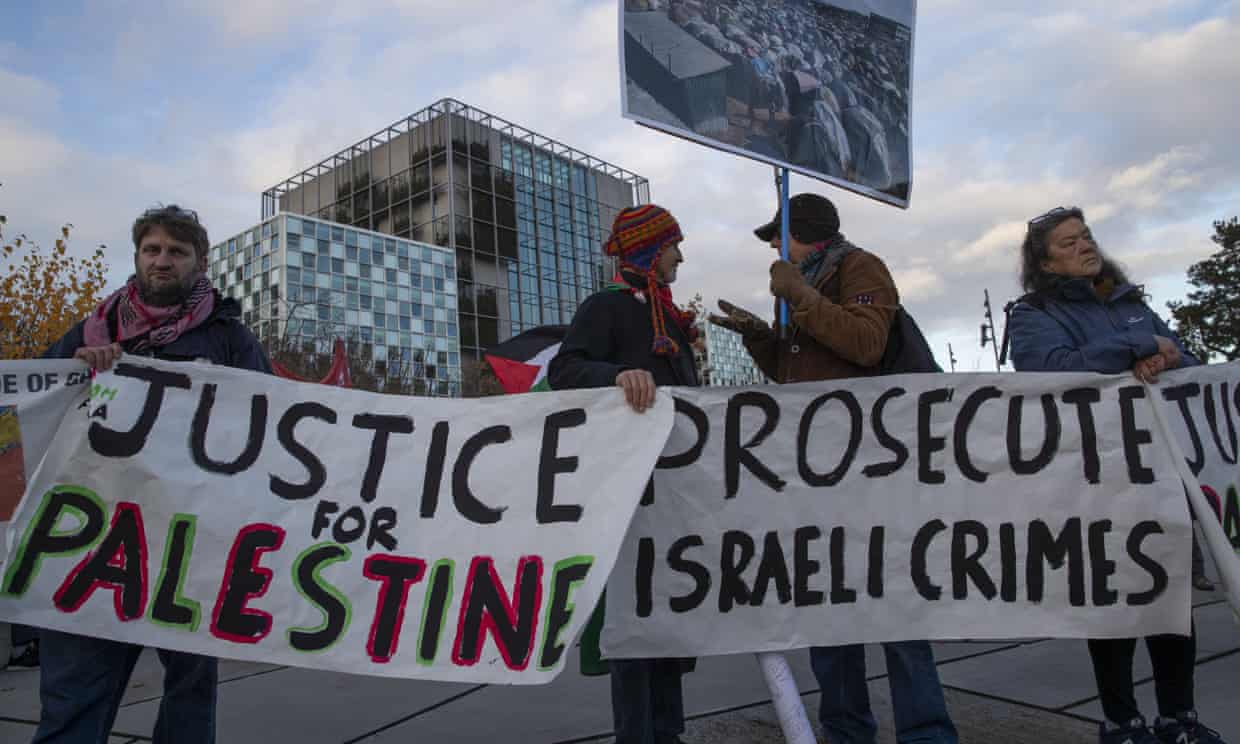
Demonstrators outside the International Criminal Court call for the Israeli army to be prosecuted for war crimes, The Hague, Nov 2019. (photo: Peter de Jong / AP)

There is sufficient evidence to investigate alleged Israeli and Palestinian war crimes committed in the West Bank, East Jerusalem and the Gaza Strip, the court has announced.

By Peter Beaumont | The Guardian | Dec 20, 2019

‘In brief, I am satisfied that war crimes have been or are being committed in the West Bank, including East Jerusalem, and the Gaza Strip.’
— Fatou Bensouda, ICC Chief Prosecutor

In a landmark decision, the ICC said it saw “no substantial reasons to believe that an investigation would not serve the interests of justice.”

The announcement ended years of preliminary investigations into alleged crimes by both Israeli forces and Palestinians, and signaled that the court was preparing to open a formal investigation.

A statement published by the court’s chief prosecutor, Fatou Bensouda, on the court’s website on Friday said her office “has concluded with the determination that all the statutory criteria under the Rome statute for the opening of an investigation have been met.”
Continue reading “International Criminal Court to investigate war crimes in Palestine”

No one in Israel knew they were committing a massacre

Palestinians mourn over the bodies of members of the same family who were killed in an Israeli airstrike in Gaza, Nov 14, 2019. (photo: AFP / Haaretz)

The Israel Defense Forces claims the target was an “unoccupied shack.”

By Gideon Levy | Haaretz | Nov 17, 2019

‘Why did they do this to us?’
— Mohammed Matar, who had worked in Israel for 30 years, and whose daughter, daughter-in-law and four grandchildren were killed in the bombing

The bomber pilot didn’t know. His commanders who gave him the orders also didn’t know. The defense minister and the commander in chief didn’t know. Nor did the commander of the air force. The intelligence officers who aimed at the target didn’t know. The army spokesman who lied without a qualm also didn’t know.

None of our heroes knew. The ones who always know everything suddenly didn’t know. The ones who can track down the son of a wanted man in a Damascus suburb didn’t know that sleeping inside their miserable hovel in Dir al-Balah was an impoverished family.

They, who serve in the most moral army and the most advanced intelligence services in the world, didn’t know that the flimsy tin shack had long since stopped being part of the “Islamic Jihad infrastructure,” and it’s doubtful that it ever was. They didn’t know and they didn’t bother to check — after all, what’s the worst that could happen?
Continue reading “No one in Israel knew they were committing a massacre”

Israel’s increasing violence against the media

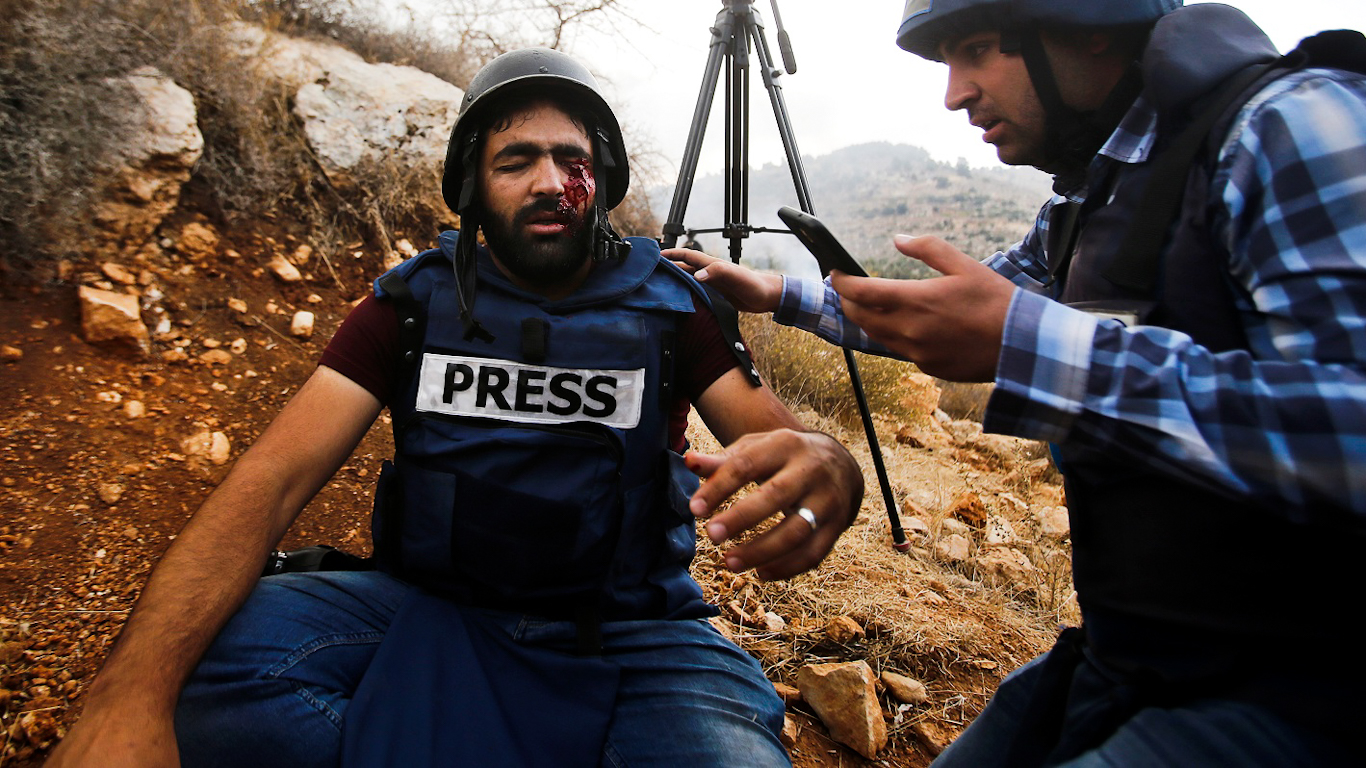
Palestinian photojournalist Mu’ath Amarneh, seated on the left, moments after being shot in the eye by an Israeli soldier in Surif, West Bank on Nov 15, 2019. (photo: Palestinian Information Center)

2018 saw a 52 percent increase in the number of violations against Palestinian press.

By Delilah Boxstein | Mint Press News | Nov 25, 2019

‘I won’t stop being a journalist but now I feel unsafe. They could attack my other eye. It will be harder for me to continue what I am doing.’
— Palestinian photojournalist Mu’ath Amarneh

On November 15, Palestinian photojournalist Muath Amarneh covered a demonstration in Surif, a West Bank city where residents were protesting against the theft of their land by Israeli settlers. Wearing a press jacket and helmet, Amarneh was shot in the head by an Israeli bullet while taking pictures on a nearby hill — about 330 feet from the soldiers.

“Everything just changed. I felt the whole world was circling around me. And I felt my whole life flash before me. I felt like I was dying,” Amarneh said, describing his reaction when hit.

With blood dripping from his eye, Amarneh was taken to a hospital in Hebron, West Bank. He was eventually transported to Hadassah Hospital in Jerusalem where his left eye was removed. He remains there awaiting further operations to have the bullet removed from his head. Continue reading “Israel’s increasing violence against the media”

Trump crushes Palestinian hopes — again

A Palestinian boy sits on a chair as Israeli authorities demolish a school in the village of Yatta, south of Hebron, in the occupied West Bank, Jul 11, 2018. (photo: Hazem Bader / AFP / Getty Images)

The U.S. Middle East peace plan may be in a coma. But that hasn’t stopped Washington from handing major diplomatic victories to Israel.

By Colum Lynch and Robbie Gramer | Foreign Policy | Nov 18, 2019

‘You now have a complete package of efforts to make a traditional solution . . . to the Israeli-Palestinian problem virtually impossible, at least for the remainder of the Trump administration.’
— Carnegie Endowment for International Peace scholar Aaron David Miller

Secretary of State Mike Pompeo declared Monday that the United States no longer considers civilian Israeli settlements on Palestinian lands a violation of international law. The move represents a historic decision that reverses decades of U.S. policy and represents the latest in a raft of pro-Israeli moves that could effectively quash hopes for the two-state solution to the Israeli-Palestinian conflict.

“The conclusion that we will no longer recognize as per se inconsistent with international law is based on the unique facts, history, and circumstances prevented by the establishment of civilian settlements in the West Bank,” Pompeo told reporters on Monday. He said that the decision does not mean the U.S. government is expressing views on the legal status of any individual settlement or “prejudging the ultimate status of the West Bank.”

Pompeo’s statement rolls back a 1978 State Department opinion that formed the bedrock of U.S. legal opinion on Israeli settlements, asserting that civilian settlements in the occupied territories are “inconsistent with international law.”

The decision marks the latest way in which the Trump administration has undercut Palestinian claims of statehood in favor of its closest historic ally in the Middle East, handing another political victory to embattled Israeli Prime Minister Benjamin Netanyahu as he struggles to stay afloat after failing to form a coalition government.
Continue reading “Trump crushes Palestinian hopes — again”

Zionism’s uneasy relationship with anti-Semitism

1920px-A_FOLK_DANCE_TROUPE_IN_KIBBUTZ_DALIA._להקת_מחול_מופיעה_בקיבוץ_דליה.D12-072 (1)

The Israeli embrace of Christian evangelicals — whose plans for Jews are conversion or a fiery death — mirrors the warm relationship that Zionists had with antisemitic leaders in Germany and Italy.

By Alice Rothchild | Mondoweiss | Nov 19, 2019

[Herzl] would declare in his foundational pamphlet that ‘the Governments of all countries scourged by Anti-Semitism will be keenly interested in assisting us to obtain [the] sovereignty we want’; and indeed that not ‘only poor Jews’ would contribute to an immigration fund for European Jews, ‘but also Christians who wanted to get rid of them.’
— Columbia University professor Joseph Massad

I grew up with a deep love for Israel, the redemptive, out-of the-ashes, kibbutz-loving, feisty little country that could do no wrong, fighting for its life in a sea of hateful Arabs and Jew-haters. I learned that Jews were a people dedicated to worship and the study of Torah and this identity kept us alive during the centuries of antisemitism in Europe. If I was not able to dedicate myself to the religiosity of my davening grandfather, tfillin and all, I understood that as a people, we were deeply committed to healing the world and working for social justice, an equally virtuous and inherently Jewish task. After all, we were naturally good, or as my mother explained, Jews bore the responsibility of being chosen for a uniquely positive role in this world.

As the decades passed, this mythology shattered against the hard rocks of reality. One of the most difficult contradictions I now face is understanding the perverse relationship between Zionism and antisemitism. I was sold the story that political Zionism developed as a response to antisemitism and as a modern, liberating movement in the backward Middle East. But in 1897 as modern Zionism was born, it adopted the trope of the diaspora Jew as a pale, flaccid, yeshiva bocher, a parasite, an eternal alien, a nebbish. That Zionism embraced the idea that this pathetic weakling (who was often to be blamed for antisemitism) needed to be Aryanized into the bronzed, muscular Hebrew farmer/warrior tilling the soil in the Galilee is a chilling realization. The evolution of Jews as a people who lived by Torah and its commandments into a biological race with distinct characteristics, (the money Jew, the ghetto Jew, the swarthy, hook-nosed Jew) mirrors the worst canards of anti-Semites, European fascists, and white supremacists.

Continue reading “Zionism’s uneasy relationship with anti-Semitism”