US to open Jerusalem embassy in 2019

Pence
Vice President Pence in Cairo, Jan 20, 2018. (photo: Getty Images)

Pence announces plans to accelerate the move in a speech to the Israeli Knesset.

By Oliver Holmes | The Guardian | Jan 22, 2018


Q&A: What will US recognition of Jerusalem mean for the peace process?

The peace process has been at death’s door since the former secretary of state John Kerry’s peace mission ended in failure in 2014. But the international community — apart from the US — is united in saying recognition of Jerusalem as the capital of Israel is disastrous for any hopes of reviving meaningful talks. The status of Jerusalem is one of the pivotal issues that diplomats and peacemakers have said must be agreed between the two parties in negotiations.

Palestinians will see Trump’s announcement as the end of their hopes and demands for East Jerusalem as a capital of a future independent state. While few want a return to violence, many will feel diplomatic efforts have got them no closer to a state of their own.

The Israeli government will be thrilled. Ever since it captured (and later annexed) East Jerusalem in the 1967 six-day war, Israel has claimed the city as its “eternal and undivided” capital, and has longed for international recognition. Some 200,000 Israelis living in illegal settlements will also celebrate.


The US will open its embassy in Jerusalem by the end of 2019, ahead of schedule, the vice-president, Mike Pence, has said. Arab-Israeli politicians were ejected from the Knesset at the start of Pence’s speech for heckling.

“In the weeks ahead, our administration will advance its plan to open the US embassy in Jerusalem – and that United States embassy will open before the end of next year,” he said in a speech to roaring applause in the Israeli Knesset.

Speaking during a two-day visit, Pence said Donald Trump had “righted a 70-year wrong” by recognizing Jerusalem as the capital of Israel.

Continue reading “US to open Jerusalem embassy in 2019”

Israel holding over 300 Palestinian minors in prison

ahed1
16-year-old Ahed Tamimi listens to her lawyer under a guard’s watchful eye before a hearing at Ofer military prison, near the West Bank city of Ramallah, Jan 15, 2018. (photo: Oren Ziv / Activestills.org)

There are hundreds of Palestinian children like Ahed Tamimi, held without bail until the end of their trials.

By Joshua Leifer | +972 Magazine | Jan 21, 2018


“The routine decision, prior to sentencing, to imprison a person who has not been convicted until the end of legal proceedings, in fact empties the legal process of substance.”
— Amit Gilutz, B’Tselem spokesperson


While the case of Ahed Tamimi has garnered international media attention, the Israeli military prison system’s treatment of Ahed and her mother is not unique. Israel Prison Service (IPS) statistics published by Israeli anti-occupation organization B’Tselem earlier in January reveal that Israel is holding over 300 Palestinian minors in prison. Over 180 of those minors are being held in detention until the end of legal proceedings, without having been convicted, like Tamimi.

According to IPS data handed over to B’Tselem, as of the end of November 2017 there were 5,881 Palestinians imprisoned by Israel, of whom 1,775 were being detained until the conclusion of legal proceedings. Over 400 were administrative detainees, including three women and two minors (aged 16 and 18). Administrative detention is a measure Israel uses to detain Palestinians (and some Jews) indefinitely without charge or trial. It is meant to be adopted rarely and with moderation. In practice, however, Israel uses administrative detention as a first, not last, resort.

In total, 2,200 Palestinians were being held in Israeli jails without having been convicted of any crime.

Continue reading “Israel holding over 300 Palestinian minors in prison”

Ahed Tamimi and her mother to remain in prison

ahed
Ahed Tamimi is seen before her hearing at Ofer Military Court near the West Bank city of Ramallah, Jan 17, 2018. (photo: Oren Ziv / Activestills.org)

The 16-year-old Palestinian girl was arrested for slapping an Israeli soldier who had come to the family home after shooting a cousin. Her mother was arrested after going to the police station to check on her daughter.

By Oren Ziv | +972 Magazine | Jan 17, 2018


“I don’t trust this court, [the Israeli military court where the Tamimis are being tried], I don’t trust this legal system, all of which is built to punish the Palestinians. My sister [was] killed inside one of these courts in 1993. My daughter and wife are in the hands of my enemy.”
— Bassam Tamimi, Ahed’s father


An Israeli military appeals court on Wednesday denied bail to Ahed Tamimi, the Palestinian girl who was filmed slapping an Israeli soldier at the entrance to her home, and her mother Nariman, ordering them held in prison until the conclusion of their respective trials.

Tamimi is charged with five counts of assaulting security forces, as well as with incitement. Her mother is accused of incitement via social media.

Military Judge Haim Baliti rejected most of the arguments put forth by Attorney Gaby Lasky, who is representing both Ahed and Nariman. In a hearing on Monday, Lasky had challenged the military prosecution’s assertion that both Ahed and Nariman posed a danger to the security of the area, questioned why Ahed was subject to a different legal system than Israeli minors in the West Bank, and called the arrests politically motivated.

Continue reading “Ahed Tamimi and her mother to remain in prison”

Pence and Jordan’s king “agree to disagree” on Jerusalem

merlin_132626039_47fc660b-6df7-4dd0-b94f-405aedf7fd86-master768
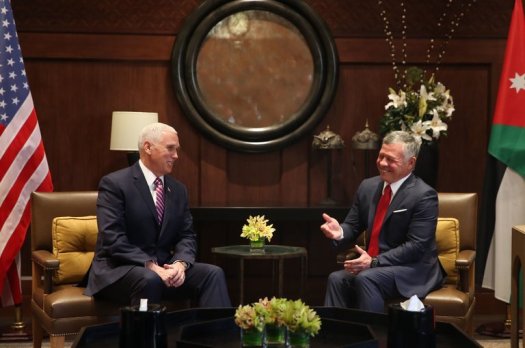
Vice President Mike Pence, left, had a “very frank discussion” with King Abdullah II of Jordan, right, in Amman on Sunday. (photo: Khalil Mazraawi / AFP / Getty Images)

Pence had delayed his trip to the region amid the furor over Trump’s decisions, which were seen as pro-Israel and a slap in the face to Palestinians.

By Rana Sweis | The New York Times | Jan 21, 2018


“Trump and Israel want to end the Palestinian cause; they want to erase the idea of Palestinian refugees. They want to pressure Jordan, the Palestinians and others to give into the demands of an imaginary peace process that benefits only Israel, and that is unacceptable.”
— Abdul Rahman Qanas, 52, a resident of the Baqaa, the largest refugee camp in Jordan


Vice President Mike Pence met with King Abdullah II of Jordan on Sunday, telling reporters afterward that they had “agreed to disagree” on the American recognition of Jerusalem as Israel’s capital.

The meeting in Amman, on the second day of Mr. Pence’s visit to the Middle East, came as tension has increased between the two allies over President Trump’s decision on Jerusalem last month and his decision last week to withhold aid to the United Nations agency that serves Palestinian refugees.

Speaking before the meeting with Mr. Pence at Al Husseiniya Palace in Amman, King Abdullah reiterated his support for “East Jerusalem as a capital of an independent Palestinian state living side by side with a secure and recognized Israel,” Petra, Jordan’s official news agency, reported.

Jordan is also home to more than two million Palestinian refugees who could be affected by the cut in American aid to the United Nations agency.

Mr. Pence said the two leaders had a “very frank discussion.”

Continue reading “Pence and Jordan’s king “agree to disagree” on Jerusalem”

Refugees hold “slave auction” to protest Israeli deportation

refugee-slave-auction-thumb
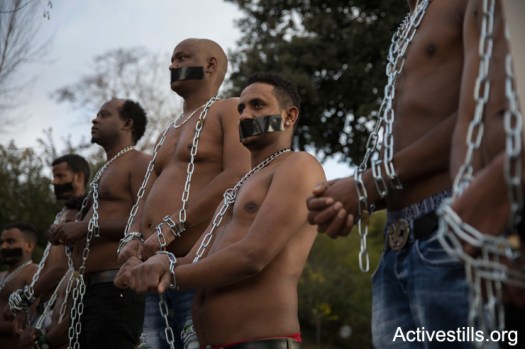
Eritrean asylum seekers stage a mock slave auction outside the Knesset to protest Israel’s plans to deport tens of thousands of Sudanese and Eritrean asylum seekers, Jan 17, 2018. (photo: Oren Ziv / Activestills.org)

Israel plans to begin deporting tens of thousands of Eritrean and Sudanese asylum seekers within weeks.

By Oren Ziv | +972 Magazine | Jan 17, 2018


“The asylum seekers that are deported from Israel end up in Libya, end up being sold. This is not just an idea, this is what happens to them actually once they are deported from Israel. Their lives are in danger. We came today to the Knesset to reinforce that message.”
— Sigal Avivi, Israeli refugee rights activist


A group of Eritrean asylum seekers and Israeli refugee advocates staged a mock slave auction outside the Knesset, Israel’s parliament, while a conference on government plans to begin mass deportations of asylum seekers took place inside Wednesday morning.

Around 10 asylum seekers stood on make-shift auction blocks made of milk crates, while an auctioneer called out, “get your slaves, slaves for half price,” over a megaphone. A single member of Knesset, Dov Khenin, came outside to support the asylum seekers, and called Israel’s refugee policy inhumane and unacceptable.

Israeli officials have stated that starting in a matter of weeks, tens of thousands of Eritrean and Sudanese asylum seekers in Israel will face a stark choice: indefinite imprisonment or agree to be sent to Rwanda or Uganda. Asylum seekers who have left Israel for the two countries in recent years have not received any legal status there, and faced dangerous conditions and choices, including heading toward Europe through Libya, where human trafficking and other types of violence is a constant danger.

Continue reading “Refugees hold “slave auction” to protest Israeli deportation”

US role as Mideast peace broker may be over

3883
Mike Pence, an evangelical Christian, has visited Israel four times before and pushed for Trump’s inflammatory policies in the Middle East. (photo: Alex Brandon / AP)

Under Trump, relations between the Palestinian leadership and Washington have soured – and Pence’s trip is expected to confirm the enmity.

By Oliver Holmes | The Guardian | Jan 20, 2018


Trump has said he wants to revitalize long-stalled peace talks in pursuit of what he has described as the “ultimate deal.” Yet when Pence touches down in Tel Aviv on Sunday evening, the US’s role as mediator in the conflict may be over for good.


It’s not the trip to the Holy Land that Mike Pence might have imagined. For a start, the US vice-president — an evangelical Christian — is no longer welcome in Jesus’s birthplace of Bethlehem.

Donald Trump doomed Pence’s chances of a visit to the West Bank when he reversed decades of US policy last month by recognising Jerusalem as Israel’s capital. This broke a longstanding international consensus that the issue would be negotiated in peace talks with the Palestinians, who also claim parts of the city.

While Trump did not rule out a future division of Jerusalem, the Palestinian president, Mahmoud Abbas, swiftly rescinded Pence’s invitation to meet him and visit Bethlehem, while senior Christian clerics in Egypt — where Pence arrives on Saturday at the start of his four-day trip ­— also cancelled planned events.

Continue reading “US role as Mideast peace broker may be over”

Female IDF soldiers move from the front lines to the headlines

4336464487_b9a23886d6_b-640x400
Female soldiers in the IDF take a water break during an exercise on Nov 19, 2007. (photo: Israel Defense Forces / Flickr)

Debate over mixed-gender IDF units rages in the Hebrew-language press.

By Adiv Sterman | The Times of Israel | Jan 18, 2018


“It is too bad that too many ultra-religious Zionists — both rabbis and MKs — are stoking the flames, stirring up unnecessary controversy, and provoking hatred.”
— Yossi Yehoshua, writing in Yedioth Ahronoth


The frustration felt by many citizens of the Jewish state over the growing chasm between religious-conservative and secular-liberal values in Israel is reflected in today’s Hebrew-language newspapers, as pundits and analysts pretty much across the board denounce calls for draft evasion issued by prominent right-wing rabbis, including Rabbi Shmuel Eliyahu, who went as far as saying that the IDF’s chief of staff should be fired for promoting women’s service in combat roles.

“Woman combat soldiers: The secret to the IDF’s success,” writes Israel Hayom’s Maayan Adam, who is an officer in the army reserves herself. “The comments against women’s service no longer manage to anger me; they even lead me to feel pity. It is easy to notice that behind the patriarchal discourse stands a distress call from a handful of scared men,” Adam says, adding that there can be no turning back now that women have been introduced into the army’s various combat units.

Continue reading “Female IDF soldiers move from the front lines to the headlines”

Jerusalem: It’s tense, crowded and can feel like a jail

10jerusalem4-superjumbo
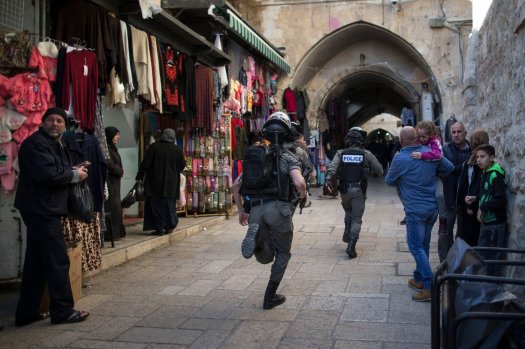
Israeli border police officers responding to a disturbance in the Muslim Quarter after Friday prayers. (photo: Uriel Sinai / The New York Times)

This is a tense city on a good day.

By David Halbfinger | The New York Times | Dec 9, 2017


“There’s a big religion problem in Jerusalem. It’s a city of racism. Once there’s a little bit of balagan [chaos] between Jews and Arabs, Jews won’t go in my taxi, and Arabs won’t go to the mall. And if I go into a religious neighborhood and they find out I’m Arab, they’ll stone my car. . . . There will never be peace here. If they take all the Arabs away, the Jews would eat each other. And the same thing with us.”
— Jerusalem taxi driver Muhammad Ziada


You feel it behind the wheel: The traffic signals turn red and yellow to alert a coming green. Hesitate a half-second before accelerating? A honking horn. Schoolgirls gesture at motorists as they step into a crosswalk, fingertips bunched and faces scowling: Will you wait, or what?

You see it in the crowding: Overstuffed apartments spilling onto one another, in teeming Palestinian neighborhoods, and in ghetto-like ultra-Orthodox enclaves, a few blocks apart on either side of the Green Line, the pre-1967 boundary with the West Bank.

You hear it in the way people talk — “The Arabs,” “The Jews” — about people with whom they have been sentenced to share a tiny patch of soil atop a ridge with no strategic value, over which the world has been battling for thousands of years, and negotiating on and off for decades, with no end in sight.

Continue reading “Jerusalem: It’s tense, crowded and can feel like a jail”

Let the two-state solution die a natural death

AlineBatarseh
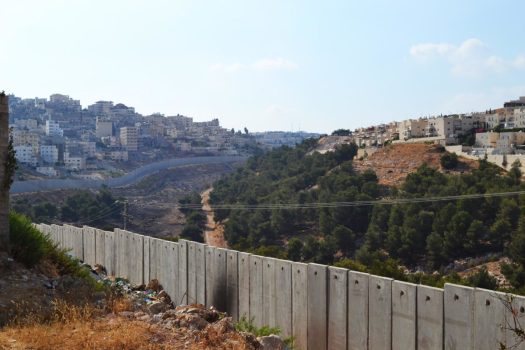
An Israeli settlement sits to the right of Israel’s separation wall in East Jerusalem, diving the Palestinian neighborhood to the left, from other Palestinian neighborhoods in the area. (photo: Eoghan Rice)

The primary political and ethical question is how to create political traction for a secular state shared equally by Israelis and Palestinians.

By Richard Falk | Mondoweiss | Jan 8, 2018


All in all, it seems time to recognize three related conclusions:

  1. The leadership of Israel has rejected the Two-State Solution as the path to conflict resolution;
  2. Israel has created conditions, almost impossible to reverse, that make it totally unrealistic to expect the establishment of an independent Palestinian state;
  3. Trump even more than prior presidents has weighted American diplomacy heavily and visibly in favor of whatever Israel’s leaders seek as the endgame for this struggle of decades between these two peoples.

Despite all appearances to the contrary, those in the West who do not want to join the premature and ill-considered Israeli victory party, are clinging firmly to the Two-State Solution amid calls to renew direct diplomatic negotiations between the parties so as to reach, in the extravagant language of Donald Trump, “the ultimate deal.”

Israel has increasingly indicated by deeds and words, including those of Netanyahu, an unconditional opposition to the establishment of a genuinely independent and sovereign Palestine. The settlement expansion project is accelerating with pledges made by a range of Israel political figures that no settler would ever be ejected from a settlement even if the unlawful dwelling units inhabited by Jews were not located in a settlement bloc that have been conceded as annexable by Israel in the event that agreement is reached on other issues.

Continue reading “Let the two-state solution die a natural death”

Emboldened by Trump, Israelis try redrawing Jerusalem’s boundaries

israel_likud_party_53721-6c7b5
Palestinian laborers work at a construction site in a new housing project in the Israeli settlement of Maale Adumim, near Jerusalem, in Feb 2017. (photo: Oded Balilty / AP)

Israeli leaders are re-engineering Jerusalem’s demographic balance by redrawing the city’s map to exclude Arab neighborhoods and include Israeli settlements.

By Loveday Morris and Ruth Eglash | The Washington Post | Jan 12, 2018


The director of Israeli human rights group B’Tselem [says] there is a battle underway between those who want to continue “smart occupation,” which manages to “fly two inches below international outrage” while incrementally shifting facts on the ground, and those who advocate “dumb occupation” — moving forward with formal annexation.


Since becoming mayor of Maale Adumim more than 20 years ago, Benny Kashriel has doggedly campaigned for his community to be recognized as part of Israel.

Now, with President Trump in the White House, Kashriel thinks it may just happen.

His settlement is around four miles east of Jerusalem in the occupied West Bank. Most of the international community, including the United States, considers its construction to be illegal, built on land captured during the 1967 war.

Still, it has steadily grown from what began as a cluster of prefabricated buildings erected by 23 families in the 1970s into a burgeoning satellite city of Jerusalem. Palm trees line the wide roads of what looks like a Florida suburb. Red-roofed houses and high-rises are home to 42,000 people, who are served by all of the accoutrements of a modern city: schools, restaurants, cafes and a shopping mall.

Continue reading “Emboldened by Trump, Israelis try redrawing Jerusalem’s boundaries”