“It’s What We Do: A Play About the Occupation”

The play, adapted from the testimony of Israeli soldiers, was recently produced in Washington, DC.

By Pam Bailey | Mondoweiss | Feb 6, 2018


This oppression is destructive for everyone: Palestinian civilians obviously suffer daily, and the Israeli soldiers — who are told “your mission is to disrupt lives” — are forced to stop thinking and do what they are ordered to do, even when the must carry out actions that are inhumane. This is called “mind occupation,” and I’m glad that some soldiers have managed to free their minds and break the silence.


This video is a production called “It’s What We Do: A Play About the Occupation,” produced and directed by Pam Nice, a member of the Washington, DC, chapter of Jewish Voice for Peace.

Although it is a drama, the dialogue of the soldiers is adapted from the actual testimonies of Israeli soldiers from Breaking the Silence, whose vivid memories continue to haunt them. The target audience is Jewish viewers. But several We Are Not Numbers writers, who have been “targets” of Israeli soldiers, watched the video, curious to see how far the the soldiers were willing to go in their confessions. It was difficult for many of them to watch, and their reactions varied. But they all agreed the video should be required viewing for people everywhere.

Continue reading ““It’s What We Do: A Play About the Occupation””
Confederation: The one possible Israel-Palestine solution

TO GO WITH AFP STORY BY CHARLES LEVINSON
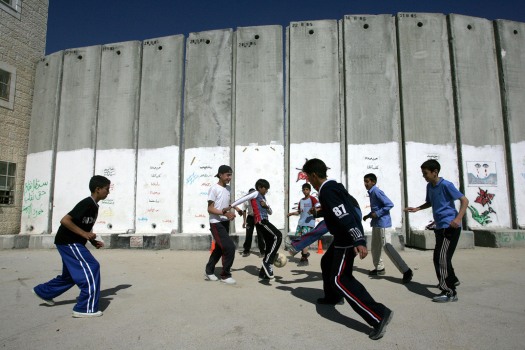
Palestinian boys playing soccer against the backdrop of the Israeli separation barrier that bisects their school playground in East Jerusalem, 2006. (photo: AWAD / AFP / Getty Images)

Talk of confederation sounds wistful in the current environment, but any talk of peace does. What’s really naïve is to suppose that only bad faith or ideological fanaticism has caused the two-state solution to fall into disrepute.

By Bernard Avishai | The New York Review of Books | Feb 2, 2018


The justification for the two-state solution is rooted, after all, in two persistent truths: first, that two separate national communities, each with a different language, historical grievance, sense of identity in the wider world, and dominant religious culture, have been squeezed by tragic events into a single small space. . . . Second, that a majority on each side prefers some form of compromise to a fight to the finish. . . . [But] moderate majorities “increasingly doubt its viability,” largely because they have grown jaded regarding the intentions of the other side, not because, in principle, they refuse the compromises two states would entail.


“The two-state solution is over,” Palestinian negotiator Saeb Erekat told reporters, responding to Donald Trump’s recognition of Jerusalem as Israel’s capital. “Now is the time to transform the struggle for one state with equal rights for everyone living in historic Palestine, from the river to the sea.” As The New York Times subsequently reported, Erekat is hardly alone. The “over”-ness of “two states” — albeit with radical disagreements about the character of a hypothetical single state — has been claimed by ideological zealots, severe liberals, and exasperated peacemakers alike.

On the Palestinian side, one hears about the almost 700,000 Israeli settlers’ making annexation an established fact; on the Israeli side, about preventing recalcitrant Palestinian terrorists from firing missiles at Ben-Gurion Airport. For those of us living in Jerusalem, just speaking of two states, implying two capitals — but also, vaguely, some redivision of the city — invites skeptical, or pitying, stares from most Jews, as well as from Arabs, over a thousand of whom applied for Israeli citizenship in 2016.

Continue reading “Confederation: The one possible Israel-Palestine solution”

Narendra Modi is visiting the Occupied Territories this week — here’s why Palestinians shouldn’t embrace him

anti-trump-protest-7
Modi will visit Ramallah, where there were mass anti-Trump protests after the US recognized Jerusalem as the capital of Israel. (photo: AFP / Getty)

Many will say Modi’s visit to Ramallah is an historic moment, but India buys 41 per cent of total Israeli arms exports.

By Umar Lateef Misgar | The Independent | Feb 7, 2018


India has gradually become Israel’s largest defense customer. According to the Stockholm International Peace Research Institute (SIPRI), between 2012 and 2016, India bought 41 per cent of total Israeli arms exports.


In an interview on Voice of Palestine radio station recently, Majid Khalidi, an adviser to Palestinian President Mahmoud Abbas, announced the visit of India’s Prime Minister Narendra Modi to the occupied Palestinian territories this weekend. Alongside a tour to Yasser Arafat Museum in Ramallah to honour the late Palestinian leader, the Prime Minister is expected to discuss issues related to information technology, tourism and health during this brief stopover on the broader Middle East tour.

Modi’s upcoming visit to Ramallah, a first for an Indian premier, is being hailed as historic by his Palestinian hosts. However, a closer scrutiny of New Delhi’s ties with Israel along with India’s own record of military control in places like Kashmir reveals an entirely different picture.

Continue reading “Narendra Modi is visiting the Occupied Territories this week — here’s why Palestinians shouldn’t embrace him”

Israel demolishes two UN-funded school buildings in Palestinian refugee camp

abu20nuwar
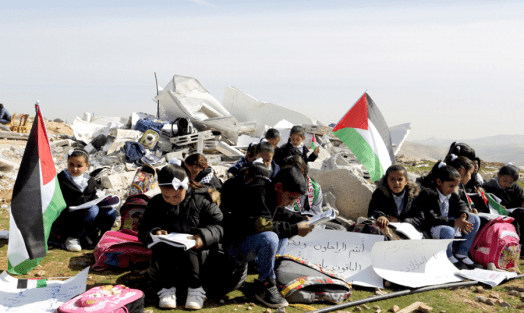
Third and fourth grade Palestinian children studying on the rubble of their classrooms in Abu Nuwar, on Feb 4, 2018. (photo: Tamer Bana / WAFA Images)

This is the sixth demolition or confiscation incident in Abu Nuwar school by the Israeli authorities since February 2016.

By Wafa | Feb 4, 2018


“Abu Nuwar is one of the most vulnerable communities in need of humanitarian assistance in the occupied West Bank. The conditions it faces also represent those of many Palestinian communities, where a combination of Israeli policies and practices — including demolitions and restricted access to basic services, such as education — have created a coercive environment that violates the human rights of residents and generates a risk of forcible transfer.”
— Roberto Valent, United Nations acting Humanitarian Coordinator for the occupied Palestinian territories


United Nations acting Humanitarian Coordinator for the occupied Palestinian territories, Roberto Valent, said on Sunday that he was deeply concerned by Israel’s destruction of donor-funded classrooms in the Palestinian community of Abu Nuwar, east of Jerusalem.

“I am deeply concerned by the Israeli authorities’ demolition this morning of two donor-funded classrooms (3rd and 4th grade), serving 26 Palestinian school children in the Bedouin and refugee community of Abu Nuwar, located in Area C on the outskirts of Jerusalem,” Valent said in a statement. “The demolition was carried out on grounds of lack of Israeli-issued permits, which are nearly impossible to obtain.”

Continue reading “Israel demolishes two UN-funded school buildings in Palestinian refugee camp”

Between Poland’s Holocaust revisionism and Israel’s Nakba denial

.
The Auschwitz-Birkenau Concentration Camp in Poland. (photo: Isaac Harari / Flash90)

Poland’s attempt to scrub clean its role in the murder of European Jewry is, at its core, no different from Israel’s attempt to erase the catastrophe that befell the Palestinians in 1948.

By Haneen Zoabi | +972 Blog | Jan 28, 2018


The new [Polish] law, which criminalizes any researcher who dares publish the truth [about Polish involvement in the Holocaust], is an attempt at historical revisionism. . . . So how is this law any different from the [Israeli] Nakba Law, which would withhold state funds from cultural and educational institutions that commemorate the horrors that befell the Palestinians in 1948?


The responses coming from Israel to the new Polish law, which forbids discussing war crimes committed by the Polish people during the holocaust, are nothing if not paradoxical. While the Israeli establishment, from the Right to the Left, denies the identity, history, and catastrophe of the Palestinian people, it reprimands those who deny responsibility for the fate of the Jews during the Holocaust.

 The Holocaust, a monstrous, well-planned genocide, was possible not only because of the Nazis’ nightmarishly meticulous implementation, but also because those who stood aside as it was happening. The Germans had willing accomplices, including many Poles, who took an active part in the persecution and murder. The history books talk about the “hunt for the Jews,” which led to the murder of hundreds of thousands of Jews, both directly and indirectly, during the Second World War.

Continue reading “Between Poland’s Holocaust revisionism and Israel’s Nakba denial”

You don’t need Jewish values to denounce Israel’s treatment of asylum seekers

gettyimages-908744180-1517954239
African asylum seekers protest outside Rwandan embassy in Herzliya. (photo: AFP)

When it comes to both asylum seekers and West Bank Palestinians, we don’t need a higher, Jewish standard. Simply asking Israel to abide by International Law is radical enough.

By Peter Beinart | Forward | Feb 7, 2018


In 2015 . . . less than two percent of Sudanese asylum requests had even received a government response. Not a single one had been approved. Of the more than 2,400 Eritreans who requested asylum, the Israeli government granted it to four.


Last week, Isabel Kershner, The New York Times’ estimable Israel correspondent, wrote an article about the Netanyahu government’s decision to either expel Eritrean and Sudanese asylum seekers to third countries or indefinitely lock them up. The article ran under the headline, “Israel Moves to Expel Africans. Critics Say That’s Not Jewish.”

“Like much of the Western world, Israel is grappling with how to balance its right to protect its borders and prevent illegal immigration with showing compassion and humanity,” writes Kershner. “But the government’s decision has struck a particular chord here and among Jews abroad since the modern state of Israel has served as a safe haven for Jews fleeing persecution.”

Kershner goes on to say that many Jews believe the government’s decision violates “Jewish values.” She suggests that “Even secular Israelis have taken to citing biblical verses like Leviticus 19:34: ‘The stranger who resides among you shall be to you as one of your citizens; you shall love him as yourself, for you were strangers in the land of Egypt.’”

There’s a danger here. Continue reading “You don’t need Jewish values to denounce Israel’s treatment of asylum seekers”

Israel holds international anti-BDS conference

2-16_4_1-bds-rally24522049300_5d080fac2c_o
BDS rally at McGill University, Toronto, in 2016 (photo: Sonia Ionescu / Creative Commons)

Israeli Ministry of Strategic Affairs leading anti-BDS efforts.

By Middle East Monitor | Feb 6, 2018


Participants were briefed about “effective methods used to pass legislation in 24 states across the US, France, Germany and elsewhere” and “gained tools and best-practices, while streamlining their tactics against efforts to ostracize the Jewish state.”


The Israeli government yesterday held an international legal conference against the Boycott, Divest and Sanctions (BDS) movement, Quds Press reported.

The news site reported Israeli media saying that the Ministry of Strategic Affairs organised the conference in cooperation with the Israeli Bar Association and the International Judicial Institute.

Israeli media said that 200 legal experts from 24 countries were invited to the conference to develop strategies “to contain the growing influence of the movement.”

According to Quds Press, Israeli Strategic Affairs Minister Gilad Erdan, Justice Minister Ayelet Shaked, Supreme Court Chief Justice Esther Hayut, Knesset Speaker Yuli Edelstein and head of the opposition Isaac Herzog were in attendance.

Continue reading “Israel holds international anti-BDS conference”

Israel issuing deportation notices to asylum seekers

1-5788342-1251868428
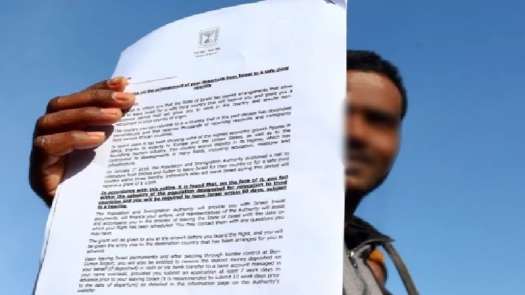
An asylum seeker holding up a deportation notice on Feb 4, 2018. (photo: Meged Gozani / Haaretz)

The first round of notices to about 20,000 people asylum seekers from Eritrea and Sudan.

By Ilan Lior | Haaretz | Feb 4, 2018


“I don’t want to go to Rwanda. I’m from Eritrea, and I don’t want to return to Eritrea. I’m going to jail, without fear.”
— Dabsai, a 47-year-old Eritrean resident of Netanya


The Population, Immigration and Border Authority will begin issuing deportation notices on Sunday to asylum seekers from Eritrea and Sudan who are not held in the Holot detention facility.

In the first stage the notices will be issued to men without children who come to renew their residence visa. Citizens of Eritrea and Sudan are required to renew their visas every two months at the authority’s office in Bnei Brak. They will receive their last two-month visa, along with a letter stating that during this period they are expected to leave the country, otherwise they will be forbidden to work and can expect to be incarcerated indefinitely. Authority personnel will suggest that they leave for either Rwanda or their native countries. . . .

Continue reading “Israel issuing deportation notices to asylum seekers”

Israel deports 14-year-old girl to Gaza, without telling her parents

erez
An electric cart provides transportation through the 900-meter caged terminal spanning the restricted access zone at the Erez border crossing between Israel and the Gaza Strip, Jul 2, 2012. (photo: Ryan Rodrick Beiler / Activestills.org)

Ghada had spent her entire life in the West Bank, yet somehow found herself deported to the Gaza Strip after being arrested by Border Police officers.

By Edo Konrad | +972 Magazine | Jan 31, 2018


“It should be noted that the girl and her father are illegal immigrants in Israel, and therefore she was sent to Erez Crossing . . . entered the Gaza Strip.”
— Israel Prison Service statement


Israeli authorities deported a 14-year-old epileptic Palestinian girl from the West Bank to the Gaza Strip earlier this month, without notifying her parents, and despite the fact that she has never lived there a day in her life.

Ghada, who was born in Ramallah where she has lived much of her life, was arrested by Israeli Border Police officers on January 13 for being in Jerusalem without a military permit. She was traveling back to her home in a-Ram, just northeast of Jerusalem where she lives with her mother and siblings, from her aunt’s home in the East Jerusalem neighborhood of Issawiya.

Her father, though originally from the Gaza Strip, currently lives in the West Bank as well, her mother told Israeli human rights group HaMoked, which is representing the family. When Ghada was born, Israeli authorities listed her address as Gaza for an unknown reason.

Continue reading “Israel deports 14-year-old girl to Gaza, without telling her parents”

As long as occupation exists, soldiers will continue to speak out

.
Palestinians clash with Israeli soldiers in Al-Fawwar refugee camp, south of the West Bank city of Hebron, Dec 31, 2017. (photo: Wisam Hashlamoun / Flash90)

We must make our voices heard sharply and clearly — speaking out is not merely an option, it is a moral duty.

By Avner Gvaryahu | +972 Blog | Jan 26, 2018


It [is] important to remind the Israeli public why soldiers continue to break their silence. After all, the central reason for breaking the silence is the occupation. As long as there is an occupation, there will be those who choose to expose what the government is trying so hard to hide.


Like many who served alongside me, I preferred to remain silent. I preferred to forget, not to speak about the Palestinian homes I broke into in the middle of the night, forgetting the violence I carried out at checkpoints and the passivity required of me when settlers freely broke the law. When I was released from the army, I preferred to repress those three years, to put them behind me.

Only after I joined a Breaking the Silence tour to the South Hebron Hills did my eyes open. Only then, I chose to speak. That is how I learned that I wasn’t alone. I learned there are others like me — soldiers who see the situation the same way and choose to take responsibility and change the way they and their society, our society, talk about the occupation.

Continue reading “As long as occupation exists, soldiers will continue to speak out”