“The announcement from Honda that the motor race it sponsors will no longer take place in an illegal Israeli settlement shows the BDS movement’s growing impact on international corporations that are complicit in Israel’s regime of occupation, colonization, and apartheid.”
— Jamal Juma, a member of the Palestinian BDS National Committee
After international pressure from the Boycott, Divestment, and Sanctions (BDS) Movement, Honda has decided to move a motorcycle racing show from an illegal Israeli settlement in the West Bank.
Honda’s distributor in Israel had launched plans to hold the MotoGP event on a race track partially built inside of a “live firing zone” near the Petza’el Israeli settlement.
The BDS movement and other Japanese human rights organizations wrote an open letter to Honda asking to them reconsider the Israeli chapter’s decision to carry out the event at such a controversial site where the violation of the human rights continues to take place and warned them that they could face an international boycott.
Shupak ably illustrates Israel’s usefulness in complementing US bellicosity and furthering imperial designs in not only the Middle East but also the wider world, describing Israel as a “garrison for US-led imperialist capitalism” as well as a convenient venue “for the US to subsidize America’s military industry” via gargantuan military aid and weapons deals.
In 1988, his final year of service as New York Times Jerusalem bureau chief before being appointed diplomatic correspondent in Washington, Thomas Friedman gave an interview to the Israeli newspaper Yediot Ahronot, in which he proposed some symbolic concessions to the Palestinians in order to keep them in line.
The Palestinians must be given “something to lose,” argued Friedman, because “I believe that as soon as Ahmed has a seat in the bus, he will limit his demands.”
Writing shortly thereafter, Noam Chomsky wondered whether a prominent journalist might also be promoted to the post of chief diplomatic correspondent by “urg[ing] South Africans to ‘give Sambo a seat in the bus,’ or propos[ing] that Jews be granted something to lose, because ‘if you give Hymie a seat in the bus, he may limit his demands.’”
Do you want to better understand the Israeli-Palestinian conflict? Do you wonder if there’s a role for Christians to play in this long-running and often violent dispute?
Date:
Saturday, Feb 24, 2018
Time:
9:30 – 11:00 am
Location:
Bellevue Presbyterian Church, Room S-140
1717 Bellevue Way NE
Bellevue, WA 98004
Join us to hear about the Bellevue Presbyterian Church trip to Israel this November that explores the Biblical themes of reconciliation and social justice. Much of our time will be spent with Israeli and Palestinian guides and guests. We’ll listen to them share their stories with the hope we can glimpse what stands in the way of peace and reconciliation to the Holy Land. We will also visit the holy sites of Jerusalem and the places where Jesus spent time around Galilee.
Through a diverse array of tour guides and speakers — Israeli and Palestinian, Christian, Jewish, and Muslim, political, religious and tribal leaders, policymakers, peace builders, grassroots activists, artists, journalists, musicians, writers, and many more — this trip provides rare cultural immersion for travelers of all backgrounds and perspectives.
After my father died in Jordan in October, it was so important for me to visit my extended family in the city of Jenin, to mourn his death with them. Unfortunately, I was prevented from doing so by the Israeli government.
Whether or not the Israeli government agrees with my work — and, of course, I know it doesn’t — I still should have been able to take part in those most human of activities: mourning my father and celebrating his life.
My father, Azzam Jarrar, died last month. He was a proud Palestinian, a refugee, a civil engineer, a farmer and an entrepreneur. He was also my friend and mentor. He taught me the multiplication tables on our way to school in Saudi Arabia. He taught me how to question authority when we lived in Iraq. He helped me finish my master’s degree when I lived in Jordan. Above all, though, he was the gateway to my Palestinian roots and identity.
My dad fled his home with his family in 1967, when Israeli soldiers invaded and occupied the West Bank. He went first to Jordan and then to Iraq, where I was born. I was the first Jarrar to be born east of the Jordan River since our family was established on Palestinian land centuries ago.
Do you want to better understand the Israeli-Palestinian conflict? Do you wonder if there’s a role for Christians to play in this long-running and often violent dispute?
Date:
Saturday, Feb 24, 2018
Time:
9:30 – 11:00 am
Location:
Bellevue Presbyterian Church, Room S-140
1717 Bellevue Way NE
Bellevue, WA 98004
Join us to hear about the Bellevue Presbyterian Church trip to Israel this November that explores the Biblical themes of reconciliation and social justice. Much of our time will be spent with Israeli and Palestinian guides and guests. We’ll listen to them share their stories with the hope we can glimpse what stands in the way of peace and reconciliation to the Holy Land. We will also visit the holy sites of Jerusalem and the places where Jesus spent time around Galilee.
Through a diverse array of tour guides and speakers — Israeli and Palestinian, Christian, Jewish, and Muslim, political, religious and tribal leaders, policymakers, peace builders, grassroots activists, artists, journalists, musicians, writers, and many more — this trip provides rare cultural immersion for travelers of all backgrounds and perspectives.
“[The Prime Minister is] up to his neck in investigations. He does not have a public or moral mandate to determine such fateful matters for the state of Israel when there is the fear, and I have to say it is real and not without basis, that he will make decisions based on his personal interest in political survival and not based on the national interest.”
— Benjamin Netanyahu, speaking about former Israeli Prime Minister Ehud Olmert, who was forced to resign in 2008
The Israeli police recommended on Tuesday that Prime Minister Benjamin Netanyahu be charged with bribery, fraud and breach of trust, casting a pall over the future of a tenacious leader who has become almost synonymous with his country. The announcement instantly raised doubts about his ability to stay in office.
Concluding a yearlong graft investigation, the police recommended that Mr. Netanyahu face prosecution in two corruption cases: a gifts-for-favors affair known as Case 1000, and a second scandal, called Case 2000, in which Mr. Netanyahu is suspected of back-room dealings with Arnon Mozes, publisher of the popular newspaper Yediot Aharonot, to ensure more favorable coverage.
Do you want to better understand the Israeli-Palestinian conflict? Do you wonder if there’s a role for Christians to play in this long-running and often violent dispute?
Date:
Saturday, Feb 24, 2018
Time:
9:30 – 11:00 am
Location:
Bellevue Presbyterian Church, Room S-140
1717 Bellevue Way NE
Bellevue, WA 98004
Join us to hear about the Bellevue Presbyterian Church trip to Israel this November that explores the Biblical themes of reconciliation and social justice. Much of our time will be spent with Israeli and Palestinian guides and guests. We’ll listen to them share their stories with the hope we can glimpse what stands in the way of peace and reconciliation to the Holy Land. We will also visit the holy sites of Jerusalem and the places where Jesus spent time around Galilee.
Through a diverse array of tour guides and speakers — Israeli and Palestinian, Christian, Jewish, and Muslim, political, religious and tribal leaders, policymakers, peace builders, grassroots activists, artists, journalists, musicians, writers, and many more — this trip provides rare cultural immersion for travelers of all backgrounds and perspectives.
The Israeli government needs the “new anti-Semitism” to justify its actions and to protect it from international and domestic condemnation. Anti-Semitism is effectively weaponized, not only to stifle speech — “It does not matter if the accusation is true.” . . . [Its] purpose is “to cause pain, to produce shame, and to reduce the accused to silence” — but also to suppress a politics of liberation.
Not long after the eruption of the Second Intifada in September 2000, I became active in a Jewish-Palestinian political movement called Ta’ayush, which conducts non-violent direct action against Israel’s military siege of the West Bank and Gaza. Its objective isn’t merely to protest against Israel’s violation of human rights but to join the Palestinian people in their struggle for self-determination. For a number of years, I spent most weekends with Ta’ayush in the West Bank; during the week I would write about our activities for the local and international press.
My pieces caught the eye of a professor from Haifa University, who wrote a series of articles accusing me first of being a traitor and a supporter of terrorism, then later a “Judenrat wannabe” and an anti-Semite. The charges began to circulate on right-wing websites; I received death threats and scores of hate messages by email; administrators at my university received letters, some from big donors, demanding that I be fired.
I mention this personal experience because although people within Israel and abroad have expressed concern for my wellbeing and offered their support, my feeling is that in their genuine alarm about my safety, they have missed something very important about the charge of the ‘new anti-Semitism’ and whom, ultimately, its target is.
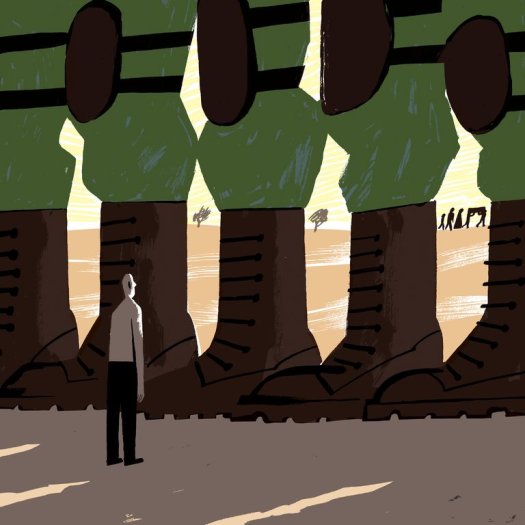
This oppression is destructive for everyone: Palestinian civilians obviously suffer daily, and the Israeli soldiers — who are told “your mission is to disrupt lives” — are forced to stop thinking and do what they are ordered to do, even when the must carry out actions that are inhumane. This is called “mind occupation,” and I’m glad that some soldiers have managed to free their minds and break the silence.
This video is a production called “It’s What We Do: A Play About the Occupation,” produced and directed by Pam Nice, a member of the Washington, DC, chapter of Jewish Voice for Peace.
Although it is a drama, the dialogue of the soldiers is adapted from the actual testimonies of Israeli soldiers from Breaking the Silence, whose vivid memories continue to haunt them. The target audience is Jewish viewers. But several We Are Not Numbers writers, who have been “targets” of Israeli soldiers, watched the video, curious to see how far the the soldiers were willing to go in their confessions. It was difficult for many of them to watch, and their reactions varied. But they all agreed the video should be required viewing for people everywhere.
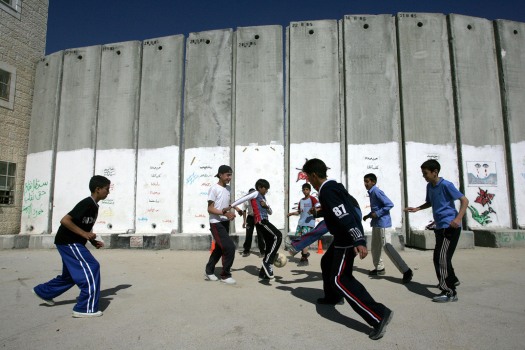
Palestinian boys playing soccer against the backdrop of the Israeli separation barrier that bisects their school playground in East Jerusalem, 2006. (photo: AWAD / AFP / Getty Images)
Talk of confederation sounds wistful in the current environment, but any talk of peace does. What’s really naïve is to suppose that only bad faith or ideological fanaticism has caused the two-state solution to fall into disrepute.
The justification for the two-state solution is rooted, after all, in two persistent truths: first, that two separate national communities, each with a different language, historical grievance, sense of identity in the wider world, and dominant religious culture, have been squeezed by tragic events into a single small space. . . . Second, that a majority on each side prefers some form of compromise to a fight to the finish. . . . [But] moderate majorities “increasingly doubt its viability,” largely because they have grown jaded regarding the intentions of the other side, not because, in principle, they refuse the compromises two states would entail.
“The two-state solution is over,” Palestinian negotiator Saeb Erekat told reporters, responding to Donald Trump’s recognition of Jerusalem as Israel’s capital. “Now is the time to transform the struggle for one state with equal rights for everyone living in historic Palestine, from the river to the sea.” As The New York Times subsequently reported, Erekat is hardly alone. The “over”-ness of “two states” — albeit with radical disagreements about the character of a hypothetical single state — has been claimed by ideological zealots, severe liberals, and exasperated peacemakers alike.
On the Palestinian side, one hears about the almost 700,000 Israeli settlers’ making annexation an established fact; on the Israeli side, about preventing recalcitrant Palestinian terrorists from firing missiles at Ben-Gurion Airport. For those of us living in Jerusalem, just speaking of two states, implying two capitals — but also, vaguely, some redivision of the city — invites skeptical, or pitying, stares from most Jews, as well as from Arabs, over a thousand of whom applied for Israeli citizenship in 2016.



 HolyLandJustice.org
You must be logged in to post a comment.