Palestinians blast Trump’s aid cut as political blackmail

Aid being given out at a United Nations food distribution center in a refugee camp in the northern Gaza Strip this month. (photo: Mahmud Hams / Agence France-Presse / Getty Images)
This is the second cut in humanitarian aid this year, now totalling almost $300 million for food, medicine, and schools.

By Isabel Kershner | The New York Times | Aug 25, 2018

“This administration is dismantling decades of US vision and engagement in Palestine. This is another confirmation of abandoning the two-state solution and fully embracing Netanyahu’s anti-peace agenda. Weaponizing humanitarian and developmental aid as political blackmail does not work.”
— Husam Zomlot, the head of the PLO’s general delegation to the United States

“This decision represents a terrible decision by Trump’s team, which seems to think it will put pressure on the Palestinians to come to the table (it won’t).”
— Daniel Shapiro, former US ambassador to Israel

Palestinian officials denounced the Trump administration’s cancellation of more than $200 million in aid, accusing Washington of “weaponizing” humanitarian assistance by using it as a tool to coerce political concessions.

The aid cut, announced Friday, was the latest in a series of measures apparently aimed at forcing the Palestinian leadership to return to the negotiating table with Israel while American officials work on a long-awaited peace proposal, the details of which remain opaque.

Continue reading “Palestinians blast Trump’s aid cut as political blackmail”
Meet the owner of Canary Mission’s anonymous anti-Palestinian blacklisting website

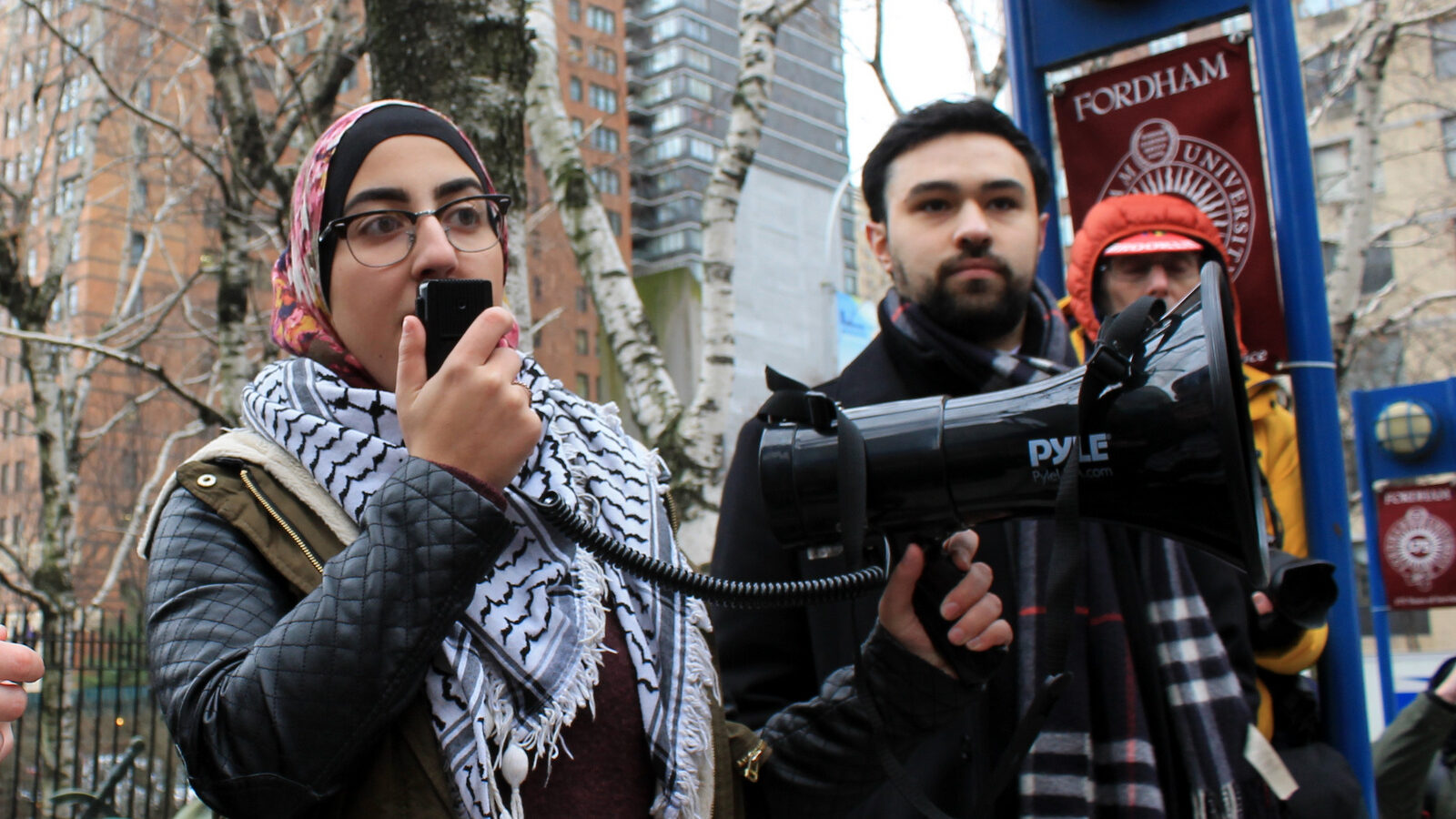
Students and supporters protest Fordham University’s ban on Students for Justice in Palestine, a student group which advocates the rights of Palestinians. (photo: Joe Catron / MintPress)
Canary Mission has exploited its anonymity to smear college students and faculty with impunity.

By Hamzah Raza and Max Blumenthal | Grayzone Project | Aug 22, 2018

The Sterling-owned website contains profiles of nearly 2000 students and over 500 college professors considered enemies of Israel.

Since it first registered its website in February 2015, Canary Mission has been a source of mystery and menace. Dedicated to blacklisting students involved in Palestine solidarity activism, intimidating them and denigrating their public reputations, Canary Mission’s administrators have gone to great lengths to conceal their identities. The secrecy has enabled them to target legally defenseless students – who are mostly members of minority and immigrant groups — with total impunity.

Now, the Grayzone can identify a key figure behind the malicious blacklisting operation. He is the owner of Canary Mission’s domain name and a wealthy lawyer who is a fervent supporter of Israel. According to documents provided to the Grayzone, his name is Howard David Sterling.

Continue reading “Meet the owner of Canary Mission’s anonymous anti-Palestinian blacklisting website”

“Silence Is health” — How totalitarianism arrives

A woman trying to prevent the detention of a young man arrested by police at a protest rally against Argentina’s military dictatorship, Buenos Aires, Mar 30, 1982. (photo: Horacio Villalobos / Corbis via Getty Images)
As a journalist, I witnessed first the erosion and then the total collapse of democratic norms, and how a ruthless autocracy can mobilize popular fears and resentments to crush its opponents.

By Uki Goñi | The New York Review of Books | Aug 20, 2018

A society that separates children from their parents, for whatever reason, is a society that is already on the path to totalitarianism.

The white supremacists chanting “blood and soil” as they marched through the streets of Charlottesville, Virginia, last year were probably unaware that the leading Nazi ideologue who used the original slogan of Blut und Boden to promote the creation of a German master race was not himself a native German. Richard Walther Darré, who proclaimed the existence of a mystic bond between the German homeland and “racially pure” Germans, was actually born “Ricardo” on the other side of the Atlantic, in Argentina’s prosperous capital, Buenos Aires.

Sent by his German immigrant family to the Heimat for schooling at the age of nine, Darré later specialized in agriculture, the logical choice for someone with an Argentine background at a time when the succulent beef and abundant wheat of Argentina’s pampas made the country renowned as the “breadbasket of the world.” For a while, during the 1920’s, he contemplated returning to Buenos Aires to pursue a career in farming, but that was before his writing caught the attention of Adolf Hitler’s rising Nazi Party. His 1930 book A New Nobility of Blood and Soil, in which he proposed applying selective cattle-breeding methods for the procreation of perfect Aryan humans, dazzled the Führer.

Continue reading ““Silence Is health” — How totalitarianism arrives”

UN Secretary General proposes armed peacekeeping force to protect Palestinians in Gaza

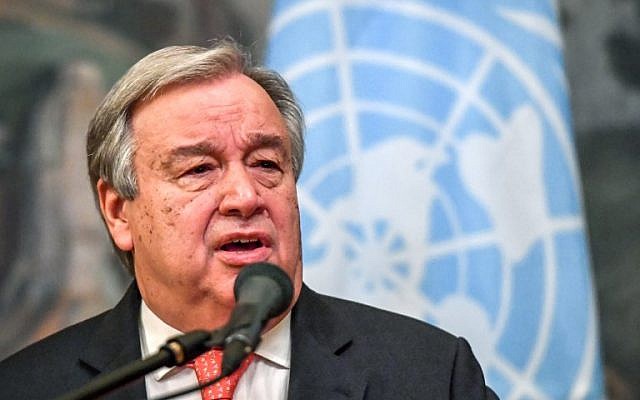
UN Secretary General Antonio Guterres speaks during a press conference , Jun 21, 2018. (photo: Yuri Kadobnov / AFP)

Armed international mission among options floated by Guterres in response to General Assembly request for report on Gaza border clashes.

By Staff | The Times of Israel | Aug 18, 2018


“The targeting of civilians, particularly children, is unacceptable,” Guterres said in the report, adding that “those responsible for violations of international humanitarian law must be held accountable.”
— UN Secretary General Antonia Guterres


United Nations Secretary-General Antonio Guterres on Friday presented four options aimed at boosting the protection of Palestinians in the West Bank and Gaza Strip, from sending UN rights monitors and unarmed observers to deploying a military or police force under UN mandate.

The proposals were contained in a report requested by the General Assembly in response to a surge of violence in Gaza, where 171 Palestinians have been killed during Hamas-led clashes with Israeli troops since late March. Dozens of the dead were members of Hamas and other terror groups, Hamas has acknowledged.

The UN chief stressed that for each of the options, cooperation by Israel and the Palestinians would be necessary. It remained unlikely however that Israel would agree to the proposals . . . .

Continue reading “UN Secretary General proposes armed peacekeeping force to protect Palestinians in Gaza”

Trump to Jordanian king: Israel will have a PM named “Mohammed” in one-state solution

Jordan’s King Abdullah II and US First Lady Melania Trump listen while President Donald Trump makes a statement for the press before a meeting in the Oval Office of the White House, Jun 25, 2018. (photo: Brendan Smialowski / AFP)

Israel’s Channel 10 claims the US president made the prediction half-jokingly after Abdullah warned that many young Palestinians now want “one state with equal rights.”

By Staff | The Times of Israel | Aug 19, 2018


“I want to advance a peace agreement in the Middle East, because if my administration cannot achieve a deal, no administration will be able to.”
— US President Donald Trump


US President Donald Trump reportedly told Jordan’s King Abdullah II at the White House a few weeks ago that, in the absence of a negotiated solution to the Israeli-Palestinian conflict, Israel will have a prime minister named Mohammed in a few years time.

Trump’s reported remark was detailed on Sunday night by Israel’s Channel 10 news, which described it as “sarcastic” and “semi-jocular,” but also as containing a grain of truth. The TV channel said its report had been confirmed by an Israeli and a former US official who had both been briefed on the White House meeting, but that the White House and the Jordanian Embassy in Washington, DC, have refused to comment on it.

Continue reading “Trump to Jordanian king: Israel will have a PM named “Mohammed” in one-state solution”

Uri Avnery: A prophet in his own city

Uri Avnery in his home. (photo: Daniel Bar-On / Haaretz)

Like the biblical prophets of Israel, Avnery saw beyond the immediate; like them, he was persecuted and like them, few listened to him.

By Editorial Board | Haaretz | Aug 21, 2018


“Life goes on. The struggle continues. Tomorrow is a new day.”
— Uri Avnery


It’s customary to claim that the cemeteries are full of irreplaceable people. But the body of Uri Avnery, who died Monday at the age of 94, will not be buried in a cemetery, as per his request, and he is indeed an irreplaceable personality. No substitute has yet emerged for this man, whose life was long and full of struggles and achievements. The Israeli left, which is at a low point in its history, is now even more orphaned than before.

It’s hard to think of an Israeli biography richer and more complex than his: The child of German immigrants who joined the Irgun and in 1948 fought in the Shimshon Foxes elite unit. The legendary editor of Haolam Hazeh, which was a pioneer in aggressive investigative journalism in Israel, a mentor to generations of journalists who has left his mark to this day. The journalist, MK and citizen who fought corruption, religious coercion, ethnic discrimination and crony capitalism long before others did. And of course, the eternal warrior for peace between Israel and the Palestinian people, one of the pioneering visionaries of the two-state solution, an Israeli and Zionist patriot, optimistic and hopeful until his final days.

Continue reading “Uri Avnery: A prophet in his own city”

Uri Avnery, Israeli journalist and peace activist, is dead at 94

Uri Avnery, fourth from the left, in 2003 alongside Yasir Arafat and others at Mr. Arafat’s compound in the West Bank city of Ramallah. (photo: Jamal Aruri / Agence France-Presse / Getty Images)

Avnery was one of the first Israelis to actively seek a Palestinian state as a peaceful solution to the conflict.

By Isabel Kershner | The New York Times | Aug 20, 2018


“What in my eyes is the great success is that I and my friends raised for the first time the principle that there is a Palestinian people with whom we have to make peace at the end of the 1948 war. I don’t think there were 10 people in the world that believed in this. Today it is a world consensus.”
— Uri Avnery


Uri Avnery, a firebrand Israeli journalist, politician and peace activist who riled the establishment by exposing national scandals and conferring with Yasir Arafat, the father of the Palestinian cause, long before that was legal or fashionable for Israelis, died on Monday in Tel Aviv. He was 94.

His death was confirmed by the Sourasky Medical Center in Tel Aviv, his hometown, where he was admitted two weeks earlier after suffering a stroke.

An unwavering and acerbic critic of the government and a disrupter of the reigning national consensus, Mr. Avnery wrote regular opinion pieces for the liberal newspaper Haaretz up until he was hospitalized.

Continue reading “Uri Avnery, Israeli journalist and peace activist, is dead at 94”

De-Arabizing Jerusalem: Biblical “history” underwrites ethnic cleansing

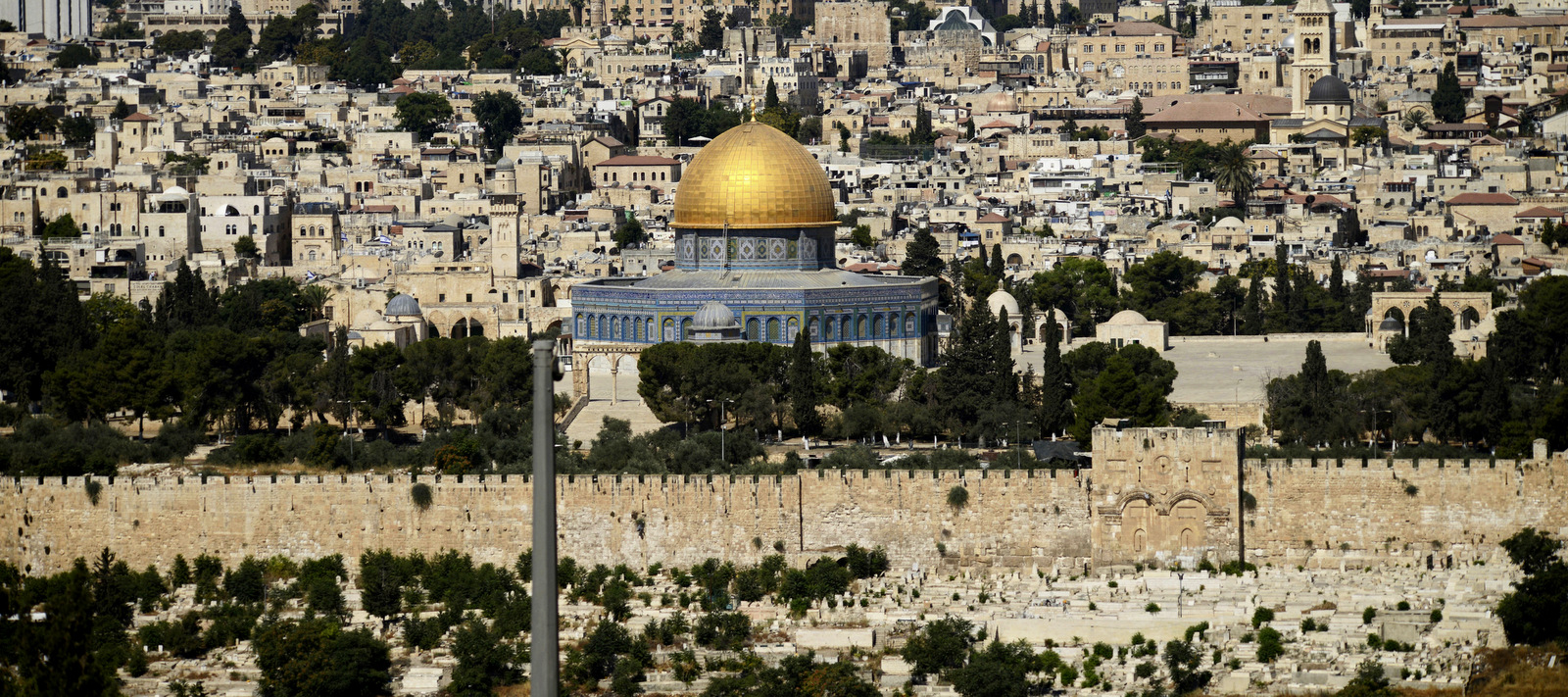
The Dome of the Rock Mosque in the Al Aqsa Mosque compound is seen in Jerusalem’s Old City, Jul 15, 2017. (photo: Mahmoud Illean / AP)
For seven decades Israel has been engaged in ethnic cleansing, threaten the City of Jerusalem with losing its heritage forever.

By Miko Peled | Mint Press News | Aug 20, 2018


“If you pay attention you will see: the tour guides tell their groups not to buy from the Arabs. So there is no business.”
— A shopkeeper in the Old City of Jerusalem


It is 2:30 pm on a weekday in Jerusalem’s Old City, and one would expect the stores and restaurants to be open and busy. Standing near one of the first stations along the Via Dolorosa, the final path Jesus took as he carried his cross to his own crucifixion, I was looking around me and Abu-Shkri restaurant was closing, as were some of the t-shirt and souvenir stores. I turned to one of the shopkeepers and asked him why they were closing so early. “No business,” he replied.

This seemed like an odd thing to say as the street was full of tourists. There were some tourists walking in groups and others walking in pairs or alone. “There are thousands of people here,” I said to him. “Yes, but they don’t stop to shop, not even to look or ask for prices.” He was right. Not a single tourist was stopping. “Look,” he continued after he noticed I continued to stand there, “if you pay attention you will see: the tour guides tell their groups not to buy from the Arabs. So there is no business.”

Continue reading “De-Arabizing Jerusalem: Biblical “history” underwrites ethnic cleansing”

Why we continue to march in Gaza

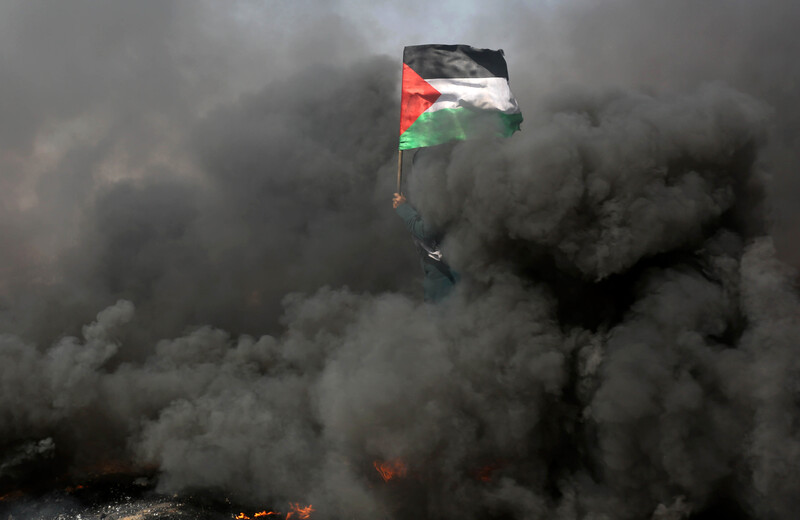
A protestor waves the Palestinian flag during the Great March of Return March near Khan Younis on May 11. (photo: Ashraf Amra / APA Images)
A young man’s a blog posting from Gaza.

By Abdalrahim Alfarra | Electronic Intifada | Aug 17, 2018


Ali requires further surgery. He is still hoping to move his legs again. He is still hoping to defy the treacherous bullet fired by a heartless sniper, and a world that answers Israel’s crimes with shocking silence.


I was sitting behind my desk in my family’s supermarket in Khan Younis on 14 May when my cousin Ali approached. There was going to be another gathering in al-Faraheen for that day’s Great March of Return protest, he said. Would I join him?

“No, I prefer the one in Khuzaa where we usually go,” I said.

Ali insisted to go to al-Faraheen and decided he would do so with his friend Saed. He stayed with me until I closed the shop and we went our separate ways. I called my friend Ahmad to go to Khuzaa.

At the protest, we found the usual: tear gas canisters falling thickly, leaving us barely able to breathe or talk; ambulances and paramedics fanning out everywhere; and the sound of live bullets whizzing past. The sound of a bullet elicits contradictory feelings. All of us know that it will hit someone. But if we hear it, we are safe, just like when we hear shelling it means it has exploded but not on us.

Continue reading “Why we continue to march in Gaza”

Faith floods the desert

(photo: Tucson Sentinel)
A response to the refugee crisis on the US-Mexican border.

By Rabbi Brant Rosen | Shalom Rav | Aug 3, 2018


According to the Torah, God provided for the needs of those who journeyed through the wilderness. The lesson this teaches us in our current political moment is all too obvious: the provision of humanitarian aid is divine work. Those who stand up to systems of state violence are not criminals — they are following a sacred imperative at the very heart of the Exodus story.


This weekend, I’ll be joining 60 faith leaders from around the country in southern Arizona to witness and respond to the suffering on our border though “Faith Floods the Desert” — a collaboration between No More Deaths/No Más Muertes, the Unitarian Universalist Service Committee, and the Unitarian Universalist Association. Representing communities of many faiths and denominations, we’re going to stand in solidarity with humanitarian aid workers and local residents by walking into the desert and leaving gallons of water along heavily-frequented migrant trails.

No More Deaths/No Más Muertes — a humanitarian organization based in southern Arizona — has documented how border enforcement pushes migration routes into some of the most remote, dangerous areas in Arizona’s deserts. As violence and hardship grow in parts of Latin America — in direct response to US foreign policy — and as pathways to asylum and other relief are cut off, growing numbers of people are crossing the border to reunite with their families and seek safety.

Continue reading “Faith floods the desert”