What Part of bombing a kindergarten is OK?

A man holds shrapnel from mortar shells fired from the Gaza Strip that landed near a kindergarten, in a Kibbutz on the Israeli side of the Israeli-Gaza border, May 29, 2018. (photo: Amir Cohen / Reuters)

Collective punishment is immoral. Period. Whether it’s rockets or the siege, whether the targets Israelis or Gazans.

By Bradley Burston | Haaretz | May 30, 2018


Collective punishment is immoral no matter who carries it out. Us or them. It’s immoral no matter what form it takes, indiscriminate shelling or gratuitously injurious siege, terrorism or oppression. No matter the justification.


What part of bombing a kindergarten is OK?

Don’t answer right away. Take a moment.

This week, when a mortar shell fired from Gaza slammed into the yard of a border-area Israeli kindergarten just before the children and staff were to arrive, the answers to the question came fast and furious.

“When Israel is bombing and killing people in Gaza on a daily basis, what do you expect?” a twitter user wrote in response to EU envoy Emanuele Giaufret’s condemnation of the shelling.

Among other answers: The Israeli kindergarten is reinforced against attack, as opposed to the much more vulnerable construction of Gaza schools, one of which was hit by an Israeli attack later in the day. Or, the rockets and mortars fired at Israel by Hamas, the Islamic Jihad and others in Gaza are largely ineffectual weapons, as opposed to the deadly, state of the art munitions employed by Israel.

Continue reading “What Part of bombing a kindergarten is OK?”

Confessions of an Israeli traitor

A Palestinian argues with Israeli policemen during clashes in the West Bank city of Hebron, Oct 2015. (photo: Abed al Hashlamoun / EPA)

The internal discussion in Israel is more militant, threatening and intolerant than it has ever been.

By Assaf Gavron | The Washington Post | Oct 23, 2015


No matter how many soldiers we put in the West Bank, or how many houses of terrorists we blow up, or how many stone-throwers we arrest, we don’t have any sense of security; meanwhile, we have become diplomatically isolated, perceived around the world (sometimes correctly) as executioners, liars, racists. As long as the occupation lasts, we are the more powerful side, so we call the shots, and we cannot go on blaming others. For our own sake, for our sanity — we must stop now.


I was an Israel Defense Forces soldier in Gaza 27 years ago, during the first intifada. We patrolled the city and the villages and the refugee camps and encountered angry teenagers throwing stones at us. We responded with tear gas and rubber bullets.

Now those seem like the good old days.

Since then, the conflict between Israelis and Palestinians has seen stones replaced with guns and suicide bombs, then rockets and highly trained militias, and now, in the past month, kitchen knives, screwdrivers and other improvised weapons. Some of these low-tech efforts have been horrifically successful, with victims as young as 13. There is plenty to discuss about the nature and timing of the recent wave of Palestinian attacks — a desperate and humiliated answer to the election of a hostile Israeli government that emboldens extremist settlers to attack Palestinians. But as an Israeli, I am more concerned with the actions of my own society, which are getting scarier and uglier by the moment.

Continue reading “Confessions of an Israeli traitor”

Trump considering downgrading US consulate in East Jerusalem

Israeli Prime Minister Benjamin Netanyahu, left and US Ambassador David Friedman in the Old City of Jerusalem, May 21, 2017. (photo: Abir Sultan / AP)

US Ambassador to Israel David Friedman is advocating for having the embassy in Jerusalem subsume the consulate in East Jerusalem.

By Josh Lederman and Matthew Lee | Associated Press via ArkansasOnline | Jun 2, 2018


For decades, the East Jerusalem consulate has operated differently than almost every other consulate around the world. Rather than reporting to the US Embassy in Israel, it has reported directly to the State Department in Washington, giving the Palestinians an unfiltered channel to engage with the US government.


President Donald Trump is considering giving US Ambassador to Israel David Friedman more authority over the US outpost that handles Palestinian affairs, five US officials said.

Any move to downgrade the autonomy of the US Consulate General in Jerusalem — responsible for relations with the Palestinians — could have potent symbolic resonance, suggesting American recognition of Israeli control over east Jerusalem and the West Bank. And while the change might be technical and bureaucratic, it could have potentially significant policy implications.

As president, Trump has departed from traditional US insistence on a “two-state solution” for the Mideast conflict by leaving open the possibility of just one state. As his administration prepares to unveil a long-awaited peace plan, the Palestinians have all but cut off contact, enraged by Trump’s decision to move the US Embassy to Jerusalem.

Continue reading “Trump considering downgrading US consulate in East Jerusalem”

Palestinian woman paramedic killed by Israeli sniper

Razan al-Najjar, 20, speaking with The New York Times about the challenges she faced as a female medical volunteer, Jun 1, 2018. (photo: Yousur Al-Hlou / The New York Times)

Razan al-Najjar was trying to help an injured protester when she was killed by Israeli snipers. She was the 119th person to be killed by Israeli soldiers at the border protests.

By Iyad Abuheweila and Isabel Kershner | The New York Times | Jun 2, 2018


“In our society women are often judged. But society has to accept us. If they don’t want to accept us by choice, they will be forced to accept us because we have more strength than any man. The strength that I showed the first day of the protests, I dare you to find it in anyone else.”
— Razan al-Najjar, Palestinian paramedic, killed on Jun 1, 2018


She had become a fixture at the weekly protests along the fence dividing the Gaza Strip from Israel, a young woman in a white paramedic’s uniform rushing into harm’s way to help treat the wounded.

As a volunteer emergency medical worker, she said she wanted to prove that women had a role to play in the conservative Palestinian society of Gaza.

“Being a medic is not only a job for a man,” Razan al-Najjar, 20, said in an interview at a Gaza protest camp last month. “It’s for women, too.”

An hour before dusk on Friday, the 10th week of the Palestinian protest campaign, she ran forward to aid a demonstrator for the last time.

Israeli soldiers fired two or three bullets from across the fence, according to a witness, hitting Ms. Najjar in the upper body. She was pronounced dead soon after.

Continue reading “Palestinian woman paramedic killed by Israeli sniper”

“Life and death are the same”

Funeral in Gaza Strip on Sunday. (photo: Ibraheem abu Mustafa / Reuters)

What Gazans are saying about the latest round of violence with Israel.

By Jack Khoury | Haaretz | May 30, 2018


“There is no joie de vivre, no joy during Ramadan. People have no incomes, no food, no medicine. The sense is that the world has forgotten about the Gaza Strip and its people. Life and death are the same side of the coin for a lot of people. I hear people say that explicitly.”
— Samir Zaqut, Al Mezan Center for Human Rights in Gaza


The feeling among people in the Gaza Strip on Tuesday night swung between despair and indifference, beyond the desire for revenge or fear of Israel’s reaction. “The feeling is that there’s nothing to lose,” a Hamas activist wrote. “So maybe war will change something in the miserable reality of the Strip. People are prepared to take another blow if war or conflict will lead to change.”

Calls to take action against Israel intensified with the dozens of deaths in recent weeks; every neighborhood and perhaps every street has known a death, or somebody badly injured, the activist said — and at the same time, the humanitarian situation has not been improving.

“The reasons are legion but death is the same death,” said Samir Zaqut of the Al Mezan Center for Human Rights in Gaza, quoting an Arab saying. “I have been living continuously in the Strip since 1998, and we’re in Ramadan, and this is the first time I see the despair everywhere, in every corner,” said Zaqut, who has been monitoring social media. . . .

Continue reading ““Life and death are the same””

Israel lets Jews protest the occupation — it doesn’t let Palestinians

Palestinian protesters run for cover from Israeli tear gas during clashes near the border between Israel and Gaza in May. (photo: Mohammed Saber / Epa-Efe / Rex / Shutterstock)

Whether in Gaza or Haifa, in Bethlehem or at Ben Gurion International Airport, the message Israel is sending is the same: It can do whatever it wants, and people need to shut up about it.

By Mairav Zonszein | The Washington Post | May 31, 2018


As a longtime activist and journalist in Israel, including for the grass-roots news and commentary site +972 Magazine, I have been arrested for documenting and trying to prevent human rights violations in the West Bank. I have reported for years on how Israel silences dissent, even among its Jewish citizens, and how it is moving to outlaw human rights organizations it deems traitors.


The images and video of Israeli soldiers shooting live ammunition into masses of mostly unarmed Palestinians on the other side of the Gaza border fence over the past several weeks horrified observers around the world. Starting March 30, Israeli troops suppressing protests in Gaza killed 118 people and wounded more than 13,000, including 1,136 children.

The deaths and injuries, Israel Defense Forces international spokesman Lt. Col. Jonathan Conricus lamented recently, have “done us a tremendous disservice, unfortunately, and it has been very difficult to tell our story.” Now Israel’s government is moving to make sure there are no more videos of mass shootings in the future — not by ordering a stop to the shootings, but by considering a law that would ban anyone from filming or photographing any military operations “with the intention of undermining the spirit of IDF soldiers and Israel’s residents.”

Even if that bill never becomes law, the fact that the Knesset is contemplating it underscores the current state of freedoms in Israel: Maintaining its decades-long occupation depends on systematic suppression of dissent on both sides of the boundary fences. Just as Israel exercises varying levels of control between the Jordan River and the Mediterranean Sea, it also permits varying levels of dissent and criticism depending on who you are, what you are protesting and where.

Continue reading “Israel lets Jews protest the occupation — it doesn’t let Palestinians”

“I have never forgotten Palestine”

Hafida Khatib in her apartment in the Burj al-Barajneh refugee camp outside of Beirut. (photo: Qantara.de)

In May 1948, Israel declared its independence. Palestinians such as Hafida Khatib refer to this moment as the “Nakba” (catastrophe). Hafida and her family fled to Lebanon, a country that has never felt like home.

By Diana Hodali | Qantara.de | May 24, 2018


Hafida remembers her family’s small house. She still has the key, but the house no longer exists. Today, she must contend with renting a dark apartment. Lebanon does not allow Palestinians to own land or housing.


Following the outbreak of the Arab–Israeli War in 1948, 19-year-old Hafida Khatib and her family fled from the Palestinian village of Dayr al-Qassi to neighbouring Lebanon. “I have lived in Lebanon for 70 years, but I’ve never forgotten Palestine,” says Hafida, who is now almost 90.

Today she lives in the Burj al-Barajneh refugee camp, which lies in the south of Lebanon’s capital, Beirut. Camp residents like to quip that not even a coffin fits through its narrow streets. Many houses are run down and at risk of collapsing. Three years ago, Hafida moved into a small ground-floor apartment after her leg was amputated because of complications resulting from diabetes.

Continue reading ““I have never forgotten Palestine””

What if . . . ?

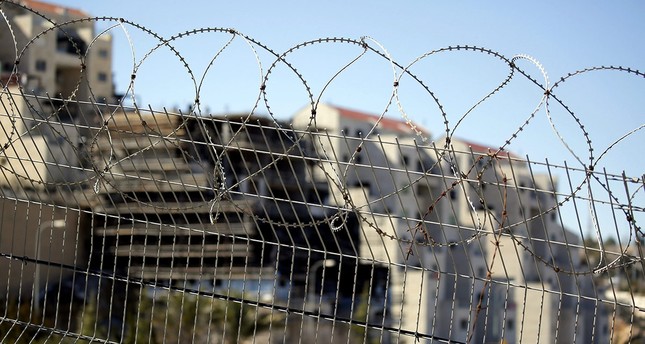
Construction of a new Israeli settlement is seen through barbed wire in Kiryat Arba near the West Bank city of Hebron, Feb 7, 2017. (photo: EPA Photos)

What if Oregon were subjected to military occupation?

By Catherine Alder | Za’atar | Spring 2018


Oregon: A land without a people for a people without a land.


I was asked to speak about my international work at Ainsworth UCC. This piece is what I shared. I want to share with you in an unusual way. Imagine with me. Step into another’s experience. Let’s play “What if . . . ?”

What if the state of Oregon suddenly was designated by other countries as the place to come for hundreds of thousands of people in trouble in Europe?

The rap from those countries about Oregon is that it is perfect. “A place without a people for a people without a place.” Send them there! BUT HEY, WE ARE HERE! WE are the Oregonians! Well, we think, it will be OK. We are good people. We will welcome these strangers who are in trouble. There is plenty of land for the new people to build. We will share.

But, when the new people come from Europe, they come with guns and run out 100‘s of thousands of Oregonians. Now 750,000 Oregonians live in refugee camps in bordering states. The new people set up a government and say Oregonians who ran away are not allowed to come back home. These people are not like other refugees who have come gently and respectfully to live among us. This is very different.

Continue reading “What if . . . ?”

There is no tradition of anti-Semitism in Islam

The Qur’an. (photo: M. Abd El Chany / Reuters)

Some are suggesting that Muslims are bringing anti-Semitism to Europe. However, it was in fact Europeans who took anti-Semitism to the Arab world in the first place.

By Peter Wien | Qantara.de | May 25, 2018


Neither racism nor the violence that results from it can be justified. However, the acceptance of anti-Semitic prejudices among Muslims should be attributed to political and social rather than religious factors. Without the colonial subjugation of the Arab world in the nineteenth and twentieth centuries, the spread of anti-Semitic thought, both there and in other Islamic countries, is almost unthinkable.


Holy books are what people make of them: after all, even the word of God needs to be understood and interpreted. The same applies to anti-Jewish statements in the Koran. Today, it isn’t just so-called critics of Islam who describe them as anti-Semitic; Muslim hate-preachers too like to quote them. In the field of traditional Koranic exegesis, this is a new kind of misuse.

For over a thousand years, Muslims have worked hard to make their word of God applicable as a moral and legal doctrine. Scholars claimed the exclusive right to interpret it. While this process wasn’t democratic, it guaranteed that extreme, isolated interpretations stood little chance.

Verses calling for violence against Jews, for example, are embedded in reports about historical events. When the Prophet emigrated from Mecca to Medina in 622, he formed an alliance with the local population, which included some Jewish tribes. It is said that when these tribes broke the contract, Mohammed and his followers took revenge. Hatred of Jews in the early Islamic tradition sprang from the precarious position of the Muslim community, which was in competition with social adversaries. When seen this way, it was clearly associated with a specific situation.

Continue reading “There is no tradition of anti-Semitism in Islam”

Falsely accusing Palestinians of anti-Semitism is malicious

Blacklisted professor Steven Salaita. (photo: Greg Kahn / The Chronicle of Higher Education)

Palestinians are tired of conversations about our barbarism and irrationality — we’re trying to survive exclusion and privation.

By Steven Salaita | Mondoweiss | May 23, 2018


Let’s look at things a different way. Support of Israel requires deference to legal discrimination, inequitable models of citizenship, and massive displacement based on ethnic background. Can’t Zionists, then, rightly be accused of racism? We never get to ask that question. They occupy a normative position in American political discourses and so their civility is guaranteed.


Author’s note: On May 18, Rabbi Jill Jacobs published an essay in the Washington Post purporting to distinguish between legitimate criticism of Israel and “anti-Semitism.”  In the essay, she posted two of my tweets to suggest that I am anti-Semitic [spoiler: I am not].  Since August, 2014, the Washington Post has run numerous articles similarly impugning my character.  The paper has never offered me space to write in my own voice, despite numerous inquiries.  I submitted an essay to the Post’s Outlook section responding to the issues raised in Jacobs’ piece, but the paper declined to run it.  That essay, as submitted, follows.

When Israeli soldiers open fire on unarmed demonstrators, as they have been doing for over a month in the Gaza Strip, Americans are implicated in the violence, for the United States arms and funds those soldiers. Yet liberal supporters of Israel insist on complicating this straightforward proposition.

They often do so by accusing Israel’s critics of anti-Semitism. On the one hand, Israel’s liberal champions brand themselves allies of Palestine; but on the other hand, they defame and sabotage Palestinians. It is no longer tenable to have it both ways.

Continue reading “Falsely accusing Palestinians of anti-Semitism is malicious”