A compelling, ground-level immersion into the greatest humanitarian crisis of our time, Sky & Ground accompanies the Nabi clan, a large, extended Syrian-Kurdish family, as they painstakingly make their way from their home in Aleppo, bombed out by the war, to the Idomeni refugee camp on the border of Greece and Macedonia. Their goal is Berlin, where they will reunite with family members and seek asylum but first they must make the arduous and dangerous journey through Serbia, Hungary and Austria.
Quick Pickled Avocado. (photos: Tom McCorkle / food styling: Lisa Cherkasky / The Washington Post)
Talking about Middle Eastern food is like talking about ‘European food. It doesn’t do justice to the differences between the cooking and traditions.
By Jane Black | The Washington Post | Feb 4, 2019
‘[Food] is a way to share our narrative with the world. It helps people to get to know Palestinians as humans, as mothers, as cooks. Not just as people in a war. When you know someone, you’re less likely to be afraid of them.’ — Reem Kassis, author of The Palestinian Table
It was a food-world fairy tale come true. In 2013, Yasmin Khan decided to write a cookbook. She was 32 and burned out from her work as a London-based human-rights campaigner focused on the Middle East. She made a pitch on Kickstarter, promising a Persian travelogue and recipe book that would explore her heritage — Khan is half Iranian — and highlight “a side of Iran that never makes the headlines.”
Unknown and untested, Khan nevertheless quickly raised the money she sought, and then some. Three years later, she published “The Saffron Tales: Recipes from the Persian Kitchen,” which won rave reviews and plaudits from such boldface culinary names as Nigella Lawson.
No wonder, then, that Khan decided to follow her winning formula for her second book, out this week. In “Zaitoun: Recipes from the Palestinian Kitchen” (W.W. Norton & Co.), she visits, cooks and eats with Palestinian Arabs to open a window to another place in the Middle East that is widely misunderstood.
A compelling, ground-level immersion into the greatest humanitarian crisis of our time, Sky & Ground accompanies the Nabi clan, a large, extended Syrian-Kurdish family, as they painstakingly make their way from their home in Aleppo, bombed out by the war, to the Idomeni refugee camp on the border of Greece and Macedonia. Their goal is Berlin, where they will reunite with family members and seek asylum but first they must make the arduous and dangerous journey through Serbia, Hungary and Austria.
The country cannot remain Jewish and democratic while controlling the entire Holy Land.
By Staff | The Economist | Feb 2, 2019
Between the Mediterranean and the Jordan river, the overall number of Arabs has caught up with that of Jews, and may soon exceed them.
Israeli-Palestinian peace talks are frozen. President Donald Trump’s plan for the “deal of the century” has been put off. The subject is absent in campaigning for the Israeli election in April, which focuses on looming corruption charges against Binyamin Netanyahu, the prime minister.
The Oslo accords of 1993 created a crazy quilt of autonomous zones in the lands that Israel captured in 1967. They also kindled the hope of creating a Palestinian state in most of the West Bank and Gaza Strip, with its capital in East Jerusalem. After much bloodshed, though, most Israelis are wary of this “two-state solution.” Today Palestinians are mostly shut off by security barriers, and divided. The Palestinian Authority in the West Bank refuses to negotiate with Israel but co-operates on security. Its Islamist rival, Hamas, which runs Gaza, dares not risk another war, for now.
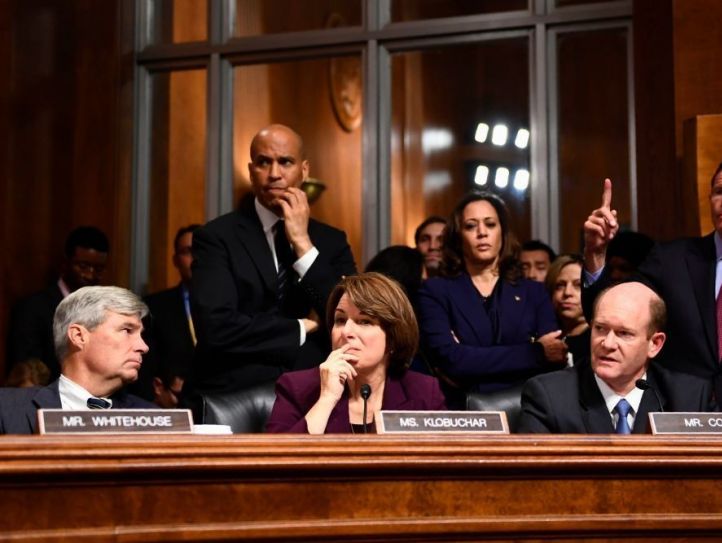
Senate Judiciary Committee members Sheldon Whitehouse, Cory Booker, Amy Klobuchar, Kamala Harris and Christopher Coons during a hearing on Capitol Hill in Washington, DC, on Sep 28, 2018. (photo: Getty Images)
Progressive Democrats are beginning to understand how Israel and BDS are being used to manipulate them into betraying their values and undermining their own cause.
By Lara Friedman | Forward | Jan 28, 2019
So long as the likes of McConnell, AIPAC, Sheldon Adelson and Benjamin Netanyahu are allowed to dictate the limits of acceptable discourse and opinion on Israel, and to impose a definition of “pro-Israel” that is inconsistent with liberal values, progressives are preordained to get hammered politically.
On Monday night [Jan 28], the United States Senate voted to advance a bill that will quash free speech in the name of supporting Israel. It’s just one more sign that Israel-Palestine is being used as a potent weapon in today’s political arena.
The bill is S. 1, aka the “Strengthening America’s Security in the Middle East Act of 2019.” S. 1 was introduced by an all-GOP set of sponsors back on January 3. A grab-bag of Israel and Middle East-related measures, it also includes the “Combating BDS Act,” a controversial bill which would grant federal cover to laws passed by U.S. states that, in the name of supporting Israel, require companies and even individual contractors to sign away their right to engage in boycotts of Israel or its settlements.
The ACLU says these state laws are unconstitutional. Federal judges in Kansas and Arizona agree. So do constitutional law scholars and free speech experts.
But AIPAC and its fellow travelers, both in the GOP and among hardline pro-Israel forces, reject such views, albeit with arguments that stand up poorly to fact-checking. Instead, they have been framing these state laws, and S. 1, as political litmus tests of pro-Israel bona fides.
Sen. Marco Rubio (R–Fla). (photo: Chip Somodevilla / Getty Images)
A provision added to the new Senate bill by Sen. Marco Rubio seeks to stifle support for the Boycott, Divestment and Sanctions (BDS) movement against Israel.
By Brant Rosen | Truthout | Jan 31, 2019
It is a message to Jews who still care about Israel, to say, ‘You’ll be much more comfortable in the Republican Party.’ — Norm Coleman, national chairman of the Republican Jewish Coalition
With the Senate’s imminent passage of the grandiosely titled Strengthening America’s Security in the Middle East Act of 2019, it’s now official: Israel/Palestine will be a major political wedge issue in the 116th Congress and the 2020 election season. And it’s not going to be pretty.
This new Senate bill is essentially a package of previous bills that appears on the surface to be boilerplate Middle East legislation. But with the addition of a provision by Sen. Marco Rubio that seeks to stifle support for the Boycott, Divestment and Sanctions (BDS) movement against Israel, this legislation is nothing short of a Republican line drawn in the sand.
BDS — the movement mobilized in response to a Palestinian civil society call for economic activism in support of Palestinian human rights — has long been a flash point for advocacy on the issue of Israel/Palestine. Over the past several years, there have been attempts on a state and federal level to fight BDS on a legislative level. While this new Senate bill does not criminalize BDS outright, it does encourage the passage of state laws that would require government contractors to certify they don’t participate in boycotts. More than two dozen states have passed such legislation in the past four years — laws that clearly violate the First Amendment right of free speech, as the ACLU and myriad other legal experts have pointed out.
In fact, the legality of these laws has already been successfully challenged in court. In Arizona, a US District judge issued an injunction blocking enforcement of its anti-BDS laws. Last December, a lawsuit was filed in federal court on behalf of a speech pathologist in Austin, Texas, after she was told that she could no longer work in the school district for refusing to sign an oath vowing that she “does not” and “will not” engage in a boycott of Israel.
Palestinian actor and playwright Ali Abu Yaseen in his Gaza City home, Jan 29, 2019. (photo: Adel Hana / AP)
Actor and playwright Ali Abu Yaseen, star of the film “Gaza,” was blocked from leaving the Gaza Strip.
By Associated Press Staff | Haaretz | Jan 30, 2019
‘I’m seething with indignation. The dream that I had for the past three months has all but collapsed.’ — Actor and playwright Ali Abu Yaseen
A new documentary called “Gaza” is hitting the screens at the prestigious Sundance Film Festival this week, providing a colorful glimpse of life in the blockaded Hamas-ruled territory. But one of its main subjects, Gaza actor and playwright Ali Abu Yaseen, won’t be attending the gathering due to the very circumstances depicted in the film.
Abu Yaseen had hoped to make his first-ever trip to the US to take part in the festival. But the continued closure of Gaza’s border with Egypt, and Hamas’ bureaucratic inefficiency, made it impossible for him to reach Cairo in time to receive a visa from the American Embassy needed to travel to Utah.
After missing Tuesday’s premiere, Abu Yaseen has all but given up hope of reaching Utah on time. The film’s final screening is on Saturday.
Israeli soldiers detain a local Palestinian cameraman during clashes with Palestinians in the village of Tuqu near Bethlehem, West Bank, Jan 25, 2019. (photo: Mussa Issa Qawasma / Reuters)
Order must be maintained. If Palestinians start getting killed against the regulations, we’ll lose control.
By Zvi Bar’el | Haaretz | Jan 30, 2019
Because it’s allowed to commit the most terrible and despicable acts, to kill a disabled Palestinian when his back is turned to the shooter, to demolish a home inhabited by innocent civilians, to prevent entry to a wheat field or an olive grove, to keep 2 million people closed up in a pen, to cause the deaths of sick people unable to get to a hospital — on condition that everything is done according to the regulations, the instructions and the norms.
Someone killed a Palestinian, and suddenly the country is amazed and in an uproar. Who in the world could have killed this Palestinian? (And who even remembers his name? After all, it happened a long time ago, four days ago.) Settlers? The settlement’s volunteer armed security team? Maybe the army?
The undisputed fact is that the Palestinian “met” his death. That’s how it is with the Palestinians. They seek and meet their death. It’s the same custom that got Aisha al-Rabi killed by a stone thrown at her a few months ago.
But the pure Jewish souls can find no rest. We have to investigate, they say, we have to discover the truth, find the murderers, punish them; the same law applies to everyone, Jews and Palestinians.
On Monday, the Democratic Majority for Israel was incorporated in Washington. On the same day it received a favorable write-up in the NY Times.
By Aiden Pink | Forward | Jan 30, 2019
AIPAC has been discussing credibility problems with progressives at the highest level. And they have been exploring the possibility of creating a Democratic group that would push AIPAC policy and fight the pro-Israel fight within the Democratic Party. That’s something they’ve been discussing for years.
For at least five years, pro-Israel groups who want Israel to enjoy bipartisan support in the United States have been worried about Democrats. While evangelical Republicans are some of Israel’s most passionate supporters, young Democrats are less likely to support Israel than in past generations.
The groups have tried to reverse this trend in lots of ways: free junkets to Israel for everyone from feminists to firefighters, increased educational programming on college campuses, and new organizations like Zioness. AIPAC, the major pro-Israel lobby, has particularly emphasized the growth (or stopping the decay) of liberal support for Israel, even naming a director of progressive outreach.
Former Michigan Gov. Jennifer Granholm spoke at the American Israel Public Affairs Committee policy conference in Washington last March. (photos: Sipa via Associated Press)
Some Democrats have suggested that the new group represents a Democratic arm of AIPAC.
By Jonathan Martin | The New York Times | Jan 28, 2019
‘My generation sees the occupation and what’s happening in Israel-Palestine as a crisis the same way we do climate change. Too many in the American Jewish establishment and the Democratic establishment have let [Israel] off the hook.’ — Simone Zimmerman, co-founder of IfNotNow
‘The idea that the Democratic Party should just support the Netanyahu government, right or wrong, is out of line with where American Jews are at and where Jewish Democrats are at.’
— Jeremy Ben-Ami, president of J Street
Several prominent veteran Democrats, alarmed by the party’s drift from its longstanding alignment with Israel, are starting a new political group that will try to counter the rising skepticism on the left toward the Jewish state by supporting lawmakers and candidates in 2020 who stand unwaveringly with the country.
With polls showing that liberals and younger voters are increasingly less sympathetic to Israel, and a handful of vocal supporters of Palestinian rights arriving in Congress, the new group — the Democratic Majority for Israel — is planning to wage a campaign to remind elected officials about what they call the party’s shared values and interests with one of America’s strongest allies.
“Most Democrats are strongly pro-Israel and we want to keep it that way,” said Mark Mellman, the group’s president and a longtime Democratic pollster. “There are a few discordant voices, but we want to make sure that what’s a very small problem doesn’t metastasize into a bigger problem.”







 HolyLandJustice.org
You must be logged in to post a comment.