A compelling, ground-level immersion into the greatest humanitarian crisis of our time, Sky & Ground accompanies the Nabi clan, a large, extended Syrian-Kurdish family, as they painstakingly make their way from their home in Aleppo, bombed out by the war, to the Idomeni refugee camp on the border of Greece and Macedonia. Their goal is Berlin, where they will reunite with family members and seek asylum but first they must make the arduous and dangerous journey through Serbia, Hungary and Austria.
The separation wall in Israel-Palestine. (photo: Issam Rimawi / Anadolu Agency / Getty Images)
The goal of Israel and the US is not to end the occupation or secure equal rights for all citizens of a single democratic state. Their preferred option is apartheid.
By Saeb Erekat | Project Syndicate | Feb 12, 2019
The US and Israeli governments may truly believe they are fulfilling a divine prophecy by denying the Palestinian people their rights, or they may merely be appeasing the extremists among their electorates. Either way, they fail to address what the endgame looks like, perhaps because they know the world will not accept it.
Since December 6, 2017, US President Donald Trump’s administration has recognized Jerusalem as Israel’s capital, closed the Palestinian mission in Washington, DC, moved the US embassy to Jerusalem, and defunded humanitarian support provided by the United Nations Relief and Works Agency for Palestine (UNRWA), among other steps. And yet we Palestinians are hounded by claims that the US really wants to pursue peace and that somehow the only problem has been our reluctance.
Nobody can claim that we did not engage Trump’s administration. We held almost 40 meetings during 2017, answered all questions, and put forward our vision of peace based on the two-state solution. But the US envoys always refused to engage in matters of substance. In fact, on the eve of a visit by Palestinian President Mahmoud Abbas to Washington, the Trump administration broke its commitment not to take unilateral steps and announced the recognition of Jerusalem as Israel’s capital. Whatever the reason — ideological bias, lack of diplomatic experience, or both — the Trump team ended up destroying any prospects for the US to play a positive peace-making role.
Moatasem Al-Nabeeh, 14, who is diagnosed with cancer, poses during an interview at his home in Gaza City Feb 12, 2019. (photo: Dylan Martinez / Reuters)
Struggling with shortages of medical equipment and medicine, Gaza’s hospitals are unable to provide proper care for cancer patients.
By Nidal al-Mughrabi | Reuters | Feb 20, 2019
‘Like children anywhere in Gaza, or in the world, those boys have ambitions, they want to become footballers and we are trying to help them achieve that.’ — Rajab Sarraj, CEO of Champions Academy
Fourteen-year-old Moatasem al-Nabeeh suffers from a brain tumor. A new youth soccer team set up in Gaza for young Palestinian cancer patients has given him new hope.
“I am happier now, I play and I made new friends,” said al-Nabeeh. “They told us we can play, defy the disease and defeat it,” he added as he hit the pitch for push-ups in his bright yellow and blue uniform.
Champions Academy, one of Gaza’s biggest soccer schools, began setting up the team up five months ago and in February “Team Hope” kicked off. Its 18 players, aged between 12 and 17, have all been diagnosed with cancer, and compete against other, non-patient teams in the academy’s league.
The committee’s statement in support of Ilhan Omar.
By The Bishop’s Committee for Justice and Peace in the Holy Land | Episcopal Diocese of Olympia | Feb 20, 2019
Every American citizen needs to understand and support the First Amendment. If we don’t, we are in danger of losing our basic rights . . . .
Ilhan Omar, Minnesota’s new US congressional representative, has been savaged for speaking the truth, but she is right about the influence of the American Israel Public Affairs Committee (AIPAC) on the politics and policies of the United States. There is no question about the growing impact of money and influence by special interest groups in this country. Unfortunately, AIPAC has been able to largely stay under the radar. Rep. Omar has put it in the spotlight.
Anyone who criticizes Israel is increasingly in danger of being branded as “anti-Semitic.” While no one can deny the existence of prejudice or discrimination against Jews, it is not “anti-Semitic” to question or criticize Israel’s unjust policies and practices with regard to the Palestinian people. This term is increasingly being used as a canard to stifle opposition to Boycott, Divestment and Sanctions (BDS), the most promising non-violent means of protesting unjust treatment of the Palestinians. AIPAC is encouraging states to legally sanction any contractor who has openly supported BDS. Rep. Omar has had the courage to endorse BDS and point to the influence of the powerful Israeli lobby. Continue reading “We need to thank Ilhan Omar for representing ALL of us”
A compelling, ground-level immersion into the greatest humanitarian crisis of our time, Sky & Ground accompanies the Nabi clan, a large, extended Syrian-Kurdish family, as they painstakingly make their way from their home in Aleppo, bombed out by the war, to the Idomeni refugee camp on the border of Greece and Macedonia. Their goal is Berlin, where they will reunite with family members and seek asylum but first they must make the arduous and dangerous journey through Serbia, Hungary and Austria.
Young American rabbinical students plant olive trees to replace those uprooted by Jewish settlers near the Palestinian village of At-Tuwani, south of Hebron, Jan 25, 2019. (photo: Nasser Nasser / AP Photo)
Two weeks later, the trees were again uprooted by Jewish settlers.
By Isabel Debre | Associated Press | Feb 19, 2019
‘Before coming here and doing this, I couldn’t speak intelligently about Israel. We’re saying that we can take the same religion settlers use to commit violence in order to commit justice, to make peace.’ — Tyler Dratch, a rabbinical student at Hebrew College in Boston
Young American rabbinical students are doing more than visiting holy sites, learning Hebrew and poring over religious texts during their year abroad in Israel.
In a stark departure from past programs focused on strengthening ties with Israel and Judaism, the new crop of rabbinical students is reaching out to the Palestinians. The change reflects a divide between Israeli and American Jews that appears to be widening.
On a recent winter morning, Tyler Dratch, a 26-year-old rabbinical student at Hebrew College in Boston, was among some two dozen Jewish students planting olive trees in the Palestinian village of At-Tuwani in the southern West Bank. The only Jews that locals typically see are either Israeli soldiers or ultranationalist settlers.
Let’s make justice for Gaza part of our weekly regimen as we prepare for Shabbat.
By Rabbi Brant Rosen | Shalom Rav | Feb 19, 2019
For its part, the Jewish communal establishment greets these crimes with silence at best and justification at worst — as if it is perfectly justifiable to regularly shoot down unarmed protesters with live gunfire.
For religious Jews, Friday is typically devoted to spiritual and practical preparation for the Sabbath. Those who are traditionally observant will spend the morning and afternoon doing their shopping, housecleaning and cooking for Shabbat before sundown. Before Shabbat worship, there is a preliminary service known as Kabbalat Shabbat: a series of Psalms and prayers of welcome that serve as a spiritual precursor to the onset of the Jewish Sabbath. As any Shabbat observant Jew will attest, the sense of spiritual preparation and anticipation that takes place on Friday is deeply imbedded in the sacred rhythm of the Jewish week.
Speaking personally, this sacred rhythm has been disrupted — perhaps even profaned — for me for almost a year now. That is because every Friday afternoon, my news feed is regularly filled with reports of Palestinian civilians killed and maimed by the Israeli military during the protests taking place during the Great March of Return.
“Academic freedom” is being twisted for inappropriate purposes.
By Michael Burawoy, Paul Fine, and others | The Daily Californian | Feb 19, 2019
We know a number of faculty members who support this very letter but feared to put their name to it. What does that say about the already existing chilled climate for speech that the chancellors’ letter has exacerbated?
On Dec 13, the ten UC chancellors took the unusual step of signing a collective statement that opposed the “academic boycott of Israeli academic institutions and/or individual scholars” as being a “direct and serious” threat to academic freedom. When some faculty members expressed concerns that such a high-level collective statement would have a chilling effect on campus speech and discourage faculty members from taking public positions on an issue that is well within the purview of their academic freedom, UC Berkeley Chancellor Carol Christ responded by defending her own academic freedom to speak out on important issues. We would not want to deny her that right, but we do have some unanswered questions about the collective statement:
How does Boycott, Divestment and Sanctions, or BDS — the movement to boycott, divest and sanction the Israeli state for its occupation of Palestine — pose a “direct and serious threat to academic freedom”? Like the South African anti-apartheid boycott and divestment movement of the 1980s, BDS targets state-funded Israeli institutions and Israeli commercial activities. It does not try to prevent anyone from saying anything or attempt to sanction or thwart individuals for their political positions.
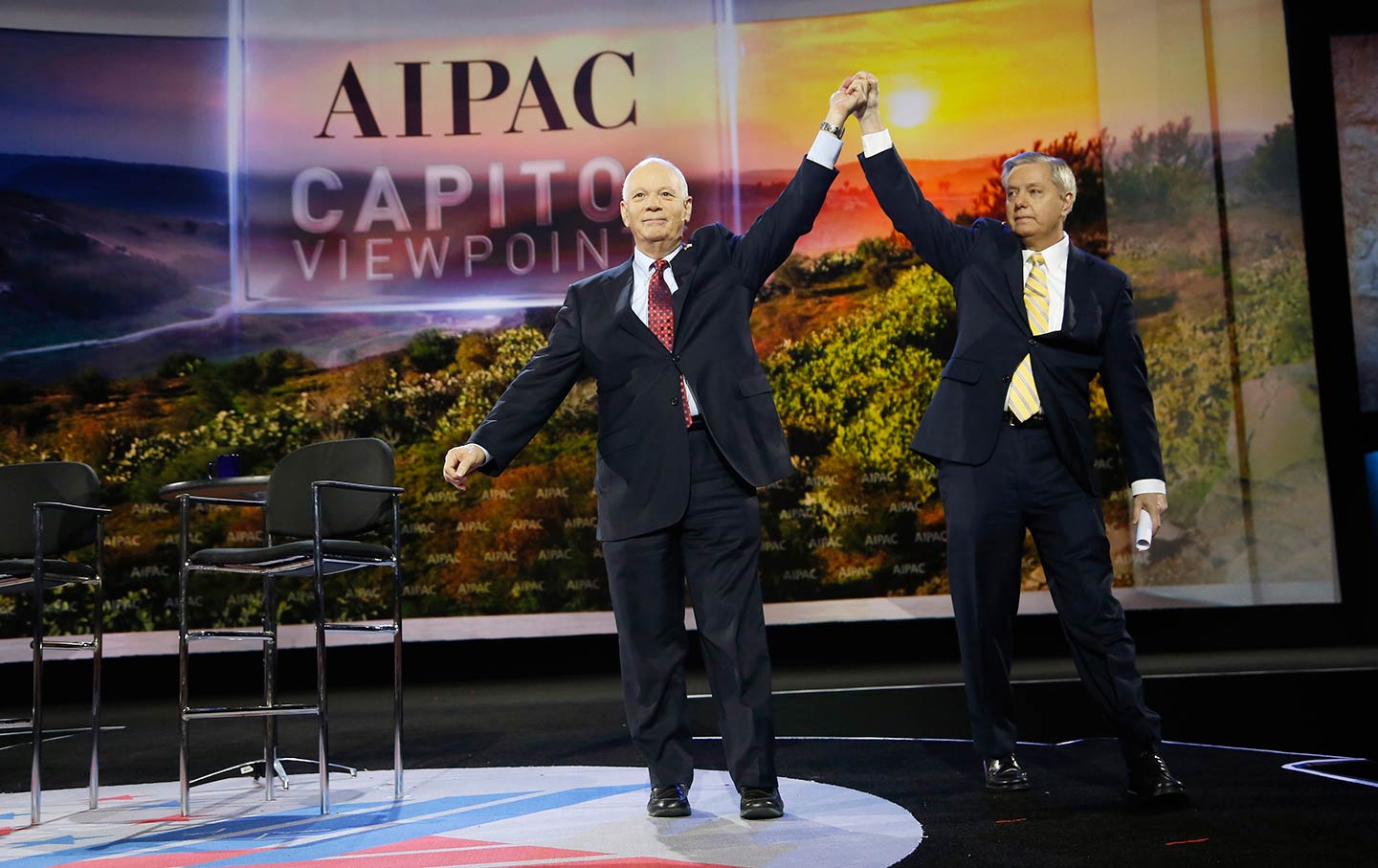
US Senators Ben Cardin (D-MD) and Lindsey Graham (R-SC) join hands as they take the stage to address the American Israel Public Affairs Committee (AIPAC) policy conference in Washington, on Mar 1, 2015. (photo: Jonathan Ernst / Reuterss)
An AIPAC and Capitol Hill veteran explains the lobby’s tactics of reward and retribution.
By M. J. Rosenberg | The Nation | Feb 14, 2019
AIPAC denies fundraising precisely the way Captain Renault in the film Casablanca declared he was ‘shocked, shocked, to find that gambling is going on’ in his establishment. As he is saying it, one of the club’s crooks hands him a wad of cash, saying, ‘Your winnings, sir.’
One thing that should be said about Representative Ilhan Omar’s tweet about the power of the American Israel Public Affairs Committee (more commonly known as AIPAC, or the “Israel lobby”) is that the hysterical reaction to it proved her main point: The power of AIPAC over members of Congress is literally awesome, although not in a good way. Has anyone ever seen so many members of Congress, of both parties, running to the microphones and sending out press releases to denounce one first-termer for criticizing the power of . . . a lobby?
Somehow, I don’t think the reaction would have been the same if she had tweeted that Congress still supports the ethanol subsidy because the American Farm Bureau and other components of the corn/ethanol lobby spend millions to keep this agribusiness bonanza going (which they do). Or that if she had opposed the ethanol subsidy, she would have been accused of hating farmers.
Following the Ilhan Omar controversy, it’s incredibly important to be able to decipher between real antisemitism and basic political facts.
By Alex Kotch | The Guardian | Feb 13, 2019
Labeling anyone who speaks of Jews and money in the same sentence an antisemite weakens our fight against the real antisemitic, neo-Nazi, and other white nationalist forces that have seen a resurgence in recent years. It also stifles legitimate discussions about the enormous power of special interests, something that threatens our democratic political system.
It’s important to remember how the controversy around Ilhan Omar, who Trump said should resign over tweets critical of a pro-Israel lobbying group, began. The first two Muslim congresswomen in the history of the United States — Ilhan Omar, a freshman representative from Minnesota and Somali refugee, and her fellow freshman representative Rashida Tlaib, a Palestinian American — have bravely criticized the Israeli government for its grotesque treatment of the Palestinian people.
Acknowledging this apartheid system is a dangerous thing for American elected officials to do. Just in 2016, when presidential candidate Bernie Sanders dared to say that “We are going to have to treat the Palestinian people with respect and dignity” it became a major media event.





 HolyLandJustice.org
You must be logged in to post a comment.