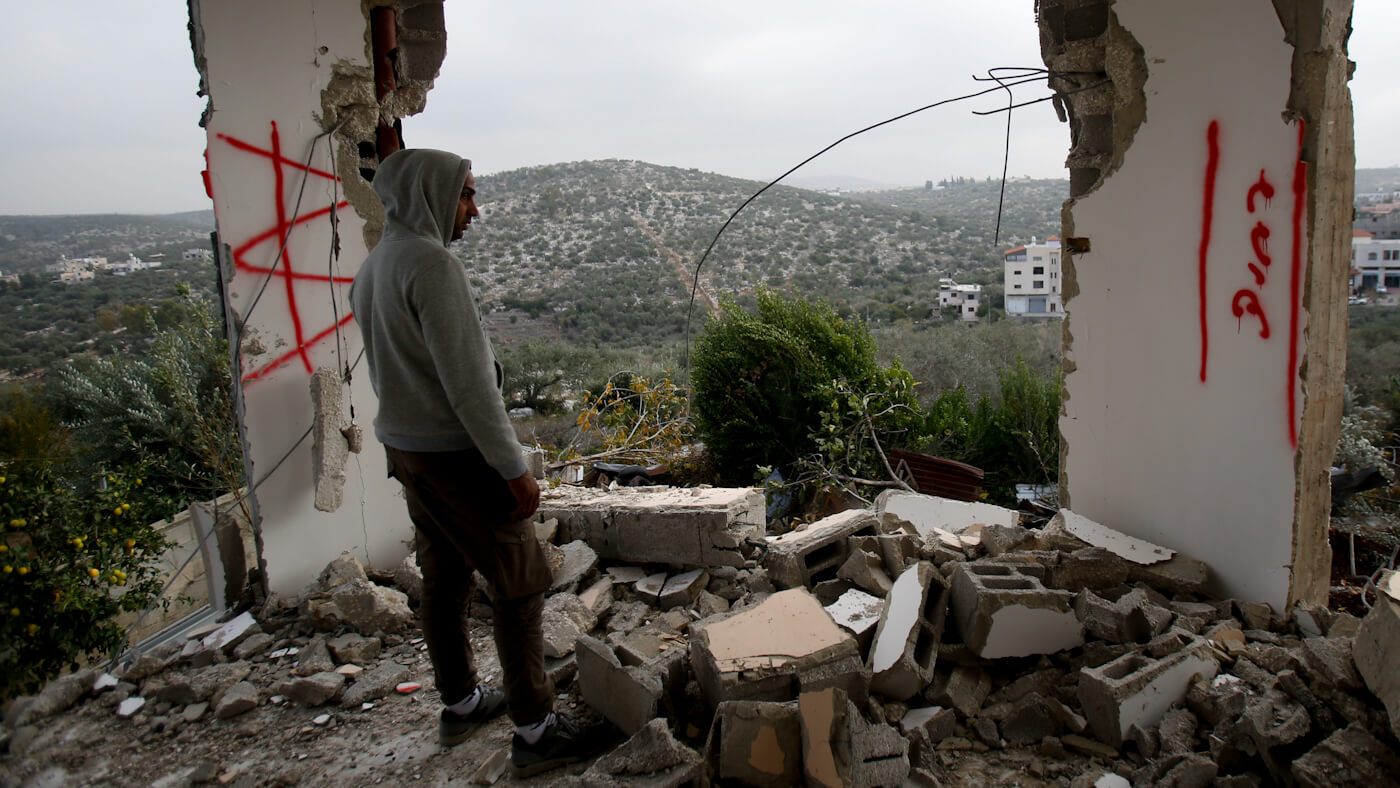
Two weeks in Palestine: A land as oppressed as it is beautiful

A Palestinian man examines a house after it was demolished by the Israeli army in the village of Shweikeh, near the West Bank city of Tulkarem, Dec 17, 2018. (photo: Majdi Mohammed / AP)
The author recounts his travels through occupied Palestine highlighting the stark juxtaposition between the beauty of the land, and the ugliness of its occupation.

By Miko Peled | Mint Press News | Mar 1, 2019

‘We drink camel’s milk, we love it and we always had camels that we used to milk. Now, as part of the ethnic cleansing process, the Israeli authorities confiscated our camels, they give them to nearby Israeli Jewish settlements and we have to buy the milk from them.’
— Aziz from the village of Al-Araqib

The beauty of Palestine in late February and particularly after a few spots of rain is unmatched. Lush green and almond blossoms everywhere, but from Tarshiha near the Lebanese border in the north to Lakia in the Naqab desert in the south, the horrors of a relentless, oppressive regime that shows every sign of becoming more oppressive are everywhere.

Tarshiha

A jewel in the northern Galilee is lush green and beautiful with signs of prosperity all around. In 1948, Tarshiha, which had a minority Christian population, was subjected to a brutal ethnic cleansing campaign but the Christian families were permitted to return. Today, the full name of the town is Ma’alot-Tarshiha because the neighboring Israeli settlement of Ma’alot, which sits on Tarshiha lands, has taken over and the two now comprise a single — yet segregated — town sharing a single municipality. Still, with all the signs of prosperity, families remember the horrors and many are still living in far off refugee camps, unable to return to their homes and their land.

Continue reading “Two weeks in Palestine: A land as oppressed as it is beautiful”

Under Israeli occupation, water is a luxury

Eliyahu Hershkovitz / Haaretz)
Of all the methods Israel uses to expel Palestinians from their land, the deprivation of water is the most cruel.

By Amira Hass | Haaretz | Feb 24, 2019

I have every right as a citizen and a journalist to ask those who hand down the orders [to destroy Palestinian water pipes], and those who carry them out: ‘Tell me, can you look at yourself in the mirror?’

When I wrote my questions and asked the spokesperson’s office of the Coordinator of Government Activities in the Territories to explain the destruction of the water pipelines in the Palestinian villages southeast of Yatta, on February 13, my fingers started itching wanting to type the following question: “Tell me, aren’t you ashamed?” You may interpret it as a didactic urge, you can see it as a vestige of faith in the possibility of exerting an influence, or a crumb of hope that there’s somebody there who doesn’t automatically carry out orders and will feel a niggling doubt. But the itching in my fingers disappeared quickly.

This is not the first time that I’m repressing my didactic urge to ask the representatives of the destroyers, and the deprivers of water, if they aren’t ashamed. After all, every day our forces carry out some brutal act of demolition or prevent construction or assist the settlers who are permeated with a sense of racial superiority, to expel shepherds and farmers from their land. The vast majority of these acts of destruction and expulsion are not reported in the Israeli media. After all, writing about them would require the hiring of another two full-time reporters.

Continue reading “Under Israeli occupation, water is a luxury”

Progressives must stop weaponizing charges of anti-Semitism against critics of Israel

Rep. Ilhan Omar, an outspoken and successful American Muslim Black woman, embodies the very threat to patriarchal white supremacy and colonialism that many in power find so disturbing. (photo: Lorie Shaull / Flickr / cc)
It is shocking that the main targets of outrage over anti-Semitism are members of marginalized communities on the progressive left who are critical of Israeli policies.

By Jordan Goldwarg and Aneelah Afzali | Common Dreams | Feb 27, 2019

It is important to ask why marginalized community members are the main targets of outrage, and who benefits when marginalized groups are pitted against each other.

As an American Jew and an American Muslim, we find the cycle of attacks on Congresswoman Ilhan Omar, Congresswoman Rashida Tlaib, Dr. Marc Lamont Hill, Tamika Mallory, Linda Sarsour, Angela Davis, and others deeply troubling. These attacks reflect a weaponization of the “anti-Semitism” charge against certain individuals (especially Muslim and/or Black leaders supporting Palestinian human rights), which turns progressive allies against each other and ignores the real source of physical threat to our Jewish (and Muslim and Black) siblings.

There is no doubt that anti-Semitism is alive and well. The FBI reported a 37% increase in anti-Semitic crimes from 2016 to 2017 (the most recent year for which data is available). Islamophobia has also increased sharply in recent years, as we face some of the highest levels of anti-Muslim hate crimes in our nation’s history along with hateful rhetoric and policies from the highest levels of our government (such as the Muslim Ban). And Black Americans are still victims of hate crimes more than any other group in our country, with a 16% increase from 2016 to 2017.

Continue reading “Progressives must stop weaponizing charges of anti-Semitism against critics of Israel”

St. Louis Jewish group slams Canary Mission for blacklisting local student

(image: Nikki Casey)
Canary Mission posts political dossiers on student activists, hoping it will be more difficult for its subjects to find work after college.

By Josh Nathan-Kazis | Forward | Feb 22, 2019

‘I’m a college sophomore. I didn’t expect to start my second year living away from home by feeling stalked by an international, shadowy organization. Seeing your face, and details about your life, on a website that you know means to slander you is a surreal, disconcerting experience.’
— Sophie Hurwitz, Wellesley College sophomore

Jewish officials in St. Louis are slamming the online blacklist website Canary Mission for posting a dossier on a college student who grew up in the local Jewish community.

“While we advocate strongly for a safe, secure and democratic state of Israel, we unequivocally reject anyone who seeks to shut down discussion and disagreement about the Jewish state through intimidation tactics,” the leaders of the Jewish Community Relations Council of St. Louis wrote in a letter to the editor of the St. Louis Post-Dispatch.

Continue reading “St. Louis Jewish group slams Canary Mission for blacklisting local student”

The ticking time bomb that could upend Israel’s election

Mohamed Abd El Ghany / Reuters)
The Israeli government’s move to withhold $140 million from tax revenues it collects for the Palestinian Authority may be good politics, but it could lead to war.

By Amos Harel | Haaretz | Feb 25, 2019

The planned cut is already making the West Bank nervous. Security officials who talk to Palestinians report that residents are afraid that the PA won’t be able to pay salaries . . . . Some of the money Israel withholds will be deducted from the funds the PA pays to the Gaza Strip, which will have an immediate impact on the economic situation there.

Beneath the surface there’s a ticking bomb that could upend the entire election campaign, even though it has nothing to do with the investigations of the prime minister or the union of the centrist parties.

A series of negative developments on issues relating to the Palestinians – Jerusalem, prisoners, Palestinian Authority funds and the condition of Gaza’s infrastructure – once again are threatening an escalation between Israel and the Palestinians, possibly during the six weeks left until the Knesset election. The Palestinians themselves, and even Jordan, are responsible for some of these developments, but it seems the Israeli leadership is marching into a potential crisis with its eyes wide open.

Continue reading “The ticking time bomb that could upend Israel’s election”

Episcopal Church joins calls for fix to US law that cut Palestinian aid

Palestinian security forces guard outside a hospital in Ramallah, West Bank, in May 2018. (photo: Reuters)
The law cuts cuts $200 million in direct aid to Palestine and all aid to the UN Relief and Works Agency (UNRWA).

By David Paulsen | Episcopal News Service | Feb 25, 2019

‘The Anti-Terrorism Clarification Act has resulted in the total cessation of aid to Palestinians, with devastating consequences for the Palestinians most in need of humanitarian assistance. This legislation also harms the security of Israel.’
— Rebecca Blachly, director of The Episcopal Church’s Office of Government Relations

The Episcopal Church — raising concerns reportedly shared by officials within the Trump administration and Israeli government — is joining a chorus of voices calling for an emergency update to a new US law that has halted aid to Palestinian security forces.

Congress passed and President Donald Trump signed the law, the Anti-Terrorism Clarification Act, in October as a way to help victims of terrorism, but when the law took effect Feb 1, the Palestinian Authority was forced to refuse $60 million in US aid or else open itself up to exponentially larger financial liability through potential American lawsuits.

The US State Department is now working on a fix to the law that will “maintain security cooperation on one hand and also justice to the families of the victims of terror,” an unnamed Israeli official told the Washington Post. The Israel-based news outlet Haaretz described the Trump administration in December as “scrambling” to find a solution. . . .

Continue reading “Episcopal Church joins calls for fix to US law that cut Palestinian aid”

Can we imagine peace for Palestine?

Richard Falk. (photo: Wikipedia)
Now is a time for stocktaking with respect to this conflict that has gone on for more than a century, and assessing what would be the best way forward.

By Richard Falk | Transcend Media Service | Feb 25, 2019

Two conclusions emerge from this analysis: first, a continued reliance on the two-state diplomacy within a framework that relies on the United States as an intermediary or peace broker is now irrelevant and discredited. It is at this point only a distraction. Secondly, despite Israel’s recent gains in acceptance within the Middle East and its one-sided support in Washington, the Palestinian national movement persists, and under certain conditions, will mount a threat to Israel’s future.

While waiting without positive expectations for the Trump ‘deal of the century’ the Palestinian ordeal unfolds day by day. Many Israelis would like us to believe that the Palestinian struggle to achieve self-determination has been defeated, and that it is time to admit that Israel is the victor and Palestine the loser. Recent events paint a different picture. Every Friday since the end of March 2018 the Great March of Return has confronted Israel at the Gaza fence. Israel has responded with lethal force killing more than 250 Palestinians and injuring over 18,000, using grossly excessive force to deal with almost completely nonviolent demonstrations. The world allows these weekly atrocities to go without any concerted adverse reaction and the UN is awkwardly silent.

It would seem that there is a feeling in international circles that nothing much can be done to bring about a peaceful and just solution at this stage. Such a conclusion partially explains the various recent moves in the Arab world toward an acceptance of Israel as a legitimate state, which has included diplomatic normalization. Beyond these developments, Israel has joined with Saudi Arabia and the United States in a war mongering escalation of an unwarranted confrontation with Iran. In addition, Israel and Egypt are collaborating on security issues at the border and in the Sinai, as well as in developing off shore oil and gas projects.

Continue reading “Can we imagine peace for Palestine?”

Film: This is Home — A Refugee Story (Apr 5)

Please join our brothers and sisters at the Mideast Focus Ministry for their First Friday Film series.
Date: Friday, Apr 5, 2019
Time: 7:00 – 8:30 pm
Location: St. Mark’s Cathedral
Bloedel Hall
1245 10th Ave E
Seattle, WA 98102
Information: Event information here →
Tickets: Free Admission
Event Details

This is Home is an intimate portrait of four Syrian refugee families arriving in America and struggling to find their footing. Displaced from their homes and separated from loved ones, they are given eight months of assistance from the International Rescue Committee to become self-sufficient. As they learn to adapt to challenges, including the newly imposed travel ban, their strength and resilience are tested. It is a universal story, highlighted by humor and heartbreak, about what it’s like to start over, no matter the obstacles.

After surviving the traumas of war, the families arrive in Baltimore, Maryland and are met with a new set of trials. They attend cultural orientation classes and job training sessions where they must “learn America” — everything from how to take public transportation to negotiating new gender roles — all in an ever-changing and increasingly hostile political environment. Their goals are completely relatable: find a job, pay the bills, and make a better life for the next generation. Continue reading “Film: This is Home — A Refugee Story (Apr 5)”

Israel says will legalize West Bank homes built on private Palestinian land

Moti Milrod / Haaretz)
State tells court it will retroactively legalize structures in Alei Zahav, invoking new legal mechanism for the first time.

By Yotam Berger | Haaretz | Feb 10, 2019

According to a Civil Administration document submitted in the past to the High Court, there are at least 1,048 structures built on West Bank land mistakenly thought to be state lands. According to the same document, 1,122 additional structures in the West Bank were built in breach of planning laws more than 20 years ago.

The state informed the Jerusalem District Court that it will retroactively legalize structures built in part on private Palestinian land in the West Bank settlement of Alei Zahav.

In doing so, the state will for the first time invoke a legal mechanism the attorney general approved in December, senior sources say. Alei Zahav is a secular settlement located close to Route 5, which links Ariel and the Greater Tel Aviv area.

According to the legal mechanism approved in December, it is permissible to retroactively authorize illegal construction on private Palestinian land if the land was allotted “in good faith,” meaning if the state erroneously believed that it was state lands when it allotted it.

Continue reading “Israel says will legalize West Bank homes built on private Palestinian land”

Event: Palestinian Rights Advocacy Day (Mar 15)

Please join our brothers and sisters at the Rachel Corrie Foundation for a day of advocacy for Palestinian Rights.
Date: Friday, Mar 15, 2019
Time: 9:00 am – 4:30 pm
Location: United Churches of Olympia Social Hall
110 11th Ave SE
Olympia, WA  98501
Information & Registration: Event information here →
Tickets: $10 suggested donation
Event Details

Our goals during this fun, action-packed day are:

  • to strengthen statewide organizing for advocacy on Palestine
  • to continue to inform and educate state legislators about issues related to Palestinian rights.
Schedule
  • Gathering and Socializing: 9:00–10:00 am
  • Welcome and Introductions 10:00–10:05 am
  • Presentations & Training: 10:05 am
  • Lunch with Legislative District Groups: 11:30 am
  • Walk and Transport to State Capitol: 12:15–12:30 pm
  • Group Photo in Front of Capitol: 12:30–12:45 pm
  • Visits and Deliveries of Materials to Legislative Offices 1:00–3:00 pm
  • Return to United Churches Location: 3:00–3:15 pm
  • Debriefs: 3:15–4:00 pm
  • Closing and Collecting Ideas, Contacts, Evaluations, and Plans for Follow-up and Ongoing Work: 4:00 pm
  • Homeward or on to dinner in Olympia! 4:30 pm

More information here →