January 30 | A Conversation with Munther Isaac

In less than one week, we hope you’ll join Kairos USA, Kairos West Michigan, and the Indiana Center for Middle East Peace for a conversation with Rev. Dr. Munther Isaac. Rev. Isaac is Pastor of Christmas Lutheran Church in Bethlehem, Academic Dean of Bethlehem Bible College, and Co-Director of the Global Kairos for Justice Coalition.

Rev. Isaac will speak with Dr. Michael Spath, DMin, founder of the Indiana Center for Middle East Peace. Everyone is invited to join on Zoom.

A Conversation with Rev. Dr. Munther Isaac & Dr. Michael Spath
Tuesday, January 30
2:00 to 3:00 p.m. ET / 11:00 a.m. to 12:00 p.m. PT
Register Here

More Upcoming Events

The Bible & Settler Colonialism in Palestine & Beyond
Webinar presented by the Center & Library for the Bible and Social Justice, featuring Rev. Prof. Mitri Raheb with Atalia Omer and Revelation Velunta.
Saturday, January 27
9:30 a.m. ET / 6:30 p.m. PT
Register Here

MIT Forum on Gaza with Dr. Alice Rothchild & Rabbi Brian Walt
Alice Rothchild joins Rabbi Brain Walt of Rabbis for Ceasefire to share important context for the current conflict. In-person at the Falmouth Public Library (Falmouth, Massachusetts) or online via Zoom.
Tuesday, January 30
7:00 p.m. ET / 4:00 p.m. PT

“Life in Palestine in This Time of War” with Fr. Fadi Diab and Dean Thomason at St. Mark’s Cathedral

On Sunday, December 10, Dean Thomason at St. Mark’s Cathedral in Seattle was joined virtually by Father Fadi Diab, rector of St. Andrew’s Anglican Church in Ramallah. Father Diab provided updates from the Christian community in Ramallah.

“We’re very much, psychologically, devastated,” he said. “The community we serve [is] also overwhelmed with the pain that mainly comes from Gaza, but also from places that the Israeli army invades in the West Bank.”

St. Andrews is providing stress-relief and trauma-response training and programs for teachers and community members, and shelter and sustenance for community members who’ve been displaced from homes and jobs. Demolition of Palestinian homes, he said, is happening quickly.

Fr. Diab also discussed the harms of propaganda in the West, far-right political power in Israel, and increased settler violence in the West Bank, armed and encouraged by Israel’s government.

“I don’t dare to drive on these roads, because you don’t know when the settlers will attack,” said Fr. Diab. And from the side of Israel’s police: “Any call for a ceasefire puts you in danger of being arrested.”

Take Action

  • Read more updates and donate at afedj.org — the American Friends of Episcopal Diocese of Jerusalem.
  • Write to friends and Christian siblings in Palestine, who feel isolated and alone.
  • If you live in the U.S., pressure your elected representatives to call for an immediate ceasefire.

“We are called to save lives,” said Fr. Diab. “It is your role as Americans to reach out to your leaders, and convince them that this is not acceptable, this is morally indefensible, and we need a ceasefire and end to this conflict forever.”

Listen to a recording of the full conversation between Dean Thomason and Father Diab here.

International Criminal Court to investigate war crimes in Palestine

5472
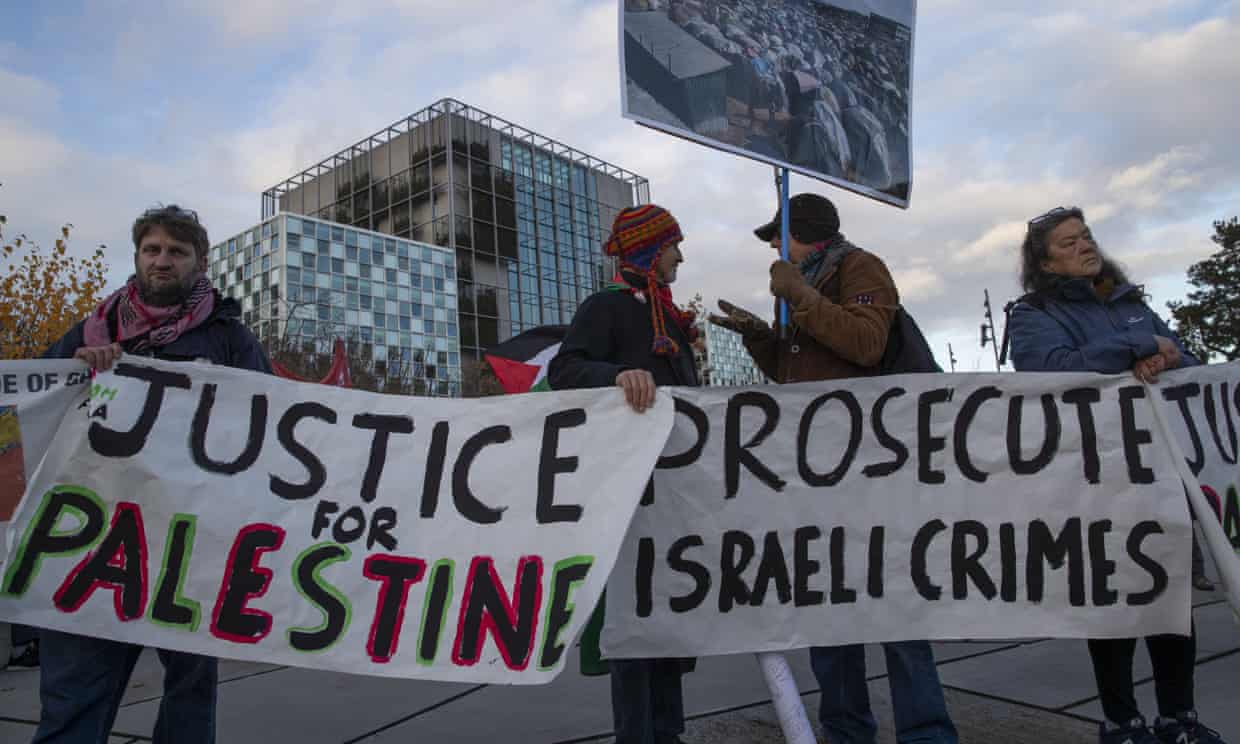
Demonstrators outside the International Criminal Court call for the Israeli army to be prosecuted for war crimes, The Hague, Nov 2019. (photo: Peter de Jong / AP)

There is sufficient evidence to investigate alleged Israeli and Palestinian war crimes committed in the West Bank, East Jerusalem and the Gaza Strip, the court has announced.

By Peter Beaumont | The Guardian | Dec 20, 2019

‘In brief, I am satisfied that war crimes have been or are being committed in the West Bank, including East Jerusalem, and the Gaza Strip.’
— Fatou Bensouda, ICC Chief Prosecutor

In a landmark decision, the ICC said it saw “no substantial reasons to believe that an investigation would not serve the interests of justice.”

The announcement ended years of preliminary investigations into alleged crimes by both Israeli forces and Palestinians, and signaled that the court was preparing to open a formal investigation.

A statement published by the court’s chief prosecutor, Fatou Bensouda, on the court’s website on Friday said her office “has concluded with the determination that all the statutory criteria under the Rome statute for the opening of an investigation have been met.”
Continue reading “International Criminal Court to investigate war crimes in Palestine”

Trump crushes Palestinian hopes — again

A Palestinian boy sits on a chair as Israeli authorities demolish a school in the village of Yatta, south of Hebron, in the occupied West Bank, Jul 11, 2018. (photo: Hazem Bader / AFP / Getty Images)

The U.S. Middle East peace plan may be in a coma. But that hasn’t stopped Washington from handing major diplomatic victories to Israel.

By Colum Lynch and Robbie Gramer | Foreign Policy | Nov 18, 2019

‘You now have a complete package of efforts to make a traditional solution . . . to the Israeli-Palestinian problem virtually impossible, at least for the remainder of the Trump administration.’
— Carnegie Endowment for International Peace scholar Aaron David Miller

Secretary of State Mike Pompeo declared Monday that the United States no longer considers civilian Israeli settlements on Palestinian lands a violation of international law. The move represents a historic decision that reverses decades of U.S. policy and represents the latest in a raft of pro-Israeli moves that could effectively quash hopes for the two-state solution to the Israeli-Palestinian conflict.

“The conclusion that we will no longer recognize as per se inconsistent with international law is based on the unique facts, history, and circumstances prevented by the establishment of civilian settlements in the West Bank,” Pompeo told reporters on Monday. He said that the decision does not mean the U.S. government is expressing views on the legal status of any individual settlement or “prejudging the ultimate status of the West Bank.”

Pompeo’s statement rolls back a 1978 State Department opinion that formed the bedrock of U.S. legal opinion on Israeli settlements, asserting that civilian settlements in the occupied territories are “inconsistent with international law.”

The decision marks the latest way in which the Trump administration has undercut Palestinian claims of statehood in favor of its closest historic ally in the Middle East, handing another political victory to embattled Israeli Prime Minister Benjamin Netanyahu as he struggles to stay afloat after failing to form a coalition government.
Continue reading “Trump crushes Palestinian hopes — again”

Don’t legalize the illegal

2019 11 21
Israeli settlers clash with Israel Police in West Bank settlement of Yitzhar, Nov 10, 2019. (photo: Hillel Mier / TPS)

International law has determined that the West Bank is governed as a territory captured in war, which makes it defined as a “belligerent occupation.”

By Gershon Baskin | The Jerusalem Post | Nov 20, 2019

The continuation of the settlement enterprise is Israel’s clearest expression that it is not willing to make peace with the Palestinians in any kind of equitable fashion.

I have some news for US President Donald Trump, and he may not like it, but here it is: Donald Trump is not the point of reference regarding international law. No unilateral declaration of the president or secretary of state of the United States of America can legalize the illegal Israeli settlements in the West Bank. The Israeli settlements are not only illegal under international law, they have been and will continue to be one of the main obstacles to reaching a two-state solution to the Israeli-Palestinian conflict.

It should be no surprise to anyone, but since at least 1977, when the Likud first came to power, Israeli governments have consistently stated that one of the main purposes of the Israeli settlements in the West Bank, especially those in the heartland of the West Bank along the central mountain ridge, is to prevent the creation of a Palestinian state. From that perspective, the Israeli settlement enterprise has been extraordinarily successful.
Continue reading “Don’t legalize the illegal”

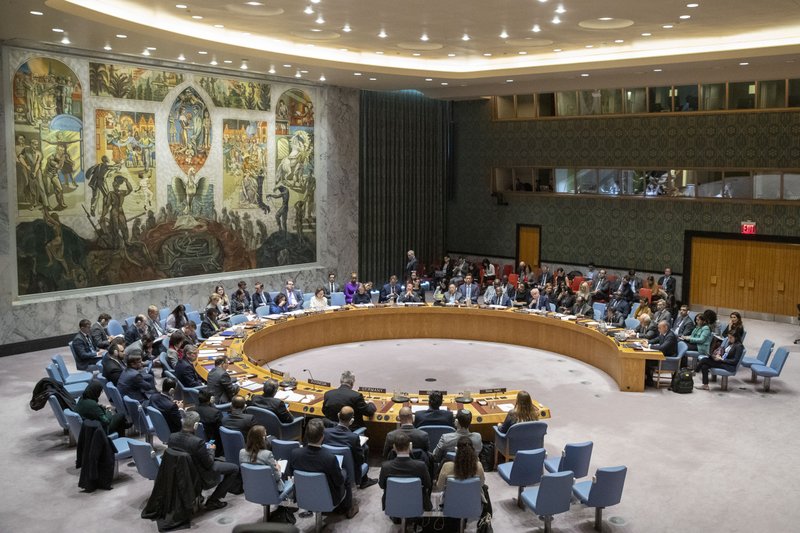
UN Security Council rebukes US on Israel settlements

The UN Security Council holds a meeting on the Middle East, including the Palestinian question, Wed, Nov 20, 2019, at United Nations headquarters. (photo: Mary Altaffer / AP)

“If we abandon international law, it will be the law of the jungle.”

By Edith Lederer | AP | Nov 20, 2019

‘Israeli settlement activities are illegal, erode the viability of the two-state solution and undermine the prospect for a just, lasting and comprehensive peace.’
— Joint statement from the 10 non-permanent Security Council members

In a sharp rebuke to the Trump administration, the 14 other U.N. Security Council members on Wednesday strongly opposed the U.S. announcement that it no longer considers Israeli settlements to be a violation of international law.

They warned that the new American policy undermines a two-state solution to the Israeli-Palestinian conflict.

The council’s monthly Mideast meeting, just two days after U.S. Secretary of State Mike Pompeo’s announcement, was dominated by negative reaction to the new American policy from countries representing all regions of the world who said all Israeli settlements are illegal under international law. Continue reading “UN Security Council rebukes US on Israel settlements”

The latest shot in the Trump administration’s war on Palestinian rights

Secretary of State Mike Pompeo delivers a statement on Israeli settlements in the West Bank during a news briefing in Washington on Monday. (photo: Yara Nardi / Reuters)

The administration has neither the right nor the agency to rewrite international law to suit its own biases and ideologies. Endorsing the results of crimes, such as the construction of settlements, amounts to complicity. It is unacceptable and unconscionable.

By Hanan Ashrawi | The Washington Post | Nov 20, 2019

Thousands of acres of private Palestinian land have been stolen or destroyed in order to make way for settlements and the roads and infrastructure that connect them. The regime has de facto control over nearly 60 percent of the occupied West Bank, and has separated Palestinian families from each other and Palestinian farmers from their land. Entire communities have been imprisoned behind a matrix of walls and Israeli-only roads, military bases and checkpoints.

On Monday, in a move that reversed more than 40 years of U.S. policy, Secretary of State Mike Pompeo announced that the Trump administration does not consider Israeli settlements built on occupied Palestinian land to be illegal. This latest gift from the Trump administration to the Israeli right is inconsistent with international law, United Nations resolutions and positions adopted by the rest of the international community. Although it has no legal validity, the decision undermines the most fundamental precepts of international law, including the inadmissibility of acquiring territory by force. This will undoubtedly have far-reaching and global consequences.

Pompeo’s reckless announcement threatens to normalize and encourage Israeli war crimes and expansionism, while emboldening other states with expansionist agendas to take steps that would further unravel the world order. It is an overt green light for Israeli annexation of Palestinian territory and the permanent denial of the Palestinian people’s rights to freedom and self-determination.

The issue of settlements is not some abstract or theoretical legal argument. Israel’s illegal settlement regime has had dire consequences on the lives and livelihoods of millions of Palestinians. It is the single greatest obstacle to the realization of the two-state formula, which has been the centerpiece of international peacemaking efforts — however feeble — for decades.

Continue reading “The latest shot in the Trump administration’s war on Palestinian rights”

America legitimizes Israeli settlements in the West Bank

An Israeli settlement in the occupied Palestinian territories in the West Bank. (photo: AFP)

The intervention will have no immediate effect on the ground but will delight evangelical American voters and may have harmful consequences.

By Staff | The Economist | Nov 19, 2019

[I]t is easy to dismiss the administration’s switch of policy as largely an empty gesture, aimed at a domestic audience, and intended mainly to appeal to the pro-Israel evangelical American voters Mr Trump will need for re-election in 2020. But it could have harmful effects in the longer term.

The announcement on November 18th by Mike Pompeo, the American secretary of state, was unscheduled but not entirely unexpected. He said that, following a legal review by the State Department, Israeli settlements in the West Bank are “not, per se, inconsistent with international law.” This is the latest in a series of such gestures by the Trump administration over the past two years, including recognizing Jerusalem as Israel’s capital and accepting its sovereignty over the occupied Golan Heights.

Looked at more broadly, the change of policy is also wholly in tune with Donald Trump’s tendency to disregard accepted diplomatic norms. Despite some dissenting views, the wide international consensus for decades has been that the settlements Israel has built in the territories it captured in the war with Arab states in 1967 are indeed illegal. They are deemed to contravene the Fourth Geneva Convention, which stipulates that “the occupying power shall not deport or transfer parts of its own civilian population into the territory it occupies.”

For over four decades, this has been the view even of Israel’s allies, including most American administrations (with the exception of Ronald Reagan’s, cited by Mr Pompeo). However, Israel, undeterred, has clung to its own interpretation of international law. Over the past 52 years it has built hundreds of settlements, both in east Jerusalem, which it formally annexed in 1967, and in the wider areas of the West Bank (what Israel calls Judea and Samaria). Palestinians, and much of the rest of the world, regard these, as well as the Gaza Strip, as belonging to a future Palestinian state.

Continue reading “America legitimizes Israeli settlements in the West Bank”

Israel’s growing settlements force stark choices about its future

Screen Shot 2019-11-19 at 14.57.33
(Graphic: The Economist)

The country cannot remain Jewish and democratic while controlling the entire Holy Land.

By Staff | The Economist | Feb 2, 2019

As Palestinians lose hope for a state of their own, some favor a ‘one-state’ deal: a single state on all the land with equal rights for Jews and Arabs. Israel would have to give up its predominantly Jewish identity. That is because, between the Mediterranean and the Jordan river, the overall number of Arabs has caught up with that of Jews, and may soon exceed them.

Israeli-Palestinian peace talks are frozen. President Donald Trump’s plan for the “deal of the century” has been put off. The subject is absent in campaigning for the Israeli election in April, which focuses on looming corruption charges against Binyamin Netanyahu, the prime minister.

The Oslo accords of 1993 created a crazy quilt of autonomous zones in the lands that Israel captured in 1967. They also kindled the hope of creating a Palestinian state in most of the West Bank and Gaza Strip, with its capital in East Jerusalem. After much bloodshed, though, most Israelis are wary of this “two-state solution.” Today Palestinians are mostly shut off by security barriers, and divided. The Palestinian Authority in the West Bank refuses to negotiate with Israel but co-operates on security. Its Islamist rival, Hamas, which runs Gaza, dares not risk another war, for now.

Besides, the growth of Jewish settlements makes a two-state deal ever harder. Establishing a Palestinian state would probably require the removal of settlers in its territory. Israel had trouble enough evicting 8,000 Jews from Gaza in 2005. There are more than fifty times as many in the West Bank. Even excluding East Jerusalem, annexed by Israel, the number of Jews east of the “green line” (the pre-1967 border) has risen from 110,000 in 1993 to 425,000. New home approvals nearly quadrupled from 5,000 in 2015–16 to 19,000 in 2017–18, according to Peace Now, a pressure group.

Continue reading “Israel’s growing settlements force stark choices about its future”

US says West Bank settlements do not violate international law

Secretary of State Mike Pompeo speaks at a news conference at the State Department in Washington, DC, Nov 18, 2019. (photo: Andrew Harnik / AP)

More than 700,000 Israeli settlers have taken up residence in the West Bank and East Jerusalem since the 1967 war. Both areas are historic Palestinian territories currently under Israeli military occupation.

By Karen DeYoung, Steve Hendrix and John Hudson | The Washington Post | Nov 18, 2019

‘The timing of this was not tied to anything that had to do with domestic politics anywhere. We conducted our review, and this was the appropriate time to bring it forward.’
— Secretary of State Mike Pompeo

Secretary of State Mike Pompeo said Monday that the Trump administration had determined that Israel’s West Bank settlements do not violate international law, a decision he said had “increased the likelihood” of a Middle East peace settlement.

Pompeo said the Trump administration, as it did with recognition of Jerusalem as the Israeli capital and Israel’s sovereignty over the disputed Golan Heights, had simply “recognized the reality on the ground.”

The move upends more than 40 years of U.S. policy that has declared Israeli expansion into territories occupied since the 1967 war a major obstacle to settling the Israeli-Palestinian conflict.

Continue reading “US says West Bank settlements do not violate international law”