“Decades of chaos”: Arab leaders condemn US decision on Jerusalem

6500
A Jordanian protester holds a poster depicting the US president Donald Trump during a demonstration outside the US embassy in Amman. (photo: Amel Pain / EPA)

Donald Trump’s unilateral move to back Israel’s claim to holy city has reunited competing factions across the Middle East to a common cause.

By Martin Chulov | The Guardian | Dec 7, 2017


“Previous American presidents never touched on the subject of Jerusalem because they knew it goes beyond the Israeli Palestinian conflict. It involves Muslims worldwide. Unfortunately Trump doesn’t have a historical or political background. If his intention is to solve the Palestinian conflict he chose the wrong door. Jerusalem is not a political symbol but will forever be a religious one.”


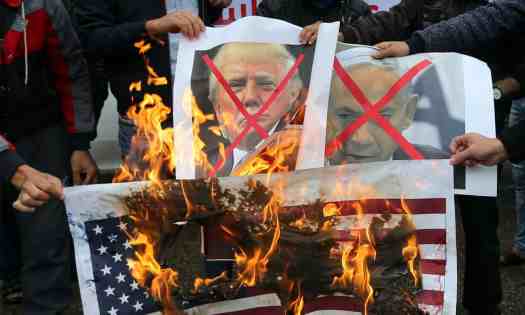
The Trump administration’s recognition of Jerusalem as Israel’s capital has drawn widespread condemnation across the Arab world, with political leaders, commentators and locals labelling the move as provocative and a threat to global security.

The decision has been cast as the final nail in the coffin of a two-state solution to the Israel/Palestine conflict – an approach broadly recognised by Arab states – and the end of meaningful US diplomacy between both sides after almost 70 years.

It has also allowed competing factions across the Middle East to refocus on a common cause that had drifted from the spotlight over the past five years, eclipsed by regional power plays, war and insurrection.

Continue reading ““Decades of chaos”: Arab leaders condemn US decision on Jerusalem”

UN Security Council to discuss US recognition of Jerusalem

1029277430
A Palestinian protester hurls stones towards Israeli troops during clashes at a protest against Trump’s decision to recognize Jerusalem as the capital of Israel, near the West Bank city of Ramallah. (photo: Mohamad Torokman / Reuters)

Meeting to be held as Palestinian protests and global criticism grow over Trump recognising Jerusalem as Israeli capital.

By Peter Beaumont | The Guardian | Dec 7, 2017


Recognizing Jerusalem as Israel’s capital puts the US out of step with the rest of the world, and legitimizes Israeli settlement-building in the east — considered illegal under international law.


The UN security council is expected to meet on Friday to discuss Donald Trump’s recognition of Jerusalem as Israel’s capital, a decision against which condemnation continues to mount across the Middle East and internationally.

Eight countries on the 15-member council requested the meeting, including the UK, Italy and France, amid claims from Palestine and Turkey that Trump’s recognition is in breach of both international law and UN resolutions.

The EU foreign policy chief, Federica Mogherini, said the bloc had united position that Jerusalem must be the capital of both Israel and a future Palestinian state. The Russian foreign ministry said US recognition risked “dangerous and uncontrollable consequences.”

Continue reading “UN Security Council to discuss US recognition of Jerusalem”

Trump’s error on Jerusalem is a disaster for the Arab world . . . and the US too

3500
Palestinians protest against US plans to move its embassy to Jerusalem, Rafah, Dec 6, 2017. (photo: Ibraheem Abu Mustafa / Reuters)

The president’s foolish move in recognizing the city as the capital of Israel will have negative consequences impossible to predict.

By Rashid Khalidi | The Guardian | Dec 6, 2017


It is now hard to see how a sustainable Palestinian-Israeli agreement is possible. True to Trump form, this is an entirely self-inflicted wound that will long echo in the annals of diplomacy. It will further diminish the already reduced standing of the US, complicating relations with allies, with Muslims and Arabs — and with people of common sense the world over.


Every time it seems Donald Trump cannot outdo himself, he does it again. Now he has announced that his administration will recognize Jerusalem as Israel’s capital, reversing nearly seven decades of American policy. This step will have multiple negative ramifications, many impossible to predict.

Jerusalem is the most important of the so-called final status issues that have been repeatedly deferred during the Israel-Palestine negotiations because of their extreme sensitivity. Trump has plowed into this imbroglio like a bull in a china shop, zeroing in on the most complex and emotional issue of all those connected to Palestine.

Continue reading “Trump’s error on Jerusalem is a disaster for the Arab world . . . and the US too”

Donald Trump’s Jerusalem statement is an act of diplomatic arson

3300
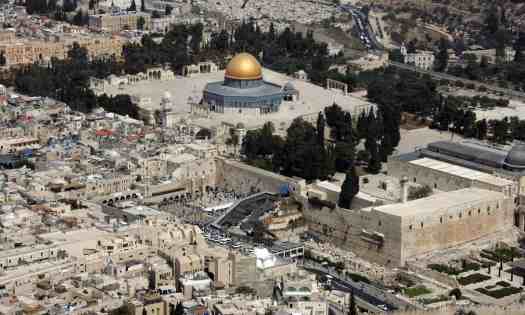
“The place that represents the nuclear core of this most radioactive conflict, the site Muslims call the Haram al-Sharif and Jews call the Temple Mount.” (photo: Jack Guez / AFP / Getty Images)

The US president’s recognition of Jerusalem as the capital of Israel turns a naked flame on the single most combustible issue in the conflict.

By Jonathan Freedland | The Guardian | Dec 6, 2017


Here comes Trump, oblivious to precedent and indeed history — even in a place where history is a matter of life and death — stomping through this delicate thicket, trampling over every sensitivity. The risk is obvious, with every Arab government — including those loyal to Washington — now issuing sharp warnings on the perils of this move, almost all of them using the same word: “dangerous.”


Not content with taking the US to the brink of nuclear conflict with North Korea, Donald Trump is now set to apply his strategy of international vandalism to perhaps the most sensitive geopolitical hotspot in the world. With a speech scheduled for later today that’s expected to recognize Jerusalem as the capital of Israel and reaffirm a pledge to move the US embassy to the city, he is walking into a bone-dry forest with a naked flame.

For the status of Jerusalem is the most intractable issue in what is often described as the world’s most intractable conflict. It is the issue that has foiled multiple efforts at peacemaking over several decades. Both Israelis and Palestinians insist that Jerusalem must be the capital of their states, present and future, and that that status is non-negotiable.

Continue reading “Donald Trump’s Jerusalem statement is an act of diplomatic arson”

BREAKING NEWS: Trump recognizes Jerusalem as capital of Israel

4050
President Trump making his announcement at the White House with Vice President Mike Pence, Dec 6, 2017. (photo: Mandel Ngan / AFP / Getty Images)

Defying near-universal opposition, Trump insists the move will facilitate peace.

By Julian Borger and Peter Beaumont | The Guardian | Dec 6, 2017


Q&A: Why would moving the US embassy to Jerusalem be so contentious?

Of all the issues at the heart of the enduring conflict between Israel and the Palestinians, none is as sensitive as the status of Jerusalem. The holy city has been at the centre of peace-making efforts for decades.
Seventy years ago, when the UN voted to partition Palestine into Jewish and Arab states, Jerusalem was defined as a separate entity under international supervision. In the war of 1948 it was divided, like Berlin in the cold war, into western and eastern sectors under Israeli and Jordanian control respectively. Nineteen years later, in June 1967, Israel captured the eastern side, expanded the city’s boundaries and annexed it — an act that was never recognized internationally.
Israel routinely describes the city, with its Jewish, Muslim and Christian holy places, as its “united and eternal” capital. For their part, the Palestinians say East Jerusalem must be the capital of a future independent Palestinian state. The unequivocal international view, accepted by all previous US administrations, is that the city’s status must be addressed in peace negotiations.
Any move to recognize Jerusalem as Israel’s capital would put the US out of step with the rest of the world, and legitimize Israeli settlement-building in the east considered illegal under international law.


Donald Trump has defied overwhelming global opposition by declaring US recognition of Jerusalem as the capital of Israel, but insisted that the highly controversial move would not derail his own administration’s bid to resolve the Israeli-Palestinian conflict.

In remarks delivered in the diplomatic reception room of the White House, Trump called his decision “a long overdue” step to advance the peace process.

“I have determined that it is time to officially recognize Jerusalem as the capital of Israel,” Trump said. “While previous presidents have made this a major campaign promise, they failed to deliver. Today, I am delivering.”

Continue reading “BREAKING NEWS: Trump recognizes Jerusalem as capital of Israel”

Media run-up to Trump’s recognizing Jerusalem as the capital of Israel

6720
Israeli flag flies overlooking the old city of Jerusalem. (photo: Abir Sultan / EPA)

Major print media coverage in anticipation of Trump’s announcement.


The New York Times:

“We believe that any action that would undermine these efforts must absolutely be avoided. A way must be found through negotiations to resolve the status of Jerusalem as a future capital of both states.”
— Federica Mogherini, High Representative of the European Union for Foreign Affairs and Security Policy

Read the full article here →


The Washington Post:

Most important will be the language Trump uses in his announcement. If he repeats the Israeli line that Jerusalem is the “undivided” capital of Israel, Trump will run the risk of angering Palestinians who will view that as proof that the United States does not support their push for statehood.

Read the full article here →


The Guardian:

“A better prepared, less clumsy process could have produced an announcement to actually move the embassy to Jerusalem, which is where it belongs. Instead the president is leaving us half-pregnant. Israelis deserve to have their capital recognized and our embassy located there. Palestinians need to know that the capital of their state will be in East Jerusalem. Instead of being clear on both of these points, the President has chosen a purely rhetorical approach, changing nothing on the ground, but spinning up significant controversy for virtually no gain.”
— Daniel Shapiro, a former US ambassador to Israel

Read the full article here →


Continue reading “Media run-up to Trump’s recognizing Jerusalem as the capital of Israel”

A wary response to Trump’s expected recognition of Jerusalem

03jerusalem-superjumbo
The Damascus Gate to Jerusalem’s Old City. (photo: Bernat Armangue / AP)

President Trump is expected to break decades of precedent by declaring Jerusalem the capital of Israel.

By David Halbfinger | New York Times | Dec 2, 2017


“Pushing this issue now, in advance of a peace process at a time when the administration has zero credibility on this issue, at a time when it wants to engage the Saudis, makes absolutely no sense. It’s a self-inflicted wound.”
— Aaron David Miller, former Mideast peace negotiator under past Republican and Democratic administrations


There were warnings of a new Palestinian uprising and calls for protests at United States embassies, dire predictions that hopes for peace would be dashed irretrievably — and expressions of relief from Israelis who have waited a half-century for the world to remove the asterisk next to this city’s name.

Yet on the whole, the responses in the region to reports that President Trump will recognize Jerusalem as the capital of Israel — something no president has done in the nearly 70 years since Israel’s founding — remained hedged, if not entirely restrained, on Saturday. Arabs and Israelis alike were impatient to see whether Mr. Trump would really do it, precisely how he would define Jerusalem, and what else he might say or do to qualify the change.

Mr. Trump’s announcement, expected in a speech on Wednesday, would amount to the not-quite fulfillment of a campaign promise to move the United States Embassy to Jerusalem from Tel Aviv, a step for which many of Mr. Trump’s Jewish and evangelical supporters, and their allies in the Israeli right wing, have been clamoring.

Continue reading “A wary response to Trump’s expected recognition of Jerusalem”

Trump Chases His “Ultimate Deal”

trump-chases-his-ultimate-deal-1200
(photo: Evan Vucci)

What is the basis of optimism In Israel about Donald Trump? For many, it seems to be his apparent endorsement of an “outside-in” peace process.

By Nathan Thrall / The New Yorker
May 22, 2017


The outside-in approach is merely the latest in a series of failed tactics aimed at creating new incentives to make peace, rather than pursuing strategies — withholding financial assistance, to begin with — that steer the parties away from the status quo. Trump frightens Israeli leaders precisely because he is one of the only American politicians they could imagine even considering the latter approach.


Not so long ago, President Donald Trump had backers of the Israeli-Palestinian peace process worried and Israeli settlers and annexationists elated. Many were convinced that a change in U.S. policy toward Israel was imminent, not least because the President’s three main advisers on Israel were modern Orthodox Jews with ties to West Bank settlements. Mr. Trump’s chief negotiator, Jason Greenblatt, is a former West Bank yeshiva student. The new U.S. Ambassador to Israel, David Friedman, until recently headed a settler fund-raising group. And the family of Jared Kushner, Trump’s son-in-law, has donated to the institutions of a settlement northeast of Ramallah.

For months after Trump’s election, Palestinians couldn’t manage to arrange so much as a phone call with his senior advisers. And, at a White House press conference in February with Prime Minister Benjamin Netanyahu, Trump himself expressed ambivalence about Palestinian statehood. Few doubted Naftali Bennett, the head of the pro-settler Jewish Home Party, when he declared that “the era of a Palestinian state is over.”

Today, however, Palestinians leaders are roundly praising Trump — not just Mahmoud Abbas, the head of the Palestinian Authority, but also Khaled Meshal, the former leader of Hamas. In Trump, they see the rare possibility of an American President who appears capable of challenging the decades-long bipartisan consensus to underwrite Israel’s occupation while making empty promises to end it. The fact that Mr. Trump is a Republican and surrounds himself with lifelong Zionists makes him seem even better positioned to twist Israel’s arm. Palestinians took note when, during the Republican primaries, Trump vowed to be a neutral mediator, refused to blame only one side for the Israeli-Palestinian conflict, and declined to back down when attacked, even though he had many electoral and financial incentives to do otherwise.

Continue reading “Trump Chases His “Ultimate Deal””

How Can Trump Make Peace Without a Partner in Palestine?

President Trump Welcomes Palestinian President Abbas To White House
(photo: Olivier Douliery / Getty Images)

The aging Mahmoud Abbas is more likely to preside over the collapse of Palestinian institutions than the creation of an independent state.

By Grant Rumley / Foreign Policy
May 18, 2017


If Trump cares about the fate of the Palestinians, he would be wise not to ignore the looming crisis. . . . When Trump repays the visit [to Abbas] next week he’ll want to consider what his newfound partner is doing to ensure a stable future in the West Bank.


President Donald Trump visits Israel next week at a supremely awkward moment, amid reports that he shared Israeli intelligence with Russian officials in the Oval Office. Both sides are likely to do their best to bury the issue. The Israelis value intelligence sharing too much to raise the issue publicly, and Trump will no doubt prefer to speak about his efforts to restart negotiations with the Palestinians — a process he hopes can yield the “ultimate deal.”

The president appears serious about trying to bring a solution to this interminable problem. National Security Advisor H.R. McMaster went so far as to say that the U.S. goal was Palestinian “self-determination,” a term previous administrations also used to describe Palestinian statehood. But rather than overseeing the creation of a Palestinian state, Trump’s term could very well witness the collapse of Palestinian institutions.

Continue reading “How Can Trump Make Peace Without a Partner in Palestine?”

Is Trump Visiting Israel to Praise Bibi — Or To Bury Him?

Israel's Prime Minister Netanyahu attends the weekly cabinet meeting in Jerusalem
(photo: PBS)

Trump has much to gain and little to lose; the reverse is true of Netanyahu.

By J. J. Goldberg / Forward
May 2, 2017


Israelis with ties to the Trump administration are reporting, according to political correspondent Tal Shalev of the widely read Walla news site, that the president wants to convene a “regional summit” of Middle East leaders this summer in Washington. Participants would include Egypt, Jordan and Saudi Arabia, along with Israel and the Palestinian Authority. The agenda would be based on the Saudi-led Arab Peace Initiative.


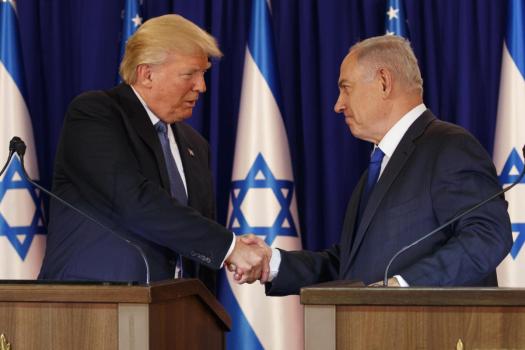
When Donald Trump visits Israel later this month, as he reportedly will do, he faces much to potentially gain and little to lose. The reverse is true of his host, Israel’s prime minister, Benjamin Netanyahu.

For Trump, it’s an opportunity to show some statesmanship and gravitas — qualities he’s not widely associated with — in a friendly environment. It’s an opportunity to solidify his shaky relationship with the ardently pro-Israel Republicans in Congress, who’ve been repeatedly undermined or plain flummoxed by Trump’s unpredictable antics. And — who knows? — he just might make some progress where so many have failed: getting the Israeli-Palestinian deadlock unstuck. Strange things happen when Trump’s around.

Besides, if he tries and fails, it will simply end up being another implausible promise he’s made and then airily dismissed. We’re used to it.

Continue reading “Is Trump Visiting Israel to Praise Bibi — Or To Bury Him?”