Palestinian national dish fuels Al-Aqsa protests

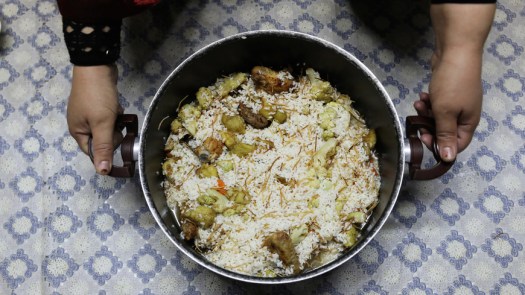
A Palestinian woman prepares maqlouba at her home in the East Jerusalem neighborhood of Jabel Mukaber
A Palestinian woman prepares maqluba at her home in the East Jerusalem neighborhood of Jabel Mukaber, Aug 21, 2017. (photo: Ammar Awad / Reuters)

Maqluba, the beloved traditional Palestinian dish, has become a tradition of the protests in Jerusalem and elsewhere, reinforcing Palestinian community and solidarity.

By Ahmad Melhem | Al-Monitor | Jan 11, 2018


“During the sit-in against Trump’s decision at the Damascus Gate, I made sure to serve maqluba, a popular Palestinian national dish, to the young protesters as a way to underline that Jerusalem is the capital of Palestine, with all its people, food and culture. People are now keen to have maqluba every week with their families in Al-Aqsa’s squares as a kind of tradition and custom to guard the mosque. . . . The true maqluba is not made with rice, chicken and vegetables but with steadfastness, persistence and perseverance and with shouts and cheers when flipped upside down.”


While hundreds of demonstrators shouted slogans on Dec 11 against US President Donald Trump in front of the Damascus Gate, one of the main entrances to Al-Aqsa, Khadija Khweis and her friend Hanadi al-Halawani were flipping pots of maqluba to serve to the protesters. In the last 12 months, this traditional food, also called the “dish of victory,” has become a part of the Palestinian protests.

Every Sunday throughout December, when people of Jerusalem held demonstrations to protest Trump’s decision to recognize Jerusalem as the capital of Israel, they would bring large pots of maqluba, which literally means “upside down” in Arabic, and eat it under the eyes of the Israeli police. The flipping of the pots as the cooks shouted “Allahu Akbar” became a ritual, and the dish also came to be called by both the Palestinians and the Israelis as the “dish of spite.”

Halawani told Al-Monitor, “During the sit-in against Trump’s decision at the Damascus Gate, I made sure to serve maqluba, a popular Palestinian national dish, to the young protesters as a way to underline that Jerusalem is the capital of Palestine, with all its people, food and culture. People are now keen to have maqluba every week with their families in Al-Aqsa’s squares as a kind of tradition and custom to guard the mosque.”

Continue reading “Palestinian national dish fuels Al-Aqsa protests”

Tapes reveal Egyptian leaders’ tacit acceptance of Jerusalem move

merlin_131695367_2ba55a6a-c40d-4fa3-b1e0-42e8985d5470-master675
As Palestinian protesters clashed with Israeli soldiers in the West Bank, an Egyptian intelligence officer was quietly working to persuade Egyptians to accept the decision. (photo: Shadi Hatem / European Pressphoto Agency)

Arab governments publicly condemned President Trump’s statement on Jerusalem but criticism in state-owned and pro-government media across the Arab world was muted.

By David D. Kirkpatrick | The New York Times | Jan 6, 2018


“How is Jerusalem different from Ramallah, really?”
— Egyptian intelligence officer Capt. Ashraf al-Kholi


As President Trump moved last month to recognize Jerusalem as the capital of Israel, an Egyptian intelligence officer quietly placed phone calls to the hosts of several influential talk shows in Egypt.

“Like all our Arab brothers,” Egypt would denounce the decision in public, the officer, Capt. Ashraf al-Kholi, told the hosts.

But strife with Israel was not in Egypt’s national interest, Captain Kholi said. He told the hosts that instead of condemning the decision, they should persuade their viewers to accept it. Palestinians, he suggested, should content themselves with the dreary West Bank town that currently houses the Palestinian Authority, Ramallah.

Continue reading “Tapes reveal Egyptian leaders’ tacit acceptance of Jerusalem move”

Trump’s plan to move US embassy to Jerusalem angers Middle East Christians

2017-12-13t182717z_179724779_rc1be779c0b0_rtrmadp_3_usa-trump-israel
Christians in Amman, Jordan, protest President Trump’s recognition of Jerusalem as Israel’s capital on Dec 13, 2017. (photo: Muhammad Hamed / Reuters)

Religious leaders turned off Bethlehem’s Christmas tree lights to protest the White House announcement.

By Loveday Morris | The Washington Post | Dec 13, 2017


“When they talk about Christian minorities in danger, they talk about Iraq and other regions where ISIS is the threat. They never, ever address the issue of Palestinian Christians under Israeli occupation. . . . Our mere existence as Christians here is inconvenient as it means this conflict can’t be framed as a religious war between Jews and Muslims. It’s not about religion. It’s a political conflict over land and resources.”
— Rev. Mitri Raheb, a Lutheran pastor in Bethlehem


Some of the festive cheer was missing this weekend at a public Christmas tree lighting near the site where Christians believe an angel proclaimed Christ’s birth to local shepherds.

“Our oppressors have decided to deprive us from the joy of Christmas,” Patriarch Michel Sabbah, the former archbishop and Latin patriarch of Jerusalem, told the crowd in the town of Beit Sahour in the Israeli-occupied West Bank. “Mr. Trump told us clearly Jerusalem is not yours.”

The Trump administration’s decision to recognize Jerusalem as Israel’s capital and move the U.S. Embassy there has provoked widespread opposition among Christians across the Middle East. When Vice President Pence arrives next week on a trip touted as a chance to check on the region’s persecuted Christians, he will be facing an awkward backlash.

Continue reading “Trump’s plan to move US embassy to Jerusalem angers Middle East Christians”

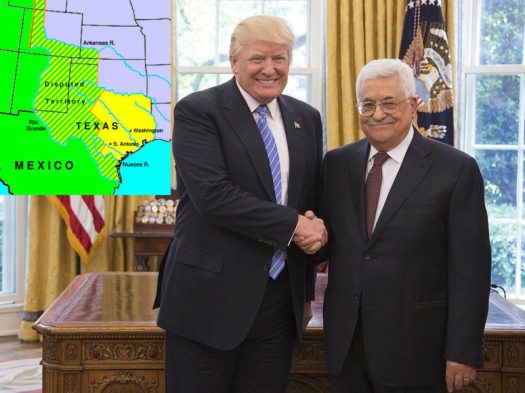
Palestinians recognize Texas as part of Mexico

trump-and-abbas-800x600

By Alex Huntley | The Beaverton | Dec 6, 2017


The Palestinian consulate in Mexico City will soon be moved to Houston to formally recognize the seized territory as part of Mexico.


In response to US President Donald Trump’s recognition of Jerusalem as the Israeli capital, the Palestinian National Authority has announced that it will recognize Texas as a state of Mexico since it was violently annexed by the United States in the 1840’s.

“The territory north and east of the Rio Grande is very important to the Mexican people,” explained a PNA spokesperson. “Before American settlers showed up and implemented slavery, Mexico oversaw this land. Then, President Polk sent his armies to invade the rest of these Mexican territories, and force the country to give up California, New Mexico, most of Arizona, Nevada, and Utah, and parts of Wyoming and Colorado. We may soon recognize these states as part of Mexico, too.”

Palestinian President Mahmoud Abbas says that this is a new approach to Mexican-US relations, and hopes it will help ease the tension between the two countries over security and immigration.

Continue reading “Palestinians recognize Texas as part of Mexico”

Did Trump kill off a two-state solution?

08two-state-print-master768
Palestinians demonstrating in Jerusalem, Dec 7, 2017. (photo: Uriel Sinai / The New York Times)

A one-state solution may now be the only viable option.

By Mark Lander, David Halbfinger and Isabel Kershner | The New York Times | Dec 7, 2017


“They’ve left us with no option [except a one-state solution],” he said. “This is the reality. We live here. Our struggle should focus on one thing: equal rights.”
— Saeb Erekat, the secretary general of the Palestine Liberation Organization


President Trump, in formally recognizing Jerusalem as the capital of Israel on Wednesday, declared that the United States still supported a two-state solution to settle the conflict between the Israelis and Palestinians, provided it was “agreed to by both sides.”

For the first time in his 26 years as a peacemaker, the chief negotiator for the Palestinians did not agree.

Saeb Erekat, the secretary general of the Palestine Liberation Organization and a steadfast advocate for a Palestinian state, said in an interview on Thursday that Mr. Trump and Prime Minister Benjamin Netanyahu of Israel “have managed to destroy that hope.” He embraced a radical shift in the P.L.O.’s goals — to a single state, but with Palestinians enjoying the same civil rights as Israelis, including the vote.

Continue reading “Did Trump kill off a two-state solution?”

“Decades of chaos”: Arab leaders condemn US decision on Jerusalem

6500
A Jordanian protester holds a poster depicting the US president Donald Trump during a demonstration outside the US embassy in Amman. (photo: Amel Pain / EPA)

Donald Trump’s unilateral move to back Israel’s claim to holy city has reunited competing factions across the Middle East to a common cause.

By Martin Chulov | The Guardian | Dec 7, 2017


“Previous American presidents never touched on the subject of Jerusalem because they knew it goes beyond the Israeli Palestinian conflict. It involves Muslims worldwide. Unfortunately Trump doesn’t have a historical or political background. If his intention is to solve the Palestinian conflict he chose the wrong door. Jerusalem is not a political symbol but will forever be a religious one.”


The Trump administration’s recognition of Jerusalem as Israel’s capital has drawn widespread condemnation across the Arab world, with political leaders, commentators and locals labelling the move as provocative and a threat to global security.

The decision has been cast as the final nail in the coffin of a two-state solution to the Israel/Palestine conflict – an approach broadly recognised by Arab states – and the end of meaningful US diplomacy between both sides after almost 70 years.

It has also allowed competing factions across the Middle East to refocus on a common cause that had drifted from the spotlight over the past five years, eclipsed by regional power plays, war and insurrection.

Continue reading ““Decades of chaos”: Arab leaders condemn US decision on Jerusalem”

UN Security Council to discuss US recognition of Jerusalem

1029277430
A Palestinian protester hurls stones towards Israeli troops during clashes at a protest against Trump’s decision to recognize Jerusalem as the capital of Israel, near the West Bank city of Ramallah. (photo: Mohamad Torokman / Reuters)

Meeting to be held as Palestinian protests and global criticism grow over Trump recognising Jerusalem as Israeli capital.

By Peter Beaumont | The Guardian | Dec 7, 2017


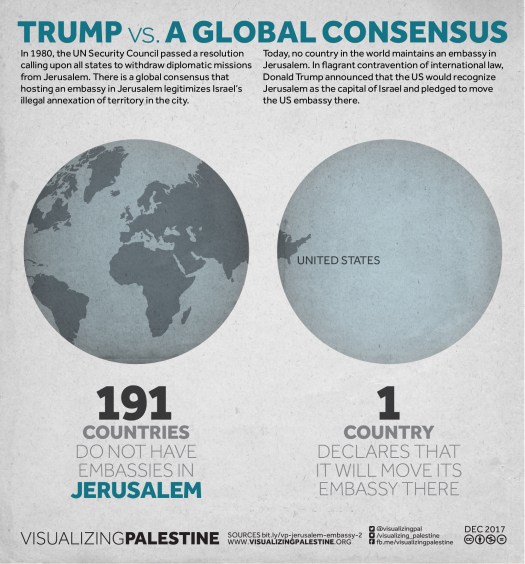
Recognizing Jerusalem as Israel’s capital puts the US out of step with the rest of the world, and legitimizes Israeli settlement-building in the east — considered illegal under international law.


The UN security council is expected to meet on Friday to discuss Donald Trump’s recognition of Jerusalem as Israel’s capital, a decision against which condemnation continues to mount across the Middle East and internationally.

Eight countries on the 15-member council requested the meeting, including the UK, Italy and France, amid claims from Palestine and Turkey that Trump’s recognition is in breach of both international law and UN resolutions.

The EU foreign policy chief, Federica Mogherini, said the bloc had united position that Jerusalem must be the capital of both Israel and a future Palestinian state. The Russian foreign ministry said US recognition risked “dangerous and uncontrollable consequences.”

Continue reading “UN Security Council to discuss US recognition of Jerusalem”

Jerusalem for dummies: Why the world doesn’t recognize Jerusalem as Israel’s capital

1745075972
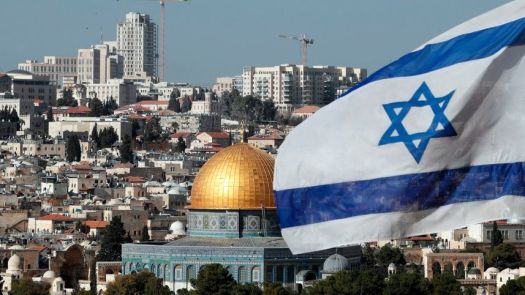
The Israeli flag fluttering in front of the Dome of the Rock mosque and the city of Jerusalem. (photo: Haaretz)

And why the possibility that Trump might do just that, seven decades after Israel’s establishment, is such a source of apprehension worldwide.

By David Green | Haaretz | Dec 7, 2017


As long as the sides cannot decide on a mutually agreeable plan for sharing sovereignty in Jerusalem, . . . [and as long as] the world community [has not] concluded that it must impose a solution on the sides — it would be highly improbable for any individual state to unilaterally give official recognition to Jerusalem as its capital.
Any individual state, that is, not led by Donald J. Trump.


Jerusalem is holy to three religions. Jerusalem is a powder keg, and the smallest wrong move there could set off a religious war. The Arab-Israeli conflict will never be solved until the Jerusalem question is resolved.

Yes, these are all truisms, and you’ve heard them a thousand times or more. But there’s a reason why the root of the word “truism” is “true.” For Jews, Jerusalem is where their Temple — the home of their one god — stood, in its various incarnations. Each time they were exiled from their cultic and political capital in ancient times, they dreamed of returning, and the term “Zion,” the name of one of the city’s hills, became a metonymy not only for the city itself, but for the Land of Israel in general, and the basis of the name of the modern movement calling for establishment of a Jewish state there.

So, why don’t the nearly 160 countries that have diplomatic relations with the State of Israel recognize Jerusalem as its capital, and why is the possibility that the United States may do just that now, nearly seven decades after Israel’s establishment, a source of such apprehension worldwide?

Continue reading “Jerusalem for dummies: Why the world doesn’t recognize Jerusalem as Israel’s capital”