UNESCO Resolution on Jerusalem

The facts lost in the PR frenzy

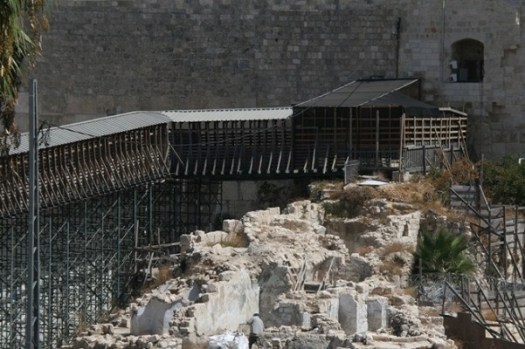
mughrabi-gate-site-1
Image courtesy of Palestine Unbound

Justine Berg / Palestine Square
October 25, 2016


“The resolution prompted Israel to suspend cooperation with UNESCO, however an analysis of its actions reveals that Israel has not been keen on cooperating with the world cultural organization for almost ten years. In fact, the drama Israel has caused around this resolution may be a way to entrench its continued non-compliance with UNESCO decisions.”


In the days leading up to the adoption of a UNESCO resolution on Occupied Palestine, the media has focused almost exclusively on Israel’s allegation that the resolution denies Jewish heritage in the Old City of Jerusalem. A deeper look at the text of the resolution, as well as a review of developments in the Old City over the past decade, offer insight into the possible reasons for the creation of this media narrative. Simply put, it is part of a long series of repeated Israeli attempts to deflect attention from the ways in which Tel Aviv has refused to comply with previous UNESCO decisions on Jerusalem.

The flurry of news articles following the acceptance of the resolution on October 18th have continuously recycled Israeli claims that it is “contentious” and “anti-Israel” because it “ignores” and “denies” Jewish connection to Jerusalem’s holy sites. The text, however, specifically “[affirms] the importance of the Old City of Jerusalem and its Walls for the three monotheistic religions,” and references other UNESCO documents that do the same. (For instance document 200 EX/25, which states “the Old City of Jerusalem is the sacred city of the three monotheistic religions — Judaism, Christianity and Islam, and . . . each of its communities has a right to the explicit recognition of their history and relationship with the city.”)

The resolution prompted Israel to suspend cooperation with UNESCO, however an analysis of its actions reveals that Israel has not been keen on cooperating with the world cultural organization for almost ten years. In fact, the drama Israel has caused around this resolution may be a way to entrench its continued non-compliance with UNESCO decisions.

[Continue reading here . . . ]


“Israel, the occupying Power, had not complied with any of the 12 decisions of the UNESCO Executive Board as well as six decisions of the World Heritage Committee that request the implementation of the reactive monitoring mission to the Old City of Jerusalem and its Walls.”


At the Boiling Point with Israel

The New York Times Editorial Board
October 6, 2016


“The ever expanding settlements have poisoned Palestinian hopes and functioned variously as a spark, a target and an excuse for violence, intensifying the conflict.”


If the aim of the Israeli government is to prevent a peace deal with the Palestinians, now or in the future, it’s close to realizing that goal. Last week, it approved the construction of a new Jewish settlement in the West Bank, another step in the steady march under Prime Minister Benjamin Netanyahu to build on land needed to create a Palestinian state.

The Obama administration, with every justification, strongly condemned the action as a betrayal of the idea of a two-state solution in the Middle East. But Mr. Netanyahu obviously doesn’t care what Washington thinks, so it will be up to President Obama to find another way to preserve that option before he leaves office. [Continue reading . . . ]

State Department Condemns Israeli Settlements

October 5, 2016
Mark C. Toner, Deputy State Department Spokesperson


“Proceeding with this new settlement is another step towards cementing a one-state reality of perpetual occupation that is fundamentally inconsistent with Israel’s future as a Jewish and democratic state.”


We strongly condemn the Israeli government’s recent decision to advance a plan that would create a significant new settlement deep in the West Bank.

Proceeding with this new settlement, which could include up to 300 units, would further damage the prospects for a two state solution. The retroactive authorization of nearby illegal outposts, or redrawing of local settlement boundaries, does not change the fact that this approval contradicts previous public statements by the Government of Israel that it had no intention of creating new settlements. And this settlement’s location deep in the West Bank, far closer to Jordan than Israel, would link a string of outposts that effectively divide the West Bank and make the possibility of a viable Palestinian state more remote.

It is deeply troubling, in the wake of Israel and the U.S. concluding an unprecedented agreement on military assistance designed to further strengthen Israel’s security, that Israel would take a decision so contrary to its long term security interest in a peaceful resolution of its conflict with the Palestinians. Furthermore, it is disheartening that while Israel and the world mourned the passing of President Shimon Peres, and leaders from the U.S. and other nations prepared to honor one of the great champions of peace, plans were advanced that would seriously undermine the prospects for the two state solution that he so passionately supported.

Israelis must ultimately decide between expanding settlements and preserving the possibility of a peaceful two state solution. Since the recent Quartet report called on both sides to take affirmative steps to reverse current trends and advance the two state solution on the ground, we have unfortunately seen just the opposite. Proceeding with this new settlement is another step towards cementing a one-state reality of perpetual occupation that is fundamentally inconsistent with Israel’s future as a Jewish and democratic state. Such moves will only draw condemnation from the international community, distance Israel from many of its partners, and further call into question Israel’s commitment to achieving a negotiated peace.

[Read the statement here. . . ]