Trump’s Envoy Should Be Persona Non Grata

1827068332
David Friedman, President-elect Donald Trump’s pick as U.S. ambassador to Israel. (photo: Kasowitz, Benson, Torres & Friedman LLP via AP)

If the settlers had a state of their own in the West Bank, he might be suitable to serve as ambassador there.

By Haaretz Editorial Board
December 18, 2016


If the settlers had a state of their own in the West Bank, he might be suitable to serve as ambassador there, and maybe not even that, because his basic identification must be with overall American interests. He must also understand the security and diplomatic interests of Israel in general, not just the settler tail that wags the dog.


Donald Trump’s transition team announced Thursday that the president-elect intends to appoint his close associate David Friedman as U.S. ambassador to Israel. Friedman, a lawyer specializing in bankruptcy cases, was one of Trump’s key campaign advisers.

More than anything, Friedman is an extreme right-winger and an avid supporter of the settlements and annexation to Israel of West Bank territories. He called members of the moderate organization J Street, whose positions many Israelis support, “worse than kapos [privileged prisoners in Nazi concentration camps],” an expression that could incite violence against them. His worldview is simplistic and befits a propagandist and a preacher, not a diplomat. Continue reading “Trump’s Envoy Should Be Persona Non Grata”

Friedman Is Hostile to Two-State Solution

16trumpisrael-master768-v2
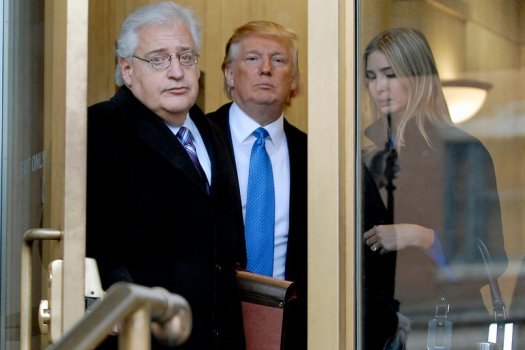
David M. Friedman, left, with Donald J. Trump and his daughter Ivanka in 2010. (photo: Bradley C. Bower / Bloomberg)

By Isabel Kershner and Sheryl Gay Stolberg / The New York Times
December 16, 2016


“He has made clear that he will appeal to a small minority of Israeli — and American — extremists, ignoring the majority of Israelis who continue to seek peace. Friedman’s appointment as ambassador runs directly contrary to Mr. Trump’s professed desire to make the ‘ultimate deal’ between Israelis and Palestinians.”


He is president of the American fund-raising arm for a yeshiva in a settlement deep in the West Bank headed by a militant rabbi who has called for Israeli soldiers to refuse orders to evacuate settlers.

He writes a column for a right-wing Israeli news site in which he has accused President Obama of “blatant anti-Semitism,” dismissed the two-state solution to the Israeli-Palestinian conflict, likened a liberal American-Jewish group to “kapos” who cooperated with the Nazis, and said American Jewish leaders “failed” Israel on the Iran nuclear deal.

Now, David M. Friedman, an Orthodox Jewish bankruptcy lawyer from Long Island, is Donald J. Trump’s pick for ambassador to Israel, despite his lack of diplomatic experience and frequent statements that flout decades of bipartisan American policy. Continue reading “Friedman Is Hostile to Two-State Solution”

Trump presidency bodes ill for Israel-Palestine peace process

4096
Photo: Jim Hollander / EPA

With president-elect likely to be either maximalist pro-Israel or isolationist, the question is whether stagnant process can survive

By Peter Beaumont / The Guardian
November 17, 2016


What is clear, for all the muddle, is that the centre of gravity in US thinking is lurching from the two-state solution as it has been understood by US politicians and diplomats for more than 20 years seemingly towards one of two extremes: a maximalist pro-Israel administration or, equally risky, a minimalist and disconnected isolationist position.


As Donald Trump continues to ponder his choice for secretary of state, and other key foreign policy positions, one thing seems clear: the impact on the peace process between Israelis and Palestinians is likely to be serious and retrograde.

The question now is whether the moribund process, which has weathered presidents both Republican and Democrat since it was sealed in 1993 with the aim of securing a two-state solution, can survive the Trump era at all.

The signs are not encouraging. Israel’s far right has greeted Trump’s success with ecstasy, hailing his promises to recognize Jerusalem as the country’s capital and move the US embassy to the city, as well as suggestions from his team he would not stand in the way of Israeli settlement construction.

The frontrunners for the secretary of state nomination — Rudy Giuliani and John Bolton — have both been vocal opponents of the idea of a Palestinian state.

Trump’s own pronouncements have swerved wildly between suggesting he would be “neutral” on the question, promising to be Israel’s “best friend,” and even suggesting he could secure the best peace deal ever.

Meanwhile his advisers have fueled a sense of deep confusion by making a series of highly contradictory statements.

[Continue reading here . . . ]

Call to Prayer from Jerusalem Rooftops

https://youtu.be/7io4UkwpR80

Jerusalemites recite call to prayer from their rooftops

By Middle East Monitor
November 18, 2016


“Israel is a state that respects the freedom of worship for all believers and it is committed to protecting those who suffer from noise which is caused by the loudspeakers.”
— Israeli Prime Minister Benjamin Netanyahu


In response to the Israeli government’s plan to prohibit the call to prayer in the city, Jerusalemites climbed onto the roofs of their houses and recited the call to prayer all together.

Over the past two weeks, Israel has been working to ban the Muslim call to prayer, the athan. Israeli Prime Minister Benjamin Netanyahu has supported the a bill to outlaw the religious calling, saying: “Israel is a state that respects the freedom of worship for all believers and it is committed to protecting those who suffer from noise which is caused by the loudspeakers.”

In video footage which is circulating on social media, residents can clearly be heard reciting the call to prayer in protest of the law to ban it in Jerusalem.

Churches in Nazareth showed solidarity by broadcasting the call to the night prayer in response to attempts to prohibit the call of prayer being broadcasted from Al-Aqsa Mosque.

In defiance to the actions of the Israeli Knesset, Arab Israeli Knesset members Ahmed El-Tibi and Teleb Abu Arar performed the call to prayer, independent of each other, in the Israeli parliament (Knesset).

[Continue reading here . . . ]

Israeli Imam Fined for Call to Prayer

ebepi_005_illus
The Muezzin’s Call to Prayer, from Ebers, Georg, “Egypt: Descriptive, Historical, and Picturesque,” 1878.

Israel-Palestine Conflict: Imam Fined For Using Loudspeakers For Islamic Call To Prayer In Lod City

By Vishakha Sonawane / International Business Times
November 23, 2016


“We shall not be deterred by threats and fines. We have always said that everything can be solved at the negotiating table, and through dialogue and mutual respect rather than by force.”


Law enforcement authorities in Israel’s Lod city, located 9.3 miles southeast of Tel Aviv, fined a Palestinian imam for making an Islamic call to prayer through a loudspeaker at a local mosque, according to reports. Authorities said that the action violated the anti-noise law in the Shnir area of the mixed Arab-Jewish city.

Mahmoud Alfar, the spiritual leader of the mosque, said he did not get any formal notice related to the fine but officials told him that it will be mailed to him, according to a Haaretz report on Monday. He will have to pay 750 shekels (US$ 194) as fine. Alfar’s brother Sheikh Adel Alfar told the Israeli newspaper that this was the first time the city fined an imam for noise caused by the call to prayer.

The Israeli parliament is mulling a controversial anti-noise legislation, dubbed the “muezzin law.” Muezzin refers to man who calls Muslims to prayer from the minaret of mosque, mostly using loudspeakers. Knesset proposed the bill on November 13 and said that it would restrict the use of loudspeakers at mosques in the country to tackle noise. Israeli Prime Minister Benjamin Netanyahu supported the bill, which was criticized by Muslims, Jewish and Christian communities.

[Continue reading here . . . ]

Trump Defense Candidate Criticized Israel for “Apartheid”

mattis
Photo: The Washington Free Beacon

General under consideration by Trump for Defense has slammed Israel for impending ‘apartheid’

Philip Weiss / Mondoweiss
November 20, 2016


The United States is paying a military and security price “every day” because of the Israeli-Palestinian conflict, warning that the continued construction of settlements is liable to turn Israel into an apartheid state.


Donald Trump says he is considering retired Marine general James Mattis as a possible Defense Secretary:

Mattis has been outspoken, that the U.S. pays a “security price” in the Middle East because it is seen as biased in favor of Israel and that Israel is in danger of becoming an apartheid state due to its occupation of the West Bank.

From Haaretz three years ago:

A former U.S. general said last week that the United States is paying a military and security price “every day” because of the Israeli-Palestinian conflict, warning that the continued construction of settlements is liable to turn Israel into an apartheid state.

Gen. (ret.) James Mattis, who until two months ago headed the Central Command of the U.S. Army (CENTCOM) and commanded U.S. forces in the Middle East, made the comments at an Aspen Institute conference last Saturday…

Gen. (ret.) Mattis then sounded a prophecy of doom regarding what is liable to happen if a Palestinian state is not established. “I would tell you that the current situation is unsustainable,” he said, adding, “It’s got to be directly addressed. We have got to find a way to make the two-state solution that Democrat and Republican administrations have supported. We’ve got to get there, and the chances for it are starting to ebb because of the settlements, and where they’re at. [They] are going to make it impossible to maintain the two-state option.”

[Continue reading here . . . ]

We Feel You, America

.
Photo courtesy of Noam Revkin Fenton / Flash90

It’s lonely at the bottom

By Mairav Zonszein / +972 Magazine
November 9, 2016


With the election of Donald Trump as president, a lot of progressive Americans must be feeling what we here in the Israeli Left have felt for a long time: outnumbered, unwanted, frustrated, and alone.


For a while now, I’ve been writing about how lonely it is to be a leftist in Israel, to be part of the minority that opposes the occupation and 50 years of discrimination and human rights violations, a minority that insists on challenging fundamental aspects of this government’s policies and this society’s values. About how it has become increasingly dangerous and radical simply to speak one’s mind, as the notions of equal rights and human rights have become derogatory terms, and as open criticism and dissent is explicitly silenced. How scary and frustrating it is to see the values and issues I believe in consistently voted down and publicly delegitimized.

What the success of Netanyahu — who was elected first in 1996 on the back of the Rabin murder and a campaign of incitement against the Left, and to his fourth term in 2015 again on the back of incitement against Palestinians citizens — and the success of Trump — who incites against or insults just about everyone — prove is that democracy is not a bulwark against inequality, racism, violence, oppression, and sexism. On the contrary, it is all too easy for people to democratically elect to do horrible things.

[Continue reading here . . . ]

You Can’t Say We Didn’t Know

Some Perspectives on Israel, Palestine, and the Conflict

Episcopal Bishop’s Committee for Israel/Palestine
Diocese of Olympia
October 2016


In preparation for the 2016 Annual Convention of the Episcopal Diocese of Olympia, the Bishop’s Committee for Israel/Palestine prepared a book of essays, You Can’t Say We Didn’t Know: Some Perspectives on Israel, Palestine, and the Conflict.

These essays are presented here for the general reader. Each author takes full responsibility for what has been written. The material has been thoughtfully researched, and is offered in the spirit of seeking peace through understanding.

We humbly thank you for your interest in learning more about Israel and Palestine, and pray for our guidance toward a peaceful resolution. Continue reading “You Can’t Say We Didn’t Know”

Privatizing the Occupation

loewensteinkennard20161114_img
Photo courtesy of Mohamad Torokman / Reuters

 How Israel is privatizing its occupation of Palestine — enriching the security industry and allowing the country to evade accountability for human-rights violations

By Antony Loewenstein and Matt Kennard / The Nation
October 27, 2016


 “Earlier this year, Human Rights Watch (HRW) released a report, ‘Occupation Inc.,’ that detailed how ‘Israeli and international businesses have helped to build, finance, service, and market settlement communities.’ It added, ‘In many cases, businesses are “settlers” themselves.’”


It is 4:30 a.m. with the moon still high in the sky, but Palestinians from across the West Bank are already disembarking from buses outside the Qalandia checkpoint near Jerusalem. They’re about to begin a day’s work on the other side of the separation wall, in Israel.

Qalandia is one of the busiest checkpoints through which Palestinians with the required work documents can travel from the occupied Palestinian territories to Israel. With unemployment around 26 percent in the West Bank (in Gaza, it’s far worse — among the highest in the world, according to the United Nations), it’s always extremely busy at this early hour, because Palestinians need work, which is more readily available in Israel, especially in construction, manufacturing, and agriculture. . . .

The warehouse-like checkpoint looks like a cattle pen on the inside: Metal bars on either side and above form a narrow chute, enclosing and herding the workers—many of whom have traveled from villages more than an hour away—toward the point where their documents will be checked by Israeli officials. They then wait on the Israeli side for transport from their employers.

For years, these checkpoints were manned by personnel from the Israel Defense Forces (IDF) and the Israeli Border Police. But starting in January 2006, gun-toting private security guards joined the soldiers and police. Today, there are 12 checkpoints in the West Bank and two on the Gaza border that use such guards. Israel is slowly privatizing its occupation.

[Continue reading here . . . ]

UNESCO Resolution on Jerusalem

The facts lost in the PR frenzy

mughrabi-gate-site-1
Image courtesy of Palestine Unbound

Justine Berg / Palestine Square
October 25, 2016


“The resolution prompted Israel to suspend cooperation with UNESCO, however an analysis of its actions reveals that Israel has not been keen on cooperating with the world cultural organization for almost ten years. In fact, the drama Israel has caused around this resolution may be a way to entrench its continued non-compliance with UNESCO decisions.”


In the days leading up to the adoption of a UNESCO resolution on Occupied Palestine, the media has focused almost exclusively on Israel’s allegation that the resolution denies Jewish heritage in the Old City of Jerusalem. A deeper look at the text of the resolution, as well as a review of developments in the Old City over the past decade, offer insight into the possible reasons for the creation of this media narrative. Simply put, it is part of a long series of repeated Israeli attempts to deflect attention from the ways in which Tel Aviv has refused to comply with previous UNESCO decisions on Jerusalem.

The flurry of news articles following the acceptance of the resolution on October 18th have continuously recycled Israeli claims that it is “contentious” and “anti-Israel” because it “ignores” and “denies” Jewish connection to Jerusalem’s holy sites. The text, however, specifically “[affirms] the importance of the Old City of Jerusalem and its Walls for the three monotheistic religions,” and references other UNESCO documents that do the same. (For instance document 200 EX/25, which states “the Old City of Jerusalem is the sacred city of the three monotheistic religions — Judaism, Christianity and Islam, and . . . each of its communities has a right to the explicit recognition of their history and relationship with the city.”)

The resolution prompted Israel to suspend cooperation with UNESCO, however an analysis of its actions reveals that Israel has not been keen on cooperating with the world cultural organization for almost ten years. In fact, the drama Israel has caused around this resolution may be a way to entrench its continued non-compliance with UNESCO decisions.

[Continue reading here . . . ]


“Israel, the occupying Power, had not complied with any of the 12 decisions of the UNESCO Executive Board as well as six decisions of the World Heritage Committee that request the implementation of the reactive monitoring mission to the Old City of Jerusalem and its Walls.”