
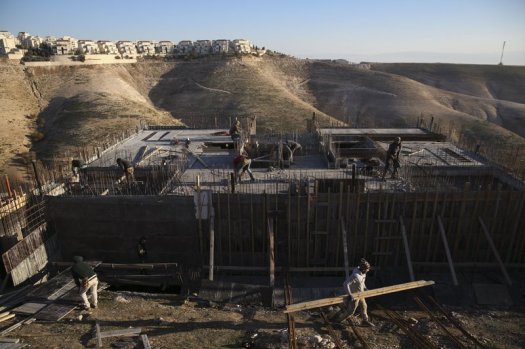
The United Nations condemns a new Israeli law legalizing dozens of unlawful West Bank settler outposts on illegally appropriated Palestinian land.
By Josef Federman / AP News
February 7, 2017
Nickolay Mladenov, the U.N.’s coordinator for the Middle East peace process, said the legislation “opens the floodgates to the potential annexation of the West Bank.” . . . It also marked the first time that the Israeli parliament has imposed Israeli law on Palestinian inhabitants of the West Bank. The area, captured by Israel in 1967, is not sovereign Israeli territory and Palestinians there are not Israeli citizens and do not have the right to vote.
The United Nations’ Mideast envoy on Tuesday said a new Israeli law legalizing dozens of unlawful West Bank settler outposts crossed a “very thick red line,” while Israeli rights groups said they would fight to overturn the measure in the Supreme Court.
The explosive law, approved by Israeli lawmakers late Monday night, was the latest in a series of pro-settler steps taken by Israel’s hard-line government since the election of Donald Trump as U.S. president. It is expected to trigger a number of challenges in the Supreme Court, while members of the international community have already begun to condemn it.
The law legalized dozens of outposts home built unlawfully on private Palestinian land in the occupied West Bank. According to the law, Palestinian landowners would be compensated either with money or alternative land, even if they did not agree to give up their property.
Continue reading “U.N. Says Israeli Settlement Law Crosses “Thick Red Line””






 HolyLandJustice.org
You must be logged in to post a comment.