I Support Boycotting Settlements — Should I Be Banned From Visiting Israel With My Children?

openhillel
Participants in the Open Hillel Conference, Harvard University. (photo: Gili Getz)

On Monday, the Knesset passed a law denying entry to any person “who knowingly issues a public call for boycotting Israel” or any territory “under Israeli control,” which includes settlements in the West Bank. I’m one of those people.

By Peter Beinart / The Forward
March 8, 2017


Now, it seems, the Knesset wants me to choose. Either stop visiting Israel or stop opposing the occupation. In a variety of ways, that’s the deal Prime Minister Benjamin Netanyahu has been offering American Jews for close to a decade now. Embrace Israel at the cost of your principles or embrace your principles at the cost of Israel.


I have a theory about American Jewish kids and Israel. I’m trying it out on my own children.

My theory boils down to “Love first, truth later.” When my kids near adulthood, I’ll encourage them to visit the West Bank. I’ll encourage them to see for themselves what it means to hold millions of people as noncitizens, under military law, without free movement or due process. I’ll encourage them to read real histories of Israel’s war of independence, histories that explode the myth that most Palestinian refugees left their homes willingly. I’ll encourage them to consume as much Palestinian poetry, literature, journalism and film as possible. I want them to see how Israel looks from the other side.

But not too early. My fear is that if they encounter harsh truths at too young an age, it will drive them away. They’ll grow to hate Israel, or wash their hands of it. I’ve seen that happen a lot.

Continue reading “I Support Boycotting Settlements — Should I Be Banned From Visiting Israel With My Children?”

Israel’s Far-Right Demagogue Bringing Fringe Beliefs to the Center

1917
Bezalel Smotrich wants the Israeli military to be allowed to kill children who throw stones. (photo: Youtube)

Bezalel Smotrich has transformed himself from radical activist into a mainstream politician with an extremist manifesto.

By Emma Graham-Harrison / The Guardian
March 11, 2017


“A healthy person — who loves those who love him and hates those who hate him — doesn’t turn the other cheek.”
— Bezalel Smotrich


Bezalel Smotrich has backed segregated maternity wards separating Jewish and Arab mothers, called for government reprisal attacks on Palestinians and once organized a homophobic “Beast Parade” protest against Gay Pride. He is also a member of Israel’s Knesset, a confident polemicist and increasingly prominent political figurehead for the country’s ascendant far-right.

Like the far-right European and American politicians who have upended the political order further west, his stock in trade is drawing fringe beliefs into the political mainstream, shifting the centre of debate.

A commitment to defending settlements on Palestinian land, deemed illegal under international law, runs through his personal and political life. He was born in one, lives in one now and, in one of his most recent forays into controversy, he likened the evacuation of Amona, an outpost deemed illegal by Israel’s own courts, to “a brutal rape.”

He wants the Israeli military to be able to shoot to kill when children throw stones, flatly rejects a two-state solution and believes Jews have a divine right to all land that made up biblical Israel, he told Haaretz newspaper in a recent interview. “Looking after my people means that the whole land of Israel is mine, religiously, historically and also in practical terms,” he said. “I abort their [Palestinian] hopes of establishing a state.”

Continue reading “Israel’s Far-Right Demagogue Bringing Fringe Beliefs to the Center”

Israel’s Travel Ban Backlash: Over 100 Jewish Studies Scholars Threaten to Not Visit Israel in Protest

walzer-2
Michael Walzer, Institute for Advanced Study, Princeton University (photo: Michael Walzer)

“In spite of our different views, we stand in strong opposition to the new law,” petition reads, while other liberal U.S. Jews warn new law will cause drift toward BDS camp.

By Taly Krupkin / Haaretz
March 10, 2017


“I’m very disappointed that Israel cannot deal with criticism in a democratic manner, and instead has to ban people who do not agree with the current government’s policy, Zionists, friends of Israel, people who feel deeply connected to the country.”
— David Biale, Professor of Jewish History, U.C. Davis


Dozens of prominent Jewish scholars worry they won’t be able to visit Israel anymore, citing a new law entitling the government to deny entry to supporters of boycotts against the country or its settlements in occupied territory. Meanwhile, only days after the passing of the new law, more than 100 Jewish studies scholars have signed a letter in which they threaten to refrain from visiting Israel in protest.

“Among us are those who oppose the BDS movement, those who oppose BDS but support a settlement boycott, and those who support BDS,” says the petition that has come to the attention of Haaretz, although it has not yet been published.

“In spite of our different views, we stand in strong opposition to the new law. It will be bad for Israel, bad for the cause of democracy at this fragile moment, and bad for the principles of free speech and thought on which our scholarship is based. We hope that the Israeli judiciary will overturn the new law and assure us that our political speech will not prevent us from continuing our rich scholarly interactions with Israeli colleagues in the field of Jewish studies. Should the law stand, we may no longer be permitted — nor permit ourselves — to enter the State of Israel.”

Continue reading “Israel’s Travel Ban Backlash: Over 100 Jewish Studies Scholars Threaten to Not Visit Israel in Protest”

Chair of U.K. Palestine Solidarity Campaign Refused entry to Israel

Hugh Lanning
(photo: The Jewish Chronicle)

Hugh Lanning was refused entry just a week after the Knesset passed a law banning foreign nationals who call for boycotts.

By Rosa Doherty / The Jewish Chronicle
March 13, 2017


“We call upon the British Government to make clear to Israel that it is not acceptable for it to ban entry to British citizens whose only crime is to advocate for human rights of the Palestinian people and to protest against policies that violate those rights.”
— Ben Jamal, Director of the Palestine Solidarity Campaign


The chairman of the [U.K.] Palestine Solidarity Campaign (PSC) has been prevented from entering Israel.

Hugh Lanning was refused entry on Sunday, just a week after the Knesset passed a law banning foreign nationals who call for boycotts.

Lanning would likely have been barred prior to the introduction of the law due to a longstanding policy to refuse entry to boycott activists; however, border police told him he had been blocked due to the new legislation.

Gilad Erdan, Israel’s Strategic Affairs Minister, also made explicit the link between the new law and the treatment of Lanning, saying on Sunday evening: “Those acting against Israel need to understand that reality is changing. No sane country would permit entry to the main activists calling for its boycott and who work leave it isolated.”

Continue reading “Chair of U.K. Palestine Solidarity Campaign Refused entry to Israel”

Perhaps the Messiah Will Come

uri-avnery
Uri Avnery (photo: countercurrents.org)

The only real solution is the much-maligned “Two States for Two peoples,” the one declared dead many times. It’s either that solution or the destruction of both peoples.

by Uri Avnery / antiwar.com
March 11, 2017


Right after the foundation of the State of Israel, God appeared to David Ben-Gurion and told him, “You have done good by my people. Utter a wish and I shall grant it.”
“I wish that Israel shall be a Jewish and a democratic state and encompass all the country between the Mediterranean and the Jordan,” Ben-Gurion replied.
“That is too much even for me!” God exclaimed. “But I will grant you two of the three.”


If someone had told me 50 years ago that the rulers of Israel, Jordan and Egypt had met in secret to make peace, I would have thought that I was dreaming.

If I had been told that the leaders of Egypt and Jordan had offered Israel complete peace in return for leaving the occupied territories, with some exchanges of territory and a token return of refugees, I would have thought that the Messiah had come. I would have started to believe in God or Allah or whoever there is up there.

Yet a few weeks ago it was disclosed that the rulers of Egypt and Jordan had indeed met in secret last year with the Prime Minister of Israel in Aqaba, the pleasant sea resort where the three states touch each other. The two Arab leaders, acting de facto for the entire Arab world, had made this offer. Benyamin Netanyahu gave no answer and went home.

So did the Messiah.

Continue reading “Perhaps the Messiah Will Come”

Israel’s New Travel Ban Tells the World to Stay Away

restricted_area_private_property_keep_out

The new anti-BDS law marks a drastic shift in Israel’s relationship with the outside world by sending the message that many of those who deeply object to the occupation are no longer welcome to visit.

By Allison Kaplan Sommer / Haaretz
March 7, 2017


With this new law, the message to young Jews, and the rest of the world is no longer: “Come, see for yourself, let’s have a discussion — even an argument — in which I try to change your views. We know it’s complicated, but let’s not end our relationship.”

Instead, [the message] is: “Stay away. If you don’t agree with us, there is no place for you here.”


At first glance, Israel’s sweeping travel ban passed by the Knesset on Monday night essentially changes nothing. The authorities at Israel’s borders and airports already have complete discretion to keep anyone out, and numerous prospective visitors have been blacklisted and turned away because they are believed to be hostile to Israel.

They don’t need this law, which spells out support of boycotting of any Israeli institution or any area under its control as grounds to block their entrance as visitor.

But, actually, it changes everything. The statement it makes and the message it sends — that those who so deeply object to the occupation that they choose not to buy settlement products — are no longer welcome to visit, see and experience their country is a drastic shift in Israel’s relationship with the outside world.

Continue reading “Israel’s New Travel Ban Tells the World to Stay Away”

How to Expel: Advice to Trump from Israel

895380216
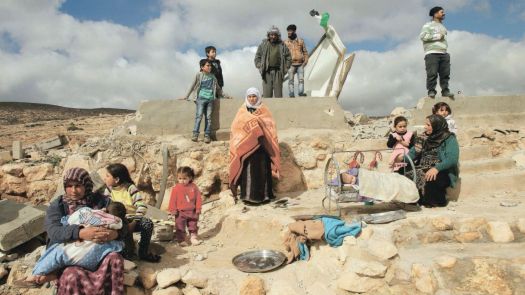
A Palestinian family sits next to the remains of their home near the village of Jenbah, which is in Firing Zone 918 in the West Bank, February 2, 2016. (photo: AFP)

Eight ways Trump can make Mexicans and Muslims experience what Palestinians do.

By Amira Hass / Haaretz
February 3, 2017

Barely a week has passed and you’ve screwed things up, Donald Trump. The reason is simple: You didn’t consult Israel on how to deny entry into your country without rousing half the world against you. But when it comes to your other promise — actual expulsion — you still have time to consult us.

For a lack of patience and space only two types of expulsion will be discussed here — two of the many types we’ve become experts at: the expulsion of native Palestinian Jerusalemites from their city, and the expulsion of West Bank residents from their homes.

  1. Quiet. Don’t publicize the expulsion policy. Let every person being expelled confront the decree alone and believe that the problem lies with him. Personally. . . .
  2. Astonishment. Insist that after all nothing has changed and that these laws have been there since time immemorial. . . .
  3. Gradualism. Expulsion is built one step at a time, as if by chance. . . .
  4. Legal support (A). In 1988, the Supreme Court ruled that it was legal to expel a Palestinian born in 1943 in Jerusalem because he also had foreign citizenship. . . .
  5. Variety. Don’t stick to one excuse, Mr. President. We successfully rely on a raft of excuses for expelling Palestinians from their land, their homeland, their homes. . . .
  6. Legal support (B). Our judges avoid ruling against the policy of unequal zoning and construction for Jews and Arabs.
  7. Scant water supply. Cut back on water, Trump. Rule that every Muslim or Mexican will be eligible for only a quarter or less of the water consumed by an average WASP. . . .
  8. The support of the elites. Send aides to Israel. They’ll get tips on how routine expulsion activities are greeted by the silence of most of the enlightened educated intelligentsia. . . .

[Read the full article here . . . ]

The Middle East “peace process” was a myth — Donald Trump ended it

3648
(photo: Pablo Martinez Monsivais / AP)

The final interment of the already moribund “two-state solution” would force all concerned to face what is obvious to any honest observer.

By Rashid Khalidi* / The Guardian
February 18, 2017


For decades, an imposed reality of one-state — the only sovereign entity enjoying total security control — has existed between the Jordan River and the Mediterranean. This one state is Israel. Irrespective of the label one uses for it, this is the only outcome that this Israeli government will accept, whatever subaltern, or helot, or “autonomous” status it deigns to allow the Palestinians.


“I’m looking at two-state and one-state, and I like the one that both parties like.” With these words at a joint press conference with Benjamin Netanyahu, Donald Trump may have finally dispelled the already receding mirage of any just solution.

Trump was clearly seeking to please his guest, spurred by the zealots in his government, four of whom, Public Safety Minister Gilad Erdan, Education Minister Naftali Bennett, Sports Minister Miri Regev, and Deputy Foreign Minister Tzipi Hotovley, just publicly came out against creation of a Palestinian state.

For decades, Israeli governments, pursuing the colonization of the entirety of “Eretz Israel,” have systematically destroyed the prerequisites for a solution involving a contiguous, sustainable, sovereign Palestinian state with Jerusalem as its capital. Nevertheless, the myth that a real Palestinian state is on offer, and that there actually is a genuine “peace process,” endures as one of the greatest examples of magical thinking in modern times.

Continue reading “The Middle East “peace process” was a myth — Donald Trump ended it”

U.N. Says Israeli Settlement Law Crosses “Thick Red Line”

800
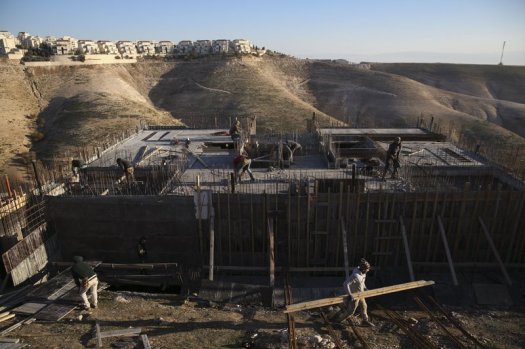
Laborers work at a new housing project in the Israeli settlement of Maale Adumim, near Jerusalem, Feb 7, 2017. (photo: Oded Balilty / AP)

The United Nations condemns a new Israeli law legalizing dozens of unlawful West Bank settler outposts on illegally appropriated Palestinian land.

By Josef Federman / AP News
February 7, 2017


Nickolay Mladenov, the U.N.’s coordinator for the Middle East peace process, said the legislation “opens the floodgates to the potential annexation of the West Bank.” . . . It also marked the first time that the Israeli parliament has imposed Israeli law on Palestinian inhabitants of the West Bank. The area, captured by Israel in 1967, is not sovereign Israeli territory and Palestinians there are not Israeli citizens and do not have the right to vote.


The United Nations’ Mideast envoy on Tuesday said a new Israeli law legalizing dozens of unlawful West Bank settler outposts crossed a “very thick red line,” while Israeli rights groups said they would fight to overturn the measure in the Supreme Court.

The explosive law, approved by Israeli lawmakers late Monday night, was the latest in a series of pro-settler steps taken by Israel’s hard-line government since the election of Donald Trump as U.S. president. It is expected to trigger a number of challenges in the Supreme Court, while members of the international community have already begun to condemn it.

The law legalized dozens of outposts home built unlawfully on private Palestinian land in the occupied West Bank. According to the law, Palestinian landowners would be compensated either with money or alternative land, even if they did not agree to give up their property.

Continue reading “U.N. Says Israeli Settlement Law Crosses “Thick Red Line””

Jerusalem’s Status Won’t Be as Easy to Settle as Other Real Estate Deals. (Here’s Why.)

israeli-flag
An Israeli flag waves in front of the minaret of a mosque in the Arab quarter of Jerusalem’s Old City on Nov. 14, 2016. (photo: Thomas Coex / AFP)

By Brent E. Sasley / The Washington Post
December 25, 2016


The “let’s make a deal” approach assumes that each negotiating party has a series of material things that can be traded off. In this approach, both sides understand they will be better off with more than they currently have. But that doesn’t apply to a place like Jerusalem, or to conflicts like it.


President-elect Donald Trump has set the foreign policymaking world on edge with his and his team’s repeated insistence that as president he will move the U.S. Embassy from Tel Aviv to Jerusalem. The goal: support Israel’s claim to the city as its “undivided, eternal capital.” By nominating David Friedman — who agrees with that position — to be ambassador to Israel, Trump apparently emphasizes this commitment.

The Israeli-Palestinian conflict has resisted resolution for decades. But Trump has insisted that “a deal is a deal” and that because he is “a negotiator,” he will be successful where others were not. In this case, presumably Trump plans to offer the Palestinians compensation to accept Israel’s claims to Jerusalem.

But it is not that simple.

Continue reading “Jerusalem’s Status Won’t Be as Easy to Settle as Other Real Estate Deals. (Here’s Why.)”