“Almost every country in the world is a member of Interpol, with the notable exception of North Korea. Saudi Arabia, Eritrea, Syria, Yemen, Iran — these are all member countries I’m assuming that, for Israel, would be not particularly friendly countries.”
— Bruno Min, a legal and policy officer at Fair Trials
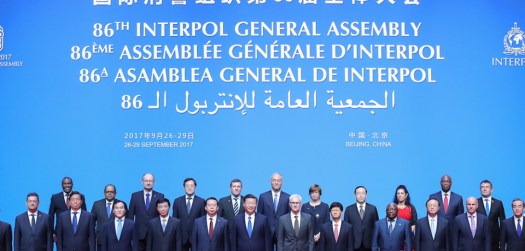
Interpol, the international police organization, has voted to accept Palestine as a member country — which will heighten fears in Israel that Palestine could use Interpol to target Israeli officials.
Interpol membership will bring several benefits to Palestinian police. They’ll get access to information that other police agencies around the world have shared about criminal activity and will be able to issue red notices, which function as international nonbinding warrants requesting the extradition of criminal fugitives.
Israel campaigned to block the Interpol move and made a series of procedural moves in an attempt to prevent the issue coming to a vote. . . . After Israel blocked the last Palestinian attempt to join Interpol — at last year’s annual general meeting in Indonesia — the Israeli prime minister, Benjamin Netanyahu, said his country’s diplomatic efforts had secured a major victory. The Israeli foreign ministry made no immediate comment on Wednesday’s decision.
Interpol has voted to admit Palestine as a full member, dealing a significant diplomatic blow to Israel, which has strenuously lobbied against Palestinian admission.
In a secret vote of representatives of the international police organization’s members in China, Palestinian membership was approved by 75 to 24 votes, with 34 abstentions — exceeding the two-thirds requirement of yes to no votes.
“The State of Palestine and the Solomon Islands are now Interpol member countries,” the organization tweeted after the ballot.
[Ed. note: This is the last of a quartet of articles that appeared recently in Haaretz. We are posting them in succession and recommend that they be read in order.]
With [Shaked], what you see is what you get — racism. In its actions and deeds, the Zionist left has done everything to implement Shaked’s views, only in polished words and without acknowledgement. The Zionist left is embarrassed by things Shaked and her colleagues are not ashamed of. That doesn’t make the left any more moral or just. It has merely been quasi-Shaked in its actions.
Ravit Hecht attributes a “fragrance of true love” for my “honest, brave princess,” Justice Minister Shaked, in her op-ed “When Gideon Levy fell in love with Ayelet Shaked.” Hecht knows my taste in women is slightly different than that, and that, despite what she writes, I don’t know how to dance the tango. But my appreciation for Shaked and her ilk is that they do not deceive: they openly acknowledge their nationalism and racism.
They don’t hide their belief that the Palestinians are an inferior people, indigenous inhabitants who will never gain the rights Jews have in the Land of Israel-Palestine; that no Palestinian state will ever be established here; that Israel will ultimately annex all of the occupied territories, as it already has done in practice; that the Jews are the Chosen People; that Zionism is in contradiction to human rights and superior to them; that dispossession is redemption; that biblical property rights are eternal; that there is no Palestinian people and no occupation; and that the current reality will last forever.
Many of these views are also held among the Zionist left, Hecht’s ideological camp. The only difference is that the Zionist left has never admitted it. It envelops its views in the glittering wrapping paper of peace talks, separation and hollow rhetoric about two states, words it has never really meant and has done precious little to realize.
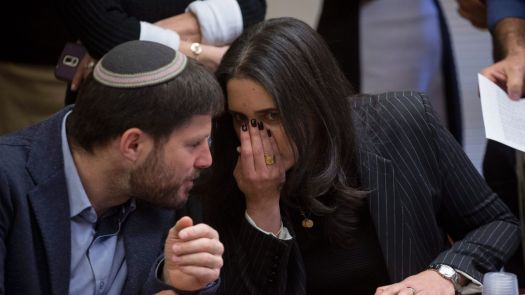
Justice Minister Ayelet Shaked speaks with fellow Habayit Hayehudi party member Bezalel Smotrich, March 2017. (photo: Olivier Fitoussi)
Gideon Levy prefers hard-line rightists to the left because they tell the truth; that is, they sincerely express dangerous sentiments popular among the people.
[Ed. note: This is the third of a quartet of articles that appeared recently in Haaretz. We are posting them in succession and recommend that they be read in order.]
There are still a few seekers of justice in Israel who believe in the basic Zionist principle of Jews’ right to a national homeland in Israel while deeply abhorring Shaked’s statement. Neither she nor Gideon Levy will make them disappear.
In his piece the other day, Gideon Levy thanked Justice Minister Ayelet Shaked for telling the truth; Shaked had said Zionism would no longer bow to the Supreme Court. The minister is thus continuing her incitement campaign against the court, a campaign that is flourishing throughout the right wing.
A fragrance of true love exudes from Levy’s text to his honest, brave princess. His op-ed conveys a message of admiration among radicals who tell it straight on their way to wreaking havoc.
And havoc has been wreaked. What a riot. Apocalypse now. The court is being aggressively worn down, and soon the media will finally be tamed and fall silent. Racism is soaring to new heights with the leadership’s encouragement and corruption runs rampant, with no need for camouflage, for the simple reason that nobody is ashamed anymore.
Israel’s Justice Minister Ayelet Shaked at an Israel Bar Association conference in Tel Aviv, August 29, 2017. (photo: David Bachar)
Israel Justice Minister Shaked said the truth loud and clear: Zionism contradicts human rights, and thus is indeed an ultranationalist, colonialist and racist movement.
[Ed. note: This is the second of a quartet of articles that appeared recently in Haaretz. We are posting them in succession and recommend that they be read in order.]
Shaked prefers Zionism to human rights, the ultimate universal justice. She believes that we have a different kind of justice, superior to universal justice. Zionism above all. . . . Now that Shaked has exposed Zionism . . . we can finally think about Zionism more freely. We can admit that the Jews’ right to a state contradicted the Palestinians’ right to their land, and that righteous Zionism gave birth to a terrible national wrong that has never been righted.
Thank you, Ayelet Shaked, for telling the truth. Thank you for speaking honestly. The justice minister has proved once again that Israel’s extreme right is better than the deceivers of the center-left: It speaks honestly.
If in 1975, Chaim Herzog dramatically tore up a copy of UN General Assembly Resolution 3379, equating Zionism with racism, the justice minister has now admitted the truthfulness of the resolution (which was later revoked). Shaked said, loud and clear: Zionism contradicts human rights, and thus is indeed an ultranationalist, colonialist and perhaps even racist movement, as proponents of justice worldwide maintain.
Shaked prefers Zionism to human rights, the ultimate universal justice. She believes that we have a different kind of justice, superior to universal justice. Zionism above all. It’s been said before, in other languages and other nationalist movements.
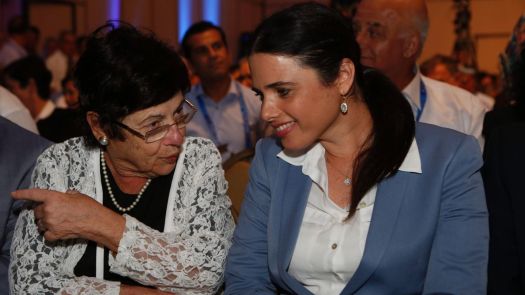
Israeli Justice Minister Ayelet Shaked, right, with Supreme Court President Miriam Naor on August 28, 2017. (photo: David Bachar)
Israeli Justice Minister Ayelet Shaked slams the Supreme court, saying it places too much emphasis on individual rights, neglecting Zionism and the will of the Jewish Majority.
[Ed. note: This is the first of a quartet of articles that appeared recently in Haaretz. We are posting them in succession and recommend that they be read in order.]
“Zionism should not continue, and I say here, it will not continue to bow down to the system of individual rights interpreted in a universal way that divorces them from history . . . disconnected from context, from our national tasks, from our identity, from our history, from our Zionist challenges.” — Israeli Justice Minister Ayelet Shaked
Justice Minister Ayelet Shaked criticized the Supreme Court on Tuesday, claiming that the justice system gives insufficient consideration to Zionism and the country’s Jewish majority.
Speaking at a conference of the Israel Bar Association in Tel Aviv, Shaked said that Zionism and “national challenges have become a legal blind spot” that carry no decisive weight in comparison to questions of individual rights. She added that the court’s rulings do not consider the matter of demography and the Jewish majority “as values that should be taken into consideration.”
Shaked’s comments come the day after the Supreme Court, sitting as the High Court of Justice, ruled that asylum seekers may be deported to Rwanda and Uganda but may not be jailed for more than two months if they refuse to go.
“Zionism should not continue, and I say here, it will not continue to bow down to the system of individual rights interpreted in a universal way that divorces them from the history of the Knesset and the history of legislation that we all know,” Shaked told her audience, which included Attorney General Avichai Mendelblit, Supreme Court President Miriam Naor, State Prosecutor Shai Nitzan and Military Advocate General Sharon Afek.
Shaked’s speech was momentarily interrupted when some of the lawyers in the audience yelled that Israeli was an apartheid state.
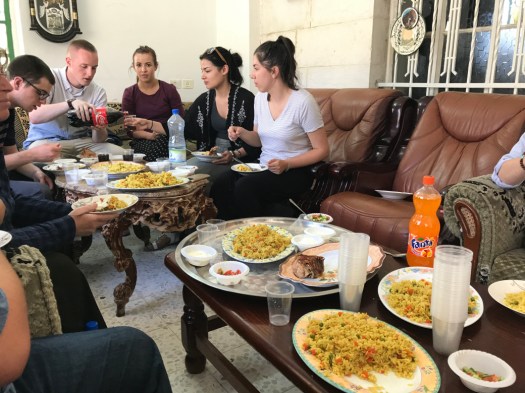
“The students appreciated a place that I had never been before [The Tent of Nations outside Bethlehem in the West Bank] and this is my 10th time going to Israel. For me it was a very emotional experience, too, because I felt like it’s such a model, it’s such a lesson in life where when you’re stuck in these horrible situations you have to consider how to stand up and be a human being. They could have become suicide bombers, they could have become people who lie in garbage. They said that they were going to find another way. I think that lesson, for the students, was absolutely profound. It was for me, too.”
— Dr. Elizabeth Goldstein, Associate Professor of Religious Studies
Controversies are often told or experienced in a one-sided manner. Israel, its history and the Israeli-Palestinian conflict associated with it is often susceptible to such exclusive perspectives.
Every aspect of the Gonzaga-in-Israel program avoided limited perspectives by embracing duality and empathy.
Dr. Elizabeth Goldstein, associate professor of religious studies and a rabbi, proposed the creation of the Israel study abroad experience with dual purposes and perspectives in mind.
“I feel like Israel and knowledge of the Middle East is an important part of a full approach to both the background of the Old Testament/Hebrew Bible as well as anything to do with contemporary Judaism,” Goldstein said. “I also felt that it was a part of the mission of the university to look at issues of social justice between Israel and Palestine.”
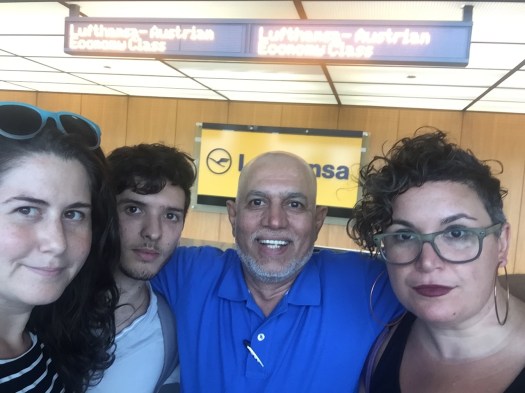
Rabbi Alissa Shira Wise, Deputy Director of Jewish Voice for Peace, and three other peace activists, were prevented from boarding a flight to Tel Aviv on July 24, 2017.
Over 200 rabbis publicly oppose Israel’s ban on BDS activists.
For me, the issue is not about Rabbi Wise herself, nor is it about the BDS movement. While the image of a rabbi being prevented from boarding an airplane to Israel is disturbing, and the Jewish community’s hysteria about the BDS movement is frustrating, the incident reflects something even more distressing: the suppression of dissent in our community.
For a community that prides itself on a tradition that honors varied and opposing ideas and upholds a strong commitment to debate, I am disgusted by its refusal to tolerate divergent voices.
In March, the Israeli Knesset passed a law that denies entry to foreigners who support the Boycott, Divestment and Sanctions movement, or BDS.
At the time, the law felt so insidious because it introduced a political litmus test designed to exclude those who object to Israel’s policies. It served to stifle legitimate political debate. But it was all so theoretical.
Until last month, that is, when Rabbi Alissa Shira Wise, who was part of an interfaith delegation that had planned to meet with Israeli and Palestinian peace activists, was banned at Washington’s Dulles Airport. I was stunned.
Five leaders on an interfaith delegation to Israel/Palestine were refused permission to board their plane in the United States, in what appears to be an implementation of Israel’s travel ban on supporters of Palestinian rights and Boycott, Divestment Sanctions (BDS).
Five members of an interfaith delegation were prevented from boarding their flight to Israel because of their public criticism of the Israeli government’s policies towards Palestinians. The group of Jewish, Muslim and Christian leaders were apparently singled out for their public support of the Palestinian call for Boycott, Divestment and Sanctions (BDS) on the state of Israel. Upon arrival at the Lufthansa check-in counter at Dulles International Airport, an airline employee informed the group that the Israeli government had told the airline not to let them board.
The five people prohibited from flying are Rabbi Alissa Wise, Jewish Voice for Peace (JVP) deputy director, Philadelphia, PA; Alana Krivo-Kaufman, Brooklyn, NY and Noah Habeeb, Virginia, both also of JVP; Rick Ufford Chase, of the Presbyterian Peace Fellowship, Rockland County, NY; and Shakeel Syed, a national board member with American Muslims for Palestine, Los Angeles, CA.
“Israel denied me the ability to travel there because of my work for justice for Palestinians, even though I’m Jewish and a rabbi,” said Rabbi Alissa Wise. “I’m heartbroken and outraged. This is yet another demonstration that democracy and tolerance in Israel only extends to those who fall in line with its increasingly repressive policies against Palestinians.”
The Israeli Knesset (parliament) passed a bill in March banning entry to those who support boycott, divestment and sanctions of Israel until Palestinians have full equal rights. Israel’s BDS ban includes those who have endorsed boycotts of products from Israeli settlements built on occupied Palestinian land in violation of international law and longstanding official U.S. policy. It is believed that this is the first time that the policy has been enforced before people even board their flight. It is also the first time that Israel has denied entry to Jews, including a rabbi, for their political positions. This new political litmus test for entry into the country is an extension of the longstanding practices of racial, religious and ethnic profiling of Palestinian, Arab and Muslim visitors to Israel.
A new peace plan for Israel and Palestine landed literally on my doorstep this morning.
It came in the form of a cautionary feature story in The New York Times, warning of the risks which Brexit poses to the arduously won peace process in Ireland. But it was how the piece began, that got me to thinking that the wisdom in it might benefit the peoples of the Holy Land as well:
Crossing the border between Northern Ireland and the Irish Republic used to involve delays, checkpoints, bureaucratic harassment and the lurking threat of violence. That it’s now virtually seamless — that you can drive across without even knowing it — feels close to miraculous.
For both Israelis and Palestinians, sick to death of bloodletting and disillusionment, one of the few points of common ground is the sense that it would take a miracle to forge a viable peace. At this point, when people on both sides ask, and with good reason, “What’s in it for me?” — bitter experience is scant incentive. It is not for nothing that the Holy Land is where peace initiatives come to die.
But what if there were a peace plan that actually offered the people on both sides something that they truly would want?
An EU passport, for example.
Here’s the hint: When the United Kingdom held its June, 2016 referendum on leaving the European Union, Northern Ireland voted against Brexit by a clear majority. Here’s the plan: Israel and the Palestinian Authority apply for membership in the European Union.





You must be logged in to post a comment.