BREAKING NEWS: Trump recognizes Jerusalem as capital of Israel

4050
President Trump making his announcement at the White House with Vice President Mike Pence, Dec 6, 2017. (photo: Mandel Ngan / AFP / Getty Images)

Defying near-universal opposition, Trump insists the move will facilitate peace.

By Julian Borger and Peter Beaumont | The Guardian | Dec 6, 2017


Q&A: Why would moving the US embassy to Jerusalem be so contentious?

Of all the issues at the heart of the enduring conflict between Israel and the Palestinians, none is as sensitive as the status of Jerusalem. The holy city has been at the centre of peace-making efforts for decades.
Seventy years ago, when the UN voted to partition Palestine into Jewish and Arab states, Jerusalem was defined as a separate entity under international supervision. In the war of 1948 it was divided, like Berlin in the cold war, into western and eastern sectors under Israeli and Jordanian control respectively. Nineteen years later, in June 1967, Israel captured the eastern side, expanded the city’s boundaries and annexed it — an act that was never recognized internationally.
Israel routinely describes the city, with its Jewish, Muslim and Christian holy places, as its “united and eternal” capital. For their part, the Palestinians say East Jerusalem must be the capital of a future independent Palestinian state. The unequivocal international view, accepted by all previous US administrations, is that the city’s status must be addressed in peace negotiations.
Any move to recognize Jerusalem as Israel’s capital would put the US out of step with the rest of the world, and legitimize Israeli settlement-building in the east considered illegal under international law.


Donald Trump has defied overwhelming global opposition by declaring US recognition of Jerusalem as the capital of Israel, but insisted that the highly controversial move would not derail his own administration’s bid to resolve the Israeli-Palestinian conflict.

In remarks delivered in the diplomatic reception room of the White House, Trump called his decision “a long overdue” step to advance the peace process.

“I have determined that it is time to officially recognize Jerusalem as the capital of Israel,” Trump said. “While previous presidents have made this a major campaign promise, they failed to deliver. Today, I am delivering.”

Continue reading “BREAKING NEWS: Trump recognizes Jerusalem as capital of Israel”

Why the problem of Jerusalem is distinctly a 20th Century one

merlin_130908887_9081d9db-2de3-42f5-8f89-ed531d1d9162-superjumbo
An aerial view of Jerusalem’s Old City. (photo: Ariel Schalit / AP)

A history of the Jerusalem conflict.

By Sewell Chan and Irit Pazner Garshowitz | New York Times | Dec 5, 2017


“Paradoxically, [early Zionist immigrants] recoiled from Jerusalem, particularly the Old City — first because Jerusalem was regarded as a symbol of the diaspora, and second because the holy sites to Christianity and Islam were seen as complications that would not enable the creation of a Jewish state with Jerusalem as its capital.”
— Amnon Ramon, senior researcher at the Jerusalem Institute for Policy Research


In December 1917 — 100 years ago this month — the British general Edmund Allenby seized control of Jerusalem from its Ottoman Turkish defenders. Dismounting his horse, he entered the Old City on foot, through Jaffa Gate, out of respect for its holy status.

In the century since, Jerusalem has been fought over in varying ways, not only by Jews, Christians and Muslims but also by external powers and, of course, modern-day Israelis and Palestinians.

It is perhaps fitting that President Trump appears to have chosen this week to announce that the United States will recognize Jerusalem as Israel’s capital, despite concerns from leaders of Arab countries, Turkey and even close allies like France.

Conflicts over Jerusalem go back thousands of years — including biblical times, the Roman Empire and the Crusades — but the current one is a distinctly 20th-century story, with roots in colonialism, nationalism and anti-Semitism.

Continue reading “Why the problem of Jerusalem is distinctly a 20th Century one”

Media run-up to Trump’s recognizing Jerusalem as the capital of Israel

6720
Israeli flag flies overlooking the old city of Jerusalem. (photo: Abir Sultan / EPA)

Major print media coverage in anticipation of Trump’s announcement.


The New York Times:

“We believe that any action that would undermine these efforts must absolutely be avoided. A way must be found through negotiations to resolve the status of Jerusalem as a future capital of both states.”
— Federica Mogherini, High Representative of the European Union for Foreign Affairs and Security Policy

Read the full article here →


The Washington Post:

Most important will be the language Trump uses in his announcement. If he repeats the Israeli line that Jerusalem is the “undivided” capital of Israel, Trump will run the risk of angering Palestinians who will view that as proof that the United States does not support their push for statehood.

Read the full article here →


The Guardian:

“A better prepared, less clumsy process could have produced an announcement to actually move the embassy to Jerusalem, which is where it belongs. Instead the president is leaving us half-pregnant. Israelis deserve to have their capital recognized and our embassy located there. Palestinians need to know that the capital of their state will be in East Jerusalem. Instead of being clear on both of these points, the President has chosen a purely rhetorical approach, changing nothing on the ground, but spinning up significant controversy for virtually no gain.”
— Daniel Shapiro, a former US ambassador to Israel

Read the full article here →


Continue reading “Media run-up to Trump’s recognizing Jerusalem as the capital of Israel”

Israelis urge UN to release “settlement blacklist”

.
Construction workers begin work on the new settlement called Amichai, in Shilo Valley, West Bank, on Jun 20, 2017. (photo: Yonatan Sindel / Flash90)

A group of prominent Israelis petition the UN to maintain the Green Line no matter how hard the Netanyahu government works to erase it.

By Michael Schaeffer Omer-Man | +972 Magazine | Dec 3, 2017


“As loyal citizens of Israel, [we] believe that the international community has a crucial and urgent role to play in order to redress the Israel/Palestine fast deteriorating conflict. We believe that to serve that end, it is essential that the international community act against the settlement policy of the Government of Israel, which bars any resolution of this conflict.”


Over 400 Israelis, including a former attorney general, retired diplomats, ex-members of Knesset, and prominent intellectuals, sent a petition to the UN urging it to release a list of companies that do business in or with Israeli settlements in the occupied West Bank.

Israel is reportedly doing “everything [it] can to ensure that this list does not see the light of day.” The UN Human Rights Council began compiling the list of companies last year and it was due to be published in March 2017, although political pressure at the time resulted in the publication date being delayed until December.

The database, or list of companies, has been referred to as a blacklist, and was one of the primary motivators behind the anti-BDS legislation currently making its way through the U.S. Congress.

The petition, authored by the Policy Working Group, points to the UN Security Council Resolution 2332, which called on the international community “to distinguish in their relevant dealings, between the territory of the State of Israel and the territories occupied since 1967.”

Continue reading “Israelis urge UN to release “settlement blacklist””

A wary response to Trump’s expected recognition of Jerusalem

03jerusalem-superjumbo
The Damascus Gate to Jerusalem’s Old City. (photo: Bernat Armangue / AP)

President Trump is expected to break decades of precedent by declaring Jerusalem the capital of Israel.

By David Halbfinger | New York Times | Dec 2, 2017


“Pushing this issue now, in advance of a peace process at a time when the administration has zero credibility on this issue, at a time when it wants to engage the Saudis, makes absolutely no sense. It’s a self-inflicted wound.”
— Aaron David Miller, former Mideast peace negotiator under past Republican and Democratic administrations


There were warnings of a new Palestinian uprising and calls for protests at United States embassies, dire predictions that hopes for peace would be dashed irretrievably — and expressions of relief from Israelis who have waited a half-century for the world to remove the asterisk next to this city’s name.

Yet on the whole, the responses in the region to reports that President Trump will recognize Jerusalem as the capital of Israel — something no president has done in the nearly 70 years since Israel’s founding — remained hedged, if not entirely restrained, on Saturday. Arabs and Israelis alike were impatient to see whether Mr. Trump would really do it, precisely how he would define Jerusalem, and what else he might say or do to qualify the change.

Mr. Trump’s announcement, expected in a speech on Wednesday, would amount to the not-quite fulfillment of a campaign promise to move the United States Embassy to Jerusalem from Tel Aviv, a step for which many of Mr. Trump’s Jewish and evangelical supporters, and their allies in the Israeli right wing, have been clamoring.

Continue reading “A wary response to Trump’s expected recognition of Jerusalem”

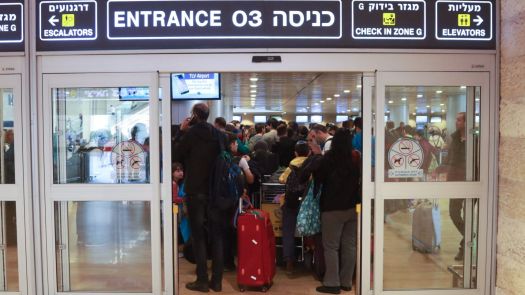
Israel denies entry to European officials for “support of boycott”

3331672300
Ben Gurion Airport in Tel Aviv. (photo: Nir Keidar / Haaretz)

Seven members of a 20-member delegation of European Parliament members and mayors were barred entry by Israel, which alleged they had called for a boycott.

By Ilan Lior, Jonathan Lis and Josh Breiner | Haaretz | Nov 14, 2017


“[These are] senior politicians who consistently support the boycott against Israel and promote it. We will not permit entry to those who actively call to harm the State of Israel.”
— Public Security Minister Gilad Erdan


Israel announced on Monday it would deny entry to seven members of a delegation of European officials using the recently approved legislation that bars visits by anti-Israel boycott activists.

The 20-member delegation, which was set to arrive in Israel next week, was to include European Parliament members and French mayors. The Interior Ministry’s Population, Immigration and Border Authority said seven of the 20 delegation members will be barred from entering Israel, adding it obtained information that they had called for a boycott of Israel.

Continue reading “Israel denies entry to European officials for “support of boycott””

Birthright is so scared of Arabs, it has banned them!

302647845
Birthright participants, Apr 5, 2015. (photo: Taglit)

Birthright Israel recently ordered participants to stop meeting with Israeli Palestinian citizens.

By Noam Shuster Eliassi | Haaretz | Nov 2, 2017


I was always concerned about the brainwashing that’s built in to [Birthright] trips.
But I also believe in young people’s hearts and minds; I believe that awareness and exposure can change mindsets. I insist on meeting Birthright groups, I insist on speaking to people who disagree with me.


Birthright is reportedly ordering their trip providers to stop meetings between their participants and Arab citizens of Israel. In their own words, “there is a need for further analysis of this module.”

I read these lines over and over again and could not trace my thoughts fast enough. My responses went from laughing out loud, to wanting to smash the nearest available wall, to being entirely unsurprised.

“Further analysis” on how and if to meet Arabs?

Maybe they mean to say Birthright participants should meet only the properly vetted and defanged “good pro-Israel Arabs,” because they’re scared delicate Birthrighters might be exposed to critical thought? After all, what a disaster it would be to raise a generation of Jews who dare to think critically about Israel. Continue reading “Birthright is so scared of Arabs, it has banned them!”

Why doesn’t Birthright believe in Israeli democracy?

gettyimages-847406474-1510070981

Birthright Israel recently ordered participants to stop meeting with Israeli Palestinian citizens.

By Sam Sussman | The Forward | Nov 8, 2017


Birthright’s conviction that its participants should not encounter Palestinian citizens is a troubling sanitization — one that does justice neither to young Diaspora Jews nor to Israel itself. Rather than ask American Jews to face Israel in all its complexities and contradictions, Birthright has chosen to offer what one congressman once described to me as “Disneyland Israel” after a trip by the American Israel Public Affairs Committee that met with no Palestinians.


So they will never know Wadeea.

This was the thought that came to me as I read the disappointing news that Birthright has chosen to end meetings with Arab citizens of Israel, who make up one-fifth of Israel’s population. Birthright’s official statement explained that “there is a need for further analysis” of such meetings before they can proceed.

Wadeea and I met in his hometown of Kafr Qasim, a city of Palestinian citizens of Israel, t2 miles east of Tel Aviv. Wadeea heard I was from New York, and he wanted to make sure I knew how much he hated the Knicks. I challenged him to a game of one-on-one. We found a court between Kafr Qasim and Rosh HaAyin and played well past dusk. The next time I was in Israel we smoked hookah, watched Barcelona beat Madrid and discovered that we both write fiction. Continue reading “Why doesn’t Birthright believe in Israeli democracy?”

Planning the ethnic cleansing of Palestine

1779340329
Then-Prime Minister Levi Eshkol and Defense Minister Moshe Dayan onboard a helicopter while touring army installations in the West Bank, Sep 1967. (photo: Ilan Bruner / GPO)

Newly declassified Israeli Security Cabinet documents show government ministers planning to force Palestinians from their land.

By Ofer Aderet | Haaretz | Nov 17, 2017


“We should deal with this issue quietly, calmly and covertly, and we should work on finding a way for [the Palestinians] to emigrate to other countries and not just over the Jordan [River]. Perhaps if we don’t give them enough water they won’t have a choice, because the orchards will yellow and wither. Perhaps we can expect another war and then this problem will be solved.”
— Israeli Prime Minister Levi Eshkol, 1967


“Empty” the Gaza Strip, “thin out” the Galilee, rewrite textbooks and censor political cartoons in Haaretz: These are among the proposals discussed by cabinet ministers after the Six-Day War that will be available to the public in a major release of declassified government documents by the Israel State Archives on Thursday.

The material being posted on the state archives’ website includes hundreds of pages of minutes from meetings of the security cabinet between August and December 1967. From reading them, it is clear that in the several months that followed the June 1967 war, members of the security cabinet were perplexed, confused and sometimes helpless in the face of the new challenges to the state.

Israel conquered East Jerusalem, the West Bank, the Gaza Strip, the Golan Heights and the Sinai Peninsula in under a week. It was not even remotely prepared for this scenario, and had to hit the ground running. Continue reading “Planning the ethnic cleansing of Palestine”