Israel demolishes two UN-funded school buildings in Palestinian refugee camp

abu20nuwar
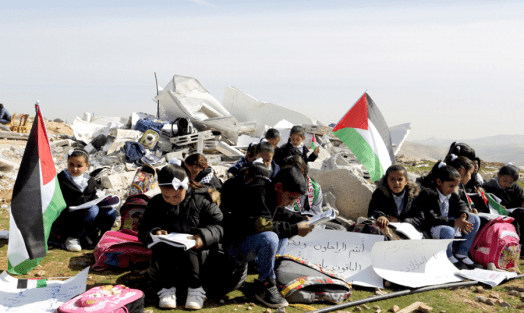
Third and fourth grade Palestinian children studying on the rubble of their classrooms in Abu Nuwar, on Feb 4, 2018. (photo: Tamer Bana / WAFA Images)

This is the sixth demolition or confiscation incident in Abu Nuwar school by the Israeli authorities since February 2016.

By Wafa | Feb 4, 2018


“Abu Nuwar is one of the most vulnerable communities in need of humanitarian assistance in the occupied West Bank. The conditions it faces also represent those of many Palestinian communities, where a combination of Israeli policies and practices — including demolitions and restricted access to basic services, such as education — have created a coercive environment that violates the human rights of residents and generates a risk of forcible transfer.”
— Roberto Valent, United Nations acting Humanitarian Coordinator for the occupied Palestinian territories


United Nations acting Humanitarian Coordinator for the occupied Palestinian territories, Roberto Valent, said on Sunday that he was deeply concerned by Israel’s destruction of donor-funded classrooms in the Palestinian community of Abu Nuwar, east of Jerusalem.

“I am deeply concerned by the Israeli authorities’ demolition this morning of two donor-funded classrooms (3rd and 4th grade), serving 26 Palestinian school children in the Bedouin and refugee community of Abu Nuwar, located in Area C on the outskirts of Jerusalem,” Valent said in a statement. “The demolition was carried out on grounds of lack of Israeli-issued permits, which are nearly impossible to obtain.”

Continue reading “Israel demolishes two UN-funded school buildings in Palestinian refugee camp”

Between Poland’s Holocaust revisionism and Israel’s Nakba denial

.
The Auschwitz-Birkenau Concentration Camp in Poland. (photo: Isaac Harari / Flash90)

Poland’s attempt to scrub clean its role in the murder of European Jewry is, at its core, no different from Israel’s attempt to erase the catastrophe that befell the Palestinians in 1948.

By Haneen Zoabi | +972 Blog | Jan 28, 2018


The new [Polish] law, which criminalizes any researcher who dares publish the truth [about Polish involvement in the Holocaust], is an attempt at historical revisionism. . . . So how is this law any different from the [Israeli] Nakba Law, which would withhold state funds from cultural and educational institutions that commemorate the horrors that befell the Palestinians in 1948?


The responses coming from Israel to the new Polish law, which forbids discussing war crimes committed by the Polish people during the holocaust, are nothing if not paradoxical. While the Israeli establishment, from the Right to the Left, denies the identity, history, and catastrophe of the Palestinian people, it reprimands those who deny responsibility for the fate of the Jews during the Holocaust.

 The Holocaust, a monstrous, well-planned genocide, was possible not only because of the Nazis’ nightmarishly meticulous implementation, but also because those who stood aside as it was happening. The Germans had willing accomplices, including many Poles, who took an active part in the persecution and murder. The history books talk about the “hunt for the Jews,” which led to the murder of hundreds of thousands of Jews, both directly and indirectly, during the Second World War.

Continue reading “Between Poland’s Holocaust revisionism and Israel’s Nakba denial”

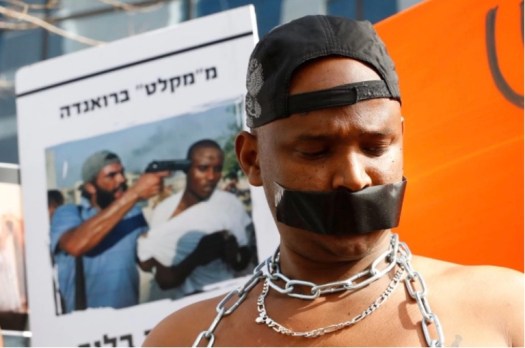
You don’t need Jewish values to denounce Israel’s treatment of asylum seekers

gettyimages-908744180-1517954239
African asylum seekers protest outside Rwandan embassy in Herzliya. (photo: AFP)

When it comes to both asylum seekers and West Bank Palestinians, we don’t need a higher, Jewish standard. Simply asking Israel to abide by International Law is radical enough.

By Peter Beinart | Forward | Feb 7, 2018


In 2015 . . . less than two percent of Sudanese asylum requests had even received a government response. Not a single one had been approved. Of the more than 2,400 Eritreans who requested asylum, the Israeli government granted it to four.


Last week, Isabel Kershner, The New York Times’ estimable Israel correspondent, wrote an article about the Netanyahu government’s decision to either expel Eritrean and Sudanese asylum seekers to third countries or indefinitely lock them up. The article ran under the headline, “Israel Moves to Expel Africans. Critics Say That’s Not Jewish.”

“Like much of the Western world, Israel is grappling with how to balance its right to protect its borders and prevent illegal immigration with showing compassion and humanity,” writes Kershner. “But the government’s decision has struck a particular chord here and among Jews abroad since the modern state of Israel has served as a safe haven for Jews fleeing persecution.”

Kershner goes on to say that many Jews believe the government’s decision violates “Jewish values.” She suggests that “Even secular Israelis have taken to citing biblical verses like Leviticus 19:34: ‘The stranger who resides among you shall be to you as one of your citizens; you shall love him as yourself, for you were strangers in the land of Egypt.’”

There’s a danger here. Continue reading “You don’t need Jewish values to denounce Israel’s treatment of asylum seekers”

Israel holds international anti-BDS conference

2-16_4_1-bds-rally24522049300_5d080fac2c_o
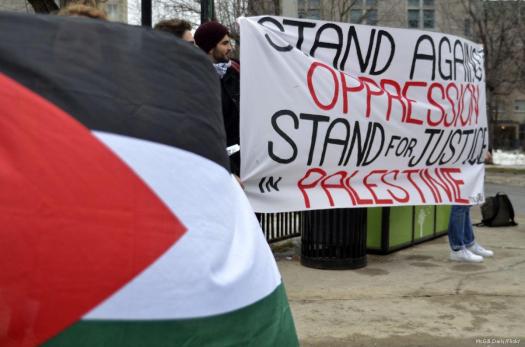
BDS rally at McGill University, Toronto, in 2016 (photo: Sonia Ionescu / Creative Commons)

Israeli Ministry of Strategic Affairs leading anti-BDS efforts.

By Middle East Monitor | Feb 6, 2018


Participants were briefed about “effective methods used to pass legislation in 24 states across the US, France, Germany and elsewhere” and “gained tools and best-practices, while streamlining their tactics against efforts to ostracize the Jewish state.”


The Israeli government yesterday held an international legal conference against the Boycott, Divest and Sanctions (BDS) movement, Quds Press reported.

The news site reported Israeli media saying that the Ministry of Strategic Affairs organised the conference in cooperation with the Israeli Bar Association and the International Judicial Institute.

Israeli media said that 200 legal experts from 24 countries were invited to the conference to develop strategies “to contain the growing influence of the movement.”

According to Quds Press, Israeli Strategic Affairs Minister Gilad Erdan, Justice Minister Ayelet Shaked, Supreme Court Chief Justice Esther Hayut, Knesset Speaker Yuli Edelstein and head of the opposition Isaac Herzog were in attendance.

Continue reading “Israel holds international anti-BDS conference”

Israel issuing deportation notices to asylum seekers

1-5788342-1251868428
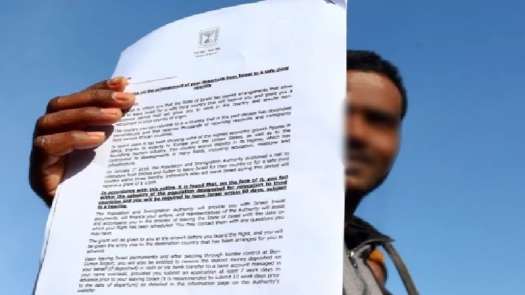
An asylum seeker holding up a deportation notice on Feb 4, 2018. (photo: Meged Gozani / Haaretz)

The first round of notices to about 20,000 people asylum seekers from Eritrea and Sudan.

By Ilan Lior | Haaretz | Feb 4, 2018


“I don’t want to go to Rwanda. I’m from Eritrea, and I don’t want to return to Eritrea. I’m going to jail, without fear.”
— Dabsai, a 47-year-old Eritrean resident of Netanya


The Population, Immigration and Border Authority will begin issuing deportation notices on Sunday to asylum seekers from Eritrea and Sudan who are not held in the Holot detention facility.

In the first stage the notices will be issued to men without children who come to renew their residence visa. Citizens of Eritrea and Sudan are required to renew their visas every two months at the authority’s office in Bnei Brak. They will receive their last two-month visa, along with a letter stating that during this period they are expected to leave the country, otherwise they will be forbidden to work and can expect to be incarcerated indefinitely. Authority personnel will suggest that they leave for either Rwanda or their native countries. . . .

Continue reading “Israel issuing deportation notices to asylum seekers”

Israel deports 14-year-old girl to Gaza, without telling her parents

erez
An electric cart provides transportation through the 900-meter caged terminal spanning the restricted access zone at the Erez border crossing between Israel and the Gaza Strip, Jul 2, 2012. (photo: Ryan Rodrick Beiler / Activestills.org)

Ghada had spent her entire life in the West Bank, yet somehow found herself deported to the Gaza Strip after being arrested by Border Police officers.

By Edo Konrad | +972 Magazine | Jan 31, 2018


“It should be noted that the girl and her father are illegal immigrants in Israel, and therefore she was sent to Erez Crossing . . . entered the Gaza Strip.”
— Israel Prison Service statement


Israeli authorities deported a 14-year-old epileptic Palestinian girl from the West Bank to the Gaza Strip earlier this month, without notifying her parents, and despite the fact that she has never lived there a day in her life.

Ghada, who was born in Ramallah where she has lived much of her life, was arrested by Israeli Border Police officers on January 13 for being in Jerusalem without a military permit. She was traveling back to her home in a-Ram, just northeast of Jerusalem where she lives with her mother and siblings, from her aunt’s home in the East Jerusalem neighborhood of Issawiya.

Her father, though originally from the Gaza Strip, currently lives in the West Bank as well, her mother told Israeli human rights group HaMoked, which is representing the family. When Ghada was born, Israeli authorities listed her address as Gaza for an unknown reason.

Continue reading “Israel deports 14-year-old girl to Gaza, without telling her parents”

As long as occupation exists, soldiers will continue to speak out

.
Palestinians clash with Israeli soldiers in Al-Fawwar refugee camp, south of the West Bank city of Hebron, Dec 31, 2017. (photo: Wisam Hashlamoun / Flash90)

We must make our voices heard sharply and clearly — speaking out is not merely an option, it is a moral duty.

By Avner Gvaryahu | +972 Blog | Jan 26, 2018


It [is] important to remind the Israeli public why soldiers continue to break their silence. After all, the central reason for breaking the silence is the occupation. As long as there is an occupation, there will be those who choose to expose what the government is trying so hard to hide.


Like many who served alongside me, I preferred to remain silent. I preferred to forget, not to speak about the Palestinian homes I broke into in the middle of the night, forgetting the violence I carried out at checkpoints and the passivity required of me when settlers freely broke the law. When I was released from the army, I preferred to repress those three years, to put them behind me.

Only after I joined a Breaking the Silence tour to the South Hebron Hills did my eyes open. Only then, I chose to speak. That is how I learned that I wasn’t alone. I learned there are others like me — soldiers who see the situation the same way and choose to take responsibility and change the way they and their society, our society, talk about the occupation.

Continue reading “As long as occupation exists, soldiers will continue to speak out”

One state or two states? You’re asking the wrong question

Protest marking 12 years for the struggle against the wall, Bil
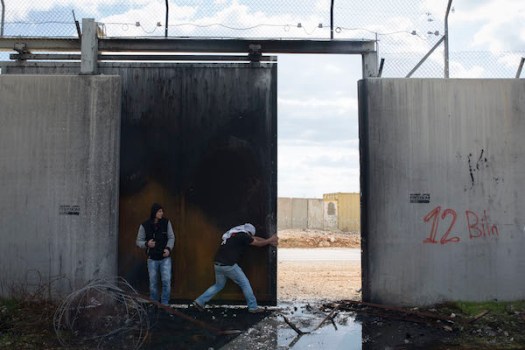
A Palestinian youth opens a gate in the Israeli wall, during a protest marking 12 years for the struggle against the wall and the occupation in the West Bank village of Bil’in, Feb 17, 2017.

We desperately need to go back to basics and recognize that guaranteeing Palestinians’ rights is the foundation for any political solution.

By Haggai Matar | +972 Magazine | Jan 29, 2018


During a recent trip to the US . . . I found devoted activists, all of them committed to resisting occupation and supporting peace . . . who refused to speak to each other solely based on the question of how many states we should have in this piece of land. I suggest that we hold off on that question and focus on the heart of the matter.


A new poll reveals that following Trump’s Jerusalem declaration there has been a drop in support for the two-state solution among both Israeli Jews and Palestinians in the occupied territories — with both communities dipping below the 50 percent level. Only Palestinians with Israeli citizenship who live inside the Green Line show overwhelming support for this solution.

The poll also shows that in tandem with this ongoing downward shift, there is a significant rise in the hostility of each group toward the other, as well as increasing support for armed struggle or a “decisive war” as a solution to the conflict. Conducted by veteran pollsters Dr. Khalil Shikaki and Walid Ladadwa from the Palestinian Center for Policy and Survey Research (PSR), along with Israeli pollster and +972 Magazine writer Dr. Dahlia Scheindlin and the Tami Steinmetz Center for Peace Research (TSC) — this is a poll to be taken seriously.

These new findings have significant value, as they expose Trump’s devastating impact on the chance to end the occupation in the foreseeable future, while sounding the alarm bells over the hopelessness of both sides, such that violence and bloodshed are actually gaining traction as possible solutions to our troubles.

And yet, we must not view the poll results as a harbinger of “the end of the two-state solution” or “final proof that one state is the only way to go.” One state? Two states? You’re asking the wrong question.

Continue reading “One state or two states? You’re asking the wrong question”

Israel is betraying its history by expelling African asylum-seekers

asylum seeker
African migrants demonstrating outside the Rwandan embassy in Herzliya, Israel on Jan 22. (Jack Guez / AFP via Getty Images)

Israel intends to tell Eritrean and Sudanese refugees that they can either accept deportation or go to prison until they change their minds.

By Gershom Gorenberg | The Washington Post | Jan 29, 2018


Netanyahu isn’t bashful. . . . For him and his allies, the world sinned against Jews, and Israel’s obligation stops at giving refuge to Jews.


“I don’t have a visa,” Emanuel Yemani told me.

He spoke in Hebrew on the phone. After his third prison term for political offenses, Yemani had fled from Eritrea, traveling north through Sudan and Egypt. He crossed the Sinai Peninsula — the same ancient route used by Hebrew slaves delivered from Egypt — and entered Israel ten years ago.

It has been enough time for him to learn the language — but not enough to gain a firm legal status. Like nearly 40,000 other refugees from Eritrea and Sudan in Israel, Yemani has lived on a short-term visa that he must renew every couple of months at the Interior Ministry. The last time he did so, he brought a document that had been requested. The ministry official refused to take it, and Yemani recounted the exchange:

“No need,” said the official. “Soon we’ll deport all of you, and you’ll sit under a tree, open your mouth and wait for a banana to fall, like a monkey.”

“But I’m a human being, not a monkey,” Yemani answered.

“Don’t you see yourselves, that you look like monkeys?” the official answered.

Continue reading “Israel is betraying its history by expelling African asylum-seekers”

Holy city of sterile streets

merlin_116869667_adb6540b-1ee6-48c3-ad08-7d30ed597c2c-master768
An Israeli soldier on a street that separates an Israeli settlement and a Palestinian neighborhood in the West Bank city of Hebron. (photo: Chris McGrath / Getty Images)

To settlers, this is the first Jewish city in the biblical hills of Judea; to the Palestinian majority, this is their centuries-old home under relentless military occupation.

By Roger Cohen | The New York Times | Jan 20, 2018


“You are treating families in a way you would not want your own family to be treated. It’s as simple as that.”
— Anonymous IDF soldier


The Israeli soldier stands at the entrance to Shuhada Street. The street is deserted, its stores shuttered, doors welded shut. The old center of Hebron has been a ghost town for many years. The Israel Defense Forces refer to “tzir sterili,” or sterile roads, because no Palestinian is allowed on them, whether in a car or on foot.

The occupation of the West Bank is a half-century old. That’s a long time. Jews did not go to the Holy Land to deploy for another people the biological metaphors of classic racism that accompanied their persecution over centuries. But the exercise of overwhelming power is corrupting, to the point that “sterile” streets, presumably freed of disease-ridden natives, enter the lexicon.

The soldier at the checkpoint is a young man with a ready smile. He tells me he’s visited New York. He asks where I bought my watch. I ask him what he’s done to merit the punishment of Hebron. He laughs, a little uneasily. He’s clearly uncomfortable with his mission, enforcing segregation, and wants to connect. No doubt he’d rather be on the beach in Tel Aviv enjoying a beer.

Continue reading “Holy city of sterile streets”