Gazans’ wounds bear witness to their living conditions

msf223324
15-month-old Shahed Abdel Rahman who suffered burns after tipping a teapot being heated over an open fire. (photo: Laurie Bonnaud / MSF)

Médecins Sans Frontières (MSF) offers care  to almost 5,000 people suffering burns or traumatic injuries in Gaza. The wounds and accounts of the patients offer a window into their daily life.

By Médecins Sans Frontières | Feb 26, 2018


“When I don’t have enough money for food, I ask around. Sometimes my stepmother lends me 15 shekels. I feel so ashamed. But she says we’re family, that I’m like her son and we have to support each other.”
— Abdel Raheem, a 30-year-old patient


First off, Gaza means confinement. A strip of land 42 kilometres long and 12.5 kilometres at its widest, it takes just an hour and a half to drive from north to south.

Gaza is hemmed in by the sea to the west, a “security barrier” — a chain-link fence topped with barbed wire — to the east, while in the north a wall several meters high has been erected to prevent people from crossing the border. And yet another wall, this one underground, is under construction. This is home to close to two million people.

Many of Gaza’s inhabitants have never been able to leave, particularly since a blockade was imposed by Israel after Hamas won the Palestinian legislative elections in 2007.

“I’ve only ever left Gaza once. It was for an operation in Egypt when I was eight. I don’t remember a thing!” says 22-year-old Hassan, who was shot on the border in December.

Continue reading “Gazans’ wounds bear witness to their living conditions”

With Gaza in financial crisis, fears that “an explosion is coming”

gaza-slide-yk6o-facebookjumbo
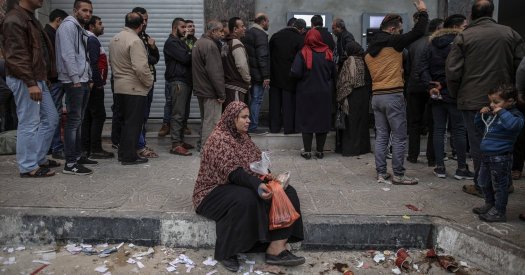
A woman begged for money as residents of Gaza lined up to withdraw what money they could from A.T.M.s at the Bank of Palestine in Gaza City. (photo: Wissam Nassar | The New York Times)

Across Gaza, the densely populated enclave of two million Palestinians sandwiched between Israel and Egypt, daily life, long a struggle, is unraveling before people’s eyes.

By David Halbfinger | The New York Times | Feb 11, 2018


United Nations officials warn that Gaza is nearing total collapse, with medical supplies dwindling, clinics closing and 12-hour power outages threatening hospitals. The water is almost entirely undrinkable, and raw sewage is befouling beaches and fishing grounds. Israeli officials and aid workers are bracing for a cholera outbreak any day.


The payday line at a downtown A.T.M. here in Gaza City was dozens deep with government clerks and pensioners, waiting to get what cash they could.

Muhammad Abu Shaaban, 45, forced into retirement two months ago, stood six hours to withdraw a $285 monthly check — a steep reduction from his $1,320 salary as a member of the Palestinian Authority’s presidential guard.

“Life has become completely different,” Mr. Abu Shaaban said, his eyes welling up. He has stopped paying a son’s college tuition. He buys his wife vegetables to cook for their six children, not meat.

And the pay he had just collected was almost entirely spoken for to pay off last month’s grocery bills. “At most, I’ll have no money left in five days,” he said.

Continue reading “With Gaza in financial crisis, fears that “an explosion is coming””

Israel deports 14-year-old girl to Gaza, without telling her parents

erez
An electric cart provides transportation through the 900-meter caged terminal spanning the restricted access zone at the Erez border crossing between Israel and the Gaza Strip, Jul 2, 2012. (photo: Ryan Rodrick Beiler / Activestills.org)

Ghada had spent her entire life in the West Bank, yet somehow found herself deported to the Gaza Strip after being arrested by Border Police officers.

By Edo Konrad | +972 Magazine | Jan 31, 2018


“It should be noted that the girl and her father are illegal immigrants in Israel, and therefore she was sent to Erez Crossing . . . entered the Gaza Strip.”
— Israel Prison Service statement


Israeli authorities deported a 14-year-old epileptic Palestinian girl from the West Bank to the Gaza Strip earlier this month, without notifying her parents, and despite the fact that she has never lived there a day in her life.

Ghada, who was born in Ramallah where she has lived much of her life, was arrested by Israeli Border Police officers on January 13 for being in Jerusalem without a military permit. She was traveling back to her home in a-Ram, just northeast of Jerusalem where she lives with her mother and siblings, from her aunt’s home in the East Jerusalem neighborhood of Issawiya.

Her father, though originally from the Gaza Strip, currently lives in the West Bank as well, her mother told Israeli human rights group HaMoked, which is representing the family. When Ghada was born, Israeli authorities listed her address as Gaza for an unknown reason.

Continue reading “Israel deports 14-year-old girl to Gaza, without telling her parents”

What I learned about UN aid to Palestinians growing up in Gaza

gettyimages-860514962-15166456701

UNRWA schools provide a generous hand to overcome the tribulations of life in the beleaguered Gaza Strip, encouraging students to dream big despite the obstacles around them.

By Muhammad Shehada | Forward | Jan 22, 2018


Each semester, UNRWA supplied free medical glasses to shortsighted students and ran periodic medical and dental examinations; they also provided vaccinations to all students. For many years, UNRWA provided students with healthy meals on a daily basis, handing out fruit, sandwiches, milk and homemade pastries that employed thousands of people in a project funded by Mercy USA. These meals helped many poor students, who had no food at home, to focus better; a few children wouldn’t eat these meals, but would hold on to them, taking them home to share with their starving families.


Last week, the US announced its decision to start defunding UNRWA, the United Nations Reliefs and Works Agency. If defunded, an immediate catastrophe will surely follow.

UNRWA, which provides aid to Palestinians through a combination of food, schools, medical and other services, means life to more than two thirds of Gaza’s two million residents — as it did for me. I grew up studying in UNRWA schools.

I can still clearly remember the happiness and excitement in my late father’s eyes on my first day of school, the same UNRWA school where he studied himself as a child. He put me in his old classroom, and even sat me down in the same old wooden bench were he sat 30 years before. I remember so clearly the dream in his eyes, that I’d be as successful in life as he was.

Continue reading “What I learned about UN aid to Palestinians growing up in Gaza”

Gaza is still under seige: Please support the Ahli Hospital campaign

test2f1506717747872-brotherandsistergaza13
(photo: AFEDJ)

A letter from our brothers and sisters at the American Friends of the Episcopal Diocese of Jerusalem.


“Gaza is still under siege. All borders are closed. In Gaza’s crisis, Ahli Hospital is a place of refuge and hope. Everyone who comes to Ahli for help is equal. We are living Christian values every day. People know this. They know that at Ahli they will be treated with dignity and respect. We are so thankful for your generous support of our mission.”
— Suhaila Tarazi, Ahli Hospital’s Director


Dear Friends,

I just returned from a trip to Gaza. I visited three Community Based Organizations that work in the poorest neighborhoods of Gaza, identifying families who need medical care and arranging treatment for them at Ahli Hospital’s Free Community Clinic.

The clinic serves the poorest of the poor in Gaza, one of the most desperate places on earth. The conditions I saw people living in is appalling. No clean drinking water, raw sewage polluting the water and land, and for most families, just two hours of electricity every day. Yet the Palestinian people living in this political tinderbox remain hopeful for their future.

Ahli Hospital needs your help. Your gift of any size will help keep open the doors of Ahli Hospital’s Free Community Clinic and continue to provide life-saving care to the desperate families and children living in Gaza. Continue reading “Gaza is still under seige: Please support the Ahli Hospital campaign”

Overcoming isolation in Gaza: A report back

photo20credit20brant20rosen
Gaza City. (photo: Brant Rosen)

Even under the brutality of Israel’s blockade, we could not help but be struck by the beauty of this place and the dignity of its people.

By Brant Rosen / AFSC Acting in Faith / Oct 18, 2017


I heard one young woman speak of entering into Israel through the Erez Crossing for the first time to travel to the West Bank for meetings. . . . She was eighteen years old and had never seen an Israeli Jew in person in her life. Up until that time, she said, she had only seen them as “helicopters, planes and bombs.”


I’ve written a great deal about Gaza for over ten years but until this past week, I haven’t had the opportunity to visit in person. I’m enormously grateful for the opportunity to experience Gaza as a real living, breathing community and I’m returning home all the more committed to the movement to free Gaza from Israel’s crushing blockade — now eleven years underway with no end in sight. . . .

It’s extremely rare for Americans to receive permission from Israel to enter Gaza through the Erez Crossing. Permits are generally issued only for journalists and staff people of registered international NGOs. Though I was technically allowed to enter Gaza as an AFSC staff member, I wasn’t 100% sure it would really happen until the moment I was actually waved through the crossing by the solider at Passport Control in Erez.

Continue reading “Overcoming isolation in Gaza: A report back”

“1984” in Israel and Palestine

3440984596
Nablus, 1990. (photo: Alex Levac)

We must get the Israeli public to recognize this basic human truth: Occupation by a foreign government cannot be a substitute for sovereignty, just as slavery isn’t freedom, war isn’t peace and ignorance isn’t strength.

By Dmitry Shumsky / Haaretz / July 13, 2017


A Palestinian state that faithfully reflects the national yearnings of all parts of the Palestinian people, which deserves national freedom like any other people  . . . will only come about with the end of the Israeli occupation and liquidation of the lion’s share of the settlement enterprise.


In one of the most trenchant articles ever written here against the occupation, Prof. Shlomo Avineri wrote that any denials of the fundamental fact that Palestinian residents of the territories — who have been under Israel’s direct or indirect control since 1967 — are under Israeli occupation “recall George Orwell’s book ‘1984,’ in which the government declares that slavery is freedom, war is peace and ignorance is strength” (Haaretz Hebrew Edition, March 17).

A recent op-ed by former Defense Minister Moshe Arens (“Gaza, a failed Palestinian state,” June 26), which claimed that the Gaza Strip is a “sovereign Palestinian state,” is clear confirmation of Avineri’s diagnosis.

Continue reading ““1984” in Israel and Palestine”