“Israel is a sovereign state and it has the right to decide who will enter its gates. No foreign residents have an inherent right to enter Israel, including Palestinian residents of the Gaza Strip.”
— Civil Administration (COGAT) spokesman
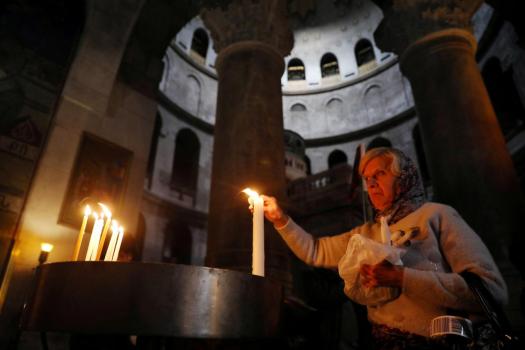
The Latin Patriarchate of Jerusalem said church authorities had applied for around 600 permits for Gazans to travel, but had not received any, three days before Good Friday.
Israel tightly restricts movements out of the Gaza Strip, territory controlled by Hamas, an Islamist group that it considers a terrorist organization.
The Israeli military-run authority that operates in the West Bank defended its policy to restrict access as many Palestinians had stayed on illegally in the past, and said it would only issue permits to people aged at least 55.
Israeli military vehicles are seen Friday next to the border on the Israeli side of the Israel-Gaza border, as Palestinians demonstrate in Gaza. (photo: Amir Cohen / Reuters)
At least 15 people have been killed at the outset of a massive protest expected to last another month and a half.
If the demonstrations continue, and Israel responds the way it did today, there is a significant risk that the death count will rise, and an already complicated situation will get worse.
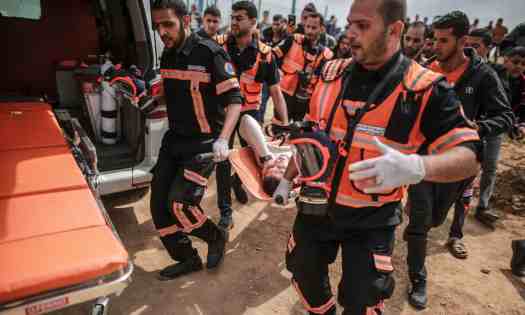
Israeli troops opened fire Friday at Palestinians near the Gaza Strip’s border with the Jewish state, killing at least 15 people and wounding many more. The numbers came from the Palestinian health ministry, which put the number of those injured at more than 1,000.
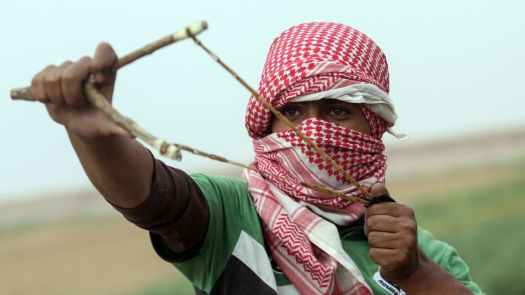
The Palestinian demonstration at the border, dubbed the Great March of Return, was billed as peaceful and nonviolent. Protesters pitched tents near the border with Israel and demanded that refugees be allowed to return to homes they left behind in 1948 during the creation of the state of Israel. Israel, which estimates that 17,000 Palestinians have gathered near the border at six locations, said its troops were enforcing “a closed military zone.” The Israeli army also said it opened fire toward the “main instigators” of what it called rioters who were “rolling burning tires and hurling stones at the security fence and at” Israeli troops. Israel had warned Gaza residents against protesting, and said Hamas, the militant group that governs Gaza, was “cynically” sending women and children “to the security fence and endangering their lives.”
The date the protest began, March 30, is the anniversary of Land Day, a 1976 event in which Israelis killed six Palestinians who were protesting the confiscation of their lands. The protests are expected to last until May 15, the anniversary of the creation of the state of Israel, which the Palestinians view as a “naqba” or “catastrophe” for their people.
Abier Almasri (photo: Human Rights Watch / Reuters)
I try not to think about how, later this month, I will enter the Erez checkpoint from the Israeli side and cross back into Gaza, unsure when, if ever, I will be allowed to leave again.
Friends and family back home keep asking, “How’s life outside Gaza?” I can’t answer. How to tell people who live on four to six hours of electricity daily that high-rise buildings in New York leave their lights on 24 hours a day, simply because it looks nice? How it feels to live without generator noises, the deafening roar of Israeli military drones at night, or the constant fear of imminent conflict? Or that you can hop on a bus, train or plane on a whim, without needing a permit, and travel across the world?
I was born and grew up in Gaza. My father was a soccer coach for many years and his stories about his travels to other countries always made me want to travel too. But Israel imposed a land, air and sea blockade on Gaza in 2007 and has kept Gaza mostly closed ever since. So I never made it out until now, at age 31, I was allowed to leave — for just a little while.
I work for a global human rights organization and spent months seeking the exit permit from the Israeli government that would allow me to leave, to participate in security and research training sessions, to attend key organizational meetings, and to meet colleagues based just a short drive away in Jerusalem or Ramallah — to say nothing of those overseas. But I faced obstacles every step of the way to obtaining the documents and permissions I needed simply to get out of Gaza itself — until I got a phone call on January 28.
“There is fear that the situation might deteriorate in the coming days.”
— Tayé-Brook Zerihoun, assistant UN secretary general for political affairs
Gaza hospitals, running low on blood and overstretched by the huge number of wounded, were reeling after one of the enclave’s bloodiest days outside of open war, in which Israeli soldiers shot 773 people with live ammunition, according to the ministry of health.
Fifteen of the wounded died, said the ministry spokesperson Dr Ashraf al-Qidra. “Most of the dead were aged between 17 and 35 years old,” he said. “The injuries were on the upper part of the body.” He added that the remainder of the wounded, some of whom were in a critical condition, had been “shot with live ammunition.”
The violence erupted on Friday after mass demonstrations took place demanding the right of return for Palestinian refugees and their descendants to land in Israel.
“Between the Jordan River and the Mediterranean there is an equal number of Palestinians and Jews, and that’s nothing new. That’s why the crossroads where we presently find ourselves is clear: either two states based on 1967, or one state that is an apartheid state, or one democratic state in which everyone has the right to vote. There is no other option, and at least this simple truth has to be stated clearly.”
— Knesset Member Ayman Odeh, head of the Joint List
The Israeli army presented data on Monday to a Knesset panel which show that more Arabs than Jews live between the Mediterranean and the Jordan River.
According to Civil Administration’s deputy commander Col. Haim Mendes, five million Palestinians live in the West Bank and the Gaza Strip. This figure does not include the hundreds of thousands of Palestinians living in East Jerusalem, or the 1.8 million Israeli Arabs. According to Israel’s Central Bureau of Statistics, as of September 2017 some 6.5 million Jews live in Israel. . . .
A Palestinian demonstrator hurls stones at Israeli troops during clashes along the border fence near Khan Yunis in Gaza, Mar 23, 2018. (photo: Said Khatib / AFP)
Israel has flagged the drones, tear gas, sniper fire, even tanks it will employ against thousands of Palestinians planning to approach the Gaza border. But confronting a PR campaign with the language of force only invites disaster.
Israel needs to prepare for the coming celebration and marching season with an extensive public diplomacy effort, not only to celebrate our own independence, but to give those that wish to mourn, the room to do so.
The Palestinians are planning and producing a huge PR event. The stage is set, and the curtain will be drawn this Friday, March 30th. Organizations in Gaza are initiating a series of events that will challenge Israel on the ground, physically and militarily, but their real intended target is the public arena.
As Israel organizes its own public relations opportunities in celebration of its 70-year anniversary, complete with a bonus additional PR event, the opening of the new American embassy in Jerusalem, the Palestinians plan to march.
Palestinians in Gaza intend to kick off their series of events by erecting “return camps,” tent campsites along the area bordering Israel. Some assessments have suggested Hamas is going to rally around 100,000 people along the border area in a huge show of force. . . .
Over the last few days, reports in the Israeli media have multiplied about how the security forces will confront the oncoming demonstrations and riots. Various means of riot dispersal, dropped from drones; tear gas; water cannons; targeted sniper fire against the main instigators; and even reports of tanks being deployed along the Israel-Gaza border. . . .
What appears to be lacking from the Israeli preparation is the response to the political challenge.
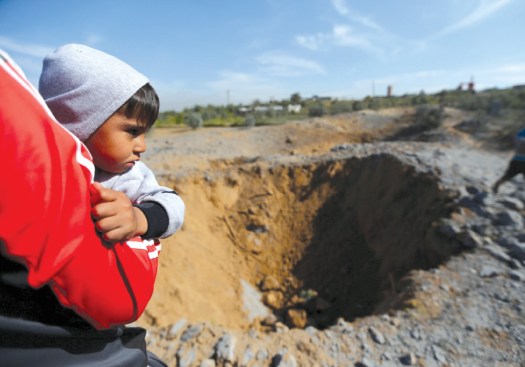
A Palestinian boy is carried as he looks at the scene of an Israeli air strike, south of Gaza City, March 2018. (photo: Ibraheem Abu Mustafa / Reuters)
There are multiple players influencing life in Gaza, but the humanitarian situation there is largely the result of Israel’s restrictive access policy.
Travel permit requests go unanswered for months, even for those seeking urgent medical care or to visit ailing relatives. Hundreds of traders have been blocked and slapped with travel bans that curtail their ability to do business. Absurd new restrictions were introduced, preventing students and aid workers from traveling with laptops.
Over the past few months, many unlikely characters seem to have started to care that Gaza is facing a humanitarian crisis. Except it is not exactly compassion for the people facing the crisis driving the discourse as much as a warning call about the dangers lurking in their desperation.
Israel’s chief of staff, decorated generals, and even its decidedly not-dovish education minister, Naftali Bennett, have said that when Gaza suffers, Israelis are endangered. America is also concerned. In a “brainstorming session” held at the White House last Tuesday with representatives of the international community, US President Donald Trump stated that the worsening conditions in Gaza “require immediate attention.” If it weren’t so tragic, it might be comical considering that these are the same characters pulling the strings and deciding Gaza’s fate.
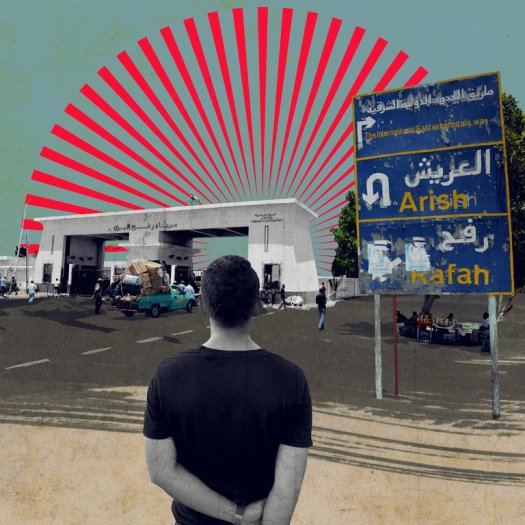
[My best student has] been trying to leave [Gaza], legally, through the Rafah border crossing into Egypt for five years. But the border is closed much of the time — last year, it was opened for a total of just over 30 days. . . . The other exit is via Erez, into Israel, and then onward to Jordan. That’s an even harder way to go. Again, you need permits. Until recently you first needed a permit from Hamas. Then there’s the permit from Israel. And then the one from Jordan. My student has never been able to get even the first of those.
“Are you still living there?” he asks.
“Where else should I live?” I answer.
It’s the same conversation I have every time I catch up with this one Palestinian friend in France. Same question, same answer. Life in Gaza is hard. Then it gets worse and we think it’s intolerable. Then it gets even worse. . . .
“You must be tempted to leave,” my friend says.
When so many basic things are so fundamentally beyond your control, you sometimes do feel like giving up, saying goodbye to both country and past, and letting Palestine go. The problem is, Palestine won’t let you go.
Whether you call it a crisis or call it a passing distress, names are irrelevant when you try to describe the impossibility of life in Gaza that no man could endure yet no man can escape.
On March 13, Jared Kushner and Jason D. Greenblatt held a White House summit on the humanitarian crisis in Gaza with leaders from Israel, several Arab nations and Western countries — but there were no leaders from either the Palestinian Authority or Gaza in attendance.
“We all know that none of this will be easy,” Greenblatt reminded those gathered at the summit. “Everything we do must be done in a way that ensures we do not put the security of Israelis and Egyptians at risk — and that we do not inadvertently empower Hamas, which bears responsibility for Gaza’s suffering. But the situation today in Gaza is unacceptable, and spiraling downwards.”
Any plan for Gaza would be better than the status quo. But if the summit is to accomplish anything, it must acknowledge three hard truths: Life in Gaza is unbearable. Unbearable suffering is fueling Hamas’s continued reign of terror. And the only way to free Gazans from their unbearable suffering is to acknowledge Israel’s role in it.
15-month-old Shahed Abdel Rahman who suffered burns after tipping a teapot being heated over an open fire. (photo: Laurie Bonnaud / MSF)
Médecins Sans Frontières (MSF) offers care to almost 5,000 people suffering burns or traumatic injuries in Gaza. The wounds and accounts of the patients offer a window into their daily life.
“When I don’t have enough money for food, I ask around. Sometimes my stepmother lends me 15 shekels. I feel so ashamed. But she says we’re family, that I’m like her son and we have to support each other.”
— Abdel Raheem, a 30-year-old patient
First off, Gaza means confinement. A strip of land 42 kilometres long and 12.5 kilometres at its widest, it takes just an hour and a half to drive from north to south.
Gaza is hemmed in by the sea to the west, a “security barrier” — a chain-link fence topped with barbed wire — to the east, while in the north a wall several meters high has been erected to prevent people from crossing the border. And yet another wall, this one underground, is under construction. This is home to close to two million people.
Many of Gaza’s inhabitants have never been able to leave, particularly since a blockade was imposed by Israel after Hamas won the Palestinian legislative elections in 2007.
“I’ve only ever left Gaza once. It was for an operation in Egypt when I was eight. I don’t remember a thing!” says 22-year-old Hassan, who was shot on the border in December.






 HolyLandJustice.org
You must be logged in to post a comment.