Palestinian woman paramedic killed by Israeli sniper

Razan al-Najjar, 20, speaking with The New York Times about the challenges she faced as a female medical volunteer, Jun 1, 2018. (photo: Yousur Al-Hlou / The New York Times)

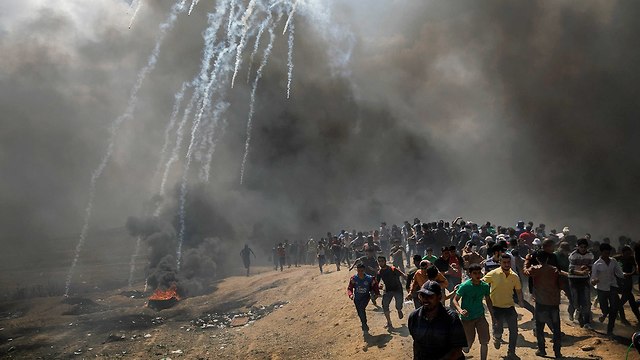
Razan al-Najjar was trying to help an injured protester when she was killed by Israeli snipers. She was the 119th person to be killed by Israeli soldiers at the border protests.

By Iyad Abuheweila and Isabel Kershner | The New York Times | Jun 2, 2018


“In our society women are often judged. But society has to accept us. If they don’t want to accept us by choice, they will be forced to accept us because we have more strength than any man. The strength that I showed the first day of the protests, I dare you to find it in anyone else.”
— Razan al-Najjar, Palestinian paramedic, killed on Jun 1, 2018


She had become a fixture at the weekly protests along the fence dividing the Gaza Strip from Israel, a young woman in a white paramedic’s uniform rushing into harm’s way to help treat the wounded.

As a volunteer emergency medical worker, she said she wanted to prove that women had a role to play in the conservative Palestinian society of Gaza.

“Being a medic is not only a job for a man,” Razan al-Najjar, 20, said in an interview at a Gaza protest camp last month. “It’s for women, too.”

An hour before dusk on Friday, the 10th week of the Palestinian protest campaign, she ran forward to aid a demonstrator for the last time.

Israeli soldiers fired two or three bullets from across the fence, according to a witness, hitting Ms. Najjar in the upper body. She was pronounced dead soon after.

Continue reading “Palestinian woman paramedic killed by Israeli sniper”

“Life and death are the same”

Funeral in Gaza Strip on Sunday. (photo: Ibraheem abu Mustafa / Reuters)

What Gazans are saying about the latest round of violence with Israel.

By Jack Khoury | Haaretz | May 30, 2018


“There is no joie de vivre, no joy during Ramadan. People have no incomes, no food, no medicine. The sense is that the world has forgotten about the Gaza Strip and its people. Life and death are the same side of the coin for a lot of people. I hear people say that explicitly.”
— Samir Zaqut, Al Mezan Center for Human Rights in Gaza


The feeling among people in the Gaza Strip on Tuesday night swung between despair and indifference, beyond the desire for revenge or fear of Israel’s reaction. “The feeling is that there’s nothing to lose,” a Hamas activist wrote. “So maybe war will change something in the miserable reality of the Strip. People are prepared to take another blow if war or conflict will lead to change.”

Calls to take action against Israel intensified with the dozens of deaths in recent weeks; every neighborhood and perhaps every street has known a death, or somebody badly injured, the activist said — and at the same time, the humanitarian situation has not been improving.

“The reasons are legion but death is the same death,” said Samir Zaqut of the Al Mezan Center for Human Rights in Gaza, quoting an Arab saying. “I have been living continuously in the Strip since 1998, and we’re in Ramadan, and this is the first time I see the despair everywhere, in every corner,” said Zaqut, who has been monitoring social media. . . .

Continue reading ““Life and death are the same””

Falsely accusing Palestinians of anti-Semitism is malicious

Blacklisted professor Steven Salaita. (photo: Greg Kahn / The Chronicle of Higher Education)

Palestinians are tired of conversations about our barbarism and irrationality — we’re trying to survive exclusion and privation.

By Steven Salaita | Mondoweiss | May 23, 2018


Let’s look at things a different way. Support of Israel requires deference to legal discrimination, inequitable models of citizenship, and massive displacement based on ethnic background. Can’t Zionists, then, rightly be accused of racism? We never get to ask that question. They occupy a normative position in American political discourses and so their civility is guaranteed.


Author’s note: On May 18, Rabbi Jill Jacobs published an essay in the Washington Post purporting to distinguish between legitimate criticism of Israel and “anti-Semitism.”  In the essay, she posted two of my tweets to suggest that I am anti-Semitic [spoiler: I am not].  Since August, 2014, the Washington Post has run numerous articles similarly impugning my character.  The paper has never offered me space to write in my own voice, despite numerous inquiries.  I submitted an essay to the Post’s Outlook section responding to the issues raised in Jacobs’ piece, but the paper declined to run it.  That essay, as submitted, follows.

When Israeli soldiers open fire on unarmed demonstrators, as they have been doing for over a month in the Gaza Strip, Americans are implicated in the violence, for the United States arms and funds those soldiers. Yet liberal supporters of Israel insist on complicating this straightforward proposition.

They often do so by accusing Israel’s critics of anti-Semitism. On the one hand, Israel’s liberal champions brand themselves allies of Palestine; but on the other hand, they defame and sabotage Palestinians. It is no longer tenable to have it both ways.

Continue reading “Falsely accusing Palestinians of anti-Semitism is malicious”

Unacceptable and inhumane: A response to Rabbi Jill Jacobs

(photo: giligetz.com)

What will it take for the world to see Gazans as real, living breathing human beings rather than either incorrigible terrorists or simple puppets of Hamas?

By Rabbi Brant Rosen | Shalom Rav | May 25, 2018


In truth, it has been difficult to avoid the abject dehumanization of Gazans by the Israeli government and Israel advocates these past few months. In statement after statement, Palestinians have all but been blamed for their own mass murder.


I continue to be troubled by Rabbi Jill Jacobs’ recent Washington Post op-ed, “How to tell when criticism of Israel is actually anti-Semitism,” and frankly disappointed to witness how warmly it has been received in progressive Jewish circles. In context and content, I find it to be anything but progressive.

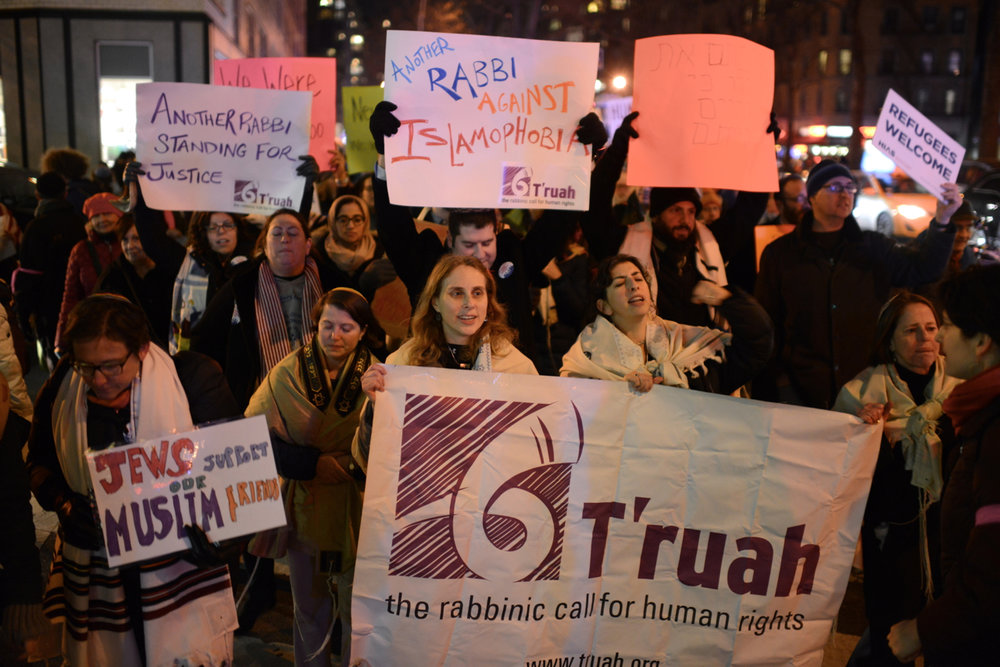
Jacob’s article was written in response to the Israeli military’s killing of over 100 Palestinians in demonstrations in Gaza since March 30, including 14 children, and injured over 3,500 with live fire. Certainly, as the Executive Director of Tru’ah — an American rabbinical organization that seeks to “protect human rights in North America, Israel and the occupied Palestinian territories” — one might have expected her to follow the lead of other human rights organizations and protest (or even call into question) Israel’s excessive use of force.

On the very same day as Jacobs’ op-ed, for instance, Human Rights Watch called for an international inquiry “into this latest bloodshed,” adding that “these staggering casualty levels (were) neither the result of justifiable force nor of isolated abuses; but foreseeable results of senior Israeli officials’ orders on the use of force.” For its part, Amnesty International called Israel’s actions “an abhorrent violation of international law” and Doctors Without Borders termed them “unacceptable and inhuman.”

Continue reading “Unacceptable and inhumane: A response to Rabbi Jill Jacobs”

There is a way to solve the Gaza crisis

Riots on Gaza border, last week. (photo: MCT)

Analysis: An arrangement led by Egypt and supervised by UN and Arab League inspectors, leading to the creation of a joint PA-Hamas civil government, would serve all parties and gradually dismantle the explosive conflict — even without forcing Hamas to disarm.

By Ron Ben-Yishai | Ynetnews | May 21, 2018


The [Israeli] defense establishment is interested in . . . a quick implementation of a comprehensive plan for humanitarian and economic aid to the [Gaza] strip. This recommendation from the IDF — and recently from the Shin Bet as well — is based on a simple idea: Humanitarian welfare (water, sewage, health and electricity services) and economic development (reducing unemployment) will calm things down [and forestall further political deterioration and violence].


After 62 Palestinians were killed and thousands were wounded during recent Gaza border riots, and following the harsh criticism against Israel in the international arena, the Gaza affair is far from over. Although neither Israel nor Hamas are interested in war, there is still a high likelihood that the clashes will escalate and deteriorate to another bloody and destructive round of war.

This may be another battle which will end in the exact situation we have today or an even worse one. In such a situation, Hamas won’t be there and we’ll have to deal with a governmental anarchy in the strip that is bound to spill into our territory.

When that happens, we will have no other choice but to return as an occupying force that will have to take care of the needs of two million hostile Palestinians. Security officials in Israel share the opinion that we have no interest in toppling the Hamas rule at this time, as it would lead to the creation of a governmental void in the strip.

The defense establishment is interested in stopping the deterioration down this slippery slope through a quick implementation of a comprehensive plan for humanitarian and economic aid to the strip. . . . Continue reading “There is a way to solve the Gaza crisis”

How do Israeli journalists report on a place they can’t reach?

Cameras belonging to news crews stationed at the Israeli side of the border with Gaza attempt to capture the clashes near the fence, May 15, 2018. (photo: Oren Ziv / Activestills.org)

For the past 11 years, Israeli journalists have been forbidden from entering Gaza. This has affected not only their reporting, but also the way fellow Israelis understand what is happening there.

By Oren Ziv | +972 Magazine | May 19, 2018


This was never Hamas’ decision; it was Israel’s.


The main obstacle that faces anyone who wants to report on what is happening at Gaza protests from the Israeli side of the border is that one can hear the gunfire, see the smoke, report on the army’s conduct, and estimate the number of protesters — and yet, you cannot get the full story. A journalist from East Jerusalem who often covers the goings on at the border summed it up perfectly: “We can hear the bullets, but we can’t see the blood.” Since Israel placed Gaza under siege 11 years ago, Israeli journalists have been forbidden from entering the Strip, both in times of conflict and calm. This was never Hamas’ decision; it was Israel’s.

Continue reading “How do Israeli journalists report on a place they can’t reach?”

Israel cannot fulfill its promise perpetuating apartheid

A Palestinian man falls to the ground after being shot by Israeli troops during a deadly protest at the Gaza Strip’s border with Israel on Monday. (photo: Khalil Hamra / The Associated Press)

As an American Jew, I feel compelled to speak the unspeakable: It is in Jewish best interests, morally and pragmatically, to rethink the notion of Israel as a Jewish state.

By Lauren Goldman Marshall | The Seattle Times | May 18, 2018


Imagine what a new Israel could be, an Israel for all peoples. If all the young lives, Jewish and Arab, cut short by this violence could instead be harnessed to irrigate the desert, desalinate the sea, create music and translate love poems into each other’s (very similar) languages! Now that would be an Israel to inspire the world.


Nineteen years ago, I rehearsed a play with Israeli and Palestinian teenagers at Seeds of Peace International Camp in Maine. Forging a script both sides could stand behind took perseverance. But at our cast party, Arabs and Jews leaned on each other and sang songs. It gave me a glimpse of what could be.

I contrast that hopeful moment with the appalling news coming out of Israel and Gaza. While Ivanka Trump, Jared Kushner and Benjamin Netanyahu celebrated the opening of the U.S. Embassy in Jerusalem, Israeli forces were firing on (mostly unarmed) Palestinian protesters gathered along the fence between Gaza and Israel, killing at least 60, and injuring more than 2,000.

Israel defends its response, claiming that the demonstrators were trying to breach the border. But the absence of any casualties on the Israeli side proves the response was grossly disproportionate. This is not an isolated incident, but an ongoing saga since 2007, when Israel imposed a blockade on Gaza following Hamas’ election victory. Nearly 2 million Gazans are squeezed into a virtual prison one-ninth the size of Rhode Island. Israel and Egypt control the borders and access to water, fuel, medical supplies and electricity. It doesn’t take a leap of logic to see that Gaza has become a concentration camp, and the demonstrations at the border are a desperate response to a humanitarian crisis.

Continue reading “Israel cannot fulfill its promise perpetuating apartheid”

As Gaza sinks into despair, a new book makes the case against Israeli brutality

Palestinians inspect the Israeli-bombed Zeitun district of Gaza City on Jan 23, 2009.
 (photo: Olivier Laban-Mattei / AFP / Getty Images)

“This book is not about Gaza,” the author writes. “It is about what has been done to Gaza.”

By Charles Glass | The Intercept | May 13, 2018


Gaza is sinking, if not into the sea, into desperation. The Israeli embargo has rendered 65 percent of Gazans under the age of 30 unemployed. Health care suffers from lack of equipment and medicine. People cannot leave to find work outside, and children live with the trauma of never knowing when their homes will be bombed. When I was there in 2002, Dr. Eyad Sarraj of the Gaza Community Mental Health Program told me that almost half the children under 16 suffered bed-wetting due to constant fear. That was before the military invasions of the last 10 years.


Israel celebrates a double anniversary on May 15 this year, the founding of the state and the formal establishment of the Israeli Defense Forces, the name the state gave to its combined army, navy, and air force. Armed statehood fulfilled the political Zionists’ dream of gathering Jews from the ancient Diaspora under their own government in what they declared to be their “promised land.” During the battle over the land between 1947 and 1949, the IDF expelled three-quarters of the indigenous population. Of the 750,000 Palestinian Arabs who fled, 250,000 took shelter in Gaza, a tiny pocket of southwest Palestine then occupied by the Egyptian army. The destitute and traumatized refugees were three times more numerous than the 80,000 Gazans who took them in.

The United Nations passed but did not enforce annual resolutions calling for the refugees’ return. Israel invaded the territory in 1956, withdrew under American pressure in 1957, and invaded again in 1967. As its population grew to nearly 2 million souls packed into a pocket five miles wide and 40 miles long, Gaza has become a byword for misery. Former British Prime Minister David Cameron, no advocate of the Palestinian cause, called it “an open-air prison.”

Continue reading “As Gaza sinks into despair, a new book makes the case against Israeli brutality”

Israel’s use of fatal fire in Gaza

Israeli soldiers arrest two Palestinian protesters who tried to approach the fence at the de facto border with Gaza. (photo: Mohammed Saber / EPA-EFE / Shutterstock)

Excessive force or justified mob control?

By Loveday Morris and Ruth Eglash | The Washington Post | May 16, 2018


“Cutting or attacking the fence is an offense. It has to be countered, but countered with reasonable force. There is no meter that I know of that would put the safety of the border fence at the same importance of the life of a 14-year-old.”
— Michael Sfard, an Israeli human rights lawyer


Fourteen-year-old Wisal Sheikh Khalil had wire cutters out and was trying to break through Gaza’s boundary fence into Israel when she was shot dead by Israeli soldiers on Monday, according to her younger brother, who was with her at the time.

She was one of at least 60 Palestinians killed by Israeli troops during protests this week along the fence, according to local health officials.

Israel’s sharpshooters, looking down from their nests on mounds of earth on the other side of the fence, have been permitted to use lethal force against those “endangering” the barrier, Israeli military officials say. These officials also say that Israeli soldiers have been allowed to use live ammunition to shoot “instigators” among “rioters” on the de facto border.

In both cases, the orders are to aim for the legs, they say, though Khalil was shot in the head.

Continue reading “Israel’s use of fatal fire in Gaza”

A grotesque spectacle in Jerusalem

US Ambassador to Israel David Friedman sits next to White House Senior Advisor Jared Kushner as he speaks during the dedication ceremony of the new US embassy in Jerusalem, May 14, 2018. (photo: Ronen Zvulun / Reuters0

Trump has empowered what’s worst in Israel, and as long as he is president, it may be that Israel can kill Palestinians, demolish their homes and appropriate their land with impunity. But some day, Trump will be gone.

By Michelle Goldberg | The New York Times | May 14, 2018


The juxtaposition of images of dead and wounded Palestinians and Ivanka Trump smiling in Jerusalem like a Zionist Marie Antoinette tell us a lot about America’s relationship to Israel right now. It has never been closer, but within that closeness there are seeds of potential estrangement.


On Monday, Ivanka Trump, Jared Kushner and other leading lights of the Trumpist right gathered in Israel to celebrate the relocation of the American Embassy to Jerusalem, a gesture widely seen as a slap in the face to Palestinians who envision East Jerusalem as their future capital.

The event was grotesque. It was a consummation of the cynical alliance between hawkish Jews and Zionist evangelicals who believe that the return of Jews to Israel will usher in the apocalypse and the return of Christ, after which Jews who don’t convert will burn forever.

Religions like “Mormonism, Islam, Judaism, Hinduism” lead people “to an eternity of separation from God in Hell,” Robert Jeffress, a Dallas megachurch pastor, once said. He was chosen to give the opening prayer at the embassy ceremony. John Hagee, one of America’s most prominent end-times preachers, once said that Hitler was sent by God to drive the Jews to their ancestral homeland. He gave the closing benediction.

Continue reading “A grotesque spectacle in Jerusalem”