Sen. Bernie Sanders (I-Vt.) speaks to the crowd during the 2019 South Carolina Democratic Party State Convention on June 22, 2019 in Columbia, South Carolina. (photo: Sean Rayford / Getty Images)
Sanders raises concern about U.S. military support to Israel.
By Jake Johnson | Common Dreams | Aug 16, 2019
‘The idea that a member of the United States Congress cannot visit a nation which, by the way, we support to the tune of billions and billions of dollars is clearly an outrage.’
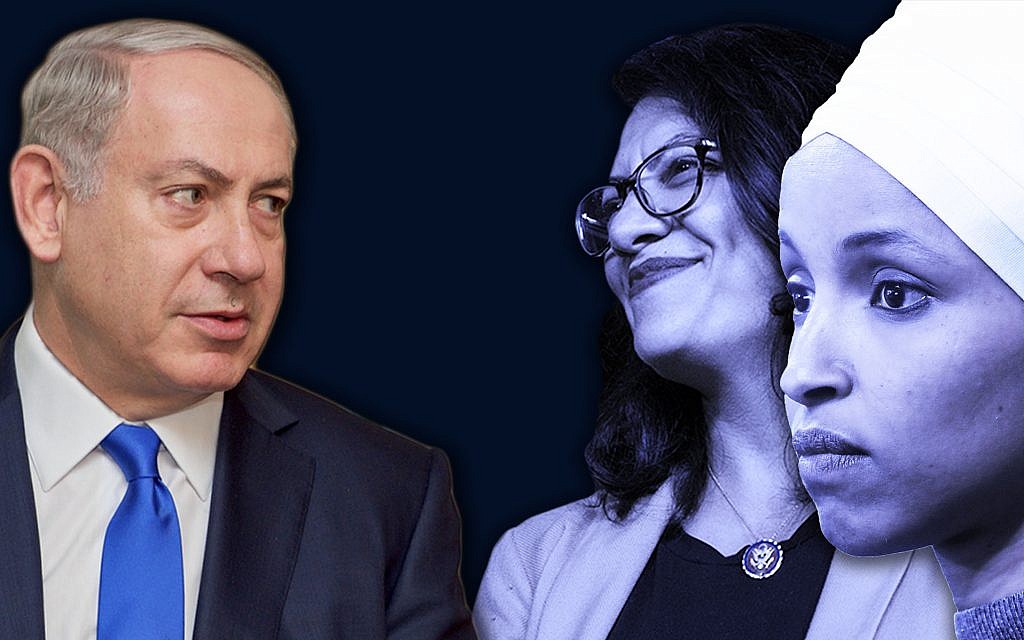
Sen. Bernie Sanders told MSNBC Thursday night that perhaps Israel should not be receiving billions of dollars in U.S. military aid after the right-wing government of Prime Minister Benjamin Netanyahu barred Reps. Ilhan Omar and Rashida Tlaib from entering the country.
“I wish I could tell you…that I am shocked. I am not,” Sanders, a 2020 Democratic presidential candidate, said of President Donald Trump’s support for Israel’s decision. “We have a president who, tragically, is a racist, is a xenophobe, and who is a religious bigot.”
On Friday morning, the New York Times reported that Israel will allow Tlaib to visit her 90-year-old grandmother who lives in the occupied West Bank. Israel did not change its position on Omar.
Prime Minister Benjamin Netanyahu of Israel and President Trump at the White House in March 2019. (photo: Doug Mills / The New York Times)
By barring Representatives Omar and Tlaib, Netanyahu has poisoned relations with America.
By Thomas Friedman | The New York Times | Aug 16, 2019
Excuse me, but when did powerful Israel — a noisy, boisterous democracy where Israeli Arabs in its Parliament say all kinds of wild and crazy things — get so frightened by what a couple of visiting freshman American congresswomen might see or say?
I am going to say this as simply and clearly as I can: If you’re an American Jew and you’re planning on voting for Donald Trump because you think he is pro-Israel, you’re a damn fool.
Oh, don’t get me wrong. Trump has said and done many things that are in the interests of the current Israeli government — and have been widely appreciated by the Israeli public. To deny that would be to deny the obvious. But here’s what’s also obvious. Trump’s way of — and motivation for — expressing his affection for Israel is guided by his political desire to improve his re-election chances by depicting the entire Republican Party as pro-Israel and the entire Democratic Party as anti-Israel.
As a result, Trump — with the knowing help of Israel’s current prime minister, Benjamin Netanyahu — is doing something no American president and Israeli prime minister have done before: They’re making support for Israel a wedge issue in American politics.
Because Tlaib and Omar cannot serve as witnesses, the responsibility falls even more heavily on us.
By Peter Beinart | Forward | Aug 15, 2019
[Netanyahu is] not a fool. He may have barred Omar and Tlaib partly because Donald Trump asked him to. He may have felt the stunt would appeal to right-wing voters in Israel’s upcoming elections. But he likely also understood that if Omar and Tlaib brought the American media with them to the West Bank, they might begin to puncture the cocoon that he and his American Jewish allies have worked so hard to build.
Most establishment American Jewish leaders think Israel’s decision to bar Representatives Rashida Tlaib and Ilhan Omar from visiting the West Bank was, in the words of The Democratic Majority for Israel, “unwise.”
Benjamin Netanyahu, the American Jewish Committee argued, should have realized that “visiting Israel is essential to gaining a better understanding of this… open, democratic society.”
AIPAC said “every member of Congress should be able to visit and experience our democratic ally Israel firsthand.”
Of course they think that. Most officials of mainstream American Jewish organizations have never been to the places Tlaib and Omar planned to go. They’ve never talked to Palestinians whose homes are about to be bulldozed because they lack the building permits that, as non-citizens under military rule, they can’t get. They’ve never heard Palestinian parents explain the terror they feel when Israeli soldiers come in the middle of the night to take their children to be interrogated, often for days, in the absence of a lawyer.
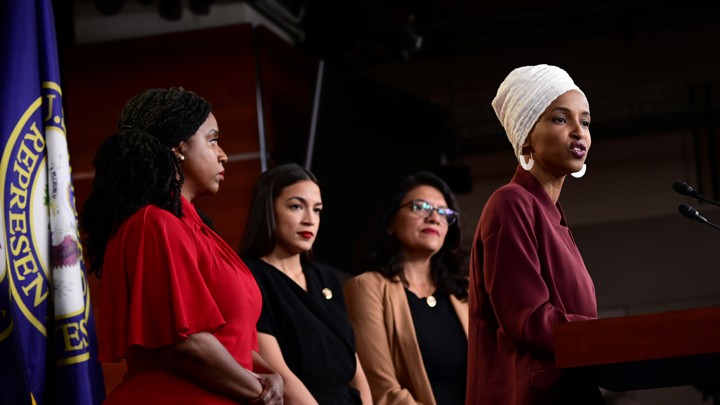
Representatives Ilhan Omar, Rashida Tlaib, Alexandria Ocasio-Cortez, and Ayana Pressley speak at a press conference. (photo: Erin Scott / Reuters)
This reflects Israeli’s intense fear of the BDS movement, and its growing intolerance for dissent from within or outside of the country.
By Emma Green | The Atlantic | Aug 15, 2019
I’m calling this like I see it: bigoted, short sighted and cruel. Any leader committed to advancing democracy would welcome with open arms two democratically elected United States Congresswomen. And every single member of Congress should be calling this out. — Rep. Ayanna Pressley (D-Mass.)
The trip was always going to be bad PR for Israel. Representatives Rashida Tlaib of Michigan and Ilhan Omar of Minnesota planned to lead a visit to Israel and the Palestinian territories, meeting with “people in the refugee camps,” “people at checkpoints,” and “people who lost their lands and had their homes demolished,” as James Zogby, the head of the Arab American Institute, told the website Jewish Insider. No matter what, these kinds of photo ops from two of the U.S.’s most outspoken and visible critics of Israel would have provided powerful ammunition to the country’s opponents.
This morning, Israel handed its critics even more powerful material. According to Reuters, the government has barred Tlaib and Omar from entering the country.
This move is not unprecedented. In recent years, Israel has routinely detained, and in some cases refused entry to, foreign visitors associated with the Boycott, Divestment, and Sanctions movement, which calls on governments and companies to put economic pressure on Israel. This policy reflects the current Israeli government’s intense fear of the BDS movement, and its growing intolerance for dissent from within or outside of the country. But in the past few years, the Israeli government has had a new ally encouraging and enabling its antidemocratic instincts: President Donald Trump. At every turn, the tight alliance between the Trump administration and the Netanyahu government has facilitated Israel’s drift to the right, further widening the gap between Israel and many of its Jewish allies in the United States. . . .
ELCA assembly overwhelming passes strong statement supporting multiple actions for their church constituency.
By Peace Not Walls | Evangelical Lutheran Church in America | Aug 7, 2019
The Assembly Action … urges the ELCA to advocate to ‘ensure that U.S. taxpayer funds not support military detention, interrogation, abuse or ill-treatment of Palestinian children’.
On August 6, 2019, at the ELCA’s 2019 Churchwide Assembly in Milwaukee, the assembly approved by 96% (YES-829; NO-33) four Assembly Actions related to Israel and Palestine (the memorials were presented en bloc with other memorials). The Assembly Actions deal with the human rights social investment screen, the detention of Palestinian children by Israel, funding for Augusta Victoria Hospital, and continuing to listen to various perspectives on the conflict. The Assembly Actions include urgent requests for advocacy related to the Lutheran World Federation’s Augusta Victoria Hospital and the military detention of Palestinian children by Israel. The Peace Not Walls team will continue to provide resources for education and advocacy related to both.
The Assembly Action titled “Category B1: Just Peace” “commend[s] and encourage[s] Portico Benefit Services to continue its implementation of the human rights social criteria investment screen as it relates to investments in Israel and Palestine.” This relates to the Churchwide Assembly Action in 2016 which directed “the ELCA’s Corporate Social Responsibility review team to develop a human rights social criteria investment screen based on the social teachings of this church and, in the case of Israel and Palestine, specifically based on the concerns raised in the ELCA Middle East Strategy; …” [CA16.06.31].
Rather than trying to broaden the perspective of Israel’s critics, Netanyahu is pushing them into an evermore radical position.
By Jennifer Rubin | The Washington Post | Aug 15, 2019
The decision to exclude them likely will, American Jewish leaders recognize, incite the boycott, divestment and sanctions (BDS) movement and create a further schism with Democrats in Congress. It will continue the process, exacerbated by Trump and Netanyahu, of making support for Israel a partisan issue, something both sides have long tried to avoid.
The Post reports, “Caught between the opposing views of President Trump and Democratic leaders, Israeli Prime Minister Benjamin Netanyahu reversed himself on Thursday and decided to prohibit Reps. Ilhan Omar (D-Minn.) and Rashida Tlaib (D-Mich.) from visiting Israel during a trip scheduled to start Sunday.” While the government originally announced it would admit the pair, the call from Trump to exclude American lawmakers, an outrageous and unprecedented step, “immediately opened up a new battle between Netanyahu and Democrats, who had privately warned that such a decision would be unprecedented and inconsistent with Israel’s claims of tolerance and openness.”
The problem arises from a recently passed law that would bar foreign nationals who support any boycott of Israel from receiving entry visas. This in and of itself was an infringement on the Israeli tradition of vigorous public debate, but with elections upcoming in September, Netanyahu is scrambling to ingratiate himself further with the far right. Before Wednesday, however, “Israeli Ambassador Ron Dermer said the two congresswomen would be allowed to visit Israel ‘out of respect for the U.S. Congress and the great alliance between Israel and America.’” So much for that “respect.” (The Israeli embassy did not respond to a request for comment.)
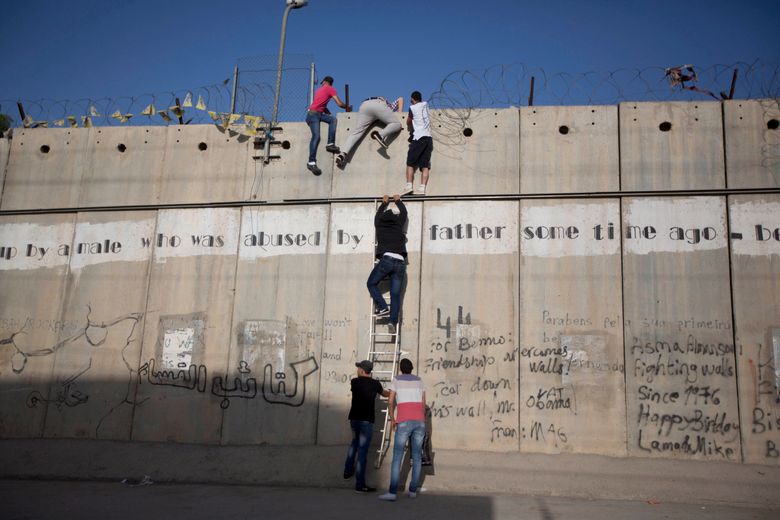
Palestinians climb over the wall in Al-Ram, north of Jerusalem. (photo: Majdi Mohammed / AP, File)
Building a strong Jewish state will not come from repressive practices.
By Alice Rothchild | The Seattle Times | Aug 9, 2019
I began to understand that Zionism inherently involves harm to Palestinians who were living in historic Palestine when Jewish immigration began in the early 1900s.
A central debate within the U.S. Jewish community involves Zionism and its relationship to Judaism. In the recent anthology “Reclaiming Judaism from Zionism: Stories of Personal Transformation,” 40 rabbis, scholars and activists reflect on their particular intellectual and emotional journeys that began with an unquestioning love of Israel. Like the other contributors, I became aware that the ideology of Jewish nationalism and the policies of the Israeli government have corrupted my concept of Judaism and its central religious and cultural values.
I grew up in a family, post Nazi Holocaust, that viewed the creation of a modern Jewish state as a miracle to be celebrated. We idealized the kibbutzim, saved our quarters to plant trees in the barren land and loved the romantic ideal of the Israeli pioneers making the desert bloom.
At the same time, like many Jews, I was proud of my progressive politics. I supported civil rights, women’s rights, labor unions; this was my lived expression of a religion that extolled healing the world and working for justice. As a second-generation immigrant, it was also how I saw my role in America, a land where my grandparents, fleeing the pogroms of Eastern Europe, found a home, even if it was only the hard scrabble ghettos of Brooklyn in the early 1900s.
An Israeli soldier points his weapon during clashes with Palestinians in the village of Kafr Qaddum near the Jewish settlement of Kedumim in the West Bank on Aug. 2. (photo: Jaafar Ashtiyeh/ AFP /Getty Images)
Timid language doesn’t help the peace process.
By Nathan Hersh | Washington Post | Aug 5, 2019
This is not the first time Democrats have shied away from using the term ‘occupation.’
Last month, Rep. Karen Bass (D-Calif.) amended a resolution initially drafted by Rep. Alan Lowenthal (D-Calif.) that supported a two-state solution to the Israeli-Palestinian conflict. The changes she made to the bill, H.R. 326, removed references to Israel’s occupation and West Bank settlement growth.
This is not the first time Democrats have shied away from using the term “occupation.” In 2016, the party rejected an amendment to its platform that would have condemned the occupation. More recently, the Democratic Majority for Israel, founded this year by major party veterans to reaffirm the bipartisan nature of support for Israel in Congress, fails to mention the occupation even once in its nearly 500-word mission statement. In response to a question about the occupation from the left-wing Jewish activist group IfNotNow, presidential candidate Beto O’Rourke didn’t say the word “occupation” at all.
Farmers near the border in Gaza. (photo: Shourideh C. Molavi and Ain Media Gaza)
A new report by the group ‘Forensic Architecture’ has found that widespread pesticide contamination from Israel into Gaza has occurred over decades, severely impacting the food grown in Gaza.
By Forensic Architecture | International Middle East Media Center | Jul 29, 2019
This ongoing practice has not only destroyed entire swaths of formerly arable land along the border fence, but also crops and farmlands hundreds of metres deep into Palestinian territory, resulting in the loss of livelihoods for Gazan farmers.
Staging the terrain
Over three decades, in tandem with the Madrid and Oslo negotiation processes, the occupied Gaza Strip has been slowly isolated from the rest of Palestine and the outside world, and subjected to repeated Israeli military incursions. These incursions intensified from September 2003 to the fall of 2014, during which Israel launched at least 24 separate military operations targeting Gaza, giving shape to its surrounding borders today.
The borders around Gaza—one of the most densely-populated areas on Earth—continue to be hardened and heightened into a sophisticated system of under- and overground fences, forts, and surveillance technologies. Part of this system has been the production of an enforced and expanding military no-go area—or ‘buffer zone’—on the Palestinian side of the border.
Since 2014, the clearing and bulldozing of agricultural and residential lands by the Israel military along the eastern border of Gaza has been complemented by the unannounced aerial spraying of crop-killing herbicides.
While Palestinian women have always faced political marginalization, developments since the Oslo Accords have caused them to endure perhaps even more formidable challenges when it comes to political participation. (photo: APA Images)
By Yara Hawari | Al Shabaka | Jul 28, 2019
…women have always been present and active at crucial political and national moments, though they have also had to navigate tensions among feminism, nationalism, and anti-colonial struggle.
EXECUTIVE SUMMARY
While Palestinian women have always faced political marginalization, developments since the Oslo Accords have caused them to endure perhaps even more formidable challenges when it comes to political participation. Al-Shabaka Palestine Policy Fellow Yara Hawari outlines these challenges and recommends ways for Palestinian women and society to disrupt this process and revitalize the Palestinian liberation struggle through feminism.
Though Palestinian women have always played a fundamental role in the struggle for liberation from the Israeli settler colonial regime, they have faced consistent political marginalization. This experience has become more multifaceted and entrenched since the 1990s, when the Oslo Accords unleashed a myriad of changes in the structure of Palestinian society and governance.
These changes have included a newfound dependence on international donor aid among Palestinian civil society, including women’s organizations, and the bolstering of a corrupt and relentlessly patriarchal Palestinian Authority (PA) that complements rather than confronts the Israeli occupation and its oppression of the Palestinian population, both male and female. Such developments have caused today’s Palestinian women to endure perhaps even more formidable challenges when it comes to activism and political participation.
You must be logged in to post a comment.