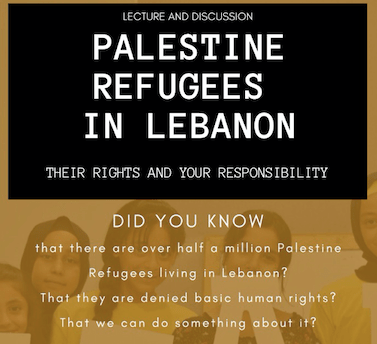
Abby Brook, a graduate student of Middle East Studies of the American University of Beirut, will share her first-hand knowledge of the history and current conditions of Palestine Refugees in Lebanon followed by a Q&A session. Abby has worked with several organizations advocating for human rights, justice, and peace for Palestinians.
Secretary of State Mike Pompeo delivers a statement on Israeli settlements in the West Bank during a news briefing in Washington on Monday. (photo: Yara Nardi / Reuters)
The administration has neither the right nor the agency to rewrite international law to suit its own biases and ideologies. Endorsing the results of crimes, such as the construction of settlements, amounts to complicity. It is unacceptable and unconscionable.
By Hanan Ashrawi | The Washington Post | Nov 20, 2019
Thousands of acres of private Palestinian land have been stolen or destroyed in order to make way for settlements and the roads and infrastructure that connect them. The regime has de facto control over nearly 60 percent of the occupied West Bank, and has separated Palestinian families from each other and Palestinian farmers from their land. Entire communities have been imprisoned behind a matrix of walls and Israeli-only roads, military bases and checkpoints.
On Monday, in a move that reversed more than 40 years of U.S. policy, Secretary of State Mike Pompeo announced that the Trump administration does not consider Israeli settlements built on occupied Palestinian land to be illegal. This latest gift from the Trump administration to the Israeli right is inconsistent with international law, United Nations resolutions and positions adopted by the rest of the international community. Although it has no legal validity, the decision undermines the most fundamental precepts of international law, including the inadmissibility of acquiring territory by force. This will undoubtedly have far-reaching and global consequences.
Pompeo’s reckless announcement threatens to normalize and encourage Israeli war crimes and expansionism, while emboldening other states with expansionist agendas to take steps that would further unravel the world order. It is an overt green light for Israeli annexation of Palestinian territory and the permanent denial of the Palestinian people’s rights to freedom and self-determination.
The issue of settlements is not some abstract or theoretical legal argument. Israel’s illegal settlement regime has had dire consequences on the lives and livelihoods of millions of Palestinians. It is the single greatest obstacle to the realization of the two-state formula, which has been the centerpiece of international peacemaking efforts — however feeble — for decades.
An Israeli settlement in the occupied Palestinian territories in the West Bank. (photo: AFP)
The intervention will have no immediate effect on the ground but will delight evangelical American voters and may have harmful consequences.
By Staff | The Economist | Nov 19, 2019
[I]t is easy to dismiss the administration’s switch of policy as largely an empty gesture, aimed at a domestic audience, and intended mainly to appeal to the pro-Israel evangelical American voters Mr Trump will need for re-election in 2020. But it could have harmful effects in the longer term.
The announcement on November 18th by Mike Pompeo, the American secretary of state, was unscheduled but not entirely unexpected. He said that, following a legal review by the State Department, Israeli settlements in the West Bank are “not, per se, inconsistent with international law.” This is the latest in a series of such gestures by the Trump administration over the past two years, including recognizing Jerusalem as Israel’s capital and accepting its sovereignty over the occupied Golan Heights.
Looked at more broadly, the change of policy is also wholly in tune with Donald Trump’s tendency to disregard accepted diplomatic norms. Despite some dissenting views, the wide international consensus for decades has been that the settlements Israel has built in the territories it captured in the war with Arab states in 1967 are indeed illegal. They are deemed to contravene the Fourth Geneva Convention, which stipulates that “the occupying power shall not deport or transfer parts of its own civilian population into the territory it occupies.”
For over four decades, this has been the view even of Israel’s allies, including most American administrations (with the exception of Ronald Reagan’s, cited by Mr Pompeo). However, Israel, undeterred, has clung to its own interpretation of international law. Over the past 52 years it has built hundreds of settlements, both in east Jerusalem, which it formally annexed in 1967, and in the wider areas of the West Bank (what Israel calls Judea and Samaria). Palestinians, and much of the rest of the world, regard these, as well as the Gaza Strip, as belonging to a future Palestinian state.
The country cannot remain Jewish and democratic while controlling the entire Holy Land.
By Staff | The Economist | Feb 2, 2019
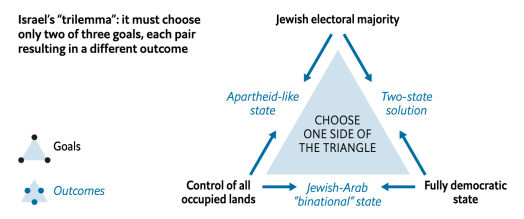
As Palestinians lose hope for a state of their own, some favor a ‘one-state’ deal: a single state on all the land with equal rights for Jews and Arabs. Israel would have to give up its predominantly Jewish identity. That is because, between the Mediterranean and the Jordan river, the overall number of Arabs has caught up with that of Jews, and may soon exceed them.
Israeli-Palestinian peace talks are frozen. President Donald Trump’s plan for the “deal of the century” has been put off. The subject is absent in campaigning for the Israeli election in April, which focuses on looming corruption charges against Binyamin Netanyahu, the prime minister.
The Oslo accords of 1993 created a crazy quilt of autonomous zones in the lands that Israel captured in 1967. They also kindled the hope of creating a Palestinian state in most of the West Bank and Gaza Strip, with its capital in East Jerusalem. After much bloodshed, though, most Israelis are wary of this “two-state solution.” Today Palestinians are mostly shut off by security barriers, and divided. The Palestinian Authority in the West Bank refuses to negotiate with Israel but co-operates on security. Its Islamist rival, Hamas, which runs Gaza, dares not risk another war, for now.
Besides, the growth of Jewish settlements makes a two-state deal ever harder. Establishing a Palestinian state would probably require the removal of settlers in its territory. Israel had trouble enough evicting 8,000 Jews from Gaza in 2005. There are more than fifty times as many in the West Bank. Even excluding East Jerusalem, annexed by Israel, the number of Jews east of the “green line” (the pre-1967 border) has risen from 110,000 in 1993 to 425,000. New home approvals nearly quadrupled from 5,000 in 2015–16 to 19,000 in 2017–18, according to Peace Now, a pressure group.
Israeli soldiers overlooking East Jerusalem. (photo: Getty Images)
It’s not clear what benefit America derives from this move, but Russia’s occupation of Crimea gains immediate legitimacy.
By Alex Zeldin | Forward | Nov 18, 2019
Whether the move is a correct reading of international law or not, it’s not clear what American national interest is advanced by claiming Israeli West Bank settlements are legal.
Most days, you could be forgiven for not paying attention to shifts in diplomatic policy stances. But on Monday afternoon, Secretary of State Mike Pompeo announced a policy change with potentially far reaching implications. He announced that “the establishment of Israeli civilian settlements in the West Bank is not per se inconsistent with international law.”
The announcement will shift little on the ground. Its effect is more rhetorical than practical. But the primary beneficiary of this rhetorical flourish is not Israel but another country entirely: Russia. And the real loser is not just the Palestinians but America.
Secretary of State Mike Pompeo speaks at a news conference at the State Department in Washington, DC, Nov 18, 2019. (photo: Andrew Harnik / AP)
More than 700,000 Israeli settlers have taken up residence in the West Bank and East Jerusalem since the 1967 war. Both areas are historic Palestinian territories currently under Israeli military occupation.
By Karen DeYoung, Steve Hendrix and John Hudson | The Washington Post | Nov 18, 2019
‘The timing of this was not tied to anything that had to do with domestic politics anywhere. We conducted our review, and this was the appropriate time to bring it forward.’ — Secretary of State Mike Pompeo
Secretary of State Mike Pompeo said Monday that the Trump administration had determined that Israel’s West Bank settlements do not violate international law, a decision he said had “increased the likelihood” of a Middle East peace settlement.
Pompeo said the Trump administration, as it did with recognition of Jerusalem as the Israeli capital and Israel’s sovereignty over the disputed Golan Heights, had simply “recognized the reality on the ground.”
The move upends more than 40 years of U.S. policy that has declared Israeli expansion into territories occupied since the 1967 war a major obstacle to settling the Israeli-Palestinian conflict.
Friends of 15-year-old Palestinian Mohammed Ibrahim Ayoub, who was shot and killed by Israeli army along the Israel-Gaza border, sit by his grave in a cemetery in Beit Lahia on 21 April, 2018. (photo: AFP)
Israel’s approach to international law can be summed up as ‘If you do something for long enough, the world will accept it’.
By Ben White | Middle East Eye | Nov 5, 2019
…Israel has been working hard to develop, and promote, interpretations of international law that provide cover for its policies and tactics in the Gaza Strip.
Since removing settlers and redeploying its armed forces to the perimeter fence in 2005, Israel has subjected Palestinians in the Gaza Strip to numerous devastating assaults, a blockade, and routine attacks on the likes of farmers and fishermen.
Many of these policies have been the subject of substantial condemnation – from Palestinians, of course, as well as Israeli and international human rights groups, and even world leaders and politicians – albeit, critically, with little concrete action at the state level.
Israel, however, has sought to thwart even the possibility of meaningful accountability. Its approach has been very simple: in the face of criticism for breaking the law, change the law.
Palestinians flee with their belongings from the Shejaiya neighborhood of Gaza City to the center of town to seek refugee at a UN school, on August 19, 2014. Warplanes bombed the strip after Palestinian rockets smashed into the country’s south. (photo: Ezz al-Zanoun)
A look at the role of the Israeli military in collective punishment of a group of people.
By Jonathan Ofir | Mondoweiss | Nov 12, 2019
Terrorization has been a consistent means of the Israeli state and army vis-à-vis Palestinians.
After the 2008-9 Israeli onslaught on Gaza that took 1500 lives, a UN fact-finding mission concluded that the three-week campaign was “a deliberately disproportionate attack, designed to punish, humiliate and terrorize a civilian population.” Note the word “terrorize.”
But was this an isolated incident? Not at all. Israel has a long and sordid history of state-terrorist activity. There was the pre-state terror, which eventually served as a means of ethnic cleansing, known as the Nakba of 1948. Those Palestinians who tried to return were shot by the thousands, most of them unarmed.
Please join our brothers and sisters at the University of Washington Stroum Center for Jewish studies for a look at the changing landscape during the Trump presidency.
In his 2016 book “Trouble in the Tribe: The American Jewish Conflict Over Israel” (Princeton University Press), Dov Waxman argued that the age of uncritical and unconditional American Jewish support for Israel is over, and that Israel is now becoming a source of division in the American Jewish community. In this talk, he will discuss how the presidency of Donald Trump has deepened American Jewish divisions over Israel, heightened communal concerns about antisemitism, and mobilized a new generation of Jewish activists. As a result, American Jewry’s relationship with Israel, and American Jewish politics, is being reshaped.
A protester holds a placard reading ‘I boycott Israel but not Jews’ during a Palestine solidarity event in Berlin. (photo: Fabrizio BenschReuters)
Painting BDS as anti-Semitic is primarily a tactic to legitimize the occupation.
By Barry Trachtenberg | The Electronic Intifada | Oct 30, 2019
In the United States, anxiety over BDS is just as palpable and extends to any perceived slight against the Jewish people.
The Czech parliament’s decision to pass a resolution condemning the Palestinian-led boycott, divestment and sanctions movement as anti-Semitic last week is only the most recent example of how the panic over BDS has reached a fever pitch.
This latest round of attempts to stop public criticism of Israel’s treatment of Palestinians began in Britain in May. Jeremy Hunt, at the time foreign secretary and running for the leadership of the Conservative Party, attacked supporters of BDS by declaring that “boycotting Israel – the world’s only Jewish state – is anti-Semitic.”
You must be logged in to post a comment.