Peter Beinart, from the Center for American Progress.
Peter Beinart challenges Jewish culture because he refuses to use the Holocaust lens of perpetual victim-hood when considering Palestinian resistance.
By Yakov Hirsch | Mondoweiss | July 26, 2020
This ‘Holocaust lens,’ Beinart claims, is what makes it so difficult for Jews to see Palestinians as created ‘b’tselem Elohim,’ in the image of God.
In his recent essay arguing for equal rights for Israelis and Palestinians, Peter Beinart says the Jewish dehumanization of the Palestinians is the biggest threat to a peaceful future for Israelis and Palestinians, and he points to the misinterpretation of the Holocaust as a reason for that dehumanization. This “Holocaust lens,” Beinart claims, is what makes it so difficult for Jews to see Palestinians as created “b’tselem Elohim,” in the image of God.
That dehumanization includes the idea that Palestinians are motivated by antisemitism in their opposition to Israel. The claim, Beinart says, is a function of “Jewish trauma.” And, Beinart argues, it says more about us than it does about them:
Bari Weiss, as a sophomore at Columbia University, speaks at a press conference organized by Columbians for Academic Freedom, a group she co-founded, on March 31st, 2005. (photo: AP Photo / Tina Fineberg)
Some of the Harper’s letter signatories use their defense of free speech to silence support for Palestinian rights.
By Mari Cohen & Joshua Leifer | Jewish Currents | July 23, 2020
…failure to recognize the tension between their free speech advocacy on the one hand, and their pro-Israel advocacy on the other, reveals an unwillingness to reckon with the relationship between speech and power.
TWO WEEKS AGO, an open letter published in Harper’s Magazine and signed by more than 150 public figures, most of them writers or academics, ignited a new round of debate over “cancel culture” and its discontents. The letter portrayed freedom of expression in the United States as dangerously imperiled: “We uphold the value of robust and even caustic counter-speech from all quarters. But it is now all too common to hear calls for swift and severe retribution in response to perceived transgressions of speech and thought.” A week later, Bari Weiss, one of the letter’s high-profile signatories, resigned her position at the New York Times op-ed desk and self-published her resignation letter. Echoing the Harper’s letter, Weiss’s statement decried an increasingly “illiberal environment” in public discourse writ large and at the Times in particular. She wrote that her colleagues—and the public—have become unwilling to accommodate views that don’t adhere to “the new orthodoxy.”
Yet, as some critics have noted, Weiss has a long history of claiming to support free speech while trying to curtail the speech of Palestinian rights advocates, from her college days through her years at the Times. And she is not the only signatory of the Harper’s letter who has sought to silence those with whom she disagrees. Cary Nelson, professor emeritus at the University of Illinois, is a prominent opponent of the Boycott, Divestment, and Sanctions (BDS) movement and has written extensively about the need to combat anti-Zionist scholarship in the name of academic freedom.
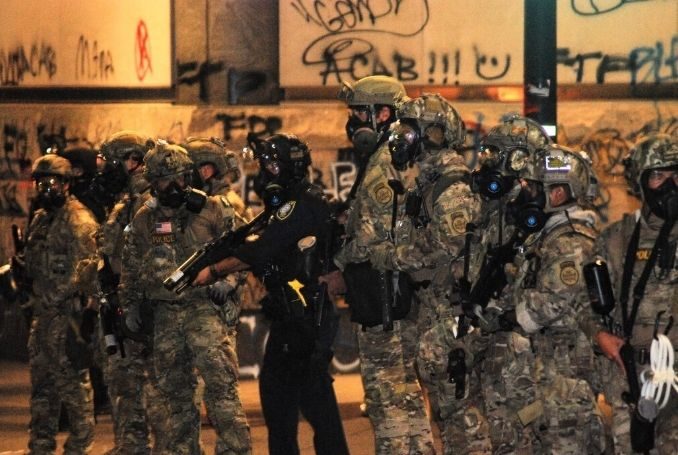
Federal agents in Portland, Oregon. (photo: via Social Media)
Israeli arms sales, surveillance and police training contributes to the militarization of police now being seen across cities in the US. In reality the disappearing has been happening for a long time.
By Benay Blend | The Palestine Chronicle | July 21, 2020
…it is possible to draw attention to Israel’s role in ‘snatching and disappearing people all over the world,’ but in particular the Southern Cone, Palestine, and now in the United States.
“What was old has become new again,” wrote local activist Lee Einer in a Facebook post this morning. Einer is referring to Donald Trump’s use of federal law enforcement officers, dressed in camouflage but with no identification, riding in unmarked cars, rounding up Black Lives Matter protesters in Portland, Oregon. Since July 14th multiple videos have documented officers whisking people off in cars with no explanation as to why they are being detained.
Reporting for The Nation, Jeet Heer contends that these actions are “illegal and unconstitutional.” Nevertheless, it is likely that they are operating under the aegis of Barack Obama’s approval of the 2011 National Defense Authorization Act which permits the detention of Americans if suspected of being terrorists.
The Jewish National Fund is a thriving relic of Europe’s colonial past, even if today it wears the garb of an environmental charity. As recent events show, ethnic cleansing is still what it excels at.
By Jonathan Cook | Mondoweiss | July 22, 2020
But the JNF’s expulsion activities did not end in 1948, when Israel was established through a bloody war on the ruins of the Palestinians’ homeland – an event Palestinians call the Nakba, or catastrophe.
The Jewish National Fund, established more than 100 years ago, is perhaps the most venerable of the international Zionist organizations. Its recent honorary patrons have included prime ministers, and it advises UN forums on forestry and conservation issues.
It is also recognized as a charity in dozens of western states. Generations of Jewish families, and others, have contributed to its fundraising programs, learning as children to drop saved pennies into its trademark blue boxes to help plant a tree.
And yet its work over many decades has been driven by one main goal: to evict Palestinians from their homeland.
Separation wall between Israel and the West Bank near Jerusalem. (photo: Mazur Travel via Shutterstock)
Please join our brothers and sisters at New York Jewish Agenda (NYJA) for a livestreamed debate over the future resolution of the Israeli-Palestinian conflict. Participants in the discussion will feature Peter Beinart, Jeremy Ben-Ami, and Rabbi Jill Jacobs.
The event will feature Jewish Currents Editor-at-Large Peter Beinart, author of a recent essay arguing that the two-state solution is obsolete, in discussion with Jeremy Ben-Ami and Rabbi Jill Jacobs.
Peter Beinart is professor of journalism and political science at the City University of New York, Editor-at-Large of Jewish Currents, an Atlantic and CNN contributor and a fellow at the Foundation for Middle East Peace.
Jeremy Ben-Ami is the President of J Street, bringing to the role both deep experience in American politics and government and a passionate commitment to the state of Israel.
Rabbi Jill Jacobs is the Executive Director of T’ruah. Formally, she was a Rabbi-in Residence at Jewish Funds for Justice (JFSJ), a national public foundation dedicated to mobilizing the resources of American Jews to combat the root causes of domestic social and economic injustice.
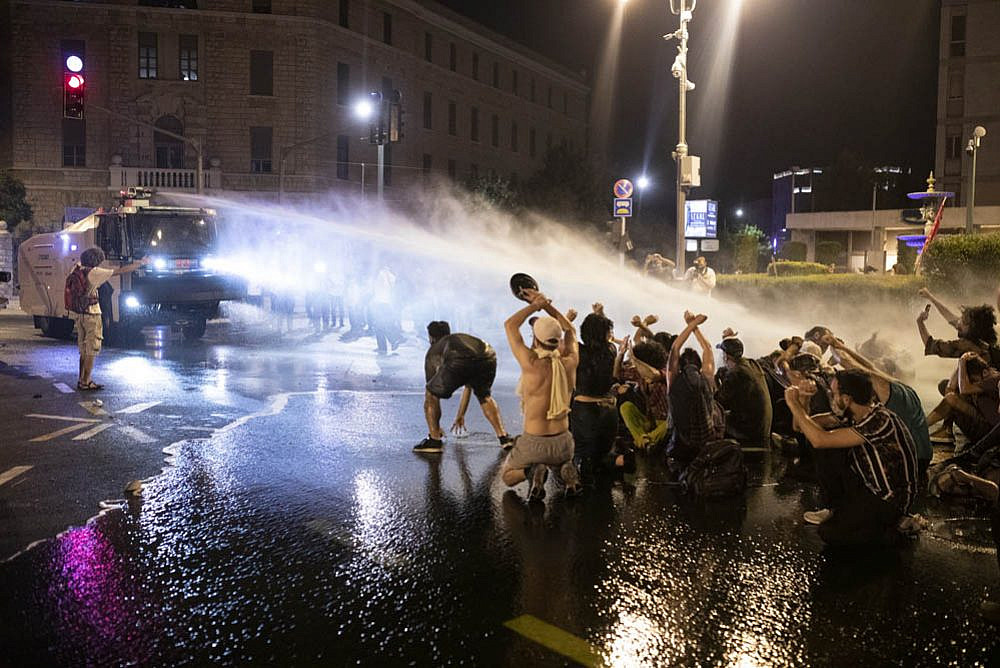
A police water cannon douses dozens of protesters in central Jerusalem during clashes that followed a mass demonstration outside the Prime Minister’s Residence, July 14, 2020. (photo: Oren Ziv)
A protest against Prime Minister Benjamin Netanyahu turned into a chaotic and historic night, during which Israeli-Jewish leftists turned their anger on the police.
By Oren Ziv | +972 | July 15, 2020
…it became apparent that while the organizers of the protest have been reticent regarding tying the recent anti-Netanyahu protests to other struggles in Israel-Palestine, the demonstrators were far more open to more radical messaging, including about resisting the occupation and police brutality.
The organizers of Tuesday night’s “Siege on Balfour” protest, outside the Prime Minister’s Residence in Jerusalem, never expected the latest demonstration against Benjamin Netanyahu’s corruption to turn into full-blown clashes with the police that would last into the early hours of the morning. It is hard to imagine that anyone thought 50 people would be arrested.
After all, protests by Israel’s Jewish left over the past few decades have typically been relatively calm — no burning trash cans or water cannons dousing demonstrators. But on “Bastille Day in Balfour,” all that changed.
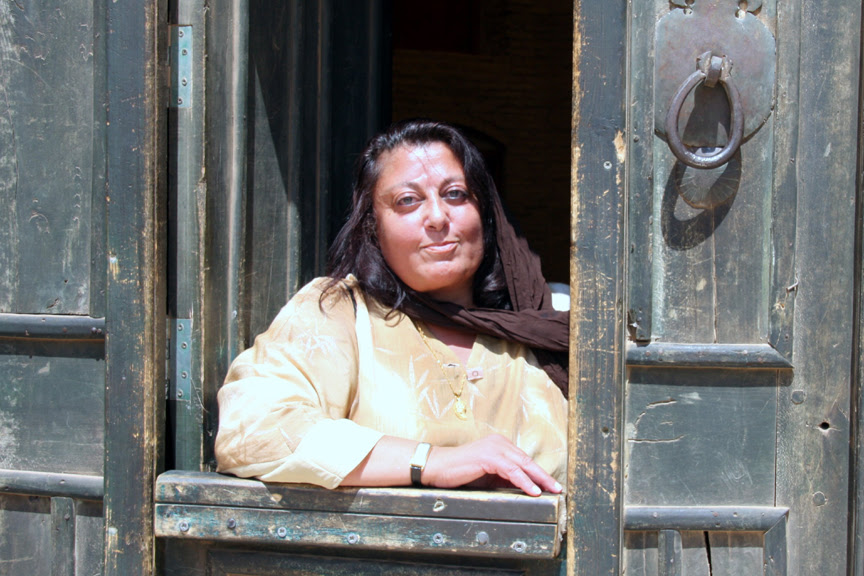
The Ethnic Heritage Council of the Pacific Northwest has recognized the work of Rita Zawaideh for her significant contribution to her ethnic community and ethnic heritage, as well as to the community at large.
By Ethnic Heritage Council | July 16, 2020
She is a ‘one-person community information center for the Arab community,’ — Huda Giddens
For decades, Rita Zawaideh has been an advocate and change-maker on behalf of Middle Eastern and North African communities in the United States and around the world. She is a “one-person community information center for the Arab community,” according to the thousands who have benefited from her activism and philanthropy. “The door to Rita’s Fremont office is always open,” says Huda Giddens of Seattle’s Palestinian community, adding that Rita’s strength is her ability to see a need and answer it. “She doesn’t leave a stone unturned in search of a solution,” says Giddens.
Rita was born in Jordan and grew up in Seattle. Through the years she has maintained close ties to the Arab world, as well as to the Arab-American communities throughout the U.S. She founded the Salaam Cultural Museum (SCM) to raise awareness of Arab American cultures and provide support to refugees and immigrants both locally and internationally. Rita is owner and founder of Caravan-Serai Tours, a Seattle travel agency specializing in the Middle East and North Africa. Through her travel agency network she has organized volunteer trips and donation drives for refugees in the Middle East and North Africa since the 1980s. She often labors into the wee hours of the night to solve a person’s problem, putting that person in touch with a lawyer, a city council member, a school principal, a church contact, perhaps even someone who lives on the other side of the country. No one is turned away.
Palestinians find inspiration in the first anti-apartheid movement and other struggles against settler colonialism in their call for BDS and secular democracy in historic Palestine.
By Haidar Eid | Mondoweiss | July 15, 2020
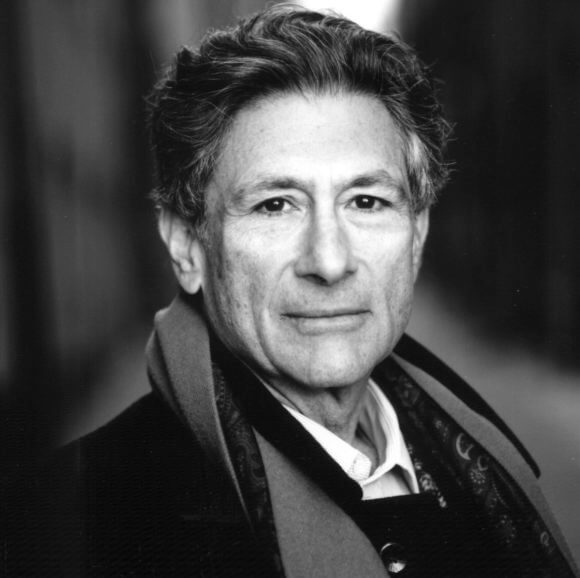
I was inspired by Edward Said because I belong to a generation that did not witness the Nakba. I am part of a generation that was thought to be resigned to more than 50 years of military occupation, and more than 70 years of dispossession and apartheid.
Since the beginning of the formation of his political consciousness in 1967, Edward Said emerged as the world’s most significant moral intellectual since Jean Paul Sartre and Bertrand Russel. As professor of literature and literary criticism and spiritual figurehead of the Palestinian cultural landscape, together with Ghassan Kanafani, Mahmoud Darwish, and countless others, he was instrumental in making Palestine one of the predominant moral causes of our time. His dedication to fundamental Palestinian human rights elevated him to a status of icon and inspiration.
After the official leadership of the Palestine Liberation Organization signed the infamous Oslo Accords in 1993, Said began to argue that it was high time that the Palestinian people moved away from the illusion of the two-state solution and advocate a democratic approach, one that could guarantee their basic rights, namely freedom, equality, and justice.
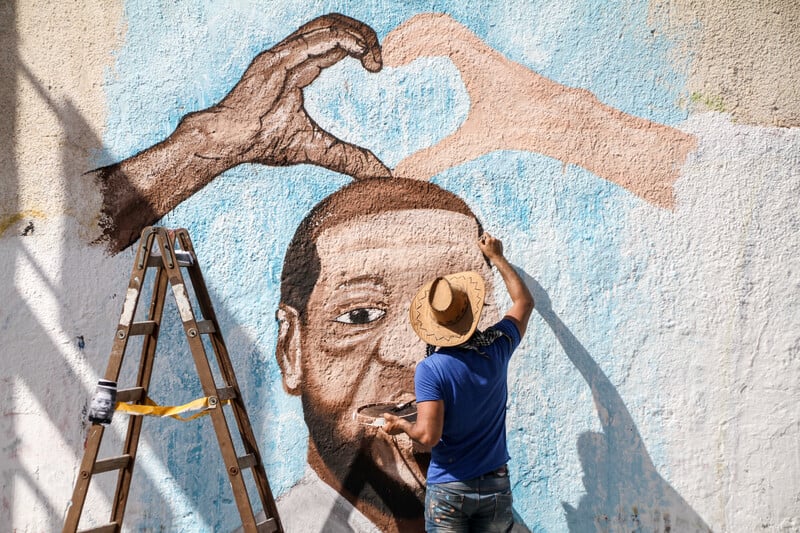
Ayman al-Hasari paints a mural of George Floyd on a wall in Gaza City in a message against racist discrimination and police brutality. (photo: Ahmad Hasaballah / IMAGESLIVE)
Systemic discrimination, settler-colonialism and inequality lie at the heart of a global struggle.
By Adam Mahoney | The Electronic Intifada | July 15, 2020
Then, a 17-year-old student asked me: Is it really as hard being Black in America, as they make it seem?
It took less than a week for me to become accustomed to daily interactions with Israeli soldiers carrying guns. It scared me. So did the number of Make America Great Again hats on people walking the streets of the Holy Land.
I had been traveling throughout occupied Palestine for several days on a student reporting trip facilitated by my school, Northwestern University, when a student’s question led to weeks of reflection.
This particular day, I was sitting in a high school classroom in the Ein Mahel local council in northern Israel. The day was focused on understanding the experience of Israel’s indigenous Palestinian minority. I was just excited for the chance to speak with young folks about their experiences growing up in the most heavily contested region in the world.
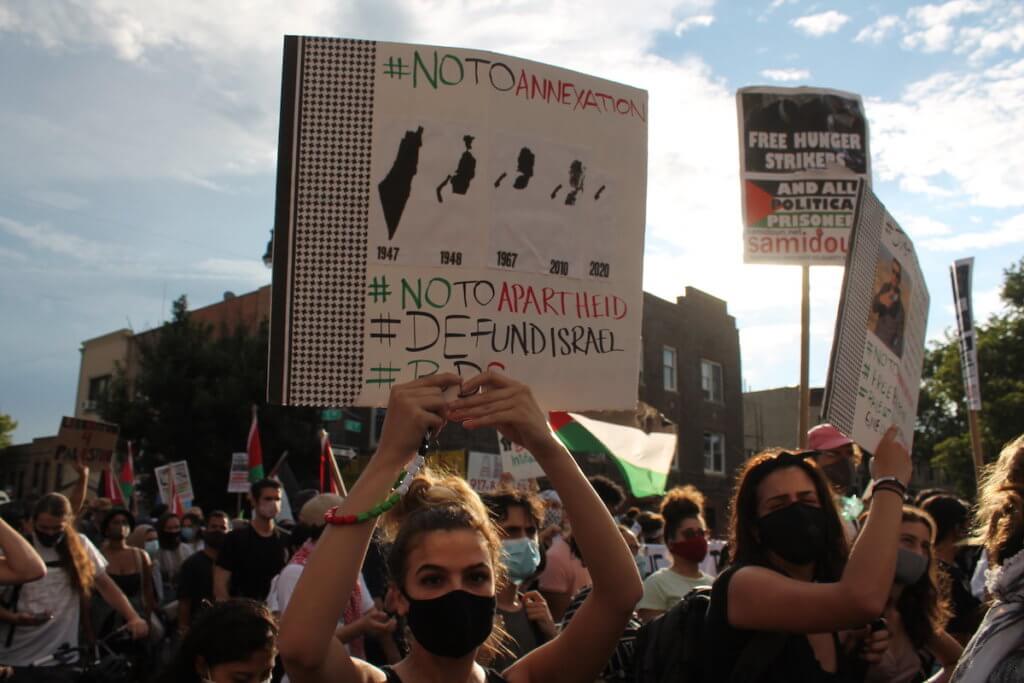
Brooklyn, NY, July 1 – Several thousand Palestinians and supporters rallied in the Palestinian-American neighborhood of Bay Ridge, then marched four miles north to the Barclays Center, to oppose threats by Israel to annex parts of the occupied West Bank. (photo by Joe Catron)
The progress and victories of recent years absolutely are a cause for celebration. But it is important to keep in mind that the fight is far from over.
By Ariel Gold and Mary Miller | Mondoweiss | July 14, 2020
…we must recognize that the change happening now cannot be credited to any one action, individual, or organization. Rather, it is the culmination of countless efforts and the work of several groups.
2020 has indisputably been a chaotic year. From the coronavirus pandemic and subsequent disruption of daily life, to the killing of George Floyd and the passionate resurgence of the Black Lives Matter movement that followed, to the looming general election: there has been plenty occupying the minds and newsfeeds of Americans. But in between all the headline-grabbing stories, another movement has been gaining traction: the effort to end the United States’ support for Israeli apartheid and finally bring peace and justice to the Palestinian people.
Israeli Prime Minister Benjamin Netanyahu was set to announce plans to annex parts of the West Bank on July 1. That date has come and gone, and still no formal announcement has been made. But what is perhaps most noteworthy about this incident isn’t that Netanyahu almost moved from de facto to de jour annexation of the West Bank, but that the response from influential members of Congress made it clear that, should Israel plan to move forward with annexation, it would not go without consequence.




 HolyLandJustice.org
You must be logged in to post a comment.