Media show little interest in Israeli bombing of Gaza

Gaza-Bombing
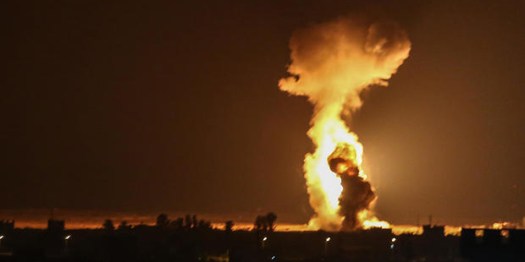
Smoke and flames rise after war planes belonging to the Israeli army carried out airstrikes over the southern Gaza Strip city of Rafah, August 12, 2020. (photo: Said Khatib / AFB via Getty)
The US press has done little reporting on the 11-day (and counting) bombing campaign of Gaza.

By Alan MacLeod | FAIR  | Aug 21, 2020

The story clearly presents the bombing as a reactive Israeli counter-effort—not an attack on Palestine, but a response against Hamas, which it describes not as a political party but as an “Islamist group.’

Israel is bombing Palestine again, although you likely wouldn’t guess that from watching TV news. For the eleventh straight night, Israeli Defense Force warplanes have been bombing the densely populated Gaza Strip. Israel’s bombs have caused considerable damage, forcing the shutdown of the area’s only power plant.

But US corporate media, focused on the coronavirus and election coverage, have shown little interest in the renewed violence in the Middle East. Searching for “Gaza” on the websites of NBC News, CNN, MSNBC and PBS elicits no relevant results. Nor has Fox News addressed the bombings, although it did find time (8/18/20) to cover the archaeological discovery of an old soap factory in Israel’s Negev Desert.

Continue reading “Media show little interest in Israeli bombing of Gaza”

Palestinian clergy: ‘Annexation could be the final straw for a viable Christian presence in Palestine’

20120310-palestine-0206-768x512
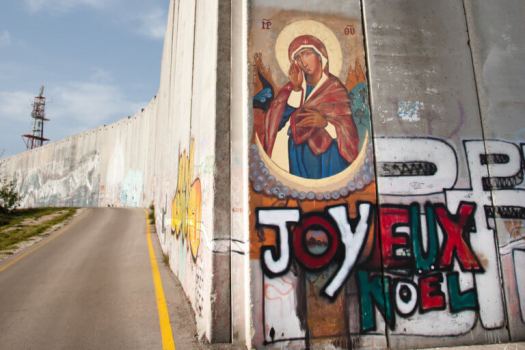
An icon of Mary is painted on the Israeli separation wall in the West Bank town of Bethlehem. (photo: Rrodrickbeiler / Dreamstime.com)
A July letter from Palestinian clergy address crisis of Christian emigration.

By Jeff Wright  |  Mondoweiss  | Aug 20, 2020

‘As any Palestinian—Christian or Muslim—will tell you, it is the Israeli occupation that is making life unbearable for Muslims and Christians alike,’
— Rev. Alex Awad, former pastor of the East Jerusalem Baptist Church 

“Annexation could be the final straw when it comes to a viable Christian presence in Palestine,” declare pastors representing four of the Holy Land’s historic denominations. “For Palestine, Bethlehem and particularly its Christian population… annexation will be particularly catastrophic.”

The July letter sent to diplomatic missions in Palestine/Israel—later released as an Open Letter—denounces Israel’s threatened annexation and calls upon the leaders of the world to “stop this severe injustice.” Written by clergy serving seven Christian congregations in Bethlehem and the neighboring towns of Beit Jala and Beit Sahour, the letter continues, “This is land theft! We are talking about land that is largely privately owned and that our families have owned, inherited and farmed for hundreds of years.”

Continue reading “Palestinian clergy: ‘Annexation could be the final straw for a viable Christian presence in Palestine’”

Palestinians in Jerusalem stuck between growing COVID-19 threat, Israeli occupation

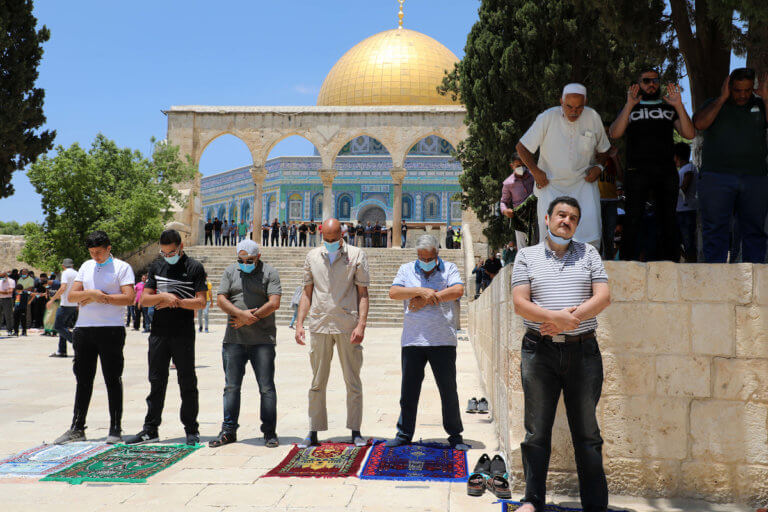
Palestinian Muslim worshipers perform the Friday prayer inside the al-Aqsa mosque, in Jerusalem’s Old City on July 10, 2020. (photo: Muhammed Qarout Idkaidek / APA Images)
Masks help protect from COVID-19, but there is little protection from Israeli authorities.

By Yumna Patel  | Mondoweiss  | Aug 18, 2020

Despite reports from the Ministry of Health that 60% of the total cases are in recovery, the number of new cases being reported every day are still in the hundreds.


It’s been five months since the first cases of the coronavirus were announced in the occupied Palestinian territories, and Palestinians are still struggling to fight the spread of the virus.

What began as a relatively slow burn, with no more than a few hundred cases within the first three months, quickly devolved into a rapidly growing crisis with the total number of cases in the West Bank, East Jerusalem, and Gaza surpassing 23,000 cases.

Despite reports from the Ministry of Health that 60% of the total cases are in recovery, the number of new cases being reported every day are still in the hundreds. Continue reading “Palestinians in Jerusalem stuck between growing COVID-19 threat, Israeli occupation”

Historic bill would penalize Israel for annexation and apartheid

People march with placards and flagsPalestinians rally against Israel’s West Bank annexation plans in Gaza City on 1 July. (photo: Ashraf Amra / APA images)
This bill would prohibit U.S. military funding to Israel being used for further annexation of Palestinian land in the occupied West Bank.

By Josh Ruebner  | The Electronic Intifada  |  Aug 17, 2020

This bill is significant because it employs the language of human rights and equality in expressing opposition to Israeli annexation and proposes concrete means of holding Israel accountable should it move forward with annexation.

On Friday, Minnesota Democratic Representative Betty McCollum introduced the Israeli Annexation Non-Recognition Act in the US Congress.

The bill prohibits US recognition of or funding for Israel’s potential annexation of additional Palestinian land in the occupied West Bank.

Continue reading “Historic bill would penalize Israel for annexation and apartheid”

Arab envoy warns Israelis that annexation threatens warming ties

The West Bank settlement of Ma’ale Efraim on the slopes of the Jordan Valley in February. (photo: Ariel Schalit / Associated Press)

In an op-ed article written by an influential Arab diplomat, he warned that normalization with Israel would not survive a unilateral land grab at the Palestinians’ expense.

By David M. Halbfinger / Ben Hubbard | The New York Times |  Aug 14, 2020

‘Annexation will definitely, and immediately, reverse all of the Israeli aspirations for improved security, economic and cultural ties with the Arab world and the United Arab Emirates,’
— Yousef al-Otaiba, the Emirates’ ambassador to the United States

JERUSALEM — In a watershed article in a leading Israeli newspaper, a top diplomat from the United Arab Emirates warned the Israeli public on Friday that unilateral annexation of West Bank territory would endanger Israel’s warming ties with Arab countries.

Writing in Friday’s Yediot Ahronot, Yousef al-Otaiba, the Emirates’ ambassador to the United States, appealed directly to Israelis in Hebrew to deter Prime Minister Benjamin Netanyahu from following through on his promise to annex occupied territory as early as next month.

“It’s Either Annexation or Normalization,” the headline over his op-ed declared.

Continue reading “Arab envoy warns Israelis that annexation threatens warming ties”

‘There is no change in our plan’ to annex West Bank, Netanyahu says, in applauding Israeli-UAE deal that sidelines Palestinians

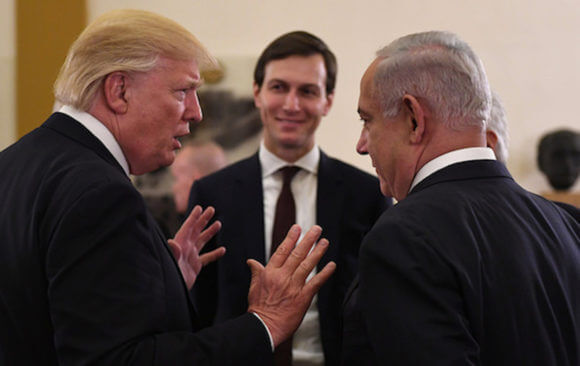
President Donald Trump talks with Israel Prime Minister Benjamin Netanyahu and Jared Kushner in Jerusalem, May 22, 2017.
President Donald Trump talks with Israel Prime Minister Benjamin Netanyahu and Jared Kushner in Jersalem, May 22, 2017. (photo: Kobi Gideon / GPO)

A historic deal for some, but many see further marginalization for Palestinians.

By Mondweiss Editors | Mondoweiss | Aug 13, 2020

Trump’s press conference on ‘historic deal’ between Israel and UAE has NO PALESTINIAN VOICE (and a room full of ALL MEN) and is all about increasing the pressure on Iran. This is peace?
— Medea Benjamin, Code Pink

Today the White House along with Israel and the United Arab Emirates announced a historic deal, the UAE will normalize relations with Israel; and annexation is off the table– for now. From the announcement:

Israel will suspend declaring sovereignty over areas outlined in the President’s Vision for Peace and focus its efforts now on expanding ties with other countries in the Arab and Muslim World.

The deal for a “Strategic Agenda for the Middle East” is a coup for Jared Kushner, who has been pushing for political wins for his father-in-law, and open economic relations between the Gulf States and Saudi Arabia and Israel– and thereby to shove the Israeli-Palestinian conflict into the margins.

Continue reading “‘There is no change in our plan’ to annex West Bank, Netanyahu says, in applauding Israeli-UAE deal that sidelines Palestinians”

The Israel lobby has lost its power to sideline critical Dems

Democratic U.S. Representatives Ilhan Omar, right, and Rashida Tlaib enjoy a supportive moment during a news conference at the State Capitol in St. Paul on Monday, Aug. 19, 2019. (Photo: John Autey / Pioneer Press)
Democratic U.S. Representatives Ilhan Omar, right, and Rashida Tlaib enjoy a supportive moment during a news conference at the state capitol in St. Paul on Monday, August 19, 2019.  (photo: John Autey / Pioneer Press)

The momentum continues for young progressive people of color in the Democratic Party who are speaking up for Palestine.

By Philip Weiss | Mondoweiss | Aug 12, 2020

‘2020 was the first election year ever in which the safe side of the issue is the side that recognizes Palestinian rights and that the US can no longer stand in solidarity with apartheid in the occupied territories and Jim Crow in Israel itself.’
— M.J. Rosenberg

It’s a big news day. Senator Kamala Harris became Joe Biden’s running mate choice yesterday afternoon, and Rep. Ilhan Omar handily defeated a challenger funded by pro-Israel groups in Minnesota last night.

Omar’s victory represents an important trend: the Democratic street is progressive on Palestine. The Israel lobby is not ten feet tall. Three times in recent weeks it has tried to defeat the pro-boycott-and-sanctions movement inside the party (BDS), and been crushed. Jamaal Bowman knocked off pro-Israel heavyweight Eliot Engel in the Bronx/Westchester in June. Rep. Rashida Tlaib handily won reelection in Michigan last week. Now Omar wins by 17 points, in a race that was all about Israel.

So the “Squad” of young progressive people of color is just getting stronger and bigger in the Democratic Party.

Continue reading “The Israel lobby has lost its power to sideline critical Dems”

Beyond failed frameworks: A re-imagined collective future

photo: Al-Shabaka, The Palestinian Policy Network

A policy brief focusing on the possibilities for building a collective vision for a Palestinian future.

By Yara Hawari | Al-Shabaka | July 23, 2020

As Israel moves from de facto to de jure annexation of the rest of the occupied West Bank many third parties desperately hold on to the two-state solution as the one that best protects their diplomatic and trade interests with Israel.

Palestinian futures have long been discussed without Palestinian input or within an imposed and limited framework. Indeed, most ideas of the future in mainstream political spaces rather consistently establish the containment of the Indigenous Palestinians and security for the Israeli settler state as their primary concern. The most recent manifestation of this was the “Vision for Peace” published by United States President Donald Trump’s Administration. 1 2

This “vision” is a far cry from the revolutionary political mandate of the Palestine Liberation Organization (PLO) that was established in the 1960s and which sought to liberate Palestine and its people from the Zionist settler colonial project that established Israel. ³ It is also a far cry from the two-state solution, which was imposed as the most appropriate and feasible future for Israelis and Palestinians and was embedded in the narrative of Israel and Palestine as two warring national groups rather than the outcome of the Zionist project.

Continue reading “Beyond failed frameworks: A re-imagined collective future”

America’s unpredictability casts doubt on annexation – analysis


Then-US Vice President Joe Biden (L) and Israeli Prime Minister Benjamin Netanyahu look at each other as they deliver joint statements during their meeting in Jerusalem March 9, 2016 (photo credit: DEBBIE HILL/REUTERS)
Then-US Vice President Joe Biden (L) and Israeli Prime Minister Benjamin Netanyahu look at each other as they deliver joint statements during their meeting in Jerusalem March 9, 2016. (photo: Debbie Hill / Reuters)

In order to go ahead with annexation, Netanyahu needs certainty in Washington.

By Herb Keinon | The Jerusalem Post | Aug 11, 2020

With Trump trailing in some of the polls by double digits, voices are still being raised, saying that he may push Netanyahu toward annexing now because this will play well with his Evangelical base.

It’s the Americans’ fault.

That, at least, was the subtext of Prime Minister Benjamin Netanyahu’s answer Monday evening to a question in a Channel 20 interview as to why he has not gone ahead and extended Israeli sovereignty to parts of Judea and Samaria.

“It was clear from the start that the application of sovereignty would be done only with agreement from the United States. Otherwise, I would have already done it a while ago,” Netanyahu said. “Trump is now busy with other things, and this [sovereignty] is not on the top of his mind.”

Continue reading “America’s unpredictability casts doubt on annexation – analysis”

The pandemic’s savage political revelations, from the U.S. to Palestine

Palestinian policemen wearing protective gear stand guard during a simulation training organized by the ministry of health and the ministry of interior in Gaza City on July 18, 2020. (Photo: Ashraf Amra/APA Images)
Palestinian policemen wearing protective gear stand guard during a simulation training organized by the ministry of health and the ministry of interior in Gaza City on July 18, 2020. (photo: Ashraf Amra / APA Images)

The issues of inequity being seen during this pandemic are also seen by Palestinians in Israel and the occupied territories who suffer from high levels of structural racism and cross generational trauma.

By Alice Rothchild | Mondoweiss | Aug 8, 2020

It can be argued that race (a predominantly social construct) is not the issue– rather, that the racism within our societies where African Americans, Hispanics, Native Americans, and other people of color live and work creates the inequities and vulnerabilities that produce the racial and ethnic differences in the data that are now obvious.

Much of the analysis of COVID-19 and Palestine examines the pandemic through a political lens. Palestinians in Israel and the territories have had less access to testing and information due to their second-class citizenship and the conditions of occupation. In the West Bank and Gaza, there are significant deficits in medical resources (such as ventilators) and trained (and adequately paid) medical staff.

In general Palestinians under occupation have high rates of diseases related to stress, poverty, smoking, and poor nutrition such as diabetes, hypertension, and obesity. They tend to live in environments contaminated by the detritus of war and the toxics from unregulated industries (such as Israeli industrial zones in the West Bank) with high levels of asthma and cancer. They often work in jobs that cannot be done on Zoom and that provide no labor protections– notably the construction and homecare workers who travel daily to Israel from the West Bank, waiting for hours in crowded checkpoints.

Continue reading “The pandemic’s savage political revelations, from the U.S. to Palestine”