A brief history of 50 years of Israeli occupation.
By Mary J. Pneuman / Bishop’s Committee for Justice and Peace in the Holy Land
[Ed. note: After returning from a recent trip to the Holy Land, the author has updated her previous writings. We offer The Promised Land or the Land of Promise Revisited here in serial form.]
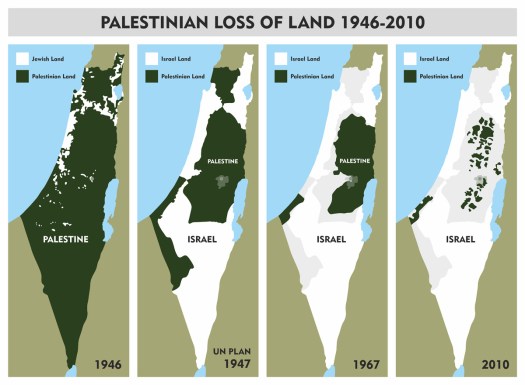
Now, about 62% of the West Bank is now under full Israeli military and civil control, but even within Area A, Israeli can and does conduct military raids at any time. This means that since 1948, the 22% of historic Palestine that was left for a Palestinian state has shrunk to less than 10%, and this remainder is now chopped up by numerous bypass roads and military security perimeters and checkpoints constructed to protect the settlements.
To an impartial observer, there can be little doubt that the single most significant impediment to peace between Israel and Palestine has been the construction of Israeli settlements, a long-term enterprise which began within a year of the 1967 war. In addition to the illegal acquisition and use of Palestinian land, the settlements have created a whole host of related problems for the Palestinians, including limits on water, urban development, housing and agricultural production, restrictions on travel and trade, access to employment, education, and places of worship, and the imposition of military, rather than civil law on Palestinians living in the occupied West Bank and East Jerusalem.
The international community deems the settlements to be illegal — a violation of the Fourth Geneva Convention which prohibits the transfer of an occupying power’s civilian population into the occupied territory. Israel disputes this claim by arguing that the Palestinian lands had not been legally held by a sovereign power prior to Israel’s occupation of them. The United Nations Security Council (UNSC) has issued a series of resolutions challenging the legality of the settlements and declaring them to be a serious obstruction to a just and lasting peace in the Middle East, including the landmark UNSC Resolution 242 of November 1967, which addressed the “right of the Palestinian people to self-determination” and was adopted as a provision of the United Nations Charter. Most recently, in December 2016, the UNSC reaffirmed that settlements have no legal validity and constitute a flagrant violation of international law. Fourteen member states voted in favor, but the US abstained.
The Israeli-Palestinian conflict over land ownership has its roots in the rise of the Zionist nationalist movement of the latter part of the 19th Century and the decision by the United Nations in 1947 to partition historic Palestine. From the late 19th Century, a growing Zionist movement had as its goal the creation of a Jewish national state in historic Palestine and was encouraging Jews to emigrate from Europe and the Middle East to their historic homeland. Jewish communities had begun to purchase land from the Ottomans, who controlled much of the Middle East for 400 years, and while the movement was largely secular, there were religious undertones associated with some of the British and Jewish proponents who believed that this land had been promised by God to the Israelite Jews.
After the defeat of the Ottoman empire in World War I — the Ottoman Turks had fought on the side of Germany — Palestine fell under British administrative and military control in 1917 and would be administered under the British Mandate of Palestine, which extended from the Mediterranean on the West to the Jordan River on the East, and from Lebanon on the North to the Red Sea on the South.
In 1917, British Foreign Secretary Arthur Balfour issued his “Balfour Declaration,” which essentially stated that the British government looked favorably on the establishment of a national home for the Jewish people in Palestine, but that nothing should be done which would “prejudice the civil and religious rights” of the existing non-Jewish population. Very recently (October 2017) there was a move in Great Britain on the part of judges and clergy to acknowledge responsibility for the unjust legacy of the Balfour doctrine and address the neglected moral and legal mandates of defending Palestinian rights (Balfour Project).
Throughout the 1920’s there was a rapid increase of emigration from Europe and concurrent resistance from indigenous Palestinians over Jewish acquisition and use of Palestinian land. Christians had been a presence in Palestine since the 1st Century and Muslims since the 7th. Especially onerous were Jewish policies and practices that prohibited the employment of Arabs in Jewish industries and farms as well as the perception that British policies favored the Jews in dispute resolution. Riots and armed confrontations ensued that persisted for over a decade and resulted in the loss of many lives.
By 1931, 17 percent of the Mandate were Jews, and immigration peaked during the rise of Nazi power in Europe, almost doubling the Jewish population in Palestine. In an effort to quell a major Arab revolt (1936–39) Britain reduced the number of emigrants allowed permanent entry, and this policy remained in place during the Mandate, which coincided with the Nazi Holocaust and the flight of Jewish refugees from Europe. At the end of the World War II, armed conflicts immediately resumed, and Britain was eager to withdraw from costly diplomatic and peace-keeping efforts, ceding these responsibilities to the United Nations. At that time, only about 7% of the land was under Jewish ownership, and resident Jews represented only about 33% of the population.
In 1947, in a desire to keep the peace and provide a safe homeland for Jewish refugees and immigrants, the UN developed a partition plan that distributed 57% of Palestine to the Jews and 43% to the Palestinians. Israel would receive three fertile plains and two-thirds of the Mediterranean coastline, along with the Negev desert and sole access to the Red Sea. Palestine was to receive the highlands of the West Bank and the Jordan valley and one-third of the coastline, namely the Gaza strip. At the epicenter of the three Abrahamic religions, Jerusalem was to become an international city administered by the UN.
Because the proposed allocations strongly favored the Israelis, even though they clearly had the least land ownership and population, the Palestinians and their Arab neighbors were understandably opposed to this plan and in May 1948, when the Mandate expired and Israel announced the formation of an independent State of Israel, war broke out between the two sides. By the time an armistice was agreed in 1949, Israel, with a much stronger and cohesive military force had prevailed over the Palestinians and their Arab allies. Almost overnight, Palestinians found themselves becoming refugees in their own land, as nearly 750,000 of them were driven from their homes, many at gunpoint, and forced to find safety in other parts of Israel or another country, never to return to their homes. Entire villages were bulldozed, as homes, businesses, and orchards were either destroyed or forcibly acquired by new Jewish occupants. Ilan Pappe, an Israeli historian and academic now living in England to preserve his academic freedom, forthrightly refers this forced migration as “ethnic cleansing” in his seminal work The Ethnic Cleansing of Palestine (One World Oxford, 2006). The Palestinian people refer to it as al nakba, or “the catastrophe.”
We are personally acquainted with Palestinians whose families were forced to leave their homes and businesses in 1948, taking nothing but the clothes on their backs. One Muslim family of twelve from Jaffa was forced to flee to Gaza — the father owned and lost his profitable farm supply store. The youngest daughter eventually obtained a scholarship for study in the US and lived in our home for almost two years while she finished a Master’s program in public administration. She returned to Gaza to help her people and now heads an after-school arts program to teach children non-violent ways to express their frustration and anger. Another family of twelve, Christians from the town of Beisan (renamed Beit She’an), were forcibly evicted with no time to gather their belongings or papers and had to flee, eventually finding refuge in Nazareth. The father lost his successful jewelry business, and the Israelis moved three Jewish families into the family’s three fully furnished homes and gardens. Their valuables were stolen, and important papers, such as deeds and birth certificates, were burned. One of the sons eventually became a theologian and influential author and peacemaker.
By the time of the armistice, Israel had conquered and incorporated nearly 50% more territory, moving the balance of land distribution to 78% for Israel and 22% for Palestine — inclusive of the West Bank, East Jerusalem and the Gaza strip. Jordan and Egypt were granted custodianship over the West Bank and Gaza, respectively. Unrest continued, and in 1967, at the close of the Six Day War, Israel took full military control of all Palestinian lands, including East Jerusalem. The complete military occupation of Palestine had begun.
Efforts to address the illegal occupation and establish Palestinian rights have waxed and waned, with the most hopeful prospects immediately following the Oslo Accords, signed by Yasser Arafat for the Palestinian Liberation Organization (PLO) and Israel’s Prime Minister Yitzhak Rabin and Foreign Minister Shimon Peres in 1993. The Oslo accords were supposed to mark the beginning of negotiations toward a permanent peace treaty between Israel and Palestine. The basis of the final status agreement was the UNSC Resolution 242 condemning the occupation of territory acquired by war and calling for the withdrawal of Israeli armed forces from those territories occupied during the 1967 war, namely the West Bank, Gaza and the Golan Heights (part of Syria). This resolution has been the cornerstone, and sticking point, in the Israeli/Palestinian dispute since 1967 and the basis for efforts to define borders and territorial integrity for the Palestinians.
The Oslo “process” was expected to address the most important issues to be determined: borders, settlements, the status of Jerusalem, the Palestinian right of return, and a negotiated balance between Israeli military control and Palestinian autonomy, (denoting areas “A” under full Palestinian civil and security authority); “B” under Palestinian civil control and Israeli security; and “C” under full Israeli military and administrative control.) These areas do not have mutually agreed territorial borders.
The Oslo accords did not create a Palestinian state, and left for future negotiation were the Israeli military withdrawal and transfer of responsibility to the Palestinians. Even then, by excluding the settlements and Jerusalem from the agreement, Israel would maintain full military control over all borders and airspace, as well as the territorial waters of Gaza. By the time the Oslo negotiations began, in addition to land and border control, Israel had already gained control over the largest share of the water resources of the West Bank, according to a report by the European Parliamentary Research Service (1.16).
Following the signing of the Oslo agreement, there was a brief period of Palestinian optimism that Israel would eventually turn over control of the West Bank to Palestinian self-rule, but by any standard, the Oslo agreement has failed miserably in fulfilling the right of Palestinians to self-determination and a secure and peaceful existence for either Israel or Palestine. Under Oslo, Israeli has consolidated vast territorial gains, and now has military control of about half of the West Bank. In 1967, Israel expanded Jerusalem’s municipal boundaries to include newly settled territory, an act of annexation never recognized by the international community. Now, about 62% of the West Bank is now under full Israeli military and civil control, but even within Area A, Israeli can and does conduct military raids at any time. This means that since 1948, the 22% of historic Palestine that was left for a Palestinian state has shrunk to less than 10%, and this remainder is now chopped up by numerous bypass roads and military security perimeters and checkpoints constructed to protect the settlements.
Read the full paper here →





 HolyLandJustice.org
You must be logged in to post a comment.