Israel-Palestine: We don’t own it

Site of Carmel caves holding earliest known human remains from Israel-Palestine. (photo: Albatross Aerial Photography)
 The land has a story to tell of it’s own.

By Richard Silverstein | Tikun Olam | Apr 8, 2019

 …even if we or our country controls the land, we don’t own it; at least not in the long-term. We are custodians.

Here’s a thought you will never hear uttered from a synagogue bima or any other Jewish institution.  And it will even come across as heresy to some supporters of Palestinian rights. How many tribes, clans, nations, religions, etc. do you think lived in the land presently called Israel-Palestine since the beginning of the human race?  We know just in the Biblical period there were Philistines, Moabites, Jebusites, Amalekites, Edomites, Canaanites, and probably a few more who’ve slipped my memory. Not to mention all the nations and powers which conquered the land of Israel including the Babylonians, Romans, Greeks, etc.  Of course we know of this history because of the Bible and similar contemporary sources.

Continue reading “Israel-Palestine: We don’t own it”

A dictionary of media terms for the Palestine/Israel ‘conflict’

A Palestinian woman is taking part of the Great March of Return in Gaza on the 70th anniversary of Nakba. (photo: Abdallah Aljamal / Palestine Chronicle)
Read carefully to see how these terms are currently being used or misused by media reporting.

By Roger Sheety | The Palestine Chronicle | Apr 2, 2019

Palestine/Israel ‘Conflict’: A corporate media abstraction used to cover up and obfuscate the continuing destruction of Palestine by creating a false balance and ethical equivalency between the colonizers and the colonized where no such balance and equivalency exists to begin with.

What is the point of journalism if not to question, doubt, and challenge state or elite power? If a journalist merely reports the standard talking points of that power (as most corporate media journalists do), isn’t he or she simply perpetuating the basic premise of those talking points, that all is fundamentally well with the status quo? How, then, can such a stance be thought of as fair, objective, or impartial?

The following piece is partially indebted to John Ralston Saul’s “The Doubter’s Companion: A Dictionary of Aggressive Common Sense”, which itself was partly inspired by earlier dictionaries such as those by Samuel Johnson and Ambrose Bierce.

The aim of these anti-dictionary dictionaries was to challenge and mock conventional wisdom and use language to clarify and communicate rather than the opposite.

Continue reading “A dictionary of media terms for the Palestine/Israel ‘conflict’”

Netanyahu puts the future of the West Bank on the ballot

Prime Minister Benjamin Netanyahu, campaigning in a market in Tel Aviv. (photo: Oded Balilty / Associated Press)
Sovereignty would almost certainly lead to a nightmare of one kind or another for Israel, like a rise in violence and international condemnation.

By David Halbfinger | The New York Times | Apr 7, 2019

If Palestinians in annexed territory are not granted citizenship, it could pave the way for the kind of apartheid state that two-state supporters have long warned against.

As Israelis get ready to go to the polls on Tuesday, a stark, fateful and long-deferred choice has suddenly reappeared to confront them after Prime Minister Benjamin Netanyahu’s unexpected promise to begin extending sovereignty over the West Bank if he is re-elected.

Do voters want to make permanent their country’s control over the West Bank and its 2.6 million Palestinian inhabitants? Or do they want to keep alive the possibility that a Palestinian state could be carved out there one day?

That question has been made newly urgent by Mr. Netanyahu, who is facing a career-threatening challenge from a unified centrist party headed by a team of former army chiefs. His shocking announcement about Israeli sovereignty in the West Bank appeared to be a last-ditch effort to rally his right-wing base and stay in power.

Continue reading “Netanyahu puts the future of the West Bank on the ballot”

Film: Naila and the Uprising (May 3)

Please join our brothers and sisters at the Mideast Focus Ministry for their First Friday Film series.
Date: Friday, May 3, 2019
Time: 7:00 – 8:30 pm
Location: St. Mark’s Cathedral
Bloedel Hall
1245 10th Ave E
Seattle, WA 98102
Information: Event information here →
Tickets: Free Admission
Event Details

When a nation-wide uprising breaks out in the Occupied Palestinian Territories, a young woman in Gaza must make a choice between love, family, and freedom. Undaunted, she embraces all three, joining a clandestine network of women in a movement that forces the world to recognize the Palestinian right to self-determination for the first time. Naila and the Uprising chronicles the remarkable journey of Naila Ayesh and a fierce community of women at the frontlines, whose stories weave through the most vibrant, nonviolent mobilization in Palestinian history — the First Intifada in the late 1980s.

Using evocative animation, intimate interviews, and exclusive archival footage, this film brings out of anonymity the courageous women activists who have remained on the margins of history — until now. While most images of the First Intifada paint an incomplete picture of stone-throwing young men front and center, this film tells the story that history overlooked — of an unbending, nonviolent women’s movement at the head of Palestine’s struggle for freedom. Continue reading “Film: Naila and the Uprising (May 3)”

Trump’s “Deal of the Century” will hand Palestine to Israel — along with new set of problems

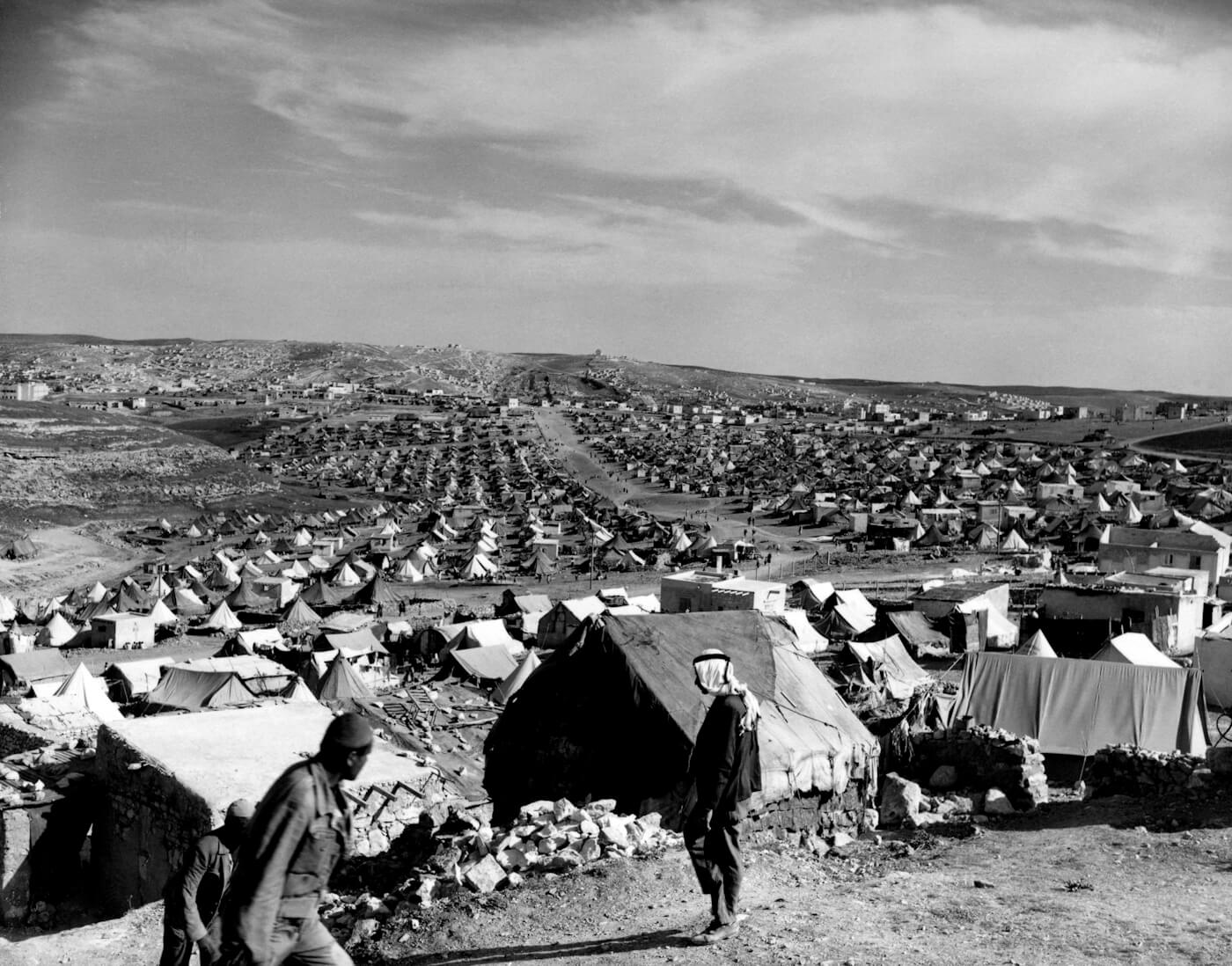
A UN refugee camp in Amman, Jordan which housed seven thousand Palestinians who were expelled from their homes, Apr 30, 1953. (photo / AP)
Netanyahu’s problem is that when you ask Palestinians in the diaspora where they are from, they say Yaffa, Haifa and Ramle. When you ask Israelis where they are from, they say, Poland, Russia and Morocco.

By Miko Peled | Mint Press News | Apr 5, 2019

Israel controls the lives of 2 million Palestinians who hold Israeli citizenship, 2.2 million Palestinians locked up in the Gaza Strip and about 3 million Palestinians in what used to be the West Bank. That is a total of 7 million Palestinians living without rights in a state where about 6 million Israeli Jews have exclusive rights.

As Benjamin Netanyahu returns from Washington to Jerusalem determined to keep his seat as Israel’s prime minister, it is clear that the Final Status issues — those pesky issues between Israel and the Palestinians that Israel never wants to discuss – are being eliminated one by one in a regional scheme that is titled Deal of the Century. This so-called “Deal” will be the final undoing of Palestinian hopes for justice, self-determination and return.

From the reckless declaration by President Donald Trump that the United States recognizes Jerusalem as the capital city of Israel, to his more recent proclamation that the United States recognized Israeli sovereignty over the Syrian Golan Heights, it is becoming clear what the Deal of the Century will entail: disregard of the Palestinians and recognition of Israeli rights to all of Palestine.

The purpose of the declaration recognizing Israeli sovereignty over the Golan Heights at this particular moment is twofold: It is an enormous contribution to Netanyahu’s campaign for re-election on April 9, a clear signal that Trump favors Netanyahu; and, what is even more troubling, it is a precursor to what we may soon see happen with Judea and Samaria, also known as the West Bank.

Continue reading “Trump’s “Deal of the Century” will hand Palestine to Israel — along with new set of problems”

I fought South African apartheid. I see the same brutal policies in Israel

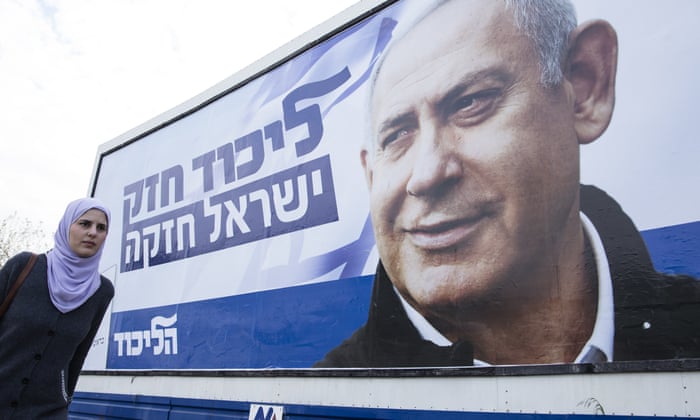
A woman passes by a Likud party election campaign poster showing its leader Israeli Prime Minster Benjamin Netanyahu on April 1, 2019.  (photo: Amir Levy / Getty Images)
Echoes of South African anti-apartheid tactics seen in the ongoing struggle for Palestinian human rights.

By Ronnie Kasrils | The Guardian | Apr 3, 2019

How disgraceful that, despite the lessons of our struggle against racism, such intolerance continues to this day

As a Jewish South African anti-apartheid activist I look with horror on the far-right shift in Israel ahead of this month’s elections, and the impact in the Palestinian territories and worldwide.

Israel’s repression of Palestinian citizens, African refugees and Palestinians in the occupied West Bank and Gaza has become more brutal over time. Ethnic cleansing, land seizure, home demolition, military occupation, bombing of Gaza and international law violations led Archbishop Tutu to declare that the treatment of Palestinians reminded him of apartheid, only worse.

I’m also deeply disturbed that critics of Israel’s brutal policies are frequently threatened with repression of their freedom of speech, a reality I’ve now experienced at first hand. Last week, a public meeting in Vienna where I was scheduled to speak in support of Palestinian freedom, as part of the global Israeli Apartheid Week, was cancelled by the museum hosting the event – under pressure from Vienna’s city council, which opposes the international movement to divest from Israel.

Continue reading “I fought South African apartheid. I see the same brutal policies in Israel”

Film: This is Home — A Refugee Story (Friday)

Please join our brothers and sisters at the Mideast Focus Ministry for their First Friday Film series.
Date: Friday, Apr 5, 2019
Time: 7:00 – 8:30 pm
Location: St. Mark’s Cathedral
Bloedel Hall
1245 10th Ave E
Seattle, WA 98102
Information: Event information here →
Tickets: Free Admission
Event Details

This is Home is an intimate portrait of four Syrian refugee families arriving in America and struggling to find their footing. Displaced from their homes and separated from loved ones, they are given eight months of assistance from the International Rescue Committee to become self-sufficient. As they learn to adapt to challenges, including the newly imposed travel ban, their strength and resilience are tested. It is a universal story, highlighted by humor and heartbreak, about what it’s like to start over, no matter the obstacles.

After surviving the traumas of war, the families arrive in Baltimore, Maryland and are met with a new set of trials. They attend cultural orientation classes and job training sessions where they must “learn America” — everything from how to take public transportation to negotiating new gender roles — all in an ever-changing and increasingly hostile political environment. Their goals are completely relatable: find a job, pay the bills, and make a better life for the next generation. Continue reading “Film: This is Home — A Refugee Story (Friday)”

Trump and Netanyahu are BDS’s best recruiters

President Donald Trump Welcomes Israeli Prime Minister Benjamin Netanyahu To The White House Mar 25, 2019. (photo: Drew Angerer / Getty Images)

A Netanyahu win in April election may cause some to rethink support for BDS.

By Dean Obeidallah |  Forward | Apr 1, 2019

… if Netanyahu and Trump both team up to say no to Palestine, and yes to Palestinians living under permanent occupation with no civil rights, where does that leave people like me?

President Trump and Israeli Prime Minister Benjamin Netanyahu have so very much in common.

They’re both being investigated for corruption; Netanyahu is on the verge of being indicted, while Trump is still being investigated by the U.S. Attorney in the Southern District of New York. Both Bibi and Trump use the term “Fake News” to delegitimize media outlets critical of them. And both have courted the support of extremists. Trump has retweeted visible white supremacists and defended racists as “fine people” after Charlottesville, while Netanyahu recently embraced the political party known as “Jewish Power” which has been called the KKK of Israel.

And now these BFF’s have something else in common: They both oppose self-determination for Palestinians. And in so doing, Netanyahu and Trump will almost certainly push people desperate for justice to join the Boycott, Divestment and Sanctions movement, known as BDS.

Continue reading “Trump and Netanyahu are BDS’s best recruiters”

If Ilhan Omar wants to help Palestinians, she should advocate for them

Rep. Ilhan Omar. (photo: Getty Images)
What does a Twitter exchange actually do for the Palestinians trapped under an oppressive occupation, or Israelis who bear the brunt of terror attacks?

By Zaid Jilani | Forward | Mar 28, 2019

AIPAC and right-wing pro-Israel activists would prefer to have a national conversation about whether what a Member of Congress said is anti-Semitic rather than Israeli policy towards Palestinian children. Omar has played into their hands by making statements that offer up that conversation rather than focusing on the plight of the Palestinians.

There is no doubt that Minnesota Democratic Rep. Ilhan Omar’s approach to the Israeli-Palestinian conflict is earning her plenty of attention. Her comments on Israel — such as claiming that U.S.-Israel policy is “all about the Benjamins” — have earned her support from some hard-left activists but also derision from many within her own party.

Witness how both the Speaker of the House Nancy Pelosi and the Senate Democratic Minority Leader Chuck Schumer used their remarks at the recent American Israel Public Affairs Committee (AIPAC) meeting to condemn her rhetoric on the Middle East conflict. Omar was also targeted by Israel’s right-wing Prime Minister Benjamin Netanyahu, who quipped, “From this Benjamin: It’s not about the Benjamins.”

Omar’s response to the denunciations of her rhetoric at the AIPAC meeting was emblematic of her approach to politics so far: she responded in kind, throwing punches and drawing attention to herself rather than the underlying policy issue. “It’s been interesting to see such a powerful conference of people be so fearful of a freshman member of Congress so I hope that they figure out a way to not allow me to have a permanent residency in their heads,” she told reporters.

Continue reading “If Ilhan Omar wants to help Palestinians, she should advocate for them”

I’m part of the next generation of Jewish leaders, and for us, AIPAC has no cred

lara-haft
The author. (photo: Lara Haft)
To the rising Jewish leaders of the Trump era, supporting AIPAC is a stone’s throw away from touting the NRA.

By Lara Haft | Mondoweiss | Mar 27, 2019

Many future cantors, rabbis, and Jewish educators actively support Palestinian civil resistance, from planting olive trees in lands threatened by settlers to spending the night alongside Palestinian and Israeli activists to prevent the demolition of Khan al Ahmar. We’re part of a growing trend of faith leaders from around the world, led by Palestinian theologians like Rev. Dr. Naim Ateek and Rev. Dr. Mitri Raheb, who believe that tearing down walls and prisons — fighting for true equality between Palestinians and Israelis — is one of the ways we honor God’s call to love our neighbors as ourselves.

This week, lobbyists, politicians, academics, and all the glitterati of the Israel lobby are gathering for the annual AIPAC conference in Washington, DC. Under the Trump administration, AIPAC has maintained a strong relationship with Republican members of congress, far right-wing Israeli politicians, and Christian Zionist groups. But the organization is facing a serious challenge: It increasingly has no cred with young Jews.

As AIPAC continues to embrace far-right politicians and lobby for militarism against Palestinians, more and more Jewish people are turning instead to political movements based on equality, dignity, and justice. . . .

Continue reading “I’m part of the next generation of Jewish leaders, and for us, AIPAC has no cred”