Committee Chairman Carl Levin leads a US Senate Armed Services Committee hearing in 2013. (photo credit: Larry Downing / Reuters)
The righteous indignation of the Ben & Jerry’s controversy is rapidly blasted in emails to prospective donors. Over and over again.
By Douglas Bloomfield | The Jerusalem Post] | Aug 4, 2021
Former US senator Carl Levin, who died last week at 87, was one of the few unafraid to speak truth to power.
Over 50 years on and around Capitol Hill, I have found Israel has many friends, but not nearly as many as those who loudly declare the love and devotion.
Like the congressman with a large Jewish constituency who portrayed himself as Israel’s greatest defender in Congress but behind the scenes worked against it. There was the time he confided in colleagues that he hated the Israeli prime minister and wanted to cut aid as punishment. After losing his argument, he sought out a favorite reporter so he could publicly declare he not only supported the current aid levels but intended to lead the fight to increase funding.
An Israeli flag is set atop a delivery truck outside US ice-cream maker Ben & Jerry’s factory in Be’er Tuvia. (Emmanuel Dunand / AFP via Getty Images)
The backlash creates a smokescreen, distracting from the moral issue of Israeli occupation.
By Toby Irving | New York Daily News | Aug 3, 2021
Unfortunately, dominant politics, both here and in Israel, are still not able to hold the nuances Ben & Jerry’s and many American Jews hold so dear. It’s all BDS to them.
The people at Ben & Jerry’s who decided to remove their products from Israeli-occupied Palestinian territories anticipated significant backlash, but I wonder if they saw all the “meltdown” puns coming. Over the last few weeks, defenders of Israeli apartheid certainly lost it reacting to one of the highest-profile corporate actions against Israeli occupation. Ben & Jerry’s decided its products would no longer be made available in settlements in the West Bank.
Settlements are violations of international law and are widely recognized as antithetical to any hope for peace. Their expansion has all but killed the possibility of a two-state solution as it entrenches apartheid into the landscape of the West Bank. Ben & Jerry’s, motivated by its longstanding values of peace and social justice and the company’s and founders’ history in Israel, is doing its part to reject endless occupation. The move is not as sweeping an economic action as the Boycott-Divest-Sanctions (BDS) movement, the international non-violent Palestinian solidarity movement which calls for boycotts of the state of Israel, would have it, but BDS advocates still consider it a success.
A neighborhood in Beit Hanoun, northern Gaza, destroyed in Israeli attacks, 21 May 2021. (photo: Mohammed Zaanoun ActiveStills)
There’s no equating Palestinian rocket fire and massacres by warplanes.
By Maureen Clare Murphy | The Electronic Intifada | Aug 4, 2021
…the group’s equation of alleged war crimes committed by Israel and Palestinian armed groups in Gaza perpetuates the myth of parity between a colonizing state and its subjects.
Israel used weapons made by Chicago-based Boeing to destroy residential towers in Gaza, massacring families in their homes in May, a new report by Human Rights Watch confirms.
The documentation contained in Human Rights Watch’s investigation is valuable and necessary and will serve those seeking to burst Israel’s bubble of impunity to prevent the next bloodbath in Gaza.
But the group’s equation of alleged war crimes committed by Israel and Palestinian armed groups in Gaza perpetuates the myth of parity between a colonizing state and its subjects.
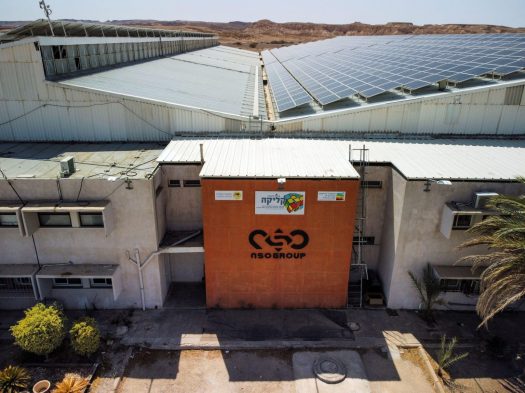
An office of the Israeli intelligence firm NSO Group. (photo: Reuters / Amir Cohen / Alamy Stock Photo)
NSO Group, the Israeli firm that sells its spyware to authoritarian regimes around the world, emerged from a military unit that perfected its surveillance techniques on Palestinians.
By Yousef Munayyer | Jewish Currents | July 26, 2021
With an occupied and stateless population of Palestinians under its rule, to which it has granted no citizenship rights or civil liberties, Israel is free to develop, test, and perfect its surveillance technology on millions of unwilling subjects.
Last week, a joint investigation by 17 media outlets—including The Washington Post, The Guardian, and Haaretz—revealed that Israeli intelligence firm NSO Group had licensed military-grade spyware known as Pegasus to a long list of authoritarian regimes. The report drew on a leaked list of more than 50,000 phone numbers; a close forensic analysis of some of the phones confirmed that they had been hacked by surveillance software capable of monitoring the targets’ movements, listening to their conversations, and accessing their private data.
The list included the phones of several people close to murdered journalist and Saudi dissident Jamal Khashoggi: His wife’s phone was targeted in the months before his gruesome murder, while his fiancée’s phone was hacked in the days after his death. The phone number of Princess Latifa bint Mohammed al-Maktoum was added to the list shortly after her escape from the United Arab Emirates and just days before she was captured on her way to Sri Lanka by Indian commandos, who returned her to Dubai. Numbers belonging to some 14 current or former heads of state were found on the list as well.
Seventy-three years after Israel’s birth in the 1948 Independence War, in which hundreds of thousands of Arabs fled or were driven out at gunpoint, Jews and Arabs in Israel live side by side but largely blind to each others’ lives. (photo: Dan Balilty for The New York Times)
Israel’s Jewish and Palestinian communities looked past each other until violence and bloodshed forced a reckoning.
By Roger Cohen | The New York Times | Aug 1, 2021
“I was targeted as a Jew by radicalized thugs… But many more Arabs came to help me put out the fires than came to burn my places down. We cannot allow a violent minority to win.” — Uri Jeremias, a celebrated Israeli chef
ACRE, Israel — Uri Jeremias, a celebrated Israeli chef, saw himself as a benefactor. By bringing jobs, tourists and investment to the mainly Arab heart of the coastal town of Acre, he believed he was seen as nurturing coexistence between Jews and Arabs.
Until an Arab mob torched his Uri Buri restaurant in May and a Jewish guest at his luxury hotel was asphyxiated in the worst inter-community riots in decades.
“I was targeted as a Jew by radicalized thugs,” Mr. Jeremias, 76, said at his airy house in Nahariya, a few miles north of Acre. “But many more Arabs came to help me put out the fires than came to burn my places down. We cannot allow a violent minority to win.”
Israeli soldiers confiscated computer equipment and client files in a dawn raid on Defense for Children International – Palestine’s main office in Al-Bireh on July 29. (photo: DCIP)
This increasingly emboldened military intimidation by Israeli forces aims to criminalize legitimate human rights and humanitarian work.
By Defence for Children International | July 30, 2021
“This latest act by Israeli authorities pushes forward an ongoing campaign to silence and eliminate Palestinian civil society and human rights organizations like DCIP” —Khaled Quzmar, general director at DCIP
Ramallah, July 29, 2021—Israeli forces raided Defence for Children International – Palestine’s headquarters in the central occupied West Bank, confiscating computers and client files, early Thursday morning.
Israeli paramilitary border police forces raided DCIP’s headquarters located in Al-Bireh’s Sateh Marhaba neighborhood, located just south of Ramallah around 5:15 a.m. on July 29. More than a dozen Israeli soldiers forced open the office’s locked front door and confiscated six desktop computers, two laptops, hard drives, and client files related to Palestinian child detainees represented by DCIP’s lawyers in Israel’s military courts. No documents were left in the office to give any indication of the reason for the raid, and they did not leave behind any receipt of materials seized.
Young Palestinian men sit by a section of the separation wall in the West Bank city of Abu-Dis, September 29, 2014. (photo: Miriam Alster / Flash90)
What does it mean to pursue regime change as a path for transformation in Israel-Palestine — and is it enough to bring about justice?
By Diana B. Greenwald | +972 Magazine | July 28, 2021
The state-first approach has, so far, failed to prevent, and, if anything, has enabled the continued abuses of the occupation, asymmetric warfare, authoritarianism within Palestinian institutions, and forcible dispossession and displacement.
As Palestinian demonstrators assembled in the streets of Ramallah, Hebron, and other West Bank cities last month, a familiar, but perhaps unexpected, rallying cry rose from the crowds: “The people want the fall of the regime.” The trigger for the protests was the June 24 killing of Nizar Banat, a prominent activist and frequent critic of the Palestinian Authority, while in the custody of Palestinian security forces. While Banat’s funeral attracted thousands in Hebron, protesters in Ramallah chanted “fall, fall, military regime.” It was PA police officers who shoved fellow Palestinians in the streets, struck protestors with batons, attacked journalists, and harassed female demonstrators and observers.
But regimes are systems, not individuals, and many have argued that the system that enabled agents of the PA to carry out these violations is the same one that targets Palestinians confined in the blockaded Gaza Strip with devastating aerial bombardment; threatens thousands of Palestinians in East Jerusalem with expulsion; repeatedly demolishes the homes, classrooms, and critical facilities of Palestinian Bedouins in the Jordan Valley; and confronts Palestinian citizens of Israel with, alternatively, state neglect or mass arrests. It is one of racial discrimination and gradual ethnic cleansing that has been a dominant feature of Israeli politics since the birth of the state.
Palestinian doctors receive the first doses of a COVID-19 vaccine at the Ministry of Health, in Gaza City, on February 22, 2021. (photo: Ashraaf Amra / APA images)
A global alliance of academic health and humanitarian advocates call out the power imbalance between the settler colonial state and the colonized in Palestine.
By Alice Rothchild | Health and Human Rights Journal | July 26, 2021
Since the founding of Israel, efforts to document Palestinian history and rights has consistently been met by well-organized protests that include a large number of letters to journals and media outlets and hostile personal attacks on authors and editors.
Journals in the medical, social, and political sciences have begun to highlight an appreciation of structural racism, and the personal and public health costs of bigotry and chronic stress. For oppressed populations, understanding these forces is critical to the establishment of basic human rights, including the right to health in its broadest sense: access to health services, clean water, sanitation, nutrition, housing, education, employment, and freedom of movement. International human rights law requires states to support these rights and calls out governments, groups, or individuals who violate these principles. However, there is one area of scholarship where these insights often do not apply, and that is Palestine.
The recent retraction of the article in Scientific American, “As Health Care Workers, We Stand in Support of Palestine,” is the latest example. The COVID-19 pandemic and repeated Israeli assaults have made it clear that the health of Palestinians is dependent on their liberation and the end of the Israeli occupation and siege
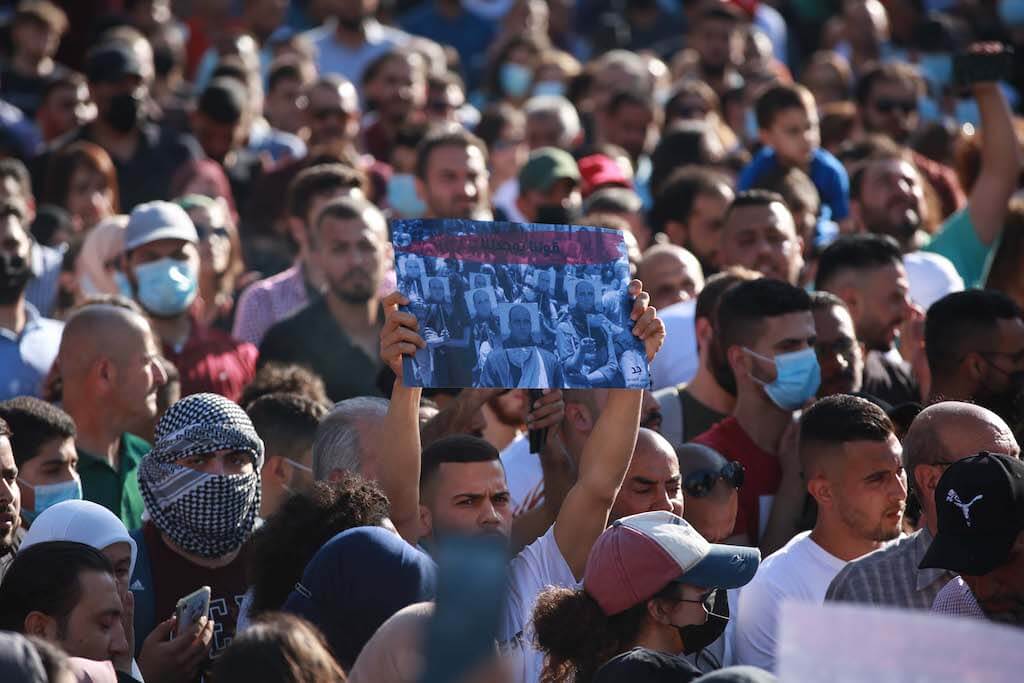
Palestinians protest the death of opposition activist Nizar Benat shortly after he was detained by Palestinian security forces in Ramallah, West Bank on June 26, 2021. (photo: Issam Rimawi / Anadolu Agency)
Young Palestinians firmly believe that the only way out is to take things into their own hands.
By Yousef Aljamal | Politics Today | July 26, 2021
Many Palestinians today feel that the PA falls short of adopting a discourse that reflects their visions under Israeli military occupation and apartheid.
Most young Palestinians were born after the signing between the Palestine Liberation Organization (PLO) and Israel of the Oslo Accords in the White House in 1993. The agreement was based on the two-state solution paradigm and promised Palestinians peace and a sovereign state; however, the agreement has never materialized. Palestinian intellectuals such as Edward Said, Ibrahim Abu-Lughod, and Walid Khalidi, foresaw that the Oslo Accords were a trap for the PLO, with Said calling it a “second Nakba.”
Long ago young Palestinians lost any hope in the so-called peace process, which served only to marginalize the PLO’s role by creating a Palestinian Authority (PA) that has a limited sovereignty and power, and that would serve as a barrier between them and the Israeli occupation. The Oslo Accords have turned the West Bank and the Gaza Strip from occupied territories to disputed territories. Israel has not stopped building new settlements in the Palestinian territories and the land of the future Palestinian state has shrunk over time, while the number of Israeli settlers in the West Bank has jumped to over half a million.
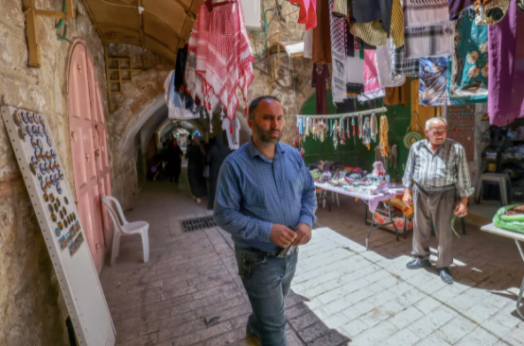
Issa Amro walks through the market of Hebron’s Old City on June 27, 2021. (photo: Emmanuel Dunand / AFP VIA GETTY IMAGES)
Disenchanted with corrupt Palestinian self-governance and Israeli apathy, Issa Amro looks to American Jews for change.
By Elhanan Miller | Tablet | July 20, 2021
“I knew that participating in a public meeting with Blinken would have a political cost for me, because there are Palestinians who don’t like the U.S., and they’re right.” — Issa Amro, Palestinian political activist
When Issa Amro was invited to an intimate meeting with Antony Blinken in Ramallah in May, he decided to aim straight for the heart. “As a Jew, is this your dream?” Amro rhetorically asked him. “Did you dream of seeing an apartheid state?”
A native of Hebron, Amro warned the American secretary of state of the “Hebronization” of East Jerusalem and the entire West Bank. By “Hebronization” he means the extension of a dual legal system for Israelis and Palestinians, the closing of main roads to Palestinian pedestrians and shop owners, and social segregation. Continue reading “A Palestinian activist fights the IDF and the Palestinian Authority”






You must be logged in to post a comment.