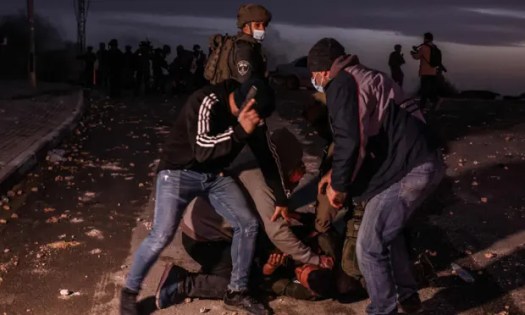
Israeli security forces and undercover police arrest a young Bedouin demonstrator during a protest in January. (credit: Menahem Kahana / AFP / Getty Images)
Demonstrators are increasingly effective at countering undercover agents.
By Hiba Yazbek | The Guardian | Apr 6, 2022
The shift in the power dynamic might mean that these agents are not as powerful as they once were.
Over the years, the activist and organizer from Daburiyya, an Arab village in the north of Israel, has had his fair share of confrontations with Israeli undercover agents who pose as Arab citizens, known as Mista’arvim. But this time was different, he said.
A wall at Netiv HaAsara facing the Gaza border reads the words “Path to Peace” in Hebrew, Arabic, and English. (credit: Cole Keister / Unsplash)
How blocking non-violent change may strengthen those who support violence.
By Peter Beinart | Beinart Notebook | Apr 4, 2022
These dehumanizing arguments about Palestinians don’t make Israelis safer. They put Israelis in greater danger because, over the long term, preventing violence requires giving people hope that they can non-violently achieve equality and freedom.
It’s 2032. Russia occupies Ukraine. Moscow has fragmented Ukrainians geographically and legally. Some Ukrainians enjoy citizenship but face structural discrimination. Many lack citizenship and live without free movement under military law. Many others have been expelled and cannot return. Suddenly, over the space of a few days, Ukrainians begin murdering Russian civilians. What would we say?
Which, as you may have guessed, is my way of talking about last week’s actual Palestinian attacks against Israeli civilians. In the US, the debate about Israel-Palestine is deeply exceptionalized. That’s a fancy way of saying that when we talk about Palestine-Israel we often ignore the principles we apply to other conflicts. So let’s imagine how American politicians and pundits might respond if these horrific acts of violence were occurring not in Hadera and Bnei Brak but in Moscow and Saint Petersburg.
A still from the film “Huda’s Salon” (credit: courtesy of IFC Films)
Challenging patriarchal notions in Palestinian society is not a separate issue from ending Zionist settler-colonialism. In fact, it has been precisely through gender violence that the colonial project has thrived.
By Tamam Mohsen | Mondoweiss | Apr 1, 2022
Putting indigenous Palestinian women at the center of analyzing the Zionist settler-colonial project aims to demonstrate the connections between gender violence and colonization in the life of Palestinian women.
By the time I am writing this piece the long-running debate flooding social media over the film Huda’s Salon has finally just cooled down.
The tense 90-minute thriller from the Palestinian director Hany Abu Asad discusses how the Israeli secret service (Shabak) recruits Palestinian women. It takes place in Bethlehem where Reem (Maisa Abd Elhadi), a Palestinian young woman, is getting her hair done at Huda’s salon (Manal Awad). Reem is then drugged by Huda, who photographs her naked with a man (Samer Bishara) who is not her husband. The images are then used to blackmail Reem and coerce her into collaborating with Shabak.
Peter Beinart speaking at Temple De Hirsch Sinai, Seattle, Washington, May 23, 2019 at an event sponsored by J Street (CC by Joe Mabel via Wikimedia)
The analogies between Ukraine and Israel are problematic.
By Peter Beinart | The Beinart Notebook | Mar 21, 2022
The message is clear: Since Israel faces its own existential foes, it too needs bipartisan support.
On Friday, AIPAC—the influential pro-Israel lobbying group—issued a statement I suspect historians of American Jewry will scrutinize for decades to come. It argues that in order to preserve US support for Israel’s ability to rule undemocratically over Palestinians, AIPAC must support politicians who seek to rule undemocratically over Americans. Authoritarianism there requires authoritarianism here.
World Water Day is an annual United Nations observance day held on 22 March that highlights the importance of fresh water.
By Al-Haq – Defending Human Rights | Mar 22, 2022
Israel’s control over all aspects of water in the OPT renders the Palestinian economy captive and entrenches an apartheid regime of discriminatory and segregating laws and policies.
Water Day, the annual United Nations day of observance on the importance of freshwater, draws attention to the billions of people around the world who are denied their basic human right to live with clean, accessible, and affordable water. This year, Water Day focuses on groundwater and the critical importance of cooperation in managing transboundary groundwaters.
At the time, I was surprised and gratified at how quickly the story was picked up by other news outlets and how easily attention was brought to my sincere concerns. In a matter of days, I was appearing on cable news, and a social media debate raged for weeks.
Israeli soldiers confiscated computer equipment and client files in a dawn raid on Defense for Children International – Palestine’s main office in Al-Bireh on July 29. (Source: DCIP)
A trustee of a Jewish family foundation that has contributed to Palestinian and Israeli civil society, Dr. Rothchild raises concerns over developments that signal danger for the human rights sector globally.
By Alice Rothchild | Alliance Magazine | Mar 17, 2022
By trying to intimidate us into silence and inaction, the Israeli government is making us complicit in harming the very civilian populations that we have been charged to protect.
In recent months, the Israeli government hurled smears at Amnesty International for issuing a report concluding that Israel is imposing a system of apartheid on the Palestinian people. The government is now considering punishing the messenger by stripping Amnesty’s Israel country section of its tax-exempt status and barring Amnesty staff from entering Israel. This crackdown on nonprofits extends beyond Israel’s borders as the government’s allies push for the UK and Australia to also strip those Amnesty country sections of their charitable status. And this goes well beyond Amnesty – Israel has deported a Human Rights Watch staffer, banned Israeli human rights groups from speaking to students, and criminalized the work of six venerable Palestinian non-profit organizations, creating a chilling effect on those funding and otherwise supporting them. Israeli officials are on the record stating that the goal of designating the six Palestinian NGOs ‘terrorist’ groups is to deprive these organizations of international funding.
Facebook recently made a sharp about-turn in its policy on hate speech (credit: AFP)
Silicon Valley’s decision to allow anti-Russia threats reveals it as little more than a propaganda arm of the West
By Jonathan Cook | Middle East Eye | Mar 18, 2022
Silicon Valley’s rank hypocrisy in allowing hate speech against Russia and Russians is particularly evident when compared with the special protections put in place by tech firms to block criticism of Israel and Israelis.
Silicon Valley has rammed through a series of changes over the past few days at dizzying speed, making explicit what should already have been obvious: Social media firms have rapidly become little more than propaganda arms of the United States and its allies.
That role has been increasingly difficult to conceal as western politicians and traditional media outlets have whipped up anti-Russia hysteria over the past three weeks, following Russia’s invasion of Ukraine.
The Israeli Knesset in Jerusalem, October 30th, 2018. (credit: Juergen Schwenkenbecher /AP)
The Citizenship and Entry Into Israel law impacts thousands of families.
By Alex Kane | Jewish Currents Tuesday News Bulletin | Mar 15, 2022
“We’re talking about a law that basically tells Palestinians, ‘You are not equal.’ It tells them, ‘You cannot gain citizenship. You don’t have the privilege that we grant Jews coming from abroad.’” — Adi Mansour, an attorney for Adalah- The Legal Center for Arab Minority Rights in Israel
On Friday, Israel’s Knesset approved a law reauthorizing a ban on giving Palestinian spouses of Israeli citizens permanent residency status. Passed with 45 Knesset members in favor and 15 opposed, the Citizenship and Entry Into Israel law impacts thousands of families, though the exact number is unclear. It bars Palestinians living in the West Bank or Gaza who are married to Israeli citizens from gaining the legal benefits foreign spouses typically receive in liberal democracies. (The law also applies to citizens of so-called “enemy states”—Lebanon, Iran, Iraq, and Syria—but in practice it mostly impacts Palestinians from the West Bank or Gaza.)
Reps. Rashida Tlaib and Ilhan Omar, along with Rep. Cori Bush, remain among only a handful of BDS supporters in federal office. (credit: Adam Bettcher / Getty Images)
While U.S. politicians have jumped over themselves to sanction Russia back to the Stone Age, widespread anti-BDS sentiment among politicians has advocates iced out of public debate.
By Joseph Gedeon | Politico | Mar 7, 2022
“But whereas the international community mobilized swiftly to confront Russia’s occupation of Ukraine, it has done very little to roll back Israel’s occupation of the West Bank, Gaza, [and the] Golan Heights. It’s exactly this lack of any real accountability or constraint on Israel, that ultimately led to the BDS movement.” — Khaled Elgindy, a senior fellow at the Middle East Institute
As the prospect of a Russian invasion into Ukraine was inching closer to reality, the U.S. took proactive steps with its allies to coordinate more concentrated sanctions against Moscow. And when the war erupted, the U.S. announced it was ready to impose stiffer sanctions, including freezing U.S. assets held by Russian banks, enforcing restrictions on high-tech imports and seizing oligarchs’ homes, planes and yachts.
The tough rhetoric and swift reprisals have been embraced by lawmakers on both sides of the aisle, who have called for sanctions to decimate Russia’s economy. To some longtime advocates of the boycott, divestment and sanctions movement meant to target Israel’s economy amid bloody conflicts with Palestinians, those calls sound eerily familiar.










You must be logged in to post a comment.