Don’t get me wrong. I understand where much of this comes from. Jews of all ethnicities bear the scars and the genetic memory of every manner of heinous racism, up to and including genocide.
It’s all too true, at the same time, that in a tragic given of human nature, the abused is at great risk of becoming an abuser.
This is Zionism as racism. This is Israel at 70.
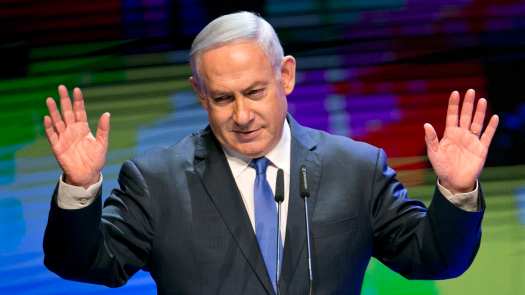
This is a country which so demeans and dismisses and conflates Palestinian lives, that after a horrendous casualty rate in massive demonstrations at the Gaza border over the weekend, Eli Hazan, a spokesman for Benjamin Netanyahu’s Likud, referred to the men, women, children and elderly protesters camped hundreds of meters from the border fence, and told i24 News Monday without flinching:
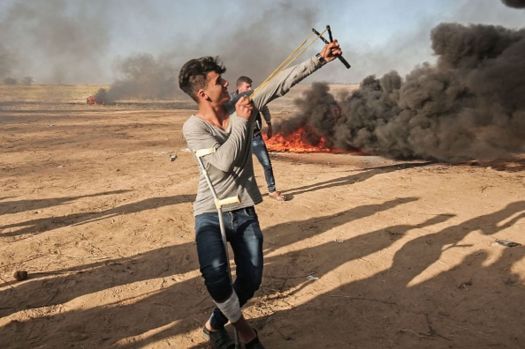
Palestinian using a slingshot at a protest in Gaza. (photo: Said Khatib / AFP / Getty Images)
When an entire people have concluded they have nothing to hope for and nothing to lose — that all their dreams will remain deferred for the foreseeable future — an explosion may be inevitable.
Both Palestinian Islamists and nationalists are out of options, out of ideas, and out of luck. The Palestinian public is out of patience and nearly out of hope. That’s a combustible formula.
The violence last Friday in Gaza, in which 18 Palestinian protesters were killed by Israeli troops near the border, was the worst since the war of 2014. But everything is in place for a significant escalation in coming weeks, particularly in mid-May.
A series of major tripwires are clustered tightly together: commemorations of the 70th anniversary of Israel’s founding on May 14–15; mourning by Palestinians who regard the same event as their “catastrophe” and observe May 15 as “Nakba Day”; and the scheduled opening of a US Embassy in Jerusalem on May 14, courtesy of the administration of President Donald Trump.
Things are likely to get worse because Palestinians increasingly feel they have nothing left to lose. The “March of Return” last week drew unprecedented crowds of up to 30,000 Palestinians from all parts of Gaza society. In a festive and surreal atmosphere, vendors sold ice cream to picnicking families as young men risked their lives by approaching the border.
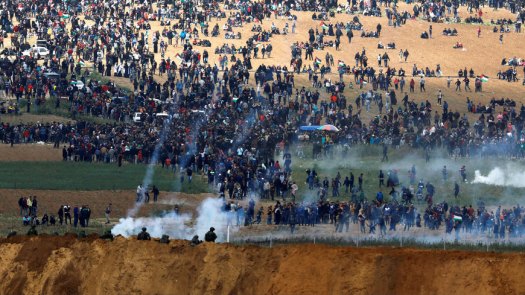
Israeli soldiers shoot tear gas from the Israeli side of the Israel-Gaza border as Palestinians protest in Gaza, Mar 30, 2018. (photo: Amir Cohen / Reuters)
The Israel Defense Forces consider “only” 16 casualties a “very significant achievement.”
“Just imagine what could have happened. Picture the outcome if they would have burst through the fence, even at a single point, and begun marching into Israel. It would have ended in a bloodbath. . . . We would have no choice but to employ enormous force, and that would have resulted in dozens, if not hundreds, of casualties. The images would have been a huge victory for the Palestinians.”
— Senior Israeli defense official, speaking anonymously
The March 30 Great March of Return to the Gaza border fence was nothing more than Act 1 of an unfolding drama, a dress rehearsal or possibly a pilot for what one can expect to see in the very near future. The Israel Defense Forces (IDF) are now preparing for April 17, Palestinian Prisoners Day, also the eve of Israel’s Memorial Day for Fallen Soldiers, and for May 15, Nakba Day, also the day after the United States is expected to open its new embassy in Jerusalem. Further complicating matters, the latter event coincides with the start of the Islamic holy month of Ramadan. The Great March of Return was initiated and orchestrated by Hamas in an attempt to change the rules of the game, create a new balance of power and send a message to Palestinian President Mahmoud Abbas that the struggle for the hearts and minds of the Palestinian people is far from over. Hamas is alive and kicking, and it is marching as well.
Hamas is in the process of losing its tunnels as a weapon. The IDF and Egypt have also successfully prevented the group from smuggling into Gaza rockets, missiles and other arms that could break the balance of power. Facing the most threatening dead end ever, Hamas found a way to reinvent itself: a popular, mass march by tens of thousands of people, all heading to the Israeli border at the Erez checkpoint, where they would trample the fence, break the Israeli siege and move on toward Jerusalem or at least to the southern town of Ashkelon. Images of IDF tanks and helicopters firing at civilians marching for their freedom would be Israel’s worst imaginable nightmare.
That is why the IDF has decided not to let that happen.
An ultra-Orthodox Jewish man walks next to Palestinian women in Jerusalem’s Old City, Sep 10, 2015. (photo: Ammar Awad / Reuters)
Israel is far from being an apartheid state currently, but if it opts for minority rule of an Arab majority, it will have no choice but to adopt apartheid methods.
The updated population data have once again placed the inherent tension between Israel’s Jewish and democratic nature in the forefront of the political arena. While Israeli liberal-minded political forces argue that there is no contradiction and that Israel can be both Jewish and democratic, others on the political right and the left reject the idea.
The Israeli political right was caught off guard by the surprising official figures presented on March 26 at the Knesset by a representative of the Civil Administration, the army unit coordinating the Israeli government’s activities in the occupied territories. The representative indicated that the number of Jews and Arabs living under Israeli control in the area between the Jordan River and the Mediterranean had reached parity at 6.5 million for each side.
Over the years, the Zionist left kept warning about the prospect of a Jewish minority in Israel controlling a Palestinian majority, with only a small number of them enjoying full civil rights. Yet the Israeli right kept dismissing these warnings. It countered with imaginary data showing that some 3 million Palestinians live in Israel and the occupied territories, compared with 6.5 million Jews. However, from the moment the true numbers were communicated to the Knesset’s Foreign Affairs and Defense Committee with the new data last week by the Israel Defense Forces, the leadership of the political right can no longer argue that political bias is skewing the figures. It is now forced to confront the figures. . . .
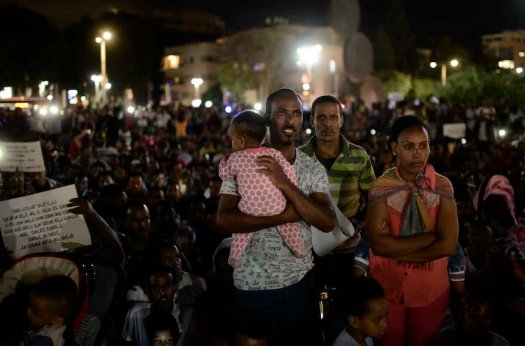
After promising to “get rid of them all” . . . the big mystery is why he made the decision in the first place to extend legal status to at least half of the 36,000 refugees and asylum seekers in Israel.
In the face of all of Prime Minister Benjamin Netanyahu’s past capitulations, it was the most disgraceful, the most transparent. In comparison to all his reversals, it was the quickest, the most humiliating. The man had already taught us a chapter on zigzags and back-and-forths — in the story of the Western Wall egalitarian prayer space and the metal detectors at the Temple Mount, for example — but this time he outdid himself, in both speed and flexibility. A contortionist could only dream of having such a liquid backbone.
What we saw in the past 24 hours is a parody of a prime minister and a tragedy to the state he heads. There’s never been anything like it: The Israeli government signs an agreement with an international organization over an issue that is at the heart of the public debate and about which the government has a firm position. The prime minister declaims to his nation the details of the deal in a jubilant news briefing in the midst of the intermediate days of Passover, and within hours he backtracks.
An Israeli policeman from a Mista’arvim unit disguised as a Palestinian protester raises a pistol in air as he arrests a Palestinian demonstrator in the West Bank city of Ramallah, Dec 13, 2017. (photo: Nasser Shiyoukhi / AP)
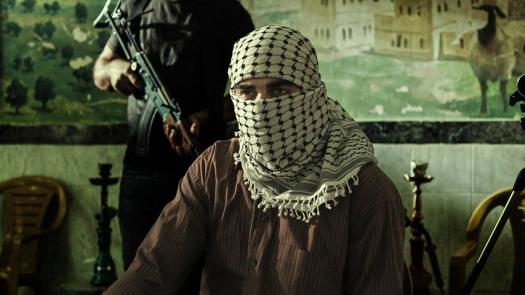
We would all do well to remember that Fauda is part of Israel’s well-oiled public-relations machine, which knows how to transform Israeli brutality into sexy, heroic images.
Palestinians often identify [Mista’arvim] when they show up, even though dressed like locals. At some point, they will pull down their ski masks, pull out their guns and arrest young Palestinians who participate in the demonstrations. They are also known to provoke violence, which is then used to justify the violence perpetrated by the Israeli forces against Palestinian protesters.
Palestinian resistance is legitimate and sanctioned by the inalienable right that all oppressed people have to resist their oppressors and occupiers, even with the use of arms. Israeli violence is raw and unchecked brutality intended to keep Palestinians from raising their heads. But the conventional wisdom is that Palestinian resistance is terrorism and Israeli violence is counterterrorism.
From time to time equivalency is drawn between the two, pointing out that both sides are “human.” While this can be misconstrued as “progress,” it is actually an insult to the cause of justice because there is no equivalency to be drawn between oppressor/occupier and the those fighting for their freedom.
In early 2017 a friend asked me whether I had watched the Netflix series “Fauda.” I said no, and this was the beginning of several weeks of persuasion, at the end of which I succumbed. “Fauda” is an Israeli-produced series about an Israeli paramilitary unit that is called in Hebrew “Mista’arvim.” The word “Mista’arvim” is a cross between the Hebrew word for camouflage and the word for Arabs.
While regular soldiers in the field wear uniforms and camouflage so that they will not be spotted by enemy forces, these are armed, undercover units that wear civilian clothes but dress and talk like Arabs.
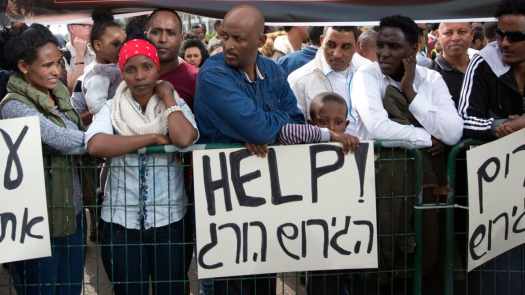
A person who suffered force labor, violence, rape and torture in his own country — is he not a refugee?
Someone who was persecuted only because of her religion and ethnic background — is she not a refugee?
A person forced to flee his home only because of his skin color — is he not a refugee?
Someone whose village was burned and her family members killed in front of her eyes — is she not a refugee?
And he who survived a genocide — is he not a refugee?
If these people are not considered refugees in Israel, than who is?
My name is Monim Harun, an asylum seeker from Sudan. I was born in a small village nested between mountains and forests, where we lived together as one big family. At a young age I was separated from my family and the people I loved most in the world when the militia forces attacked our village. They went through the village killing every man and boy in sight, but by a miracle I survived. My mother wanted me to live in a safer place and have the opportunity to study, so in 2001, at the age of 12, she sent me to the other side of the country, to the Blue Nile region of the Republic of Sudan.
When I left the village it felt bittersweet — leaving behind my mother and sisters, and the people I loved. But I knew that in doing so, I would be able to acquire new skills that would help me rebuild my community on my return. In the Blue Nile region I completed elementary through high school, and was accepted to Blue Nile University. I spent three years there studying toward a degree in electrical engineering — five years are required for the program. During those years I joined a student organization that fights against the rule of radical Islam in Sudan, and calls for a democratic, secular and liberal system of government. My involvement in social and political advocacy wound up placing my life in great danger, all the more so because my Fur ethnicity is one against which the Sudanese government has been perpetrating genocide.
Teargas canisters fired from Israeli drones fall on Palestinians during a demonstration near the Gaza Strip border with Israel, Mar 30, 2018. (photo: Hatem Moussa / AP)
The “humanitarian” concern of the US is all too often a cover for regime change ambitions. It seems to disappear when the victims in need are without strategic geopolitical value to Washington.
There are no efforts to hold Israel to account for its recent massacre of civilians. Instead, Israel has rejected UN and EU calls for an inquiry into the killings and a UN Security Council resolution on the matter was blocked by the United States.
Over the weekend, outrage took hold as the state of Israel authorized more than 100 snipers to fire upon the demonstrations of unarmed Palestinians in Gaza. The Palestinians, participating in the “March of Great Return” to demand the right for exiled Palestinians to return to their ancestral lands, were fired upon while fleeing and even praying. 17 Palestinians were killed and over 1,400 were injured. The Gaza Health Ministry stated that most of the reported injuries were bullet wounds to the legs and feet. The Israeli Defense Forces stated on Twitter that they were fully aware of where “every bullet landed” and Israeli Defense Minister Avigdor Lieberman said that the snipers “did what had to be done” and “deserve a commendation.”
The outrage, however, was confined to only a few countries as, throughout the West, the horrific event was the subject of slanted reports — such as those that portrayed the Israeli military firing on unarmed demonstrators as “clashes” — or was not even covered at all. Despite the number of people killed and the flagrant violation of international law, the story didn’t even make the Sunday edition of The New York Times, the US “paper of record.”
“Fauda reveals the contribution made by the series to Israeli propaganda efforts in concealing Israeli crimes, including ethnic cleansing, particularly in Jerusalem, the Negev and the Jordan Valley, the demolition of houses and the bulldozing of agricultural land and the siege of two million Palestinians in Gaza and the establishment of colonies.”
— BDS
The international Boycott, Divestment and Sanctions (BDS) movement is leading a campaign against the hit Israeli series, “Fauda.” Denouncing the widely acclaimed series as “racist propaganda for the Israeli occupation army”, BDS called on Netflix, which bought the rights to “Fauda,” to remove the show or face legal action.
In its statement announcing the campaign to boycott “Fauda,” BDS claims that the series serves as propaganda for Israel’s political and security establishment. It notes that the “Fauda” cast, including the production team, were hosted by the Israeli President, Reuven Rivlin, last month along with Israeli soldiers. The crew expressed gratitude to the Israeli soldiers and were described as a “source of inspiration” for the series while Rivlin expressed “gratitude” to the series’ producers.
An Israeli Jewish settler shoots in the air as Palestinians protest against a plan to resettle Israel’s Palestinian Bedouin minority from their villages in the Negev Desert, near the Israeli settlement of Bet El, north of the West Bank city of Ramallah. (photo: Majdi Mohammed / AP)
About 50% of the West Bank has been annexed by settlements, and 90% of the West Bank’s water is stolen from underneath the Palestinians.
“The Occupying Power shall not deport or transfer parts of its own civilian population into the territory it occupies.”
— Article 49, Fourth Geneva Convention
It is time to pose a question: Are Israeli settlers civilians? Or are they illegal occupiers? A group of Israeli settlers made the move to seize land in East Hebron (al-Khalil) last Monday (Mar 6, 2018), setting up camp — adjacent to the “Kharsina settlement” — backed by an entourage of heavily armed soldiers.
This move threatens three Palestinian families, with fears that they will soon be dispossessed of their land and homes. Those at risk of being cleansed and their property stolen, are the Eida, Jwihan and the al-Halawa families. The initiative to take this land came from the settlers themselves, who now occupy the 70-dunums. The settlers are living in four newly purchased caravans.
The above example clearly illustrates the way in which illegally established settlements, in the West Bank, come to their fruition.





 HolyLandJustice.org
You must be logged in to post a comment.