Trump to Jordanian king: Israel will have a PM named “Mohammed” in one-state solution

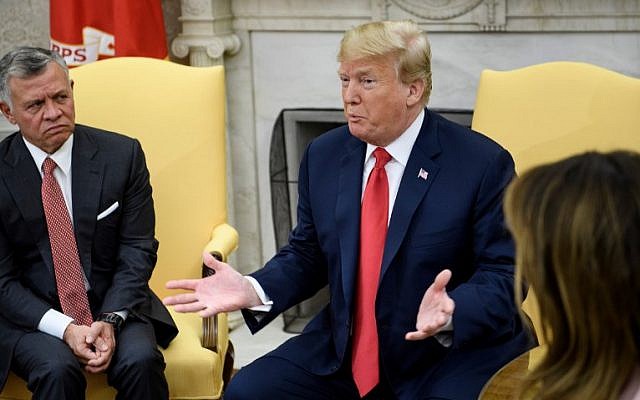
Jordan’s King Abdullah II and US First Lady Melania Trump listen while President Donald Trump makes a statement for the press before a meeting in the Oval Office of the White House, Jun 25, 2018. (photo: Brendan Smialowski / AFP)

Israel’s Channel 10 claims the US president made the prediction half-jokingly after Abdullah warned that many young Palestinians now want “one state with equal rights.”

By Staff | The Times of Israel | Aug 19, 2018


“I want to advance a peace agreement in the Middle East, because if my administration cannot achieve a deal, no administration will be able to.”
— US President Donald Trump


US President Donald Trump reportedly told Jordan’s King Abdullah II at the White House a few weeks ago that, in the absence of a negotiated solution to the Israeli-Palestinian conflict, Israel will have a prime minister named Mohammed in a few years time.

Trump’s reported remark was detailed on Sunday night by Israel’s Channel 10 news, which described it as “sarcastic” and “semi-jocular,” but also as containing a grain of truth. The TV channel said its report had been confirmed by an Israeli and a former US official who had both been briefed on the White House meeting, but that the White House and the Jordanian Embassy in Washington, DC, have refused to comment on it.

Continue reading “Trump to Jordanian king: Israel will have a PM named “Mohammed” in one-state solution”

Uri Avnery: A prophet in his own city

Uri Avnery in his home. (photo: Daniel Bar-On / Haaretz)

Like the biblical prophets of Israel, Avnery saw beyond the immediate; like them, he was persecuted and like them, few listened to him.

By Editorial Board | Haaretz | Aug 21, 2018


“Life goes on. The struggle continues. Tomorrow is a new day.”
— Uri Avnery


It’s customary to claim that the cemeteries are full of irreplaceable people. But the body of Uri Avnery, who died Monday at the age of 94, will not be buried in a cemetery, as per his request, and he is indeed an irreplaceable personality. No substitute has yet emerged for this man, whose life was long and full of struggles and achievements. The Israeli left, which is at a low point in its history, is now even more orphaned than before.

It’s hard to think of an Israeli biography richer and more complex than his: The child of German immigrants who joined the Irgun and in 1948 fought in the Shimshon Foxes elite unit. The legendary editor of Haolam Hazeh, which was a pioneer in aggressive investigative journalism in Israel, a mentor to generations of journalists who has left his mark to this day. The journalist, MK and citizen who fought corruption, religious coercion, ethnic discrimination and crony capitalism long before others did. And of course, the eternal warrior for peace between Israel and the Palestinian people, one of the pioneering visionaries of the two-state solution, an Israeli and Zionist patriot, optimistic and hopeful until his final days.

Continue reading “Uri Avnery: A prophet in his own city”

Uri Avnery, Israeli journalist and peace activist, is dead at 94

Uri Avnery, fourth from the left, in 2003 alongside Yasir Arafat and others at Mr. Arafat’s compound in the West Bank city of Ramallah. (photo: Jamal Aruri / Agence France-Presse / Getty Images)

Avnery was one of the first Israelis to actively seek a Palestinian state as a peaceful solution to the conflict.

By Isabel Kershner | The New York Times | Aug 20, 2018


“What in my eyes is the great success is that I and my friends raised for the first time the principle that there is a Palestinian people with whom we have to make peace at the end of the 1948 war. I don’t think there were 10 people in the world that believed in this. Today it is a world consensus.”
— Uri Avnery


Uri Avnery, a firebrand Israeli journalist, politician and peace activist who riled the establishment by exposing national scandals and conferring with Yasir Arafat, the father of the Palestinian cause, long before that was legal or fashionable for Israelis, died on Monday in Tel Aviv. He was 94.

His death was confirmed by the Sourasky Medical Center in Tel Aviv, his hometown, where he was admitted two weeks earlier after suffering a stroke.

An unwavering and acerbic critic of the government and a disrupter of the reigning national consensus, Mr. Avnery wrote regular opinion pieces for the liberal newspaper Haaretz up until he was hospitalized.

Continue reading “Uri Avnery, Israeli journalist and peace activist, is dead at 94”

De-Arabizing Jerusalem: Biblical “history” underwrites ethnic cleansing

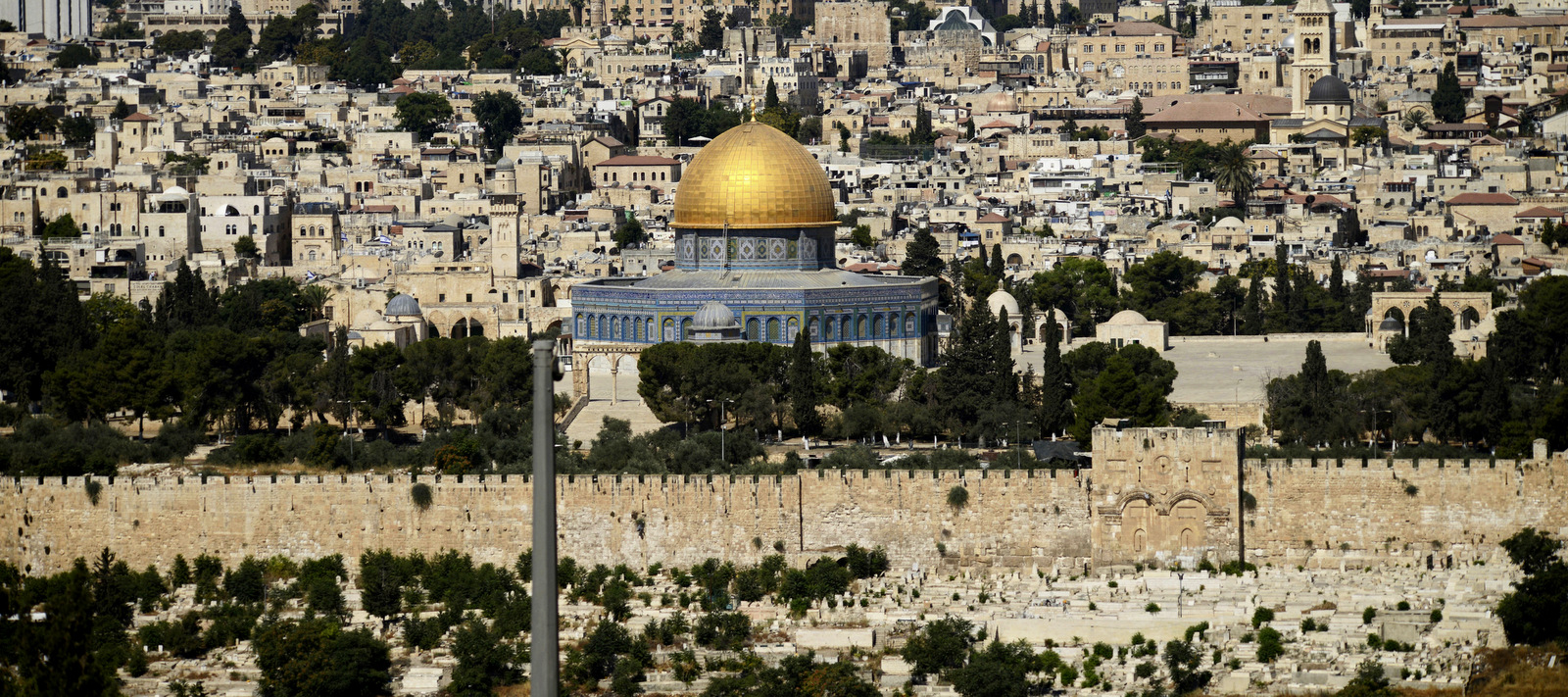
The Dome of the Rock Mosque in the Al Aqsa Mosque compound is seen in Jerusalem’s Old City, Jul 15, 2017. (photo: Mahmoud Illean / AP)
For seven decades Israel has been engaged in ethnic cleansing, threaten the City of Jerusalem with losing its heritage forever.

By Miko Peled | Mint Press News | Aug 20, 2018


“If you pay attention you will see: the tour guides tell their groups not to buy from the Arabs. So there is no business.”
— A shopkeeper in the Old City of Jerusalem


It is 2:30 pm on a weekday in Jerusalem’s Old City, and one would expect the stores and restaurants to be open and busy. Standing near one of the first stations along the Via Dolorosa, the final path Jesus took as he carried his cross to his own crucifixion, I was looking around me and Abu-Shkri restaurant was closing, as were some of the t-shirt and souvenir stores. I turned to one of the shopkeepers and asked him why they were closing so early. “No business,” he replied.

This seemed like an odd thing to say as the street was full of tourists. There were some tourists walking in groups and others walking in pairs or alone. “There are thousands of people here,” I said to him. “Yes, but they don’t stop to shop, not even to look or ask for prices.” He was right. Not a single tourist was stopping. “Look,” he continued after he noticed I continued to stand there, “if you pay attention you will see: the tour guides tell their groups not to buy from the Arabs. So there is no business.”

Continue reading “De-Arabizing Jerusalem: Biblical “history” underwrites ethnic cleansing”

Why we continue to march in Gaza

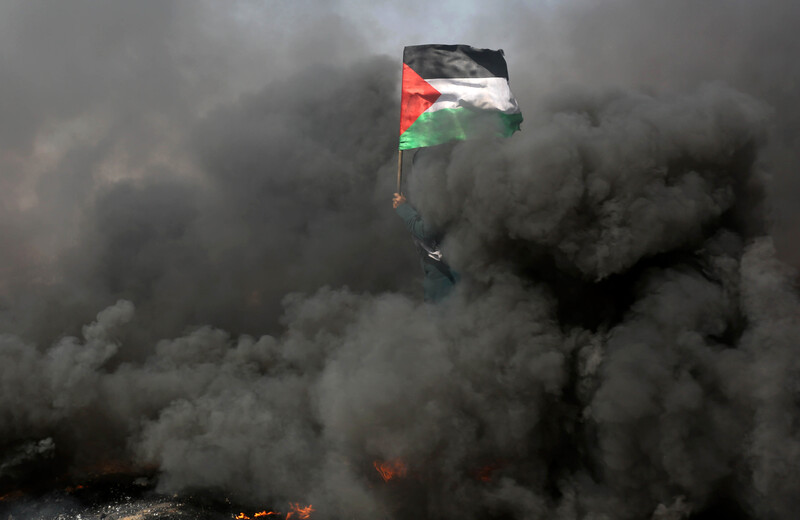
A protestor waves the Palestinian flag during the Great March of Return March near Khan Younis on May 11. (photo: Ashraf Amra / APA Images)
A young man’s a blog posting from Gaza.

By Abdalrahim Alfarra | Electronic Intifada | Aug 17, 2018


Ali requires further surgery. He is still hoping to move his legs again. He is still hoping to defy the treacherous bullet fired by a heartless sniper, and a world that answers Israel’s crimes with shocking silence.


I was sitting behind my desk in my family’s supermarket in Khan Younis on 14 May when my cousin Ali approached. There was going to be another gathering in al-Faraheen for that day’s Great March of Return protest, he said. Would I join him?

“No, I prefer the one in Khuzaa where we usually go,” I said.

Ali insisted to go to al-Faraheen and decided he would do so with his friend Saed. He stayed with me until I closed the shop and we went our separate ways. I called my friend Ahmad to go to Khuzaa.

At the protest, we found the usual: tear gas canisters falling thickly, leaving us barely able to breathe or talk; ambulances and paramedics fanning out everywhere; and the sound of live bullets whizzing past. The sound of a bullet elicits contradictory feelings. All of us know that it will hit someone. But if we hear it, we are safe, just like when we hear shelling it means it has exploded but not on us.

Continue reading “Why we continue to march in Gaza”

Faith floods the desert

(photo: Tucson Sentinel)
A response to the refugee crisis on the US-Mexican border.

By Rabbi Brant Rosen | Shalom Rav | Aug 3, 2018


According to the Torah, God provided for the needs of those who journeyed through the wilderness. The lesson this teaches us in our current political moment is all too obvious: the provision of humanitarian aid is divine work. Those who stand up to systems of state violence are not criminals — they are following a sacred imperative at the very heart of the Exodus story.


This weekend, I’ll be joining 60 faith leaders from around the country in southern Arizona to witness and respond to the suffering on our border though “Faith Floods the Desert” — a collaboration between No More Deaths/No Más Muertes, the Unitarian Universalist Service Committee, and the Unitarian Universalist Association. Representing communities of many faiths and denominations, we’re going to stand in solidarity with humanitarian aid workers and local residents by walking into the desert and leaving gallons of water along heavily-frequented migrant trails.

No More Deaths/No Más Muertes — a humanitarian organization based in southern Arizona — has documented how border enforcement pushes migration routes into some of the most remote, dangerous areas in Arizona’s deserts. As violence and hardship grow in parts of Latin America — in direct response to US foreign policy — and as pathways to asylum and other relief are cut off, growing numbers of people are crossing the border to reunite with their families and seek safety.

Continue reading “Faith floods the desert”

Israel passes Jewish state law, enshrining “national home of the Jewish people”

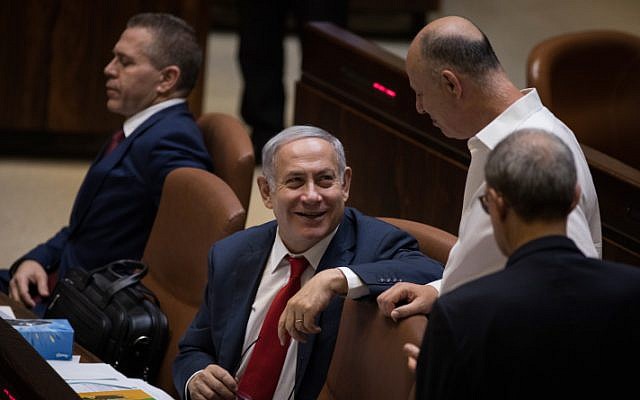
Prime Minister Benjamin Netanyahu with cabinet ministers at the Knesset plenum on Jul 18, 2018. (photo: Hadas Parush / Flash90 )

After hours of furious debate, Knesset narrowly approve quasi-constitutional Basic Law, which critics say discriminates against Arabs and other minority communities.

By Raoul Wootliff | The Times of Israel | Jul 19, 2018


“I declare with astonishment and sorrow the death of democracy . . . The funeral will take place today in the plenum.”
— Knesset member Ahmad Tibi


The Knesset overnight Wednesday passed into law the contentious nation-state bill that for the first time enshrines Israel as “the national home of the Jewish people” in its quasi-constitutional Basic Laws.

Lawmakers approved the bill in its second and third readings overnight, with 62 voting in favor, 55 opposed and two abstaining, after hours of heated debate in the Knesset chamber.

Similar to a constitution, the Basic Laws underpin Israel’s legal system and are more difficult to repeal than regular laws. The nation-state bill, proponents say, puts Jewish values and democratic values on equal footing. Critics, however, say the law effectively discriminates against Israel’s Arabs and other minority communities.

Continue reading “Israel passes Jewish state law, enshrining “national home of the Jewish people””

The Episcopal Church decides to screen investments in Israel and Palestine

Palestinians in Gaza ask the Episcopal Church, “Will you bind up the broken-hearted?” (Isaiah 61:1-2). (photo: FOSNA)

A resolution to “end complicity” in the occupation fails to garner support among the bishops, but a second resolution succeeds in establishing investment screening criteria for human rights abuses.

Joint Press Release | Friends of Sabeel North America, US Campaign for Palestinian Rights, and American Friends Service Committee | Jul 17, 2018


We congratulate the Episcopal Church for joining its ecumenical partners in aligning its investments with its values and taking action for justice in Palestine.


At its 79th general convening, the Episcopal Church considered several resolutions to support Palestinian rights, including multiple resolutions to take economic action. After 10 days of powerful organizing and lively debate, the Episcopal Church adopted six key resolutions affirming Palestinian rights, including resolution B016 calling for the adoption of a human rights investment screen on Palestine and Israel.

The resolution, adopted Friday, July 13, directs the Episcopal Church to follow a similar action adopted by the Evangelical Lutheran Church in America, calling for the development of criteria to screen investments based on the church’s long-held stance against human rights abuses in Palestine and Israel, for investment in the Palestinian economy, and for continued corporate engagement. This resolution passed handily in both the Episcopal House of Deputies and House of Bishops.

Continue reading “The Episcopal Church decides to screen investments in Israel and Palestine”

After Trump’s controversial embassy move to Jerusalem, other embassies are also relocating

Ivanka Trump hosts the dedication ceremony of the U.S. Embassy in Jerusalem on May 14, 2018. (photo: Wikimedia Commons)

As more countries move their embassies to Jerusalem, it comes with it the perception that more nations are recognizing Jerusalem as the capital of Israel, angering world powers who do not recognize Israeli sovereignty over the Holy City.

By Edward Leano | The Christian Post | Jul 10, 2018


  • Countries with embassies in Jerusalem: US, Guatemala and Paraguay
  • Countries considering moving their embassies to Jerusalem: Czech Republic, Romania, Honduras and Slovakia
  • Countries with embassies elsewhere in Israel: Albania, Angola, Argentina, Australia, Austria, Belarus, Belgium, Belize (consulate), Bolivia, Bosnia-Herzegovina, Brazil, Bulgaria, Cameroon, Canada, Chile, China, Columbia, Congo, Congo, Democratic Republic of, Costa Rica, Croatia, Cyprus, Denmark, Dominican Republic, Ecuador, Egypt, El Salvador, Eritrea, Ethiopia, European Union (delegation), Finland, France, Georgia, Germany, Ghana, Greece, Hungary, India, Ireland, Italy, Ivory Coast, Japan, Jordan, Kazakhstan, Kenya, Korea, South, Latvia, Liberia, Lithuania, Mexico, Moldova, Myanmar, Netherlands, Nigeria, Norway, Panama, Peru, Philippines, Poland, Portugal, Russia, Serbia, Slovenia, South Africa, Spain, Sri Lanka, Sweden, Switzerland, Thailand, Turkey, United Kingdom, Ukraine, Uruguay, Uzbekistan, Vatican, and Venezuela

The move by the US to relocate its Israel embassy from Tel Aviv to Jerusalem has been hotly debated both before and after the dedication ceremonies, but several countries seem to have seen some merits in doing the same. Guatemala was the first to join the US embassy in Jerusalem earlier this May.

Slovakia is now among the latest of a group of countries mulling the idea of having an embassy in the Holy City, an idea that has become somewhat more accepted among other countries despite intense criticism from the United Nations, as Fox News reported.

Continue reading “After Trump’s controversial embassy move to Jerusalem, other embassies are also relocating”

“Jesus wasn’t a refugee” — Trump’s spiritual adviser rewrites the Gospel

Televangelist Paula White during a National Day of Prayer ceremony in the White House, May 3, 2018. (photo: Bloomberg)

Paula White says Jesus’ three-and-a-half-year exile in Egypt did not make him a refugee because he had not “broken the law.”

By Haaretz | Jul 11, 2018


“Yes, He [Jesus] did live in Egypt for three-and-a-half years. But it was not illegal. If He had broken the law then He would have been sinful and He would not have been our Messiah.”
— Paula White, televangelist and spiritual advisor to Donald Trump


Paula White, an American evangelical pastor and one of US President Donald Trump’s spiritual advisors, has voiced her support for zero tolerance regarding border laws and has stated that Jesus’ three-and-a-half year stay in Egypt did not qualify him as a refugee during an interview with CBN, published on July 9th.

White preaches the “prosperity gospel,” a subset of the Christian faith popular in the United States, which advocates that donations given to the Church will come back around and make the donor richer. White was a guest of Trump at the US Embassy opening in Jerusalem.

Professor Anthony Pinn, religious studies professor at Rice University, has described the prosperity gospel as “as a way to religiously rationalize material acquisition.”

Continue reading ““Jesus wasn’t a refugee” — Trump’s spiritual adviser rewrites the Gospel”