Trump’s anti-Palestinian agenda will ultimately hurt Israel

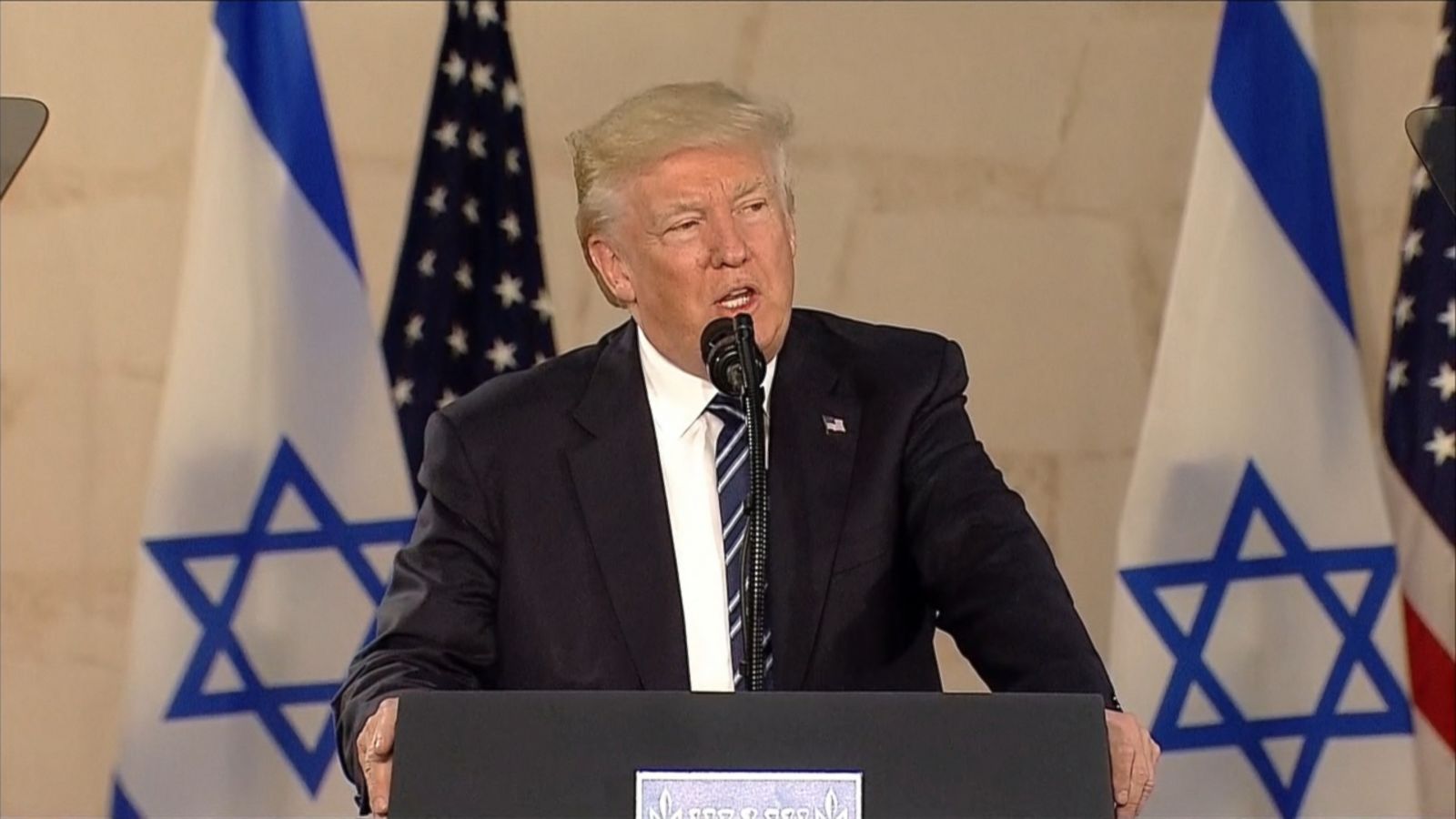
Trump stresses “unshakable” bond between US and Israel during Jerusalem speech, May 23, 2017. (photo: ABC News)
The U.N. Relief and Works Agency, or UNRWA, has tended to the needs of Palestinian refugees for nearly seven decades — if President Trump has his way, it will soon be out of business.

By Ishaan Tharoor | The Washington Post | Sep 4, 2018

Past US administrations were also slanted toward the Israelis, but what’s different today is that the usual mitigating factors in decision-making, such as American national security interests and the desire to at least appear evenhanded, no longer seem to be present. Instead we have domestic politics and ideology in their purest form dictating US policy on this issue.
— Khaled Elgindy, fellow at the Brookings Institution’s Center for Middle East Policy

On Friday, the Trump administration said it would cease funding the UN agency, which was launched in 1949 to provide for more than 700,000 Palestinians who fled or were forced from their homes in what is now Israel. Relying on volunteer donors — of which Washington has been the largest — UNRWA has had its mandate renewed repeatedly by the UN General Assembly as the Israeli-Palestinian conflict has dragged on. Over the decades, the population of Palestinian refugees in the occupied territories and now-semi-permanent camps in Jordan, Syria and Lebanon has ballooned to around 5 million, encompassing the descendants of the original exiles.

The White House, along with Israel’s right wing, argues that the rolls of recognized refugees should be limited to those alive in 1949 — a move at odds with other U.N. operations that also confer refugee status upon the descendants of the displaced. At a conference in Washington last week, Nikki Haley, Trump’s envoy to the United Nations, bemoaned the “endless number of refugees that continue to get assistance” and how “the Palestinians continue to bash America.” . . .

“There is only one thing that perpetuates the situation of refugees, including Palestinian refugees, and that is the extraordinary failure of the international community to bring about a just and fair and inclusive solution to the conflict,” Pierre Krähenbühl, UNRWA’s commissioner general, said to The Washington Post’s Ruth Eglash.

Continue reading “Trump’s anti-Palestinian agenda will ultimately hurt Israel”

Who needs a Nation State Law?

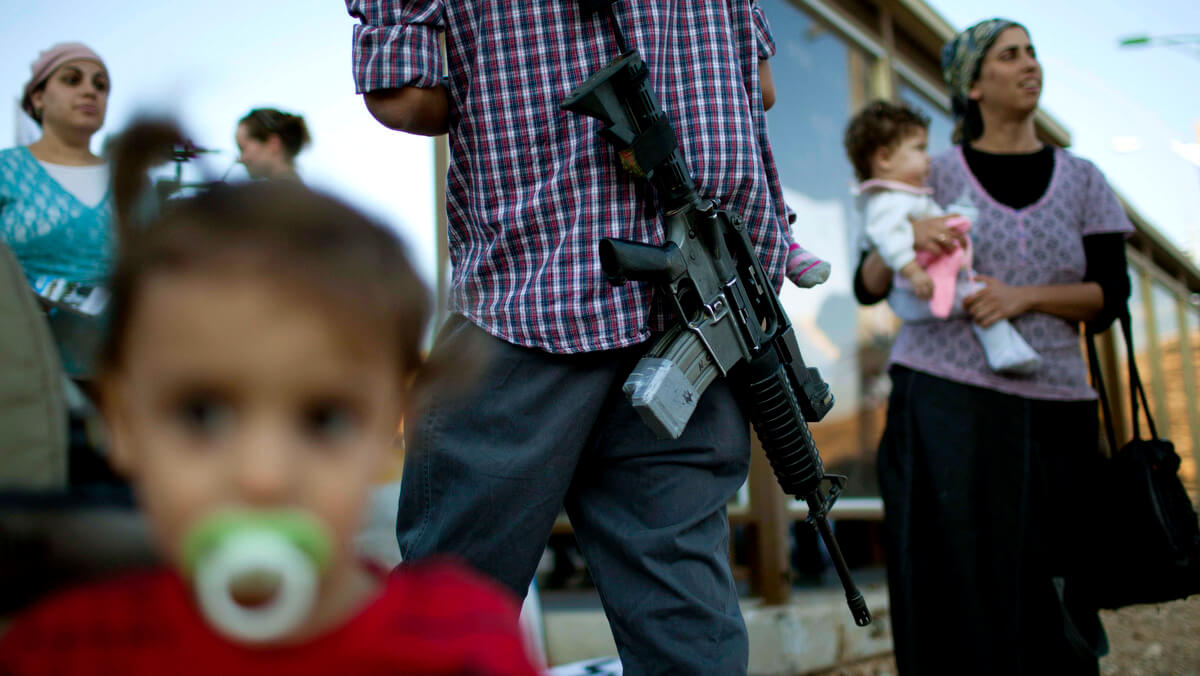
A Jewish man carries a rifle at a protest against Palestinian statehood in the Jewish-only settlement of Kiryat Arba, near the Palestinian town of Hebron. (photo: Bernat Armangue | AP)
The Israeli Nation State Law is the hallmark of an unfree people living in fear.

By Miko Peled | Mint Press News | Aug 31, 2018

From its very inception, the State of Israel passed laws that limit the rights of Palestinians in all areas of life — from citizenship rights to the right to political participation, land and housing rights, education rights, cultural and language rights, religious rights, and due-process rights.

Who needs a Nation State Law? What does the insistence and the passing of a law that states Israel’s exclusive rights to the land and the state mean? Since many laws and the reality on the ground make it seemingly obvious that Israel is already a state for Jews, one would think this law is redundant at least, if not totally unnecessary.

So is Israel’s government suffering from a serious case of insecurity? The question why this law was necessary is particularly interesting considering that the Knesset, the Israeli house of representatives, has legislated dozens of laws that make certain that within occupied Palestine — or Israel — Jews are privileged and that the Jewish and native Palestinian communities remain completely segregated from each other. This law added nothing that was not already stated in other laws. Palestinians, in comparison, do not seem to need a law that says they have a right to the land and that their language is superior to others. Still, this Israeli government, which claims Israel has historical rights that date back to biblical times, felt the need to pass this law.

Continue reading “Who needs a Nation State Law?”

Trump’s hardball Palestinian policy will blow up in Israel’s face

A poster of the U.S. President Donald Trump is set on fire during the annual anti-Israeli Al-Quds, Jerusalem, Day rally in Tehran, Iran. June 8, 2018Ebrahim Noroozi,AP
Slashing funds for the Palestinians is a radicalizing gift for terrorists — and a ticking time bomb for Israel’s security.

By Peter Lerner | Haaretz | Aug 26, 2018

The question is: will this doctrine bring peace, or will more, and potentially escalated, violence prevail? After all, in our region, poverty has been a breeding ground for radical recruitment, violence, and terrorism.

Over the weekend two indicators of the Trump Doctrine for the Middle East emerged. The first was an announcement from the US Department of State that $200 million earmarked for the aid for the Palestinians will be “redirected” from the West Bank and Gaza and be spent in accordance with U.S. national interests. USAID has been involved in developing Palestinian agriculture and infrastructure development — roads, and water supply and treatment.

The second, a leaked report that the Trump administration will announce at the beginning of September 2018 that it will cut its financial support for the operations of the UN’s Relief and Works Agency (UNRWA) in the West Bank. The beneficiaries of these operations include include 809,738 registered refugees, 19 refugee camps, 96 schools with 48,956 pupils, two vocational and technical training centers, 43 primary health centers, 15 community rehabilitation centers and 19 women’s program centers. . . .

Continue reading “Trump’s hardball Palestinian policy will blow up in Israel’s face”

Peace Works 2018: Middle Eastern Film Festival

Please join our brothers and sisters from the Rachel Corrie Foundation for this exciting event.
Date: Saturday, Sep 15, 2018
Showtimes: 2:00 pm The Prophet
5:00 pm Persepolis
8:00 pm Naila and the Uprising
Location: Capitol Theatre
205 5th Ave SE
Olympia, WA  98501
Information: Event information here →
Tickets: Buy tickets here →
Event Details

The purpose of the project is to enliven and enrich the South Sound community with Middle Eastern films and allied arts, and to raise funds for the upcoming Shuruq IV: Olympia Arab Festival taking place at The Olympia Center on October 6, 2018.

The film festival will feature the following:

  • 2 PM: The Prophet, an animated children’s film based on the writings of Lebanese-American writer, poet, and visual artist Khalil Gibran. Exiled artist and poet Mustafa embarks on a journey home with his housekeeper and her daughter; together the trio must evade the authorities who fear that the truth in Mustafa’s words will incite rebellion.
  • 5 PM: Persepolis, an adult animated biographical comedy-drama film, based on Marjane Satrapi’s autobiographical graphic novel of the same name, about a precocious and outspoken Iranian girl growing up during the Islamic Revolution.
  • 8 PM: Naila and the Uprising, a documentary, chronicles the remarkable journey of Naila Ayesh whose story weaves through the most vibrant, nonviolent mobilization in Palestinian history — the First Intifada in the late 1980s.
  • Photography exhibit, “A Day in the Life of Yemen,” showcasing the work of Luke Somers, a British-born American freelance photographic journalist and resident of Yemen, who was held hostage and killed by al-Qaeda in 2014.
  • Children’s activities, film Q&A sessions, and opportunities to get involved with RCF.

“Peace Works, a cornerstone project for RCF, is always an opportunity for us to creatively engage with community members on issues of injustice and struggle, and this year is no different. We are all too aware of the polarization and oppression occurring in communities around the country, including our own, and we hope that through film and allied arts, we can amplify the voices that are all too often silenced,” stated Whitney Faulkner, RCF Executive Director.

More information here →

BDS: How a non-violent movement has transformed the Israeli-Palestinian debate

4804
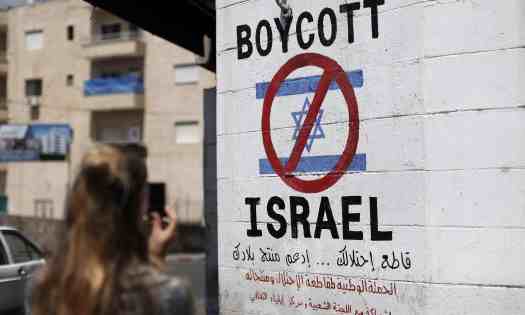
 Bethlehem, Jun 2015. (photo: Thomas Coex / AFP / Getty Images)
Israel sees the international boycott campaign as an existential threat; Palestinians regard it as their last resort.

By Nathan Thrall | The Guardian | Aug 14, 2018

Above all, [BDS] has underscored an awkward issue that cannot be indefinitely neglected: whether Israel, even if it were to cease its occupation of the West Bank and Gaza, can be both a democracy and a Jewish state.

The movement for Boycott, Divestment and Sanctions against Israel — known as BDS — has been driving the world a little bit mad. Since its founding 13 years ago, it has acquired nearly as many enemies as the Israelis and Palestinians combined. It has hindered the efforts of Arab states to fully break their own decades-old boycott in pursuit of increasingly overt cooperation with Israel. It has shamed the Palestinian Authority government in Ramallah by denouncing its security and economic collaboration with Israel’s army and military administration. It has annoyed the Palestine Liberation Organization by encroaching on its position as the internationally recognized advocate and representative of Palestinians worldwide.

It has infuriated the Israeli government by trying to turn it into a leper among liberals and progressives. It has exasperated what is left of the Israeli peace camp by nudging the Palestinians away from an anti-occupation struggle and towards an anti-apartheid one. It has induced such an anti-democratic counter-campaign by the Israeli government that it has made Israeli liberals fear for the future of their country. And it has caused major headaches for the Palestinians’ donor governments in Europe, which are pressured by Israel not to work with BDS-supporting organizations in the Palestinian territories, an impossible request given that nearly all major civil society groups in Gaza and the West Bank support the movement. . . .

Continue reading “BDS: How a non-violent movement has transformed the Israeli-Palestinian debate”

US cutting all funding to Palestinian refugee agency

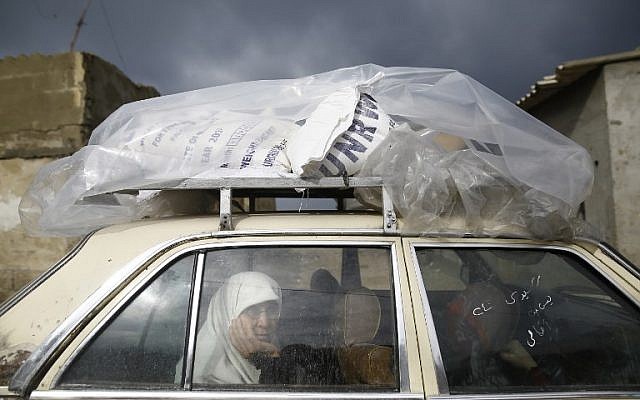
A Palestinian woman rides in a car after collecting aid provided by the UN agency for Palestinian refugees UNWRA, in Gaza City, Jan 17, 2018. (photo: Mohammed Abed / AFP)
The US provides almost 30% of UNRWA budget.

By Staff and Agencies | The Times of Israel | Aug 31, 2018

[The US] will no longer commit further funding to this irredeemably flawed operation.
— US State Department statement
The loss of this organization could unleash an uncontrollable chain reaction.
— German Foreign Minister Heiko Maas

The Trump administration announced Friday it is cutting nearly $300 million in planned funding for the UN agency that aids Palestinian refugees, and that it would no longer fund the agency after decades of support. Instead, it said it would seek other channels by which to aid the Palestinians.

The administration castigated the UN’s Relief and Works Agency for Palestine Refugees (UNRWA) for failed practices, and indicated that it rejected the criteria by which UNRWA defines Palestinian refugees, whereby the UN agency confers refugee status not only on original refugees but on their millions of descendants. . . .

Continue reading “US cutting all funding to Palestinian refugee agency”

My daughter loves the miracle of Israel

la-1535127300-6qmgagqhdj-snap-image
Israeli army soldiers take position during clashes with Palestinian stone throwers in the West Bank city of Hebron on Aug 3. (photo: Abed Al Hashlamoun / EPA-EFE)
It was time for her to see the other side.

By Rabbi Sharon Brous | Los Angeles Times | Aug 26, 2018

The rising generation of American Jews is increasingly alienated from Israel. They say they’re tired of the fantasy, a defensive story of half-truths. Yet many American Jewish community leaders, while wringing their hands over the lost generation, persist in the sanitized approach to teaching young people about Israel. They argue that it’s simply not possible to instill a love of Israel while exposing its faults. They are wrong.

I didn’t want to take my kid to the West Bank city of Hebron. A few years ago, a former Israeli paratrooper had guided me through the silent, “sterilized” streets of its old city, free of any Palestinian presence. I saw Hebrew graffiti triumphantly sprayed on sealed homes and shops, walked by the checkpoints that ensure complete separation of the Jewish and Muslim populations. Hebron is not an easy place to be — I wasn’t sure my 14-year-old was ready for it.

My family and I travel to Israel as often as we can. Our kids’ bedtime stories are tales of the struggles and triumphs of the Jewish people, our people. They have learned Hebrew as a living language. They love Israeli culture and food and they FaceTime their cousins in Tel Aviv nearly every day.

And we speak honestly and critically with them about what’s happening in Israel, just as we do about what’s happening in the United States. We talk about the miracles and the missteps, the dreams fulfilled and those unrealized. And now, at 9, 12 and 14, they’re old enough to begin to understand the complexities.

Continue reading “My daughter loves the miracle of Israel”

Al Jazeera names Adam Milstein as Canary Mission’s funder

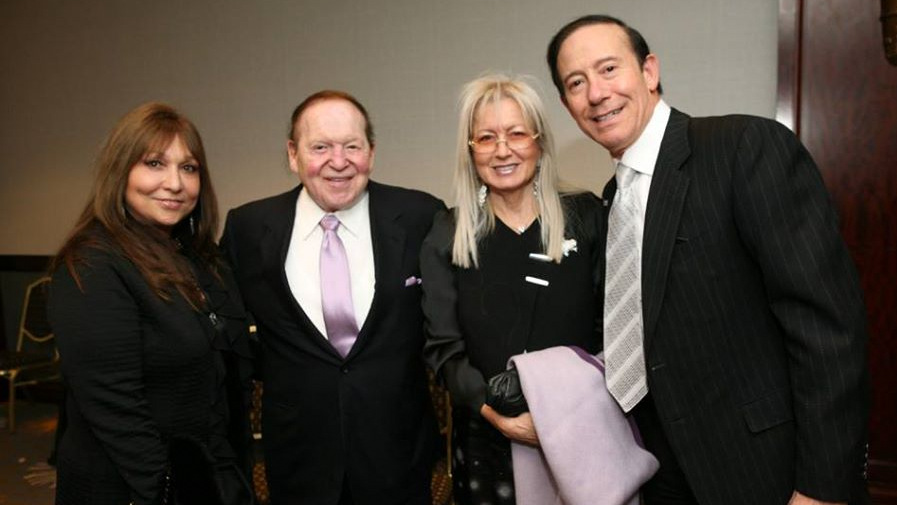
Pro-Israel philanthropist Adam Milstein (far right) with Sheldon and Miriam Adelson and Milstein’s wife, Gila. (photo: Adam Milstein / Facebook)
Al Jazeera’s investigative documentary into the US Israel lobby was censored by Qatar over “national security” fears.

By Asa Winstanley and Ali Abunimah | The Electronic Intifada | Aug 27, 2018

[Such activities] raise questions about whether the Israel on Campus Coalition and individuals associated with the work he describes are acting as agents of a foreign state without registering, as required by US law, with the counterintelligence division of the Department of Justice.

Israel lobby financier Adam Milstein has been identified as the funder of Canary Mission, the anonymous website that aims to tarnish the reputations of US supporters of Palestinian rights.

Milstein is named as the financier of Canary Mission by Eric Gallagher, a former employee of The Israel Project, in Al Jazeera’s censored investigative film, The Lobby – USA.

The Electronic Intifada is releasing segments it has obtained of the film: one shows Gallagher telling an undercover Al Jazeera reporter about Milstein’s role and the other shows Milstein talking about the need to “investigate” and “expose” critics of Israel, who Milstein believes are not only anti-Semites, but also “anti-Christian” and “anti-freedom” activists who “terrorize us.”

The film also reveals that Israel lobby operatives who rely on information provided by Canary Mission “coordinate” their activities with the Israeli government.

Continue reading “Al Jazeera names Adam Milstein as Canary Mission’s funder”

“We don’t shoot women”

Kristin Foss, after she was shot in the foot with a rubber covered bullet in occupied Kfar Qaddum, Aug 24, 2018. (photo: Mondoweiss)
Norwegian peace activist is shot twice in one week in Palestine.

By Jonathan Ofir | Mondoweiss | Aug 25, 2018

“When in Palestine, you get shot, it fuxking [sic] hurts, but you get up again . . . everyone has been shot at some point. . . . And 9 people got shot today. Including an 8 year old. And a man to his head. They are ok too. Hope they are also with friends!”
— Kristin Foss, Norwegian peace activist after being shot for the second time in a week

“We don’t shoot women,” a Lieutenant in the Israeli army said yesterday, when asked why they shot a Norwegian activist in Kafr Qaddum Saturday last week, shortly before shooting her again. Israeli activist Matan Cohen posted this exchange and occurrence yesterday on his Facebook with photos from the scene.

This time Kristin was not shot in the abdomen, but in the foot, by a rubber-coated steel bullet. I was alerted to Kristin’s injury by her Facebook update from the clinic:

“Went back to Kufur Quaddum to show that solidarity, is stronger than fear! Very nervous though, so kept right at the back, up against the wall. Thought I was safe-ish. But they shot me again!! The protest has been on for 2 minutes. Israeli activists at the front talking to the soldiers earlier . . . so yeah . . . I just go shot twice in a week.”

Continue reading ““We don’t shoot women””

BDS targets may differ, but the goal is the same

A protester holds a sign promoting BDS on Jun 9, 2018 in Berlin. (photo: AFP)
In the global quest to attain justice for Palestinians, we must coordinate and celebrate each other’s success, from Beirut to the US.

By Nada Elia | Middle East Eye | Aug 26, 2018

As a movement that exposes, challenges and organizes to dismantle racism, BDS can take many forms, so long as these steer clear of racism itself. . . . In the US, anti-Zionist Israelis play a critical role in the struggle against state-sanctioned disenfranchisement of Palestinians. This flexibility allows us to optimize our organizing, guided by a vision of justice and unshackled by rigid criteria that do not work in all contexts.

With Israel officially enshrining apartheid with its newly passed nation-state law, the Boycott, Divestment and Sanctions (BDS) movement was boosted once again as the most viable grassroots strategy to end Israel’s violation of international law. As Professor Richard Falk put it, “If BDS continues to gain momentum around the world, and especially in the West, it will strengthen the will of governments to do the right thing, and gain sufficient momentum to shake the foundations of the Zionist insistence on a Jewish state in what is still essentially a non-Jewish society.”

Meanwhile, there is renewed discussion in the West around whether it is still relevant to boycott only products from the settlements or all Israeli products. After all, the new law affirms that “the state views the development of Jewish settlement as a national value and will act to encourage and promote its establishment and consolidation.”

Continue reading “BDS targets may differ, but the goal is the same”