Israel denies 2,000 Palestinians entry based on their family names

An Israeli border police officer pushes away Palestinian protesters outside the Damascus Gate in Old City of Jerusalem, Dec 7, 2017. (photo: Ariel Schalit / AP)
Since 2016, thousands of Palestinian workers from the West Bank have had their entry denied overnight, rendering them jobless.

By Middle East Monitor | Sep 27, 2018

‘It could be hundreds or thousands of people for that matter [who have the same family name]. It is as if cancelling the entry permit for someone called Cohen, when someone else called Cohen did something wrong.’
— Yoav Gal Tamir of the Advice Centre, which represents Palestinian workers

Over the past two years, more than 2,000 people have been impacted by a decision to revoke entry permits to Israel from Palestinians who share a name with someone who has carried out a resistance attack, a report by Hebrew channel Social TV has revealed.

Since 2016, thousands of Palestinian workers from the West Bank, many of whom have worked in Israel for over 20 years, have had their entry denied overnight, rendering them jobless.

When the reason for the refusal is requested, Israeli authorities state that it is due to a shared family name with a suspected resistance attacker, even if no actual familial connection exists between the two parties. The move has impacted hundreds of people with common Palestinian names.

Continue reading “Israel denies 2,000 Palestinians entry based on their family names”

GOP candidate accuses Palestinian-American opponent of hiding “ties to terrorism”

https://youtu.be/Ou3mUSQuvrY

US Representative Duncan Hunter is currently under federal indictment for campaign finance violations, including using campaign funds to pay his children’s private school tuition.

By Bill Tarrant | Forward & Reuters | Sep 30, 2018

“I think he’s trying to tap into dark emotions and I don’t think people will rise to that,”
— Ammar Campa-Najjar, candidate for the House of Representatives

When a Democrat with Palestinian-Mexican ancestry who had never before run for office was elected to challenge a Republican incumbent in a staunchly conservative southern California congressional district, few gave him much of a chance.

But five-term US Representative Duncan Hunter, who has been criminally charged with misusing campaign funds, is concerned enough about Ammar Campa-Najjar to issue a YouTube ad accusing his Democratic rival of trying “to hide his family’s ties to terrorism.” It was a reference to his Palestinian grandfather, who was involved in a 1972 plot to kill Israeli athletes at the Olympics and was killed the following year by Israeli commandos.

The ad, released on Wednesday, shows Hunter, a former US Marine who followed his father into Congress, dressed in camouflage and saying he approved the message.

Continue reading “GOP candidate accuses Palestinian-American opponent of hiding “ties to terrorism””

Israel denies entry to American student even though she had a visa

Passengers departing from Ben Gurion Airport, Tel Aviv. (photo: Ofer Vaknin / Haaretz)
The Population, Immigration and Border Authority said entry was denied “because of boycott activity.”

By Noa Landau | Haaretz | OCt 3, 2018

[The student] was showed an photo of herself taken from the right-wing website Canary Mission, which claims to track and document ‘people and groups that promote hatred of the USA, Israel and Jews on North American college campuses.’

Israel prevented on Tuesday the entry of Lara Alqasem, a 22-year-old American student whose grandparents are Palestinian, despite her having recently been granted an A/2 Student Visa for her masters’ degree in the Hebrew University.

Alqasem’s visa was granted by the Israeli consulate in Miami, and is valid for a year. However, when she landed in Ben-Gurion International Airport Tuesday night, she was refused entry into Israel.

The Population, Immigration and Border Authority said entry was denied “because of boycott activity,” adding she would remain at the airport until her appeal against the deportation is heard, scheduled for 2 pm.

Continue reading “Israel denies entry to American student even though she had a visa”

Religious freedom for me, but not for thee

Vice President Pence at the 2018 Values Voter Summit in Washington, DC,  Sep 22. (photo: Susan Walsh / AP)
Today we see the evangelization of the administration’s policy goals, accompanied by the demonization of its critics. This is not what religious liberty meant to the nation’s founders, nor should it be what it means today.

By Katherine Franke | The Washington Post | Sep 28, 2018

The administration is not defending a neutral constitutional principle — religious liberty — for all people, but rather only for those who share the administration’s political perspective. In fact, this government has weaponized the notion of religious liberty, not for its own sake, but rather to advance a blatantly partisan, conservative agenda.

The Catholic sisters in the order of the Adorers of the Blood of Christ announced this month that they plan to petition the Supreme Court to consider whether their religious-freedom rights are being violated by the construction and pending use of a natural-gas pipeline on their land in Pennsylvania. They argue their faith commits them to “believe that God calls humans to treasure land as a gift of beauty and sustenance that should not be used in an excessive or harmful way.” Lawyers representing the federal government have vigorously opposed the nuns’ right to assert a religious-liberty claim in federal court.

The government’s position in the Adorers case is surprising, given that Vice President Pence announced in July that “religious freedom is a top priority of this administration.” Attorney General Jeff Sessions echoed those remarks a few days later: Under “this administration, the federal government is not just reacting — we are actively seeking, carefully, thoughtfully and lawfully, to accommodate people of faith. Religious Americans are no longer an afterthought.”

Continue reading “Religious freedom for me, but not for thee”

According to Sheldon Adelson’s newspaper, BDS has nothing to do with the occupation

Graffiti on the Israeli separation wall dividing the West Bank town of Bethlehem promotes the BDS (boycott, divestment, sanctions) Movement. (photo: Ryan Rodrick Beiler / Activestills.org)
Israel Hayom, Israel’s most-read newspaper, deletes crucial explanations from an Associated Press article, leaving its readers with zero understanding of why Palestinians might want the world to boycott Israel.

By Michael Schaeffer Omer-Man| +972 Magazine | Sep 17, 2018

The campaign, founded in 2005, calls for boycotts, divestment and sanctions against Israeli businesses, cultural institutions and universities. BDS says it seeks to end Israel’s occupation of lands captured in the 1967 Mideast war and what it describes as discrimination against Israel’s Arab minority. It calls for the ‘right of return’ for millions of Palestinian refugees and their descendants to homes their ancestors fled or were expelled from in the 1948 war over Israel’s creation.

The Associated Press published a feature article last week discussing the impact that the Boycott, Divestment, and Sanctions Movement has had on the Israeli music scene as of late.

Spurred by a few high-profile cancellations at a recent music festival in Israel, most notably by singer Lana Del Rey, the article did what one would reasonably expect an international wire service covering such a story to do: it explained the phenomenon, gave some subjective views and objective facts, and, of course, explained what the BDS Movement is and what its demands are.

The article was reproduced and published by a typically large number of international news outlets, including the New York Times. One of those publications, however, the English edition of Israel’s most-read newspaper, Israel Hayom, made an interesting change to the AP article in the version it put online for its readers.

Continue reading “According to Sheldon Adelson’s newspaper, BDS has nothing to do with the occupation”

What Trump gets right about cutting funding to Palestinian kids

Israeli children from Kibbutz Harel play football with Palestinian children in the Umm al-Kheir village, near the West Bank city of Hebron, in 2011. (photo: Hazem Bader / AFP / Getty Images)
As long as the Israeli military controls every aspect of Palestinian life, no soft-power program is going to make a dent in the deep anger that comes as a result.

By Daoud Kuttab | The Washington Post | Sep 19, 2018

You can do a lot to change the perception of Israelis who have only imaginary ideas of Palestinians. But for Palestinians who see soldiers and checkpoints and witness their parents being humiliated, no coexistence program for children could ever erase such tough images.

Of all the punitive and one-sided decisions that President Trump has taken against Palestinians this year, the latest one defunding cooperation programs between Palestinians and Israelis is one that I can support.

Following the cut of nearly $300 million in support to a UN agency providing humanitarian aid to Palestinian refugees and $25 million to East Jerusalem hospitals, Washington announced the end of a program bringing Israeli and Palestinian children together.

The White House cut $10 million worth of funding to a so-called coexistence program that includes joint Palestinian and Israeli soccer games, farming efforts and other reconciliation projects. The Trump administration did the right thing. It makes little sense to pretend that things are normal in Palestine and Israel. It is illogical to fund a program that brings Israeli and Palestinian children to play soccer as if there is no occupation, no walls, no exclusive settlements for Jews or no siege on Gaza.

Continue reading “What Trump gets right about cutting funding to Palestinian kids”

How peace keeps receding in the Middle East

A demonstrator holding a Palestinian flag gestures in front of Israeli forces during a protest in the West Bank on Sep 16. (photo: Mohamad Torokman / Reuters)
The “peace process,” as we knew it, is dead. To speak of Palestinian rights these days is to draw scorn, or just a big yawn. The Palestinians are yesterday’s problem.

By David Ignatius | The Washington Post | Sep 18, 2018

The peace I worked on for 35 years will not be achieved in our lifetimes. But it will happen eventually, because there is no other way.
— Martin Indyk, former US ambassador to Israel

This month commemorates two pinnacles for the benign, naive superpower that was America, both involving our now-lost role as Middle East peacemaker. Forty years ago, President Jimmy Carter brokered the Camp David Accords between Israel and Egypt; and 25 years ago, President Bill Clinton presided over the signing of the Oslo Accord between Israel and the Palestinians.

As we looked this week at the old photographs of beaming U.S. presidents grandly mediating between adversaries, what was happening in today’s Middle East? Russian President Vladimir Putin was cutting a deal with Turkish President Recep Tayyip Erdogan to avert a catastrophe in Syria and carve up that country in a peace of the tyrants.

Russia as a Middle East bullyboy has been a nuisance for the United States. Russia as the hegemonic regional power that brokers peace deals may be a more serious problem.

Continue reading “How peace keeps receding in the Middle East”

The US sends an unwelcoming signal to refugees

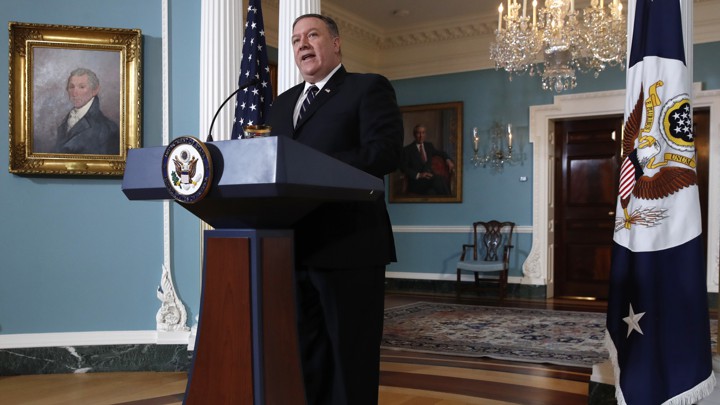
Secretary of State Mike Pompeo. (photo: Jacquelyn Martin / AP)
By dramatically reducing the admission cap for the upcoming fiscal year, the administration seems to be abandoning the country’s long-standing commitment to helping those fleeing war and persecution.

By Priscilla Alavarez | The Atlantic | Sep 18, 2018

This repeated reduction in the number of refugees allowed into the US is incredibly troubling. Not only is it a continuation of a series of unprecedented attacks on our American values and on the humanitarian nature of the refugee resettlement program, but it falls far short of helping the large number [of] vulnerable people around the world.
— World Relief CEO Tim Breene

More than 25 million refugees around the world have had to flee their origin country due to war, famine, or persecution. Many will spend years in refugee camps, while others — those who can never return home — are placed elsewhere. For millions of refugees, their ultimate destination has been the United States, which has historically been committed to the resettlement of the world’s most vulnerable people. But not anymore.

Secretary of State Mike Pompeo announced on Monday that the country will admit, at most, 30,000 refugees in fiscal year 2019, down from 45,000 this year. It will be the lowest refugee cap since the passage of the Refugee Act of 1980. “The improved refugee policy of this administration serves the national interest of the United States, and helps those in need all around the world,” Pompeo said in a statement.

The figure is a significant setback for the United States: By sharply reducing admissions, the country is not only diverging from long-standing policy on refugees, but also relinquishing its leadership role in resettlement. Just within the past few years, the country well outpaced others in admitting thousands of refugees. The Obama administration set the refugee cap for fiscal year 2015 at 70,000; by 2016, the number was 85,000. And those numbers didn’t just represent lofty estimations: The Obama administration came close to achieving both caps, admitting 69,000 people in 2015 and nearly 85,000 in 2016.

Continue reading “The US sends an unwelcoming signal to refugees”

US cuts funding for children’s soccer games between Israel and Palestine

Palestinian girls play soccer in Ramallah. (photo: Abbas Momani / AFP / Getty Images)
The United States is cutting the last of its funding to Palestine, in support of cross-border programs between Israelis and Palestinians.

By Edward Wong | The New York Times | Sep 14, 2018

The decision to cut off funding for the West Bank and Gaza [is] a sign that this White House has failed at diplomacy. This is not a partisan view. It’s the view of those who recognize that you don’t advance the cause of peace by cutting off programs that are designed to promote tolerance, understanding and address shared problems.
— Tim Rieser, foreign policy aide to Sen. Patrick Leahy, (Dem. VT)

As part of its policy to end all aid for Palestinian civilians, the United States is blocking millions of dollars to programs that build relationships between Israelis and Palestinians, according to current and former American officials briefed on the change.

The move to prevent Palestinians — including, in many cases, children — from benefiting from the funds squeezes shut the last remaining channel of American aid to Palestinian civilians.

The money had already been budgeted by Congress for allocation in fiscal year 2017, which ends this month. In the past, these designated funds went mostly to programs that organized people-to-people exchanges between Palestinians and Israelis, often for youth. Some went to programs for Israeli Jews and Arabs.

Continue reading “US cuts funding for children’s soccer games between Israel and Palestine”