Our outpouring of compassion will vanquish moral bankruptcy

Detainees sleep and watch television in a holding cell where hundreds of mostly Central American immigrant children are being processed and held at the U.S. Customs and Border Protection Nogales Placement Center in Nogales, AZ. (photo: Ross Franklin / AP Photo)

So many of us are deeply wounded by Trump’s immigration policies and what they reflect about our less welcoming, more calloused new national norm.

By Daniel Weiner | The Seattle Times | Jun 20, 2018


To deliberately subvert divinely inspired ideas to absolve the inhumanity of imprisoning children, or to glean political advantage to enact even more draconian measures against the most vulnerable, crosses some kind of unseen line . . . .


Many have marveled at the citing of sacred texts to support even the most heinous of thoughts and acts. Others still have struggled to understand the mind and heart that could do such damage to holy writ. And people of faith take unique exception to the mangling of words that bind them to God.

And so, when Attorney General Jeff Sessions doubled down on rooting an immigration policy of family separation in the holy justification of biblical texts, faith communities across the ideological spectrum united in opposition to a perversion that defied even our most jaded expectations for this administration’s chutzpah.

The outrage goes beyond the gall of employing a text as cover for a policy that embodies the very inverse of its meaning, or omitting the myriad expressions of compassion and welcome that represent the fullness of the Bible.

Continue reading “Our outpouring of compassion will vanquish moral bankruptcy”

Vigil: Prayer and Procession for Families at the Border (Tonight)

(photo: inmediahk.net)

Please join our brothers and sisters for a prayerful vigil and procession from St. Mark’s Episcopal Cathedral to St. James Roman Catholic Cathedral, beginning tonight at 7:00 pm.

Date: Thursday, Jun 21, 2018
Time: 7:00 – 9:00 pm
Location: St. Mark’s Episcopal Cathedral
1245 10th Ave East
Seattle
Information: Event information here →
Event Details

As people of faith, we stand in solidarity with all the migrants and asylum-seekers who come to our borders, fleeing violence or simply seeking a better life for their families. We protest the inhumane separation of children from their parents. We urge our government to allow victims of domestic violence and gang violence to seek asylum in this country. This will be an opportunity to gather together for prayer, and to bring our prayerful witness to the streets of our city.

More information here →

US quits UN Human Rights Council

US Ambassador to the United Nations Nikki Haley, with Secretary of State Mike Pompeo, speaking at the Department of State in Washington, DC, on Tuesday.
(photo: Andrew Caballero-Reynolds / AFP / Getty Images)

Nikki Haley says council is “protector of human rights abusers” that targets Israel in particular and ignores atrocities elsewhere.

By Julian Borger | The Guardian | Jun 19, 2018


“The UN human rights council has played an important role in such countries as North Korea, Syria, Myanmar and South Sudan, but all Trump seems to care about is defending Israel.”
— Kenneth Roth, executive director of Human Rights Watch


The US is withdrawing from the United Nations human rights council, the Trump administration announced on Tuesday, calling it a “cesspool of political bias” that targets Israel in particular while ignoring atrocities in other countries.

The US ambassador to the UN, Nikki Haley, said she had traveled to the council’s headquarters in Geneva a year ago to call for reforms, to no avail.

“Regrettably it is now clear that our call for reform was not heeded,” Haley told reporters at the state department. “Human rights abusers continue to serve on, and be elected to, the council.”

Continue reading “US quits UN Human Rights Council”

Human rights in Israel

Rabbi Sharon Kleinbaum and others protesting in support of “Dreamer” immigrants, Washington, DC, Jan 2018. (photo: Ralph Alswang / Religious Action Center of Reform Judaism)

The last of the tzaddiks (righteous ones).

By David Shulman | The New York Review of Books | Jun 28, 2018


A Palestinian brought before such a military court, for example in the notorious Ofer Prison north of Jerusalem, has no hope of achieving even the slightest semblance of justice. Conviction rates of Palestinians in these courts are higher than 99 percent. Proceedings take place in Hebrew, which Palestinian defendants often don’t understand, and security specialists routinely give secret testimony to which defendants and their counsel have no access.


In the somewhat exotic Jewish home in Iowa where I grew up, it was axiomatic that there was an intimate link between Judaism and universal human rights. Like nearly all Eastern European Jewish families in America, my parents and grandparents were Roosevelt Democrats, to the point of fanaticism.

They thought that the Jews had invented the very idea, and also the practice, of social justice; that having started our history as slaves in Egypt, we were always on the side of the underdog and the oppressed; that the core of Judaism as a religious culture was precisely this commitment to human rights, and that all the rest — the 613 commandments, the rituals, the theological assertions — was no more than a superstructure built upon a strong ethical foundation.

For me, this comfortable illusion was shattered only when I moved to Israel at the age of eighteen. . . .

Continue reading “Human rights in Israel”

Donald Trump’s new world order

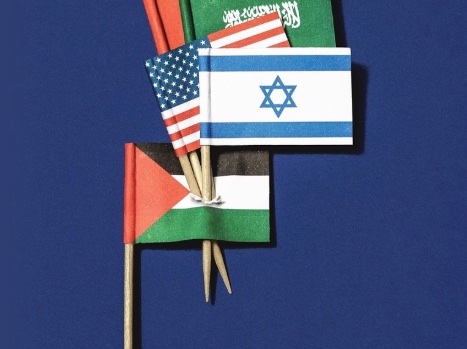
flags
(illustration: Javier Jaén / The New Yorker)

How the President, Israel, and the Gulf states plan to fight Iran — and leave the Palestinians behind.

By Adam Entous | The New Yorker | Jun 18, 2018


In response to the violence in Gaza, the Gulf states issued ritual denunciations and support for the Palestinians, but Israeli officials regarded the language as unmistakably bland, similar to their reactions to the Jerusalem decision. That their emphasis had shifted away from the Palestinians and to the specter of a confrontation with Iran was obvious.


On the afternoon of December 14, 2016, Ron Dermer, Israel’s Ambassador to the United States, rode from his Embassy to the White House to attend a Hanukkah party. The Obama Administration was in its final days, and among the guests were some of the President’s most ardent Jewish supporters, who were there to bid him farewell. But Dermer, like Prime Minister Benjamin Netanyahu, did not share their sense of loss. For the Israeli leadership, the Trump Presidency could not come soon enough.

Netanyahu believed that Barack Obama had “no special feeling” for the Jewish state, as one of his aides once put it, and he resented Obama’s argument that Israel’s treatment of the Palestinians was a violation of basic human rights and an obstacle to security, not least for Israel itself. He also believed that Obama’s attempt to foster a kind of balance of power between Saudi Arabia and Iran in the Middle East was naïve, and that it underestimated the depth of Iran’s malign intentions throughout the region.

Continue reading “Donald Trump’s new world order”

Enough already — not all criticism of Israel is anti-Semitism

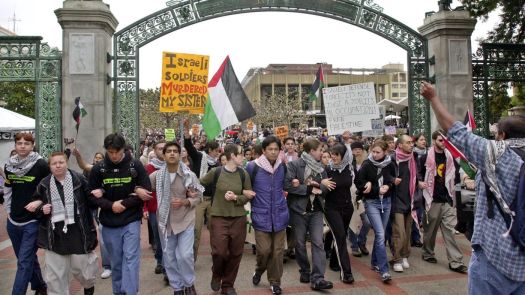
UCberkeley
Pro-Palestinian demonstrators march through Sather Gate on the University of California, Berkeley campus. (photo: Paul Sakuma / Associated Press)

The Anti-Semitism Awareness Act of 2018 should be shelved.

By The Times Editorial Board | Los Angeles Times | Jun 8, 2018


Is it necessarily anti-Semitic to harshly criticize the Jewish state or to do so without, in the same breath, criticizing Saudi repression?


Freedom of speech on college campuses is under enough pressure without the federal government adding to the problem by threatening to withdraw funding to punish people for expressing their political opinions. That would be a real possibility if Congress enacted and President Trump signed a bill called the Anti-Semitism Awareness Act of 2018.

The legislation, which has recently been reintroduced in both chambers, purports to target harassment of Jewish students on college campuses, which has occurred in California and elsewhere.

But this proposal would blur the distinction between unacceptable, intimidating expressions of intolerance directed against Jews with criticism of the state of Israel. The latter, even when expressed in intemperate terms, is protected by the 1st Amendment. . . .

Continue reading “Enough already — not all criticism of Israel is anti-Semitism”

Arab-Israeli couple strip-searched in Greek airport by Israeli security guards

Israeli journalist Sahar Issawi in Jerusalem, May 10, 2018. (photo: Emil Salman / Haaretz)

The couple, a lawyer and a journalist, both Israeli citizens of Arab descent, were asked to present their marriage license before being searched.

By Jack Khoury | Haaretz | Jun 11, 2018


“There were no security considerations here, it was all built on profiling. If you’re an Arab, you’re a suspect.”
— Arab-Israeli journalist, Sahar Issawi


An Arab Israeli couple was asked to present their marriage license before boarding a plane to Israel from Greece on Sunday. The couple also claimed they were subjected to a degrading security check.

Sahar Issawi and her husband, Firas Asali, who were asked for their marriage license by Israeli security personnel before they could board an Israir flight to Israel from Crete.

Issawi, a journalist, and Asali, a lawyer, both Israeli citizens, came to Heraklion Airport in Crete on May 10 for their flight back to Israel.

“When we got to the check-in counter we were greeted by an Israeli security guard, who then called a female security guard to take me so we could be questioned separately,” says Issawi.

Continue reading “Arab-Israeli couple strip-searched in Greek airport by Israeli security guards”

Palestine is not occupied — it is colonized

Israeli troops screened captured Egyptian troops and Palestinians at the start of the war on Jun 5, 1967, in Rafah in the Gaza Strip. (photo: David Rubinger / Israeli Governement / Getty Images)

Israel’s colonization began when the 19th-Century Zionist movement aspired to build an exclusive homeland for Jews in Palestine.

By Ramzy Baroud | Palestine Chronicle | Jun 6, 2018


The Palestinian Occupied Territories have, long ago, crossed the line from being occupied to being colonized. But there are reasons that we are trapped in old definitions, leading amongst them is American political hegemony over the legal and political discourses pertaining to Palestine.


June 5, 2018, marks the 51st anniversary of the Israeli occupation of East Jerusalem, the West Bank and Gaza.

But, unlike the massive popular mobilization that preceded the anniversary of the Nakba — the catastrophic destruction of Palestine in 1948 — on 15 May, the anniversary of the occupation is hardly generating equal mobilization.

The unsurprising death of the “peace process” and the inevitable demise of the “two-state solution” has shifted the focus from ending the occupation per se to the larger, and more encompassing, problem of Israel’s colonialism throughout Palestine.

Grassroots mobilization in Gaza and the West Bank, and among Palestinian Bedouin communities in the Naqab Desert, are, once more, widening the Palestinian people’s sense of national aspirations. Thanks to the limited vision of the Palestinian leadership those aspirations have, for decades, been confined to Gaza and the West Bank.

In some sense, the “Israeli occupation” is no longer an occupation as per international standards and definitions. It is merely a phase of the Zionist colonization of historic Palestine, a process that began over a 100 years ago, and carries on to this day. . . .

Continue reading “Palestine is not occupied — it is colonized”

Cal State East Bay student government unanimously passes BDS resolution

California State University East Bay. (photo: BDS Movement)

The Student Government of CSU East Bay endorsed a resolution calling for divestment from corporations complicit in the illegal military occupation of Palestine.

Press Release | SJP West | May 24, 2018


Under international law, Israel’s occupation of the Palestinian Territories, which include the West Bank, East Jerusalem, and the Gaza Strip, is illegal and inhumane. The occupation restricts the movement and freedom of Palestinians in these territories, and monitors and controls Palestinian lives and livelihoods as well as removing them from the lands they live on through the use of the separation barrier, checkpoints, and Jewish-only settlements in the West Bank which are also considered illegal under international law, as well as a military blockade surrounding the Gaza Strip.


Hawyard, May 23, 2018: Associated Students, Incorporated (ASI) Board of Directors of California State University, East Bay voted unanimously in favor of a resolution in support of divestment from corporations that profit from the occupation of Palestine.

The resolution, which was authored and introduced by a coalition of diverse student organizations and individuals at CSU East Bay, spearheaded by the Muslim Student Association, calls upon the university’s trustees to review their investments and divest from any companies found to be complicit in the violation of international law.

Some corporations were specifically mentioned, such as Caterpillar, Hewlett Packard, G4S, and Motorola Solutions, for being directly involved in allowing the Israeli government to maintain and enforce the occupation and construct Jewish-only settlements, walls and barriers, and checkpoints.

Continue reading “Cal State East Bay student government unanimously passes BDS resolution”

Eurovision organizers reluctant to hold 2019 event in Jerusalem

Netta Barzilai reacts as she wins the Eurovision Song Contest in Lisbon, May 12, 2018. (photo: Armando Franca / AP)

European officials fear that celebrations in the contested city could cause controversy.

By Chaim Levinson | Haaretz | Jun 7, 2018


Production of next year’s spectacle is in the hands of the Israeli public broadcaster, Kan, but the European Broadcasting Union has broad powers over details.


Officials at the European Broadcasting Union are uneasy about holding the Eurovision Song Contest in Jerusalem next year, say Israelis involved in the production.

Following a series of meetings last week, the European officials expressed concern that Mideast politics could harm the competition and erode the brand, the sources say.

The Eurovision will take place in Israel next year because an Israeli, Netta Barzilai, won the 2018 contest held in Portugal last month. No decision has been made on the location or date; preparations are at a very early stage, and controversy surrounding Jerusalem increased last month when the United States moved its embassy there.

Continue reading “Eurovision organizers reluctant to hold 2019 event in Jerusalem”