
Trump vs. international law

An interfaith resource for news and information about the Holy Land.
By Matthew Gindin | The Forward | Nov 29, 2017
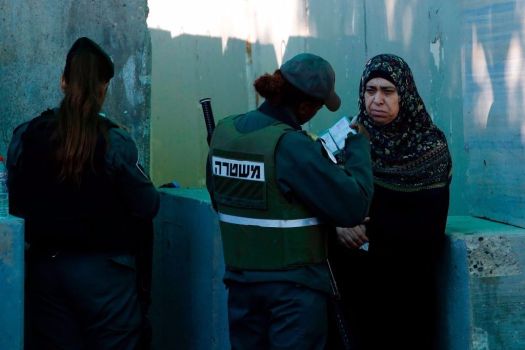
Harassment and inhumane conduct sometimes practiced by members of the IDF towards Palestinians has been well documented. It should horrify us, and we should make no excuses for it.
On November 27, the Forward published an opinion piece by Palestinian activist and journalist Mariam Barghouti, who asserted that one cannot be both a feminist and a Zionist. Despite the fact that the Forward’s opinion section published, on the same day, an essay promoting the point of view of “Zioness,” a feminist Zionist organization, The Forward’s opinion editor, Batya Ungar-Sargon, was besieged by hate mail from Jewish writers, including a threat to “rape and behead” her, as well as one calling her a “demented scumbag kapo.”
Although I am proud to write for an outlet that is committed to a pluralism of opinions and that publishes Palestinian voices, I don’t agree with Barghouti’s fundamental thesis. I do think one can be a feminist and Zionist, though of course, as many commentators pointed out, it depends on how you define Zionism and how you define feminism. In her essay, Barghouti makes feminism synonymous with general humanism. As she writes, “Fundamentally speaking, feminism cannot support racism, supremacy and oppressive domination in any form.”
Continue reading “You don’t have to be anti-Zionist to listen to Palestinian voices”
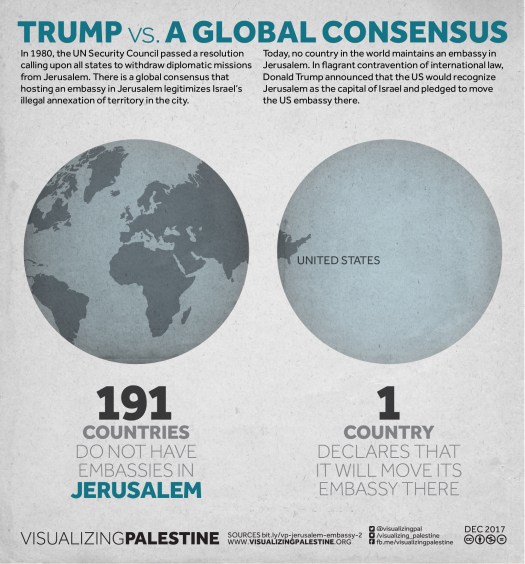

“Let’s make the balance not tip to the side of power, but of justice. . . . Our obligation as public officials to promote and guarantee respect for human rights, here, in our towns and cities, and in Palestine.”
This week, on the International Day of Solidarity with the Palestinian People, more than 350 elected officials across the Spanish state published an open-letter in support of Palestinian human rights. They denounced Israel’s institutionalized racism and discrimination as “apartheid” and expressed support for the Boycott, Divestment and Sanctions (BDS) movement as the only viable instrument for achieving a just and lasting peace for the Palestinian people.
These public officials include mayors, city councillors, members of congress, presidents of regional parliaments and members of the European Parliament.
By Alex Huntley | The Beaverton | Dec 6, 2017
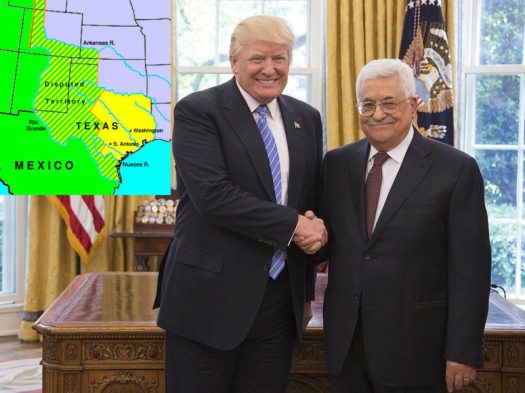
The Palestinian consulate in Mexico City will soon be moved to Houston to formally recognize the seized territory as part of Mexico.
In response to US President Donald Trump’s recognition of Jerusalem as the Israeli capital, the Palestinian National Authority has announced that it will recognize Texas as a state of Mexico since it was violently annexed by the United States in the 1840’s.
“The territory north and east of the Rio Grande is very important to the Mexican people,” explained a PNA spokesperson. “Before American settlers showed up and implemented slavery, Mexico oversaw this land. Then, President Polk sent his armies to invade the rest of these Mexican territories, and force the country to give up California, New Mexico, most of Arizona, Nevada, and Utah, and parts of Wyoming and Colorado. We may soon recognize these states as part of Mexico, too.”
Palestinian President Mahmoud Abbas says that this is a new approach to Mexican-US relations, and hopes it will help ease the tension between the two countries over security and immigration.
Continue reading “Palestinians recognize Texas as part of Mexico”

By Mark Lander, David Halbfinger and Isabel Kershner | The New York Times | Dec 7, 2017
“They’ve left us with no option [except a one-state solution],” he said. “This is the reality. We live here. Our struggle should focus on one thing: equal rights.”
— Saeb Erekat, the secretary general of the Palestine Liberation Organization
President Trump, in formally recognizing Jerusalem as the capital of Israel on Wednesday, declared that the United States still supported a two-state solution to settle the conflict between the Israelis and Palestinians, provided it was “agreed to by both sides.”
For the first time in his 26 years as a peacemaker, the chief negotiator for the Palestinians did not agree.
Saeb Erekat, the secretary general of the Palestine Liberation Organization and a steadfast advocate for a Palestinian state, said in an interview on Thursday that Mr. Trump and Prime Minister Benjamin Netanyahu of Israel “have managed to destroy that hope.” He embraced a radical shift in the P.L.O.’s goals — to a single state, but with Palestinians enjoying the same civil rights as Israelis, including the vote.

By Martin Chulov | The Guardian | Dec 7, 2017
“Previous American presidents never touched on the subject of Jerusalem because they knew it goes beyond the Israeli Palestinian conflict. It involves Muslims worldwide. Unfortunately Trump doesn’t have a historical or political background. If his intention is to solve the Palestinian conflict he chose the wrong door. Jerusalem is not a political symbol but will forever be a religious one.”
The Trump administration’s recognition of Jerusalem as Israel’s capital has drawn widespread condemnation across the Arab world, with political leaders, commentators and locals labelling the move as provocative and a threat to global security.
The decision has been cast as the final nail in the coffin of a two-state solution to the Israel/Palestine conflict – an approach broadly recognised by Arab states – and the end of meaningful US diplomacy between both sides after almost 70 years.
It has also allowed competing factions across the Middle East to refocus on a common cause that had drifted from the spotlight over the past five years, eclipsed by regional power plays, war and insurrection.
Continue reading ““Decades of chaos”: Arab leaders condemn US decision on Jerusalem”

By Peter Beaumont | The Guardian | Dec 7, 2017
Recognizing Jerusalem as Israel’s capital puts the US out of step with the rest of the world, and legitimizes Israeli settlement-building in the east — considered illegal under international law.
The UN security council is expected to meet on Friday to discuss Donald Trump’s recognition of Jerusalem as Israel’s capital, a decision against which condemnation continues to mount across the Middle East and internationally.
Eight countries on the 15-member council requested the meeting, including the UK, Italy and France, amid claims from Palestine and Turkey that Trump’s recognition is in breach of both international law and UN resolutions.
The EU foreign policy chief, Federica Mogherini, said the bloc had united position that Jerusalem must be the capital of both Israel and a future Palestinian state. The Russian foreign ministry said US recognition risked “dangerous and uncontrollable consequences.”
Continue reading “UN Security Council to discuss US recognition of Jerusalem”
By David Green | Haaretz | Dec 7, 2017
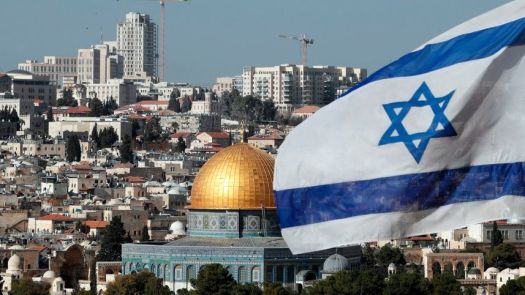
As long as the sides cannot decide on a mutually agreeable plan for sharing sovereignty in Jerusalem, . . . [and as long as] the world community [has not] concluded that it must impose a solution on the sides — it would be highly improbable for any individual state to unilaterally give official recognition to Jerusalem as its capital.
Any individual state, that is, not led by Donald J. Trump.
Jerusalem is holy to three religions. Jerusalem is a powder keg, and the smallest wrong move there could set off a religious war. The Arab-Israeli conflict will never be solved until the Jerusalem question is resolved.
Yes, these are all truisms, and you’ve heard them a thousand times or more. But there’s a reason why the root of the word “truism” is “true.” For Jews, Jerusalem is where their Temple — the home of their one god — stood, in its various incarnations. Each time they were exiled from their cultic and political capital in ancient times, they dreamed of returning, and the term “Zion,” the name of one of the city’s hills, became a metonymy not only for the city itself, but for the Land of Israel in general, and the basis of the name of the modern movement calling for establishment of a Jewish state there.
So, why don’t the nearly 160 countries that have diplomatic relations with the State of Israel recognize Jerusalem as its capital, and why is the possibility that the United States may do just that now, nearly seven decades after Israel’s establishment, a source of such apprehension worldwide?
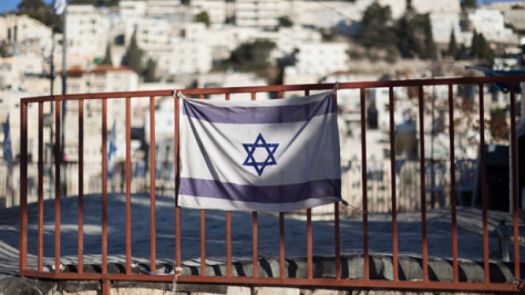
By Moshe Arens | Haaretz | Dec 3, 2017
Instead of fiddling with Jerusalem’s boundaries, the ministers and mayor should set in motion a plan to rehabilitate all East Jerusalem’s neighborhoods. That a Palestinian refugee camp, Shoafat, has existed for 50 years within Israel’s sovereign borders is inexcusable.
Ministers Zeev Elkin and Naftali Bennett are sponsoring legislation that would let the government change Jerusalem’s borders, making the Kafr Aqab and Shoafat refugee-camp neighborhoods that have been within the city’s boundaries for 50 years separate municipal entities.
Both ministers have impeccable records regarding their opposition to the division of Jerusalem, but still the legislation they’re trying to move through the Knesset at lightning speed constitutes a shrinking of the municipal boundaries of Israel’s capital by separating off certain neighborhoods. Like it or not, this is a division of Jerusalem. No wonder Mayor Nir Barkat objects.
 HolyLandJustice.org
You must be logged in to post a comment.