I’m part of the next generation of Jewish leaders, and for us, AIPAC has no cred

lara-haft
The author. (photo: Lara Haft)
To the rising Jewish leaders of the Trump era, supporting AIPAC is a stone’s throw away from touting the NRA.

By Lara Haft | Mondoweiss | Mar 27, 2019

Many future cantors, rabbis, and Jewish educators actively support Palestinian civil resistance, from planting olive trees in lands threatened by settlers to spending the night alongside Palestinian and Israeli activists to prevent the demolition of Khan al Ahmar. We’re part of a growing trend of faith leaders from around the world, led by Palestinian theologians like Rev. Dr. Naim Ateek and Rev. Dr. Mitri Raheb, who believe that tearing down walls and prisons — fighting for true equality between Palestinians and Israelis — is one of the ways we honor God’s call to love our neighbors as ourselves.

This week, lobbyists, politicians, academics, and all the glitterati of the Israel lobby are gathering for the annual AIPAC conference in Washington, DC. Under the Trump administration, AIPAC has maintained a strong relationship with Republican members of congress, far right-wing Israeli politicians, and Christian Zionist groups. But the organization is facing a serious challenge: It increasingly has no cred with young Jews.

As AIPAC continues to embrace far-right politicians and lobby for militarism against Palestinians, more and more Jewish people are turning instead to political movements based on equality, dignity, and justice. . . .

Continue reading “I’m part of the next generation of Jewish leaders, and for us, AIPAC has no cred”

Film: This is Home — A Refugee Story (Friday)

Please join our brothers and sisters at the Mideast Focus Ministry for their First Friday Film series.
Date: Friday, Apr 5, 2019
Time: 7:00 – 8:30 pm
Location: St. Mark’s Cathedral
Bloedel Hall
1245 10th Ave E
Seattle, WA 98102
Information: Event information here →
Tickets: Free Admission
Event Details

This is Home is an intimate portrait of four Syrian refugee families arriving in America and struggling to find their footing. Displaced from their homes and separated from loved ones, they are given eight months of assistance from the International Rescue Committee to become self-sufficient. As they learn to adapt to challenges, including the newly imposed travel ban, their strength and resilience are tested. It is a universal story, highlighted by humor and heartbreak, about what it’s like to start over, no matter the obstacles.

After surviving the traumas of war, the families arrive in Baltimore, Maryland and are met with a new set of trials. They attend cultural orientation classes and job training sessions where they must “learn America” — everything from how to take public transportation to negotiating new gender roles — all in an ever-changing and increasingly hostile political environment. Their goals are completely relatable: find a job, pay the bills, and make a better life for the next generation. Continue reading “Film: This is Home — A Refugee Story (Friday)”

Netanyahu isn’t the problem — the Israeli people are

 (photo: Gali Tibbon / Reuters)
The apartheid did not start with him and will not end with his departure.

By Gideon Levy | Haaretz | Mar 13, 2019

Simply put, the people are the problem. . . . There are those who have hated Arabs long before Netanyahu. There are those who despise blacks, detest foreigners, exploit the weak and look down their noses at the whole world — and not because of Netanyahu. . . . There are those who think that after the Holocaust, they are permitted to do anything. There are those who believe that . . . international law doesn’t apply to [Israel], and that no one can tell it what to do.

It’s not Prime Minister Benjamin Netanyahu, or at least not just him. One cannot blame one person, influential and powerful as he may be, for every evil, as his opponents and enemies do. The racism, extreme nationalism, divisiveness, incitement, hatred, anxiety and corruption is all because of Netanyahu, they say.

But it’s not so. His sins are innumerable and the damage he’s done immeasurable, and it would be great to have him out of our lives, but blaming everything on him is deceiving and a shirking of responsibility.

Continue reading “Netanyahu isn’t the problem — the Israeli people are”

Netanyahu’s AIPAC speech is a knife in the heart of the US-Israel alliance

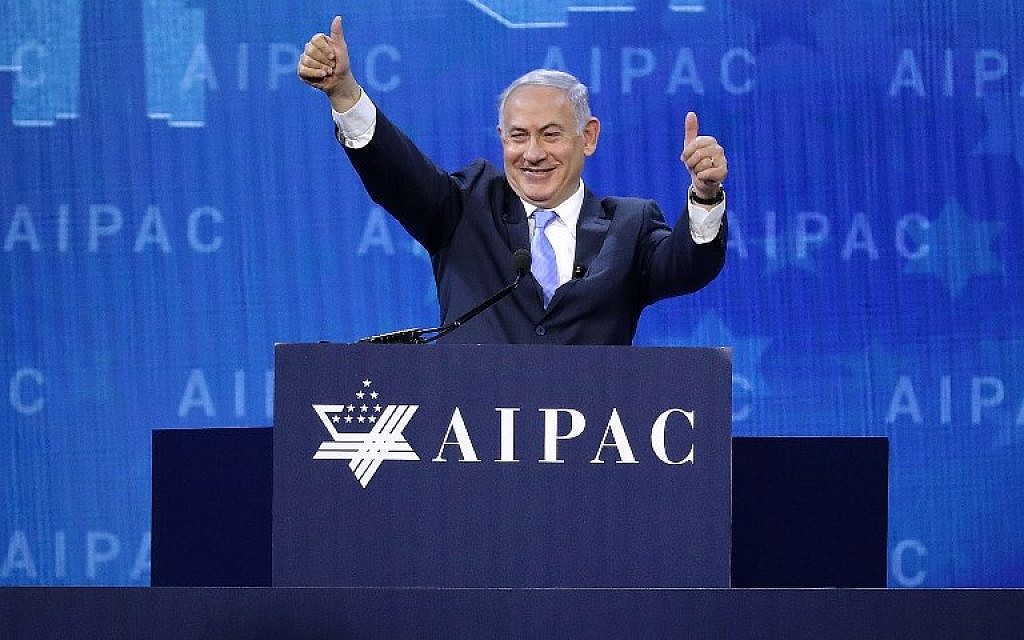
Prime Minister Benjamin Netanyahu addresses the American Israel Public Affairs Committee’s annual policy conference at the Washington Convention Center, Mar 6, 2018. (photo: Chip Somodevilla / Getty Images / AFP)
Cheering the dishonest and partisan jabs of Netanyahu and the Republicans destroys the American political consensus that has preserved the Jewish state for 70 years.

By Dana Milbank | The Washington Post | Mar 26, 2019

On Monday, Rep. Mo Brooks (R-Ala.) literally read from Adolf Hitler’s ‘Mein Kampf’ on the House floor and borrowed Hitler’s ‘big lie’ allegation against Jews to use on Democrats. ‘Unconscionable,’ said the Anti-Defamation League. But Republicans, and Netanyahu, said nothing.

The gods were toying with Benjamin Netanyahu and the American Israel Public Affairs Committee.

The Israeli prime minister canceled his Tuesday appearance at the pro-Israel lobbying group’s Washington conference because of violence in Israel, but he attempted a live video address.

“Mr. Prime Minister, can you hear us?”

“I can hear you. I always hear you,” Netanyahu replied.

Then, 11 seconds after the prime minister began, the satellite feed broke up and never completely recovered.

“I returned to deal with the [inaudible],” Netanyahu said.

But whoever or whatever disrupted the feed performed a mitzvah. . . .

Continue reading “Netanyahu’s AIPAC speech is a knife in the heart of the US-Israel alliance”

After Trump’s Golan Heights announcement, Israeli politicians now pushing for US recognition of the West Bank as “Israeli”

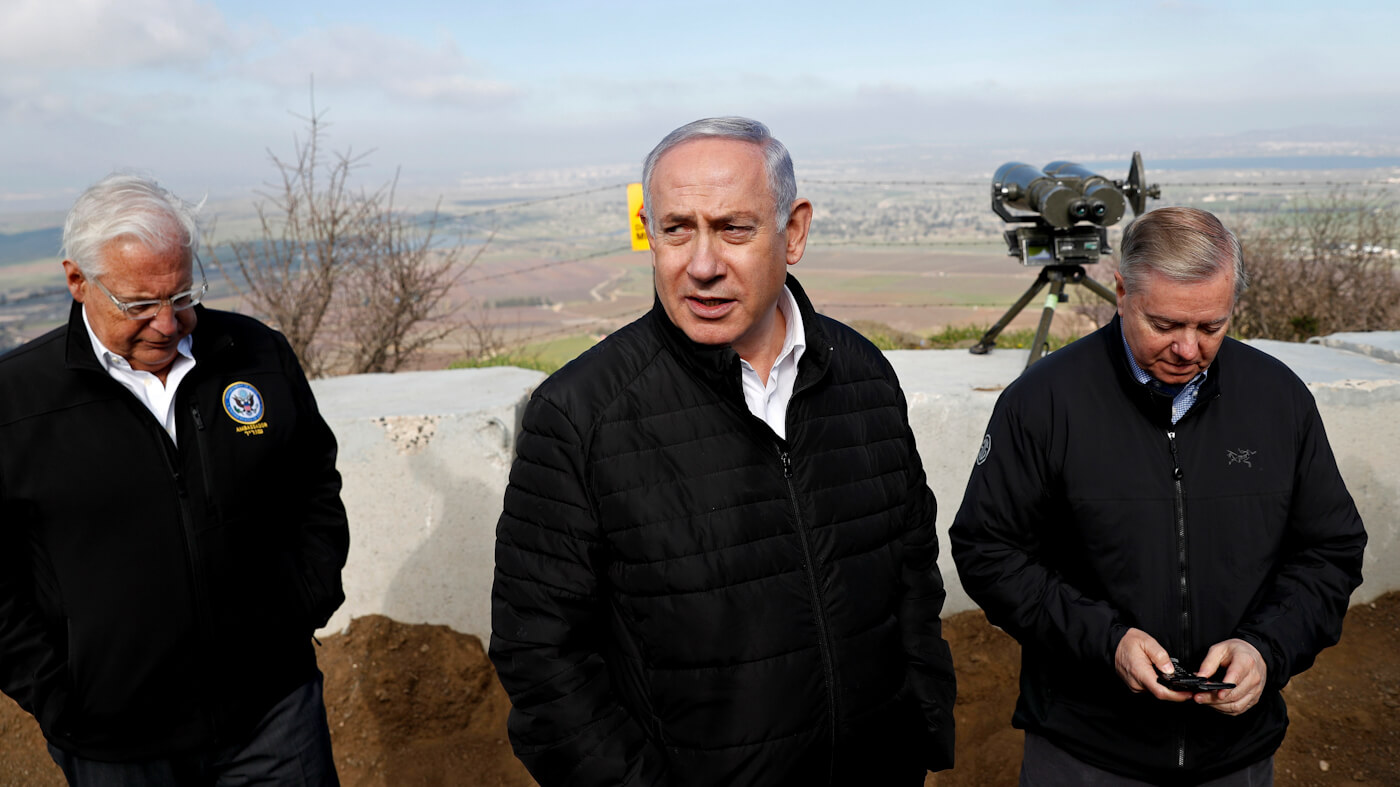
US Ambassador to Israel David Friedman, Israeli Prime Minister Benjamin Netanyahu and Republican Senator Lindsey Graham visit the Israeli-occupied Golan Heights, Mar 11, 2019. (photo: Ronen Zvulun / AP)
In 2016, longtime Trump advisor and current US Ambassador to Israel, David Friedman, said Trump would recognize Israel’s sovereignty over the entire West Bank if Israel “deemed it necessary.”

By Whitney Webb | Mint Press News | Mar 25, 2019

‘After years of creeping Israeli de facto annexation of the large swathes of the West Bank through settlement expansion, the creation of closed military zones and other measures, Israel appears to be getting closer to enacting legislation that will formally annex parts of the West Bank.’
— Michael Lynk, UN Special Rapporteur on Human Rights in the Occupied Palestinian Territories

After US President Donald Trump announced that he planned to unilaterally recognize Israeli sovereignty over the Golan Heights — which is internationally recognized as Syrian territory — some powerful Israeli politicians are now petitioning Trump to also recognize Israeli sovereignty over Palestine’s occupied West Bank.

Though Trump casually announced that it was “time for the United States to fully recognize Israel’s Sovereignty [sic] over the Golan Heights” last Thursday, he made the US’s recognition of Israel’s claim to the territory official on Monday, at a signing ceremony that was attended by Israeli Prime Minister Benjamin Netanyahu. Trump’s willingness to use his executive power to grant Israeli land grabs “official recognition” — such as in Jerusalem and now the Golan — has emboldened far-right Israeli politicians who have long been eager to annex other territories.

Continue reading “After Trump’s Golan Heights announcement, Israeli politicians now pushing for US recognition of the West Bank as “Israeli””

Brown University students vote to support BDS — the first among Ivy League schools

Brown University. (photo: State of Rhode Island)
Students at 31 US colleges have passed resolutions in support of BDS, although no school administration has taken action to divest.

By Aiden Pink | Forward | Mar 22, 2019

‘Today is a historic day for Brown as we take an emboldened and clear stand against the university’s complicity in human rights abuses in Palestine and in similar systems of oppression around the world.’
— Brown Divest, a student organization in support of BDS

Students at Brown University voted Thursday to call on the school to divest from companies that allegedly violate human rights through their work in Israel.

Some 69% voted for the measure in a campus referendum, with 31% opposed. Students were asked whether the university should “divest all stocks, funds, endowment and other monetary instruments from companies complicit in human rights abuses in Palestine.” Around 44% of the student body participated in the vote, which also included student government elections.

Continue reading “Brown University students vote to support BDS — the first among Ivy League schools”

Trump just made a huge mistake in the Middle East

Israeli tourists view the Syrian side of the border at Ben Tal next to the Israeli-Syrian border in the Golan Heights, Mar 22, 2019. (photo: Atef Safadi / EPA-EFE / REX)
Trump is opening a Pandora’s box where states are allowed to change international borders by force. He is making not just Netanyahu but also Vladimir Putin and Xi Jinping very happy.

By Max Boot | The Washington Post | Mar 22, 2019

No previous president promised to recognize Israeli sovereignty over the Golan Heights, and indeed President Ronald Reagan supported a 1981 UN Security Council resolution calling the annexation ‘null and void,’ because all previous presidents had adhered to the principle of territorial integrity.

President Trump’s announcement that “it is time for the United States to fully recognize Israel’s Sovereignty over the Golan Heights” — which stops just short of actually doing so — is being received as yet another example of, as the New York Times wrote, his “willingness to flout diplomatic orthodoxy and shake up a debate over the Middle East that has changed little since the 1970s.” That’s true, but it greatly understates the significance of his action. Trump is subverting one of the most fundamental pillars of the post-1945 world order: the principle that no nation can change international boundaries by force.

Territorial integrity was listed as both the first and second war aims agreed to by President Franklin D. Roosevelt and British Prime Minister Winston Churchill in the 1941 Atlantic Charter: “First, their countries seek no aggrandizement, territorial or other; second, they desire to see no territorial changes that do not accord with the freely expressed wishes of the peoples concerned.” It was then enshrined in Article 2 of the 1945 United Nations Charter: “All Members shall refrain in their international relations from the threat or use of force against the territorial integrity or political independence of any state.”
Continue reading “Trump just made a huge mistake in the Middle East”

Israel is on the brink of disaster — Trump just made things worse

Palestinian demonstrators from Birzeit University during clashes with Israeli forces in Ramallah, near the Jewish settlement of Beit El, in the occupied West Bank, Mar 20, 2019. (photo: Abbas Momani / Agence France-Presse / Getty Images)
Israeli voters may be about to rush headlong into quicksand that they don’t even realize exists.

By Michael Koplow | The New York Times | Mar 22, 2019

[Annexing the West Bank] would cost billions of dollars annually, would create virtually indefensible borders . . . provide ammunition to the anti-Israeli Boycott, Divestment and Sanctions movement, and destroy Israel’s foreign relations with a host of countries. . . .
Israel would then have to grant citizenship to the 2.5 million Palestinians living there, giving itself the choice of no longer functioning as a Jewish state, or destroy its democracy by denying the Palestinians political equality. If anything can truly threaten Israel, the region’s pre-eminent military and economic powerhouse, it is that.

On April 9, Israelis will go to the polls to choose their next government. The campaign has largely been a referendum on whether Prime Minister Benjamin Netanyahu should remain Israel’s leader in light of his expected indictment in three corruption cases for bribery and breach of trust. With those scandals front and center, policy disagreements have largely been ignored, leaving Israeli voters at risk of unwittingly bringing an avoidable disaster on themselves by annexing territory in the West Bank.

President Trump just raised that risk.

Continue reading “Israel is on the brink of disaster — Trump just made things worse”

Film: This is Home — A Refugee Story (Apr 5)

Please join our brothers and sisters at the Mideast Focus Ministry for their First Friday Film series.
Date: Friday, Apr 5, 2019
Time: 7:00 – 8:30 pm
Location: St. Mark’s Cathedral
Bloedel Hall
1245 10th Ave E
Seattle, WA 98102
Information: Event information here →
Tickets: Free Admission
Event Details

This is Home is an intimate portrait of four Syrian refugee families arriving in America and struggling to find their footing. Displaced from their homes and separated from loved ones, they are given eight months of assistance from the International Rescue Committee to become self-sufficient. As they learn to adapt to challenges, including the newly imposed travel ban, their strength and resilience are tested. It is a universal story, highlighted by humor and heartbreak, about what it’s like to start over, no matter the obstacles.

After surviving the traumas of war, the families arrive in Baltimore, Maryland and are met with a new set of trials. They attend cultural orientation classes and job training sessions where they must “learn America” — everything from how to take public transportation to negotiating new gender roles — all in an ever-changing and increasingly hostile political environment. Their goals are completely relatable: find a job, pay the bills, and make a better life for the next generation. Continue reading “Film: This is Home — A Refugee Story (Apr 5)”

Breaking down the Combating BDS Act of 2019 and challenges to state Anti-BDS laws

Sen. Marco Rubio. (photo: AFP)
In the absence of further movement in Congress, the next action on state anti-BDS laws will be in the circuit courts.

By Nathaniel Sobel | Lawfare | Mar 19, 2019

The Court agrees that the commercial actions (or non-actions) of one person . . . to show support for a political position, may not be deserving of First Amendment protections . . . . However, when a statute requires a company, in exchange for a government contract, to promise to refrain from engaging in certain actions that are taken in response to larger calls to action that the state opposes . . . such a regulation squarely raises First Amendment concerns.
— US District Judge Diane J. Humetewa, US District Court of Arizona

On Feb 5, the Senate passed a package of Middle East policy bills, including the Combating BDS Act of 2019. The act, which would affect laws on the books in 26 states that prevent state and local governments from doing business with entities that boycott Israel, has reignited debate over whether lawmakers’ efforts to stymie the boycott, divestment and sanctions (BDS) movement against Israel violate the First Amendment. This post examines the bill passed by the Senate and tracks ongoing litigation against state anti-BDS laws in federal courts.

On the first day of the 116th Congress, Sens. Marco Rubio, R-Fla., James Risch, R-Idaho, Cory Gardner, R-Colo., and Mitch McConnell, R-Ky., introduced S.1, the Strengthening America’s Security in the Middle East Act, a package of four Middle East policy bills that died in the last Congress. Three of the act’s four sections were relatively uncontroversial: One codified a 2016 agreement guaranteeing Israel $38 billion in security assistance over 10 years, another reauthorized defense cooperation with Jordan through 2020, and the third added sanctions on the Syrian regime and those that do business with it.

The fourth section, entitled the Combating BDS Act, was more controversial. According to a press release from Sen. Rubio, it would “empower state and local governments in the United States to counter the anti-Israel boycott, divestment and sanctions movement’s discriminatory economic warfare against the Jewish state.” Senate foreign relations committee Chairman Risch added that the bill “is vital to . . . end discrimination against Israel.”

Continue reading “Breaking down the Combating BDS Act of 2019 and challenges to state Anti-BDS laws”