Profiting from loss: how business in illegal Israeli settlements continues unchecked

A man pushes a shopping cart outside Shufersal, Israel’s largest supermarket chain, in the West Bank settlement of Mishor Adumim. (Ammar Awad/Reuters)
A man pushes a shopping cart outside Shufersal, Israel’s largest supermarket chain, in the West Bank settlement of Mishor Adumim. (photo: Ammar Awad / Reuters)
UN efforts to protect Palestinian land from economic exploitation are failing, and exposing the hypocrisy of western states.

By Jonathan Cook  | Information Clearing House | Feb 18, 2020

The UN has even taken an extremely narrow view of what constitutes involvement with the settlements.

After lengthy delays, the United Nations finally published a database last week of businesses that have been profiting from Israel’s illegal annexation and settlement activity in the West Bank.

The UN High Commissioner for Human Rights, Michelle Bachelet, announced that 112 major companies had been identified as operating in Israeli settlements in ways that violate human rights.

Aside from major Israeli banks, transport services, cafes, supermarkets, and energy, building and telecoms firms, prominent international businesses include Airbnb, booking.com, Motorola, Trip Advisor, JCB, Expedia and General Mills.

Human Rights Watch, a global watchdog, noted in response to the list’s publication that the settlements violate the Fourth Geneva Convention. It argued that the firms’ activities mean they have aided “in the commission of war crimes”.
Continue reading “Profiting from loss: how business in illegal Israeli settlements continues unchecked”

Where is the world for the Palestinians?

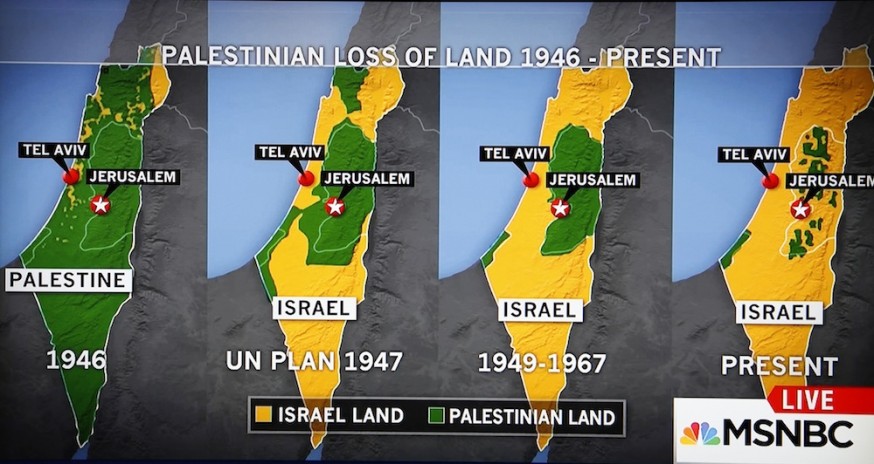
Fact Check: MSNBC’s Palestinian Loss of Land Map
MSNBC map showing loss of Palestinian land to Zionist settlers and then to Israel from 1946 to the present. (photo: screenshot MSNBC). Additional info about image
The Trump administration’s peace plan for Israel and Palestine embodies none of the ingredients of successful conflict resolution, including talking and listening, accommodation of core interests, and a compromise solution that the majority can support. It reads, not surprisingly, more like a real-estate transaction.

By Prince El Hassan Bin Talal  | Holy Land Christian Ecumenical Foundation | Feb 12, 2020

‘It’s very clear that the overarching goal is to eliminate the Palestinian refugees as an issue by defining them out of existence.’
— Lara Friedman, President of the Foundation for Middle East Peace

AMMAN – It should come as no surprise that the proposed US peace agreement between Israel and the Palestinians bears all the hallmarks of a real-estate transaction. This supposed “Deal of the Century” certainly embodies none of the ingredients of successful conflict resolution, including talking and listening, accommodation of core interests, and a compromise solution that the majority can support. And how could it when the most important partners in the conversation – the Palestinians – were notable only by their absence, having been forced from the room by impossible demands.

Shortly after Jared Kushner’s laudable comment in May 2018 that the pursuit of peace is “the noblest pursuit of humankind,” the journalist Robert Fisk asked the right question about Kushner’s plan: “After three Arab-Israeli wars, tens of thousands of Palestinian deaths, and millions of refugees, does Kushner really believe that the Palestinians will settle for cash?”

Continue reading “Where is the world for the Palestinians?”

Why did Palestinians reject Trump’s peace plan? Here are three reasons

President Trump speaks during an event with Israeli Prime Minister Benjamin Netanyahu in the East Room of the White House in Washington on Jan. 28. (Susan Walsh/AP)
President Trump speaks during an event with Israeli Prime Minister Benjamin Netanyahu in the White House, Jan 28. (photo: Susan Walsh / AP)
This situation has a name, regardless of whom one blames for it: apartheid.

By Ezzedine Fishere | The Washington Post | Feb 6, 2020

Condemning Trump’s plan and calling for resuscitating the two-state solution is no longer useful; that ‘solution’ has been dead for more than a decade. . . . Trump’s plan opened a gate for a powerful stream that will carry us toward the dreadful challenges of an apartheid state. The question before us now is what we all — Palestinians, Arabs, Israelis and the world — will do about that.

One didn’t need to read 25 books to predict that the Palestinians would reject President Trump’s Middle East “peace plan.” Palestinians have a reputation for rejecting offers, knowing quite well the next could be worse. They rejected the 1947 United Nations partition plan that gave them less than 45 percent of Mandatory Palestine, Ehud Barak’s “generous offer” at Camp David in 2000, and Ehud Olmert’s even “more generous” offer in 2008 after the Annapolis process. The world has grown weary of this perceived lack of pragmatism; many feel that, given their weak position, Palestinians should accept what they can get or “shut up,” as Saudi Crown Prince Mohammed bin Salman so eloquently put it in 2018.

Yet, without truly understanding the behavior and motivations of Palestinians, it is impossible to find a solution or even begin to manage the Arab-Israeli conflict.

The Palestinians have accepted other offers, such as the Security Council resolution 242 in 1967 and the Oslo Accords, which promised them a meager 22 percent of Palestine — at best. All the proposed solutions involved a loss, so why do they accept some plans and reject others? The answer lies in three things Palestinians care about most: a sense of fairness, the hope of living freely in a sovereign state of their own, and the facts on the ground.
Continue reading “Why did Palestinians reject Trump’s peace plan? Here are three reasons”

Informational Meeting: Tour of the Holy Land (Tomorrow)

780x438-n_cbea96a5d9cafa78ad6268fd984d267e
(photo: DeAgostini / Getty Images)
Please join our brothers and sisters this Sunday, Jan 5, at Bellevue Presbyterian Church to learn about an upcoming tour of the Holy Land where you’ll visit celebrated holy sites and meet with Israelis and Palestinians working to bring peace to the Holy Land.
Date: Sunday, Jan 5, 2020
Time: 12:15 – 1:15 pm
Location: Bellevue Presbyterian Church
1717 Bellevue Way NE, Bellevue, WA 98004
Room S-140
Information: Event information here →
Event Details
  • The tour is scheduled for April 25 to May 2 with an extension available from May 2 to May 5.
  • The BelPres Israel Palestine Impact Team has joined with our counterparts at University Presbyterian Church (Seattle) to organize the trip. We’ve worked closely with BelPres mission partner Churches for Middle East Peace to create the itinerary.
  • Professional Israeli and Palestinian guides along with staff from Churches for Middle East Peace will help lead the tour.
  • Our tour group will meet several times prior to our departure so we can get to know each other and gain useful historical and cultural background.

We’ll have more details about the trip and answer any questions at the meeting this Sunday at 12:15 PM in Room S-140, Bellevue Presbyterian Church, 1717 Bellevue Way NE, Bellevue, WA 98004.

If you’re interested in a Holy Land tour that also explores how Christians can respond to the heartbreaking conflict between Israelis and Palestinians, we urge you to join us Sunday.

More information here →

Informational Meeting: Tour of the Holy Land (Sunday)

780x438-n_cbea96a5d9cafa78ad6268fd984d267e
(photo: DeAgostini / Getty Images)
Please join our brothers and sisters this Sunday, Jan 5, at Bellevue Presbyterian Church to learn about an upcoming tour of the Holy Land where you’ll visit celebrated holy sites and meet with Israelis and Palestinians working to bring peace to the Holy Land.
Date: Sunday, Jan 5, 2020
Time: 12:15 – 1:15 pm
Location: Bellevue Presbyterian Church
1717 Bellevue Way NE, Bellevue, WA 98004
Room S-140
Information: Event information here →
Event Details
  • The tour is scheduled for April 25 to May 2 with an extension available from May 2 to May 5.
  • The BelPres Israel Palestine Impact Team has joined with our counterparts at University Presbyterian Church (Seattle) to organize the trip. We’ve worked closely with BelPres mission partner Churches for Middle East Peace to create the itinerary.
  • Professional Israeli and Palestinian guides along with staff from Churches for Middle East Peace will help lead the tour.
  • Our tour group will meet several times prior to our departure so we can get to know each other and gain useful historical and cultural background.

We’ll have more details about the trip and answer any questions at the meeting this Sunday at 12:15 PM in Room S-140, Bellevue Presbyterian Church, 1717 Bellevue Way NE, Bellevue, WA 98004.

If you’re interested in a Holy Land tour that also explores how Christians can respond to the heartbreaking conflict between Israelis and Palestinians, we urge you to join us Sunday.

More information here →

International Criminal Court to investigate war crimes in Palestine

5472
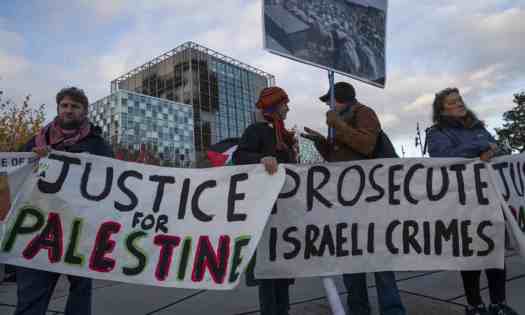
Demonstrators outside the International Criminal Court call for the Israeli army to be prosecuted for war crimes, The Hague, Nov 2019. (photo: Peter de Jong / AP)
There is sufficient evidence to investigate alleged Israeli and Palestinian war crimes committed in the West Bank, East Jerusalem and the Gaza Strip, the court has announced.

By Peter Beaumont | The Guardian | Dec 20, 2019

‘In brief, I am satisfied that war crimes have been or are being committed in the West Bank, including East Jerusalem, and the Gaza Strip.’
— Fatou Bensouda, ICC Chief Prosecutor

In a landmark decision, the ICC said it saw “no substantial reasons to believe that an investigation would not serve the interests of justice.”

The announcement ended years of preliminary investigations into alleged crimes by both Israeli forces and Palestinians, and signaled that the court was preparing to open a formal investigation.

A statement published by the court’s chief prosecutor, Fatou Bensouda, on the court’s website on Friday said her office “has concluded with the determination that all the statutory criteria under the Rome statute for the opening of an investigation have been met.”
Continue reading “International Criminal Court to investigate war crimes in Palestine”

Trump plunges into campus conflicts about Israel and Palestinian rights

A guest at the White House Hanukkah reception on Wednesday wears a “Make America Great Again” yarmulke. (Tom Brenner/Reuters)
A guest at the White House Hanukkah reception wears a “Make America Great Again” yarmulke, Wed, Dec 11, 2019. (photo: Tom Brenner / Reuters)
The executive order, like many of Trump’s policy moves related to Israel, drew approval from parts of his evangelical Christian base, while Jewish leaders were divided in their responses.

By Julie Zauzmer and Susan Svrluga | The Washington Post | Dec 11, 2019

The executive order ‘has been crafted carefully in a way to paper over the inherent flaw in directing federal agencies to use a definition of anti-Semitism that reaches speech plainly protected by the First Amendment.’
— Will Creeley, a senior vice president of the Foundation for Individual Rights in Education

President Trump added new fuel Wednesday to a long-simmering fight about how colleges should handle activism around the Israeli–Palestinian conflict, signing a controversial executive order directing the federal government to penalize universities that allow anti-Semitism on campus.

Jewish Americans, from rabbis to college students, were deeply divided in their opinion of an order ostensibly meant to protect Jews. Advocates for Palestinian rights and for free speech on college campuses feared that the order might be used to punish students for criticism of Israel that they contend is political, not anti-Semitic.

On campuses across the country, including at George Washington University in the District, students and faculty are fighting over what constitutes bias against Jews and what is legitimate criticism of a foreign government. Continue reading “Trump plunges into campus conflicts about Israel and Palestinian rights”

No one in Israel knew they were committing a massacre

Palestinians mourn over the bodies of members of the same family who were killed in an Israeli airstrike in Gaza, Nov 14, 2019. (photo: AFP / Haaretz)
The Israel Defense Forces claims the target was an “unoccupied shack.”

By Gideon Levy | Haaretz | Nov 17, 2019

‘Why did they do this to us?’
— Mohammed Matar, who had worked in Israel for 30 years, and whose daughter, daughter-in-law and four grandchildren were killed in the bombing

The bomber pilot didn’t know. His commanders who gave him the orders also didn’t know. The defense minister and the commander in chief didn’t know. Nor did the commander of the air force. The intelligence officers who aimed at the target didn’t know. The army spokesman who lied without a qualm also didn’t know.

None of our heroes knew. The ones who always know everything suddenly didn’t know. The ones who can track down the son of a wanted man in a Damascus suburb didn’t know that sleeping inside their miserable hovel in Dir al-Balah was an impoverished family.

They, who serve in the most moral army and the most advanced intelligence services in the world, didn’t know that the flimsy tin shack had long since stopped being part of the “Islamic Jihad infrastructure,” and it’s doubtful that it ever was. They didn’t know and they didn’t bother to check — after all, what’s the worst that could happen?
Continue reading “No one in Israel knew they were committing a massacre”

Israel’s increasing violence against the media

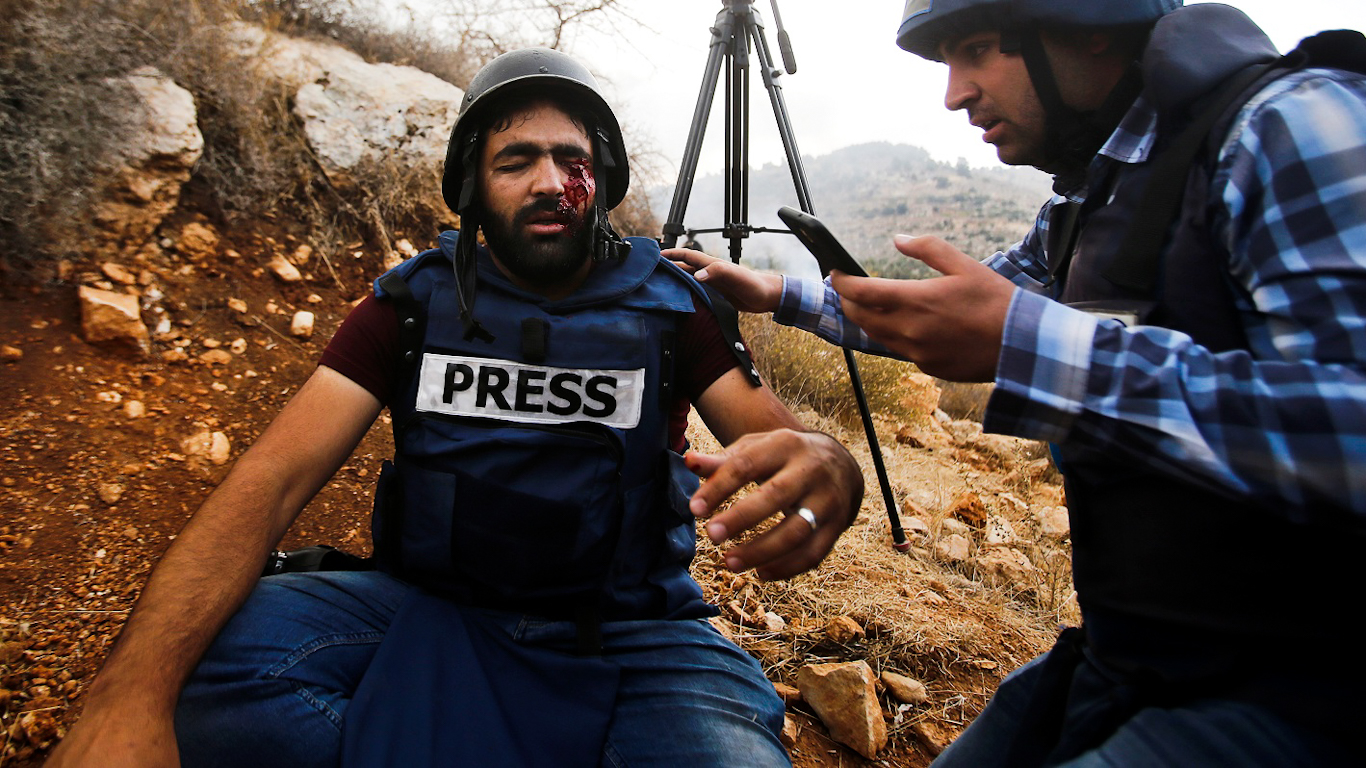
Palestinian photojournalist Mu’ath Amarneh, seated on the left, moments after being shot in the eye by an Israeli soldier in Surif, West Bank on Nov 15, 2019. (photo: Palestinian Information Center)
2018 saw a 52 percent increase in the number of violations against Palestinian press.

By Delilah Boxstein | Mint Press News | Nov 25, 2019

‘I won’t stop being a journalist but now I feel unsafe. They could attack my other eye. It will be harder for me to continue what I am doing.’
— Palestinian photojournalist Mu’ath Amarneh

On November 15, Palestinian photojournalist Muath Amarneh covered a demonstration in Surif, a West Bank city where residents were protesting against the theft of their land by Israeli settlers. Wearing a press jacket and helmet, Amarneh was shot in the head by an Israeli bullet while taking pictures on a nearby hill — about 330 feet from the soldiers.

“Everything just changed. I felt the whole world was circling around me. And I felt my whole life flash before me. I felt like I was dying,” Amarneh said, describing his reaction when hit.

With blood dripping from his eye, Amarneh was taken to a hospital in Hebron, West Bank. He was eventually transported to Hadassah Hospital in Jerusalem where his left eye was removed. He remains there awaiting further operations to have the bullet removed from his head. Continue reading “Israel’s increasing violence against the media”

Trump crushes Palestinian hopes — again

A Palestinian boy sits on a chair as Israeli authorities demolish a school in the village of Yatta, south of Hebron, in the occupied West Bank, Jul 11, 2018. (photo: Hazem Bader / AFP / Getty Images)
The U.S. Middle East peace plan may be in a coma. But that hasn’t stopped Washington from handing major diplomatic victories to Israel.

By Colum Lynch and Robbie Gramer | Foreign Policy | Nov 18, 2019

‘You now have a complete package of efforts to make a traditional solution . . . to the Israeli-Palestinian problem virtually impossible, at least for the remainder of the Trump administration.’
— Carnegie Endowment for International Peace scholar Aaron David Miller

Secretary of State Mike Pompeo declared Monday that the United States no longer considers civilian Israeli settlements on Palestinian lands a violation of international law. The move represents a historic decision that reverses decades of U.S. policy and represents the latest in a raft of pro-Israeli moves that could effectively quash hopes for the two-state solution to the Israeli-Palestinian conflict.

“The conclusion that we will no longer recognize as per se inconsistent with international law is based on the unique facts, history, and circumstances prevented by the establishment of civilian settlements in the West Bank,” Pompeo told reporters on Monday. He said that the decision does not mean the U.S. government is expressing views on the legal status of any individual settlement or “prejudging the ultimate status of the West Bank.”

Pompeo’s statement rolls back a 1978 State Department opinion that formed the bedrock of U.S. legal opinion on Israeli settlements, asserting that civilian settlements in the occupied territories are “inconsistent with international law.”

The decision marks the latest way in which the Trump administration has undercut Palestinian claims of statehood in favor of its closest historic ally in the Middle East, handing another political victory to embattled Israeli Prime Minister Benjamin Netanyahu as he struggles to stay afloat after failing to form a coalition government.
Continue reading “Trump crushes Palestinian hopes — again”