Portland Trail Blazers game at Moda Center, Portland, Oregon (2013). (photo: Wikimedia)
Portland Trailblazers respond to protestor demands to drop relationship with sponsor selling rifle scopes to Israeli military.
By Michael Arria | Mondoweiss | Oct 1, 2019
I think it’s terrible that Leupold & Stevens actively profits from war crimes, as many IDF have been spotted using their scopes in ‘combat’ zones against Palestinian protesters. — Josuee Hernandez, US Marine
Portland Trail Blazers president and CEO Chris McGowan has announced that the National Basketball Association (NBA) team will no longer partner with a rifle scope manufacturer that has a contract with Israeli military. The move comes after a year-long campaign by local activists to pressure the Blazers to drop the sponsor.
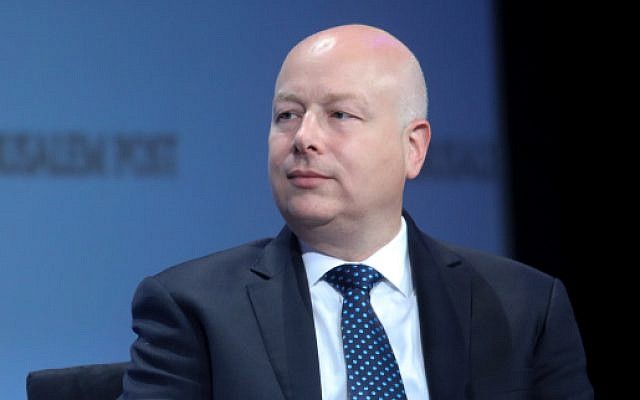
US Special Envoy Jason Greenblatt speaks at a conference in New York City, June 16, 2019. (photo: Marc Israel Sellem / POOL)
The intersection of Israel’s election, US impeachment efforts and the resignation of US Special Envoy Jason Greenblatt create many roadblocks to what is already a failed peace proposal.
By Adnan Abu Amer | IMEMC News | Oct 9, 2019
With Trump’s constitutional crisis to consider, as well as Greenblatt’s resignation and the political deadlock in Israel, Palestinians and Israelis are adopting contrasting positions regarding the deal and its announcement.
Palestinians and Israelis are following the ongoing constitutional measures to impeach US President Donald Trump with great interest. They want to know what the implications will be for the so-called deal of the century; will, for example, its formal announcement have to be postponed due to Trump being otherwise engaged? There is also a nagging fear that the US President will be impeached, and that it will have negative consequences for Washington’s already waning involvement in what passes for a peace process.
The Palestinians welcome the legal and constitutional procedures against Trump, not least because he has put them under great pressure to accept the deal. Moreover, the so-called US peace envoys have stopped visiting the region, and Jason Greenblatt has announced his resignation. This coincided with Israel’s General Election and the political deadlock that has resulted.
President Donald Trump and First Lady Melania Trump visit a memorial outside the Tree of Life Synagogue in Pittsburgh Tuesday, October 30, 2018, following the mass shooting that left 11 worshippers dead. (photo: Andrea Hanks / White House)
More than 100 Jewish academics sign open letter demanding the Trump administration stop exploiting anti-Semitism in order to quash criticism of Israel on college campuses.
By Joshua Leifer | +972 | Oct 6, 2019
‘We have the Department of Education leveraging an attack on a conference related to Gaza to have a chilling effect on free speech overall on campuses.’ — Lara Friedman, president of Foundation for Middle East Peace
Jewish academics are fighting back against the Trump administration’s attempts to silence criticism of Israel on college campuses. More than 100 Jewish scholars have signed an open letter to the U.S. Department of Education in response to its demand that the Duke-University of North Carolina Consortium for Middle East Studies modify its curricular programming or face defunding.
The open letter to Education Secretary Betsy DeVos, whose signatories include renowned scholar Judith Butler, Noam Chomsky, and artist Molly Crabapple, condemns the Education Department’s recent investigation of the consortium and subsequent ultimatum as “an unfounded and anti-democratic campaign of intimidation” and charges the Education Department with “exploiting fears of anti-Semitism” and “using Jews and our concerns over anti-Semitism to try and justify repressive policies.”
Palestinian poet Dareen Tatour after her release from Damoun Prison, September 20, 2018. (photo: Oren Ziv / Activestills.org)
Four years ago, a Palestinian citizen of Israel was arrested because the security services decided a poem she wrote and published on her personal Facebook page was ‘incitement.’
By Oren Ziv | +972 | Oct 3, 2019
The efforts to taint her poetry as a criminal act were now at an end. — Attorney Gaby Lasky
Dareen Tatour, the Palestinian poet arrested in 2015 over a poem she published on Facebook, is finally free. After years of house arrest, months in prison, and dogged efforts by the government to secure the maximum conviction possible, the Supreme Court last week rejected the state’s petition to restore her overturned conviction for incitement to violence. With that, Tatour’s legal ordeal came to an end, more than four years after it began.
Rifles and rifts: Houthi rebels in Sanaa, Yemen, December 2018. (photo: Hani Al-Ansi / Picture Alliance / dpa / AP Images)
A complex and paradoxical mix of polarization and integration in the Middle East creates uncertainties and potential for all-out war.
By Robert Malley | Foreign Affairs | November/December 2019
When it comes to the Middle East, Tip O’Neill, the storied Democratic politician, had it backward: all politics—especially local politics—is international.
The war that now looms largest is a war nobody apparently wants. During his presidential campaign, Donald Trump railed against the United States’ entanglement in Middle Eastern wars, and since assuming office, he has not changed his tune. Iran has no interest in a wide-ranging conflict that it knows it could not win. Israel is satisfied with calibrated operations in Iraq, Lebanon, Syria, and Gaza but fears a larger confrontation that could expose it to thousands of rockets. Saudi Arabia is determined to push back against Iran, but without confronting it militarily. Yet the conditions for an all-out war in the Middle East are riper than at any time in recent memory.
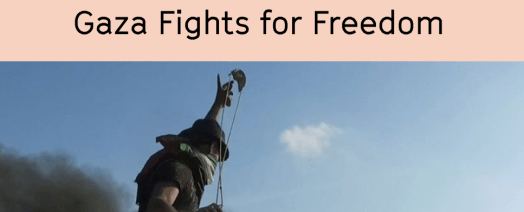
This debut feature film by journalist Abby Martin began while reporting in Palestine, where she was denied entry into Gaza by the Israeli government on the accusation she was a “propagandist.” So Abby connected with a team of journalists in Gaza to produce the film through the blockade.
This collaboration shows you Gaza’s protest movement like you’ve never seen before. Filmed during the height of the Great March of Return protests, it features exclusive footage of demonstrations where 200 unarmed civilians have been killed by Israeli snipers since March 30, 2018.
The documentary tells the story of Gaza past and present, showing rare archival footage that explains the history never acknowledged by mass media. Victims are heard from the ongoing massacre, including journalists, medics and the family of internationally-acclaimed paramedic, Razan al-Najjar.




 HolyLandJustice.org
You must be logged in to post a comment.