Help us recognize the many successes of the past year as we also look forward with excitement to upcoming programs. You will hear directly from youth involved in Kids4Peace and get updates on our work in the US and Jerusalem.
Tickets are $50 per person; there will be an opportunity to make an additional pledge of support at the event. The ticket price is fully tax-deductible, and all donations go directly to support the work of Kids4Peace as we develop a new generation of peace leaders.
“I don’t want the Palestinians as citizens of Israel and I don’t want them as subjects of Israel. So I want a solution where they have all the powers they need to govern themselves but none of the powers that would threaten us. What that means is that whatever the solution is, the area west of the Jordan — that includes the Palestinian areas — would be militarily under Israel.”
— Israeli Prime Minister Benjamin Netanyahu
He’s said it countless times before in myriad ways. But he usually only says it in Hebrew. This week, however, Israeli Prime Minister Netanyahu said in English, and on camera, that under his leadership Israel will never end the occupation of Palestine.
Speaking at the Economic Club of Washington earlier this week, Netanyahu dodged a question about whether he supports a one- or two-state solution, and outlined a vision that sounds a lot like an entrenched and enhanced version of the occupation as it exists today.
“Taking a stand for economic and social justice is at the heart of the co-op’s mission. Given Israel’s ongoing violations of Palestinian human rights, we would have failed in this mission had we not approved a boycott.”
— Grace Cox, former Olympic Food Co-op board member and defendant in the lawsuit
Today, a Washington State court ended a seven-year litigation battle against former volunteer board members of the Olympia Food Co-op over their decision to boycott Israeli goods. The lawsuit was first filed in 2011 by five co-op members seeking to block the co-op’s boycott and to collect monetary damages against the board members. Two of the five members pulled out of the case, and none of the defendants originally named in the case remains a board member of the co-op. The court granted the motion for summary judgment from the former board members, who were represented by Center for Constitutional Rights (CCR) and co-counsel, finding the plaintiffs had no standing to bring a case because they failed to show the co-op was injured.
“We are pleased that the court has dismissed this meritless lawsuit. It is a relief and a vindication for our clients, and a victory for everyone who supports the right to boycott,” said Center for Constitutional Rights Deputy Legal Director Maria LaHood, who argued today.
Lawyers say the lawsuit is part of a broad and growing pattern of suppressing activism in support of Palestinian rights, a phenomenon that CCR and Palestine Legal have documented and called the “Palestine Exception” to free speech. CCR and Palestine Legal report the widespread use of administrative disciplinary actions, harassment, firings, legislative attacks, false accusations of terrorism and antisemitism, and baseless legal complaints. Between 2014 and 2016, Palestine Legal responded to 650 such incidents of suppression targeting speech supportive of Palestinian rights.
Senator Chuck Schumer (D-NY) speaking at the AIPAC Strategy Conference in Washington, DC. (photo: Getty Images)
Young Americans, including young American Jews, are more critical of Israel than their elders. But it’s not because they’re ignorant of history — it’s because they’re less enthralled by myth.
The real problem confronting Schumer isn’t that young Americans are ignorant. It’s that more and more of them are knowledgeable enough to realize that Israeli policy in both the West Bank and Gaza massively violates Palestinian human rights. And to wonder why a Democrat like Chuck Schumer is supporting policies so antithetical to the progressive principles he claims to hold dear.
Chuck Schumer is worried about young people. In his speech on Monday at the American Israel Public Affairs Committee policy conference, he warned that “too many of the younger Americans don’t know the history” of the Israeli-Palestinian conflict “and as a result they tend to say, well, both sides are to blame.” And so — after a joke about a Mrs. Goldfarb who is sentenced to one night in jail for each of the four peaches she stole, and whose husband yells to the judge, “She stole a can of peas, too” (relevance: unclear) — the Senate Minority leader offered a history lesson to America’s youth.
He began with the settlements. “There are some who argue, the settlements are the reason there’s not peace,” Schumer declared. “But we all know what happened in Gaza. Israel voluntarily got rid of the settlements there. The soldiers, Israeli soldiers dragged the settlers out of Netzarim and three weeks later the Palestinians threw rockets into Sderot. It’s sure not the settlements that are the blockage to peace.” Take that Israel-queasy millennials.
The implication of Schumer’s tale is that because Palestinians kept fighting Israel even after Israel withdrew its settlements from Gaza, Palestinians don’t really care about settlements. Their real beef is with Israel’s very existence.
“[The University’s decision] portrayed Dr. Salih in a manner that does not befit a respected academic with more than 15 years’ experience of chairing meetings in a balanced and scholarly way. We therefore would like to apologize to Dr. Salih for removing her as a chair, and we recognize that there was no evidence to support the view that she would not ensure a democratic debate, allowing all views to be expressed.”
— Cambridge University statement
The University of Cambridge has apologized to a Palestinian academic, whom it prevented from chairing a talk on the Boycott, Divestment, Sanctions (BDS) movement in November last year.
Ruba Salih from the School of African and Oriental Studies (SOAS) in London was stopped from moderating the event organized by pro-Palestinian activists and replaced by the university’s own choice, apparently over concerns about her neutrality.
The decision sparked anger among activists, who saw it as yet another example of a university attempting to shut down or disrupt debate on Israel and the BDS movement.
Hundreds of academics and students also signed an open letter condemning the university’s conduct.
Join the Rachel Corrie Foundation for Peace and Justice (RCF) in Seattle on Saturday, March 17, 2018, to remember Rachel Corrie and celebrate fifteen years of Palestinian solidarity and community organizing! In honor of 15 years of dedicated work around the globe, the Rachel Corrie Foundation wishes to raise $15,000 to support the programs that carry on Rachel’s vision, spirit, and creative energy!
This fundraising event will feature guest speakers Huwaida Arraf, Palestinian-American human rights activist, lawyer, and cofounder of the International Solidarity Movement (ISM), and Cindy and Craig Corrie, founders of the Rachel Corrie Foundation and parents of Rachel Corrie. Attendees will have the opportunity to hear first-hand accounts of Rachel Corrie and the work of the International Solidarity Movement, what the last 15 years have yielded in terms of struggle and victory for the Palestinian people, the challenges of holding the Israeli and US governments accountable, and the impact of grassroots organizing. Continue reading “Rachel Corrie: 15 Years Later (Saturday)”
“It’s the Louis XIV syndrome. More than just saying that the state is him, his feeling and the feeling of those around him, is that the damage to the party and the country by his resigning would be so great that it’s worth doing things that would have been unthinkable were it anyone else.”
— Nahum Barnea, Israeli columnist for Yediot Ahronot
Israel is famously low on pomp and circumstance. Attend an Israeli wedding and guests are likely to appear in jeans, with sunglasses perched on their foreheads. When Donald Trump landed at Ben Gurion Airport last May, the Israeli government tried to keep it stately — red carpet, military orchestra — but it wasn’t long before a member of the ruling Likud Party whipped out his cell phone and snapped a selfie with the American President on the tarmac. So minimal is the ceremoniousness that, whenever it exists, it tends to take on outsized meaning.
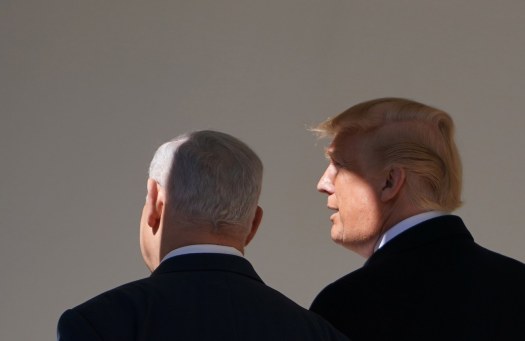
One such ceremony took place on Monday, when Prime Minister Benjamin Netanyahu met with President Trump in the Oval Office. Netanyahu tried to project an air of business as usual — the relationship between the United States and Israel “has never been better,” he gushed — even as Trump may have quickened the Israeli leader’s pulse by saying, nonchalantly, that “we have a shot” at “doing” peace with the Palestinians. But only one thing was on the mind of the travelling Israeli press corps. A reporter asked, “Prime Minister Netanyahu, would you like to comment about the latest news coming from Israel?”
Despite Israel’s claims that occupied East Jerusalem is part of its “eternal, undivided” capital, the Palestinians who are born and live there do not hold Israeli citizenship, unlike their Jewish counterparts.
The Israeli parliament has passed a law that allows the minister of interior to revoke the residency rights of any Palestinian in Jerusalem on grounds of a “breach of loyalty” to Israel.
The bill, ratified on Wednesday, will also apply in cases where residency status was obtained on the basis of false information, and in cases where “an individual committed a criminal act” in the view of the interior ministry.
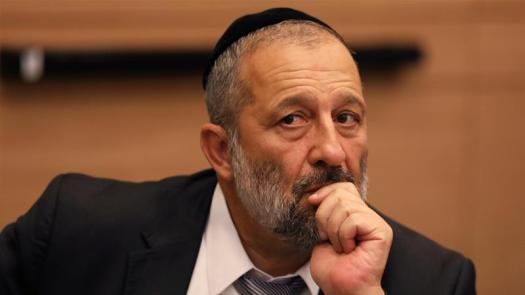
Under the new measure, Israel’s Interior Minister Aryeh Deri, leader of the ultra-Orthodox political party Shas, will be able to strip the residency documents of any Palestinian whom he deems a threat.
Pushing for Change: Mideast Focus Ministry Film Series V
Through riveting and moving personal recollections of Palestinians and Israelis, “1948” reveals the shocking events of the most pivotal year in the most controversial conflict in the world. Seen through the eyes of those who lived it, we see people pushing for change after suffering years of injustice and Holocaust.
Our concern is to help balance the limited and confusing media coverage of the Holy Land. We use compelling films as an entry point for reflection and discussion. As Christians, we respond to Christ’s call to seek justice and love the oppressed. As Americans, we ask: Can we reconcile this calling with our government’s massive financial support of Israeli military operations? We hope the time will come when Jews, Muslims and Christians will again come together in harmony in the Holy Land.
In this series, we see how people pushed to bring about a safe country for the Jewish people, and how today others are still push- ing for safety and change. Do our efforts for change lead to peace and justice . . . or not?
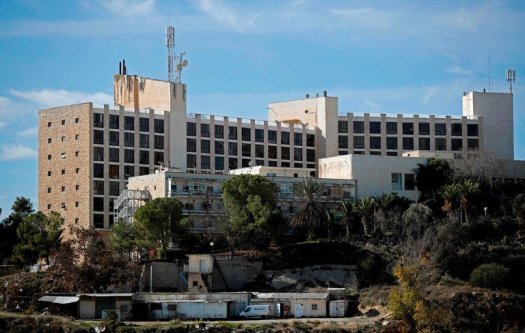
The former Diplomat Hotel, now part of the United States consular compound in Jerusalem, was built on disputed territory. (photo: Thomas Coex / Agence France-Presse / Getty Images)
The site of the US diplomatic compound is in occupied territory that has never been formally incorporated into Israel.
“Much more important than what the State Department says, it is what their actions say. You don’t build an embassy in territory that is not sovereign to Israel.”
— Eugene Kontorovich, director of international law at the conservative Kohelet Policy Forum in Jerusalem
In two months, the United States plans to open a new embassy to fulfill President Trump’s recognition of Jerusalem as Israel’s capital.
There’s just one problem: The embassy may be in Jerusalem, but it may not be fully in Israel.
The diplomatic compound that will serve as the American Embassy until a permanent site is found lies partly in a contested zone known as No Man’s Land.
No Man’s Land encompasses the area between the armistice lines drawn at the end of the 1948–49 war and was claimed by Jordan and Israel. Israel won full control of it in the 1967 war, so the United Nations and much of the world consider it occupied territory.







 HolyLandJustice.org
You must be logged in to post a comment.