If Israel were not an ally, the US would be working to overthrow its government

Palestinians Israel
Teargas canisters fired from Israeli drones fall on Palestinians during a demonstration near the Gaza Strip border with Israel, Mar 30, 2018. (photo: Hatem Moussa / AP)

The “humanitarian” concern of the US is all too often a cover for regime change ambitions. It seems to disappear when the victims in need are without strategic geopolitical value to Washington.

By Whitney Webb | Mint Press News | Apr 3, 2018


There are no efforts to hold Israel to account for its recent massacre of civilians. Instead, Israel has rejected UN and EU calls for an inquiry into the killings and a UN Security Council resolution on the matter was blocked by the United States.


Over the weekend, outrage took hold as the state of Israel authorized more than 100 snipers to fire upon the demonstrations of unarmed Palestinians in Gaza. The Palestinians, participating in the “March of Great Return” to demand the right for exiled Palestinians to return to their ancestral lands, were fired upon while fleeing and even praying. 17 Palestinians were killed and over 1,400 were injured. The Gaza Health Ministry stated that most of the reported injuries were bullet wounds to the legs and feet. The Israeli Defense Forces stated on Twitter that they were fully aware of where “every bullet landed” and Israeli Defense Minister Avigdor Lieberman said that the snipers “did what had to be done” and “deserve a commendation.”

The outrage, however, was confined to only a few countries as, throughout the West, the horrific event was the subject of slanted reports — such as those that portrayed the Israeli military firing on unarmed demonstrators as “clashes” — or was not even covered at all. Despite the number of people killed and the flagrant violation of international law, the story didn’t even make the Sunday edition of The New York Times, the US “paper of record.”

Continue reading “If Israel were not an ally, the US would be working to overthrow its government”
BDS calls for boycott of Netflix over Israel “propaganda” series, “Fauda”

5fc011578b3e6e736b9c96bf4e88adec18fc2956
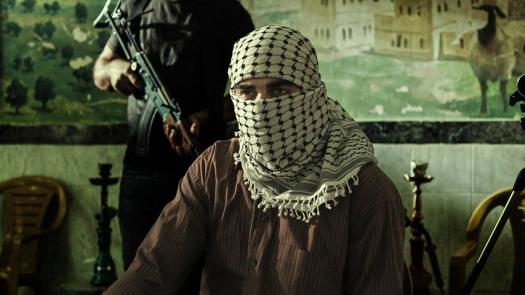
A screenshot from Episode 1 of Fauda. (photo: Netflix)

BDS says that “Fauda” celebrates secret Israeli military units which carried out numerous assassinations and extrajudicial executions.

By Middle East Monitor | Mint Press News | Mar 29, 2018


“Fauda reveals the contribution made by the series to Israeli propaganda efforts in concealing Israeli crimes, including ethnic cleansing, particularly in Jerusalem, the Negev and the Jordan Valley, the demolition of houses and the bulldozing of agricultural land and the siege of two million Palestinians in Gaza and the establishment of colonies.”
— BDS


The international Boycott, Divestment and Sanctions (BDS) movement is leading a campaign against the hit Israeli series, “Fauda.” Denouncing the widely acclaimed series as “racist propaganda for the Israeli occupation army”, BDS called on Netflix, which bought the rights to “Fauda,” to remove the show or face legal action.

In its statement announcing the campaign to boycott “Fauda,” BDS claims that the series serves as propaganda for Israel’s political and security establishment. It notes that the “Fauda” cast, including the production team, were hosted by the Israeli President, Reuven Rivlin, last month along with Israeli soldiers. The crew expressed gratitude to the Israeli soldiers and were described as a “source of inspiration” for the series while Rivlin expressed “gratitude” to the series’ producers.

Continue reading “BDS calls for boycott of Netflix over Israel “propaganda” series, “Fauda””

Should Israeli settlers be considered civilians?

Mideast  Israel Palestinians
An Israeli Jewish settler shoots in the air as Palestinians protest against a plan to resettle Israel’s Palestinian Bedouin minority from their villages in the Negev Desert, near the Israeli settlement of Bet El, north of the West Bank city of Ramallah. (photo: Majdi Mohammed / AP)

About 50% of the West Bank has been annexed by settlements, and 90% of the West Bank’s water is stolen from underneath the Palestinians.

By Robert Inlakesh | Mint Press News | Mar 29, 2018


“The Occupying Power shall not deport or transfer parts of its own civilian population into the territory it occupies.”
— Article 49, Fourth Geneva Convention


It is time to pose a question: Are Israeli settlers civilians? Or are they illegal occupiers? A group of Israeli settlers made the move to seize land in East Hebron (al-Khalil) last Monday (Mar 6, 2018), setting up camp — adjacent to the “Kharsina settlement” — backed by an entourage of heavily armed soldiers.

This move threatens three Palestinian families, with fears that they will soon be dispossessed of their land and homes. Those at risk of being cleansed and their property stolen, are the Eida, Jwihan and the al-Halawa families. The initiative to take this land came from the settlers themselves, who now occupy the 70-dunums. The settlers are living in four newly purchased caravans.

The above example clearly illustrates the way in which illegally established settlements, in the West Bank, come to their fruition.

Continue reading “Should Israeli settlers be considered civilians?”

How do you make a TV show set in the West Bank?

170904_r30450
“Fauda” follows an undercover Israeli unit trying to ensnare a terrorist mastermind. (illustration: R. Kikuo Johnson / The New Yorker)

What the thriller “Fauda” reveals about what Israelis will watch — and what they won’t.

By David Remnick | The New Yorker | Sep 4, 2018


“Today, a film like ‘Khirbet Khizeh’ would be impossible. You won’t be jailed for it, but the subject of the Nakba” — the Arabic term for the “catastrophe” of Palestinian expulsion and exile, in 1948 — “cannot be mentioned unless you want to be branded a ‘leftist.’ ”
— Rogel Alpher, television critic for Haaretz


In 1949, Yizhar Smilansky, a young Israeli veteran, national legislator, and novelist writing under the pen name S. Yizhar, published “Khirbet Khizeh,” a novella about the destruction of a lightly fictionalized Palestinian village near Ashkelon, some thirty miles south of Tel Aviv.

Writing from the point of view of a disillusioned Israeli soldier, Yizhar describes the Army’s capture of the village and the expulsion of its remaining inhabitants. The time is 1948, the moment of Israel’s independence and its subsequent victory over five invading Arab armies that had hoped to erase the fledgling Jewish state from the map.

It would be forty years before the New Historians — Benny Morris, Avi Shlaim, and Simha Flapan among them — marshalled the nerve and the documentary evidence required to shatter the myth that hundreds of thousands of Palestinian Arabs had all voluntarily “abandoned” their cities and villages.

Yizhar was there to bear witness in real time. Continue reading “How do you make a TV show set in the West Bank?”

Hopeless in Gaza

Mideast Gazas Emergency Room
Palestinian medical personnel treat a wounded girl at the emergency room of the Shifa hospital in Gaza City following an Israeli bombing campaign, Jul 18, 2014. (photo: Khalil Hamra / AP)

A conversation with controversial scholar Norman Finkelstein.

By Eric Gordon | Mint Press News | Mar 30, 2018


When we think “refugees” from war, disaster or oppression, images of large numbers of people come to mind, crossing borders, departing on the last flights out, fording streams, boarding leaky transport ships, washing ashore. That what’s completely different about Gaza: The borders are sealed and there is no place to flee. The population is trapped in a tiny sliver of land equal in size to twice the District of Columbia. Some have named it “the largest open-air prison in the world,” but others claim that implies guilt on the part of the inmates, preferring bluntly to call it a “concentration camp.”


“The nadir of the Palestinian struggle is now,” says distinguished but controversial scholar Norman G. Finkelstein. He spoke on March 26 at the University of Southern California Annenberg School for Communication and Journalism. “Nothing is happening there in Palestine. There is no mass resistance.”

That explains why worldwide the pro-Palestinian cause is not drawing the crowds it once did. It also explains why the USC auditorium was at most half full. As Finkelstein surveyed the audience, he pointed to one college-age man in the front row, observing that he was by far the youngest person in the room. In Gaza today, 51 percent of the population is under 18 years of age. Half of Gaza’s people would be younger than this young man.

However, if the martyrdom of Gaza seems right now to be sealed in the pages of history, “We don’t know what will come tomorrow,” says the author, on a tour to promote his newest book, Gaza: An Inquest into Its Martyrdom. “So we must keep preparing the ground.”

Continue reading “Hopeless in Gaza”

“He had no gun, no Molotov” — he was just running away with a tire

crop_90abdel_fattah
Abdul Fattah Abdul Nabi, a 19-year-old Palestinian, moments before he was killed during Friday’s protests in the Gaza Strip. (photo: Mahmoud Abu Salama / The Washington Post)

An unarmed civilian was shot in the back of the head by an Israeli sniper while running away from the border fence.

By Loveday Morris and Hazem Balousha | The Washington Post | Mar 31, 2018


“These are the predictable outcomes of a manifestly illegal command: Israeli soldiers shooting live ammunition at unarmed Palestinian protesters. What is predictable, too, is that no one — from the snipers on the ground to top officials whose policies have turned Gaza into a giant prison — is likely to be ever held accountable.”
— Amit Gilutz, spokesman for the Israeli human rights group B’Tselem


The morning after burying 19-year-old Abdul Fattah Abdul Nabi, his family gathered in a tent set up to receive mourners, watching and re-watching a video of the moment they say Israeli soldiers shot him in the back of the head.

The video appears to show the teenager, dressed in black, running away from Gaza’s border fence with Israel carrying a tire. Just before reaching a crowd, he crumples under gunfire.

“He had no gun, no molotov, a tire. Does that harm the Israelis, a tire?” asked his brother Mohamed Abdul Nabi, 22. “He wasn’t going toward the Israeli side. He was running away.”

Continue reading ““He had no gun, no Molotov” — he was just running away with a tire”

To the settler chief who insists Jews must rule Israel even if Arabs become the majority

1-5955978-143511924
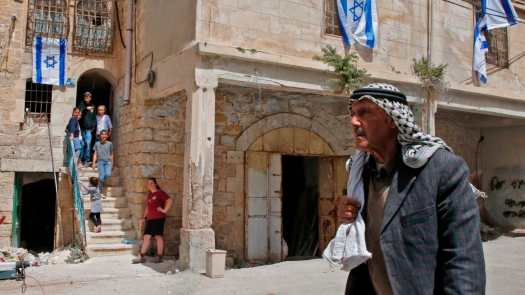
A Palestinian man walks past Israeli settlers standing outside a Palestinian house after it was occupied by settlers, Hebron, West Bank, Mar 27, 2018. (photo: Hazem Bader / AFP)

If nothing else, the right has persuaded me of this: We need to offer every West Bank Palestinian the option of voting in Israeli elections. If you refuse to allow them a country, for God’s sake, allow them the vote.

By Bradley Burston | Haaretz | Mar 27, 2018


“I truly believe that our right to the Land of Israel holds true whether or not [there is a majority]. It is just as when Ben-Gurion established the state and there were 600,000 [Jewish] people facing one and a half to two million Arabs. Our right to the land of Israel was strong and present then. And it exists now as well. Therefore, the majority is not meant to be the deciding factor in our decision making.”
— Yigal Dilmoni, deputy CEO of the settlement movement’s Yesha Council


A senior Israeli settlement movement official, responding to statistics cited by the Israeli military indicating that Jews are now a minority in the Holy Land, stated this week that Jews have the right to rule Israel even if Arabs become a majority within the country.

The statement came hours after a furor erupted Monday in the Knesset, where figures cited by an army colonel showed that some three million Palestinians now live in the West Bank and another two million in the Gaza Strip.

Combined with the 1.8 million Arab citizens of Israel and the 300,000 Palestinian residents of East Jerusalem, the statistics meant that from the Mediterranean Sea to the Jordan River, Arabs may outnumber Israel’s 6.6 million Jews by as many as 600,000 people. . . .

Continue reading “To the settler chief who insists Jews must rule Israel even if Arabs become the majority”

Trinity College Dublin students overwhelmingly back BDS

2018_2-27-trinity-college-students-support-bds28379829_352265535256025_804080783351570836_n
Trinity College Dublin student come together to support the Palestinian-led BDS campaign. (photo: Palestinians abroad / Facebook)

The referendum saw the highest turnout in recent years.

By Middle East Monitor | Mar 23, 2018


“If we can help make a difference by boycotting, divesting, and sanctioning those organizations complicit the oppression of the Palestinian people, then I think it worthwhile to do so.”
— TCDSU President Shane De Rís

Students at Trinity College Dublin have overwhelmingly voted to support the Palestinian-led Boycott, Divestment, Sanctions (BDS) campaign, with the referendum result announced to cheers and chants.

Asked whether Trinity College Dublin Students’ Union (TCDSU) should “accept a long-term policy on Palestine and in support of Boycott, Divestment and Sanctions (BDS),” 64.5 per cent of students voted in favor (1,287 students of a total of 2,050). . . .

As BDS is a “long-term policy,” it required that 60 per cent or above of the students balloted voted in its favor. The referendum was held after students gathered the necessary 500 signatures to put the vote to the student body.

Continue reading “Trinity College Dublin students overwhelmingly back BDS”

Elderly Palestinian return to their villages for the first time in 80 years

283353672dbf41739bf73925dad4226d_18
Amena Sanqar was 17 when she and her family were forced to flee their village of Beit Nabala. (photo: Shatha Hammad / Al Jazeera)

To commemorate Land Day, group of Palestinian refugees returned to the villages from which they were expelled in 1948.

By Shatha Hammad | Al Jazeera | Mar 29, 2018


“We only took a few utensils to use for food preparation, we didn’t take many clothes, and we left our jewelry back at our home. We thought we would be back in a few days.”
— Hawwa told Al Jazeera.


In a rush, Hawwa al-Khawaja and her daughter Khawla stepped off a bus as it pulled over at the entrance of what was once the village they called home. The elder Khawaja stood there greeting others who had arrived on the buses that followed, just as she used to greet her village’s visitors as a young woman before 1948.

“Welcome, welcome to al-Thahiryeh,” the 90-year-old said. “We apologize for not having a home to welcome you in.”

Since 1948, there have been no homes or residents in the destroyed village of al-Thahiryeh, which lies southeast of the city of al-Lydd. That year, Zionist forces pushed out Palestinian families living in the village, before destroying every inch of it. Al-Thahiryeh was one of 500 villages that faced the same fate in what became known as the ethnic cleansing of at least 800,000 Palestinians.

On Wednesday, Hawwa al-Khawaja returned to al-Thahiryeh for the first time, but only for a few hours.

Continue reading “Elderly Palestinian return to their villages for the first time in 80 years”

Gazan Christian do not yet have permits to visit Jerusalem for Easter

FILE PHOTO: A worshipper lights a candle as she visits the Church of the Holy Sepulchre in Jerusalem's Old City
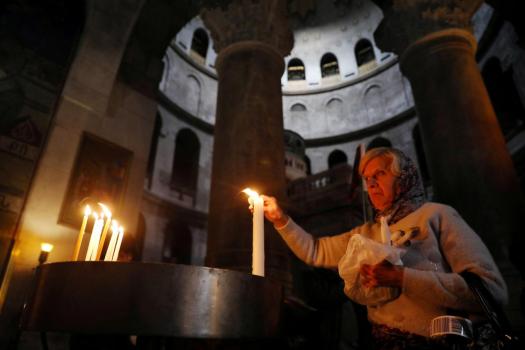
A worshipper lights a candle in the Church of the Holy Sepulchre in Jerusalem’s Old City, Jan 22, 2018. (photo: Ammar Awad / Reuters)

Gaza has only 1,000 Christians among a population of 2 million in the narrow coastal strip.

By Stephen Farrell | Reuters | Mar 27, 2018


“Israel is a sovereign state and it has the right to decide who will enter its gates. No foreign residents have an inherent right to enter Israel, including Palestinian residents of the Gaza Strip.”
— Civil Administration (COGAT) spokesman


The Latin Patriarchate of Jerusalem said church authorities had applied for around 600 permits for Gazans to travel, but had not received any, three days before Good Friday.

Israel tightly restricts movements out of the Gaza Strip, territory controlled by Hamas, an Islamist group that it considers a terrorist organization.

The Israeli military-run authority that operates in the West Bank defended its policy to restrict access as many Palestinians had stayed on illegally in the past, and said it would only issue permits to people aged at least 55.

Continue reading “Gazan Christian do not yet have permits to visit Jerusalem for Easter”