Criticism and defense of Kairos Palestine

kairos palestine
(photo: uruknet.info)

The director of AJC New England denounces Kairos Palestine; the United Church of Christ responds

By Robert Leikind / The Boston Globe / Sep 20, 2017
By Peter Makari and The Rev. Jim Antal / The Boston Globe / Oct 3, 2017


Israel, [Kairos] states, is the “enemy” who stands in opposition to God himself. Its “occupation,” according to Kairos Palestine, “is an evil that must be resisted.”

[Kairos] advocates peace with justice, rejects and condemns violence and extremism . . . . It offers a word of hope and of love, while naming the injustice of the occupation.


From AJC New England:

Over the last decade, a number of mainline Protestant Churches, including some with a significant presence in New England, have adopted resolutions harshly critical of Israel. During the summer two more were passed by the United Church of Christ and the Disciples of Christ. These measures share three core elements: Each assigns Israel near total culpability for the conflict with the Palestinians; each overlooks decades of Palestinian activity that has undermined prospects for peace with Israel; and each justifies its claims by referring to a document called Kairos Palestine. . . .

This appeal reduces the complex, painful history of the Palestinian-Israeli conflict to a single word: “occupation.” Information that might contradict Kairos Palestine’s far-reaching declaration is ignored. Gone from the historical narrative are  . . . multiple Israeli peace proposals, rejected by Palestinian leadership, that included withdrawal from nearly all of the West Bank; acts of terror that have caused thousands of Israeli casualties; thousands of missiles that followed Israel’s withdrawal from Gaza; and repeated calls by Palestinian religious, civic, and political leaders to reject peaceful coexistence with Israel on any terms.

Read the full article here →


From United Church of Christ:

. . . Because the voices of Palestinian Christians are among the voices that need to be heard, our churches commended Kairos Palestine for study, reflection, and response in April 2010, five months after it was issued. The document is written by Palestinian Christians who have lived under Israeli occupation for half a century — a people whose rights are denied every day. Kairos Palestine is an authentic and legitimate voice of a community with which we have close relations, a document that advocates peace with justice, rejects and condemns violence and extremism, and seeks better relationships among all the people of Israel and Palestine. It offers a word of hope and of love, while naming the injustice of the occupation.

We are eager to engage with the multiple perspectives of our sisters and brothers in the Jewish community on Israel and Palestine, and hope that Leikind and the American Jewish Committee would be willing to speak more publicly and critically of the settlements and of occupation, which cannot go on indefinitely, but which must be addressed more urgently.

Read the full article here →

A history lesson on Zionism

robert2bcohen2bmicahs2bparadigm2bshift

The author responds to criticism of anti-Zionism as being anti-Semitic.

By Robert A. H. Cohen / Patheos / Nov 8, 2017


The crimes against the Palestinians should not have to match the Holocaust before we can express our horror or outrage.


Dear Professor Schama,

I’ve just read your letter to The Times this week about Zionism and antisemitism in the Labour Party, co-signed by your fellow historian Simon Sebag Montefiore and novelist Howard Jacobson. As you’re the senior academic, I’m addressing my concerns to you, although I’m slightly embarrassed at having to offer someone of your reputation a history lesson.

While I’m sympathetic to some of your points over the language and tone of the Israel/Palestine debate in some parts of the British left, overall your letter only adds to the lock down of freedom of speech on Israel by attempting to make criticism of Zionism toxic by association. That doesn’t feel like a good position for you to take as a public intellectual.

Your letter makes questioning either the theory or outcomes of Zionism politically, socially and morally unacceptable. In my view, that does little to help our understanding of Zionism, modern Jewish history, or traditional rabbinic Judaism. And, like others before you, you are muddying the meaning of antisemitism.

Continue reading “A history lesson on Zionism”

TOMORROW: Acquiring and applying advocacy skills

uncle-sam-wants-you (1)

Please join our brothers and sisters from Kairos Puget Sound at this advocacy workshop.

Date: Saturday, Nov 11, 2017
Time: 9:00 a.m. – 3:30 p.m.
Location: Episcopal Diocese of Olympia
1551 10th Ave E
Seattle, WA  98102
Information: Event website
Questions
Tickets: $15 / $5 students (includes lunch)
Event Details

Conference will feature keynote speaker Cindy Corrie, Director of Rachel Corrie Foundation, who will discuss “Principled Advocacy” followed by Nada Elia discussing Nuts and Bolts of Boycott, Divestment, and Sanctions and the current legislative efforts to stifle this initiative. Workshops will include letter writing, using social media to get the word out, and organizing a visit to your legislator.

More information here →

TOMORROW: End the deadly exchange — no more US-Israel police partnerships!

israeli_police_850_548

Please join our brothers and sisters from JVP Seattle at this upcoming event.


Date: Wednesday, Nov 8, 2017
Time: 12:00 – 1:00 p.m.
Location: US District Court Plaza, Seattle
7th Ave @ Stewart St
Information: Facebook event
Sponsor page
Event Details

Join us in action to call on the Anti-Defamation League (ADL) to end its deadly law enforcement exchanges between the U.S. and Israel.

Under the banner of “counter-terrorism,” the ADL’s police exchange programs send high-ranking U.S. law enforcement, FBI and ICE officials to train with Israeli police, military and intelligence agencies. These trainings transform Israel’s 70 years of dispossession and 50 years of Occupation into a marketing brochure for successful policing — reinforcing racist & militarized policing in Palestine/Israel and the U.S.

Our own Seattle Police participated in these programs in 2013 and 2015, and it’s time to make clear that these deadly exchanges must end. In Seattle, we need housing, services and support for targeted communities, not more militarized, racist policing. At the action, local activists will speak to these connections between the crisis of police violence here and Israeli occupation and apartheid abroad.

On the anniversary of Trump’s election, with highly visible white supremacist violence, islamophobia and antisemitism on the rise, let’s remind the ADL that it is time for everyone to choose a side — upholding the racist, violent status quo or fighting for a just future, in Seattle and in Palestine/Israel.

More information here →

Cambridge bans study abroad students from going to Palestine

20581
The bridge connecting the West Bank with Israel. (photo: Chadica / Wikimedia Commons)

The University of Cambridge has taken Palestine off its list of acceptable places of study due to visa difficulties in Israel.

By Patrick Wernham / University of Cambridge Varsity / Oct 22, 2017


“Whilst we do not ban independent travel to, or study in, the Palestinian territories, students cannot choose to spend their Year Abroad in the West Bank for the time being due to recent difficulties faced by students in securing visa renewals from the Israeli authorities.”


The University of Cambridge has banned its students from studying in the Palestinian territories on their year abroad.

In a statement, the University said that the decision was made “due to recent difficulties faced by students in securing visa renewals from the Israeli authorities.”

It is the first time that a destination of study has been marked unacceptable since 2011, when Syria was removed as a result of the civil war.

Continue reading “Cambridge bans study abroad students from going to Palestine”

“This land is just dirt”: A rooftop view of Jerusalem

50001
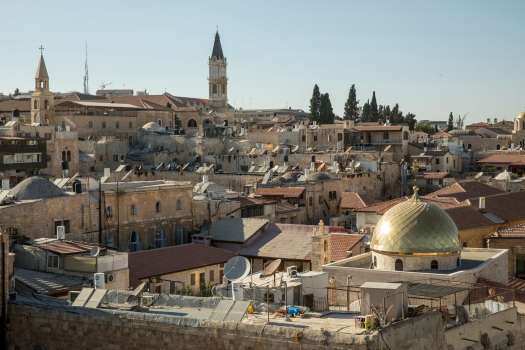
The view from the roof of the Citadel youth hostel in the Old City of Jerusalem. (photo: David Levene / The Guardian)

For its Season of Culture, the ancient capital has thrown open its rooftops to encourage residents to see beyond their blinkered boundaries. But the reality is a city where the divides are growing deeper.

By Hannah Ellis-Petersen / The Guardian / Oct 23, 2017


“All three religions are here on this roof. It is a holy place. Sometimes I sit here and I pray to God and I feel that the angels come and sit here with me. Up here it does not matter if you are a Muslim or a Jew: we are all just human beings. Real peace will only come when we remember this. And I’m talking about real peace — not the peace that politicians speak about — and that’s why I open up my house, to bring people together with food.”
— Abu Yehia


The rooftops of Jerusalem can be deceptive. From up here, the domes and towers of the hundreds of churches, mosques and synagogues glimmer on the skyline in what seems like peaceful coexistence; the neighborhoods below come together in a unified sprawl.

But down below, it is a city defined by barriers. They may not be as tangible as the towering security wall that divides Israel and the Palestinian territories a few miles east, but they are just as divisive and inviolable. Living side by side in Jerusalem are communities who exist with no interaction with one another — kept apart by fear, nationalism and religion.

Continue reading ““This land is just dirt”: A rooftop view of Jerusalem”

Where do we go from here?

OLYMPUS DIGITAL CAMERA
Jaffa Gate, Old City of Jerusalem. (photo: Rennie Coit)

By Mary J. Pneuman / Bishop’s Committee for Justice and Peace in the Holy Land

[Ed. note: After returning from a recent trip to the Holy Land, the author has updated her previous writings. We offer The Promised Land or the Land of Promise Revisited here in serial form.]


A PRAYER FOR JUSTICE AND PEACE

Pray not for Arab or Jew,
For Palestinian or Israeli,
But pray rather for ourselves,
That we might not divide them
In our prayers, but keep them
Both together in our hearts.

— Based on a prayer by a Palestinian Christian


The dollar cost of supporting injustice and oppression in the occupation of the residents of the West Bank, East Jerusalem and Gaza is in the billions. In “The True Cost of Israel,” Philip Giraldi, a former CIA officer who is executive director of the Council for the National Interest wrote in April 2017, that according to the Congressional Research Service, Israel has been “the largest recipient of US foreign assistance since World War II.” The US has given Israel financial aid averaging about 3.6 billion dollars per year since 1948, not including extra defense appropriations, and this calculation of funding is an underestimate because US appropriations are redeposited in the US treasury, which operates on a deficit. As Israel draws down its account, the US taxpayer pays about $100 million more in interest per year. Furthermore, loans have been made that are not repaid, and Israel enjoys preferential trade status with the US. This year, congress approved $3.8 billion to begin on October 1.

In addition to “public assistance” to Israel, private foundations and tax-exempt charities, covered by “religious exemption,” are raising billions of dollars in donations that benefit Jewish settlements. Says Giraldi, “money being fungible, some American Jews have been surprised to learn that the donations they had presumed were going to what they regard as charitable causes have instead wound up in expanding the illegal settlements on the West Bank.” Not long ago, it came to light that a foundation of the family of Jared Kushner, the President’s son-in-law, had made contributions to an Israeli settlement. In his report, Giraldi cites additional ways and means that AIPAC (American Israel Public Affairs Committee) raises US funds for Israel.[1] Continue reading “Where do we go from here?”

SATURDAY: Acquiring and applying advocacy skills

uncle-sam-wants-you (1)

Please join our brothers and sisters from Kairos Puget Sound at this advocacy workshop.

Date: Saturday, Nov 11, 2017
Time: 9:00 a.m. – 3:30 p.m.
Location: Episcopal Diocese of Olympia
1551 10th Ave E
Seattle, WA  98102
Information: Event website
Questions
Tickets: $15 / $5 students (includes lunch)
Event Details

Conference will feature keynote speaker Cindy Corrie, Director of Rachel Corrie Foundation, who will discuss “Principled Advocacy” followed by Nada Elia discussing Nuts and Bolts of Boycott, Divestment, and Sanctions and the current legislative efforts to stifle this initiative. Workshops will include letter writing, using social media to get the word out, and organizing a visit to your legislator.

More information here →

WEDNESDAY: End the deadly exchange —no more US-Israel police partnerships!

israeli_police_850_548

Please join our brothers and sisters from JVP Seattle at this upcoming event.


Date: Wednesday, Nov 8, 2017
Time: 12:00 – 1:00 p.m.
Location: Downtown Seattle (specifics TBD)
Information: Facebook event
Sponsor page
Event Details

Join us in action to call on the Anti-Defamation League (ADL) to end its deadly law enforcement exchanges between the U.S. and Israel.

Under the banner of “counter-terrorism,” the ADL’s police exchange programs send high-ranking U.S. law enforcement, FBI and ICE officials to train with Israeli police, military and intelligence agencies. These trainings transform Israel’s 70 years of dispossession and 50 years of Occupation into a marketing brochure for successful policing — reinforcing racist & militarized policing in Palestine/Israel and the U.S.

Our own Seattle Police participated in these programs in 2013 and 2015, and it’s time to make clear that these deadly exchanges must end. In Seattle, we need housing, services and support for targeted communities, not more militarized, racist policing. At the action, local activists will speak to these connections between the crisis of police violence here and Israeli occupation and apartheid abroad.

On the anniversary of Trump’s election, with highly visible white supremacist violence, islamophobia and antisemitism on the rise, let’s remind the ADL that it is time for everyone to choose a side — upholding the racist, violent status quo or fighting for a just future, in Seattle and in Palestine/Israel.

More information here →

Why Palestinians are leaving, part 2

gate
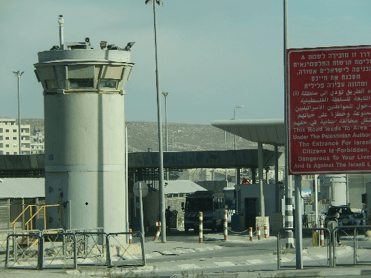
Israeli security checkpoint. (photo: Mary Pneuman)

The facts on the ground.

By Mary J. Pneuman / Bishop’s Committee for Justice and Peace in the Holy Land

[Ed. note: After returning from a recent trip to the Holy Land, the author has updated her previous writings. We offer The Promised Land or the Land of Promise Revisited here in serial form.]


Israel has the distinction of being the only country in the world that each year detains and prosecutes in military courts between 500 and 700 children, some as young as 12 years, most often for throwing stones, In February 2016, 440 children were in the military system, a quarter of them between 12 and 15 years. The Israel Prison System stopped releasing data after May 2016.


Restrictions on economic development and trade

Many Palestinians now work for the Israelis — most often in construction. About 60,000 of an estimated 100,000 have work permits that allow them to work in the settlements or over the Green Line. Most of those who do not have permits work in menial, low-paid jobs and take the risk of working illegally because unemployment is now so high in Palestine. As such, these workers have little control over their working conditions or compensation.

The productive sectors, including agriculture, manufacturing and tourism are on “artificial respiration” according to Ha’aretz (Nov. 2016). Agricultural and industrial output was now only about 15% of the economy. Because of Israeli restrictions on development, control of land and water resources as well as transportation and trade, regulation of the import and export of materials and goods, Israel has significantly impacted the sustainability of the Palestinian economy. Amira Haas writing in Ha’aretz in 2013 on restrictions that weaken competitiveness of Palestinian business vis-a-vis Israeli farmers, manufacturers and hi-tech companies quoted an outgoing World Bank director saying that “. . . unleashing the potential from ‘withheld land’ — access to which constrained by layers of restrictions and allowing the Palestinians to put these resources to work would provide whole new areas of economic activity and set the economy on the path to sustainable growth.” Continue reading “Why Palestinians are leaving, part 2”