
“Church Militant” Theology Put to New, and Politicized, Use

00religion3-master768
Michael Voris, the senior executive producer of ChurchMilitant.com, says the website’s positions are a righteous defense of patriotism and morality. (photo: Brittany Greeson / The New York Times)

By Samuel G. Freedman / The New York Times
December 30, 2016


“This is breaking down into forces that believe in God and those that don’t. Largely, I would say this is a war of religion versus non-religion.”
— Michael Voris, senior executive producer of ChurchMilitant.com

“[Historically,] when you heard the expression ‘the Church Militant,’ it didn’t bring to mind a call to arms or some kind of mobilized, militant action in the way we understand the term now. A lot of the struggle of the Church Militant is against interior temptations that lead you to greed and all kinds of spiritual pathologies. And it’s about engaging in acts of mercy. Part of the victory of the Church Militant is the victory of love. It didn’t have the triumphalist and militarized connotation that’s been attached to it now.”
— John C. Cavadini, a professor of theology at the University of Notre Dame


A week after Stephen K. Bannon helped engineer the populist revolt that led to Donald J. Trump’s election, Buzzfeed unearthed a recording of him speaking to a Vatican conference of conservative Catholics in 2014.

In his presentation, Mr. Bannon, then the head of the hard-right website Breitbart News and now Mr. Trump’s chief strategist, called on the “church militant” to fight a global war against a “new barbarity” of “Islamic fascism” and international financial elites, with 2,500 years of Western civilization at risk.

While most listeners probably overlooked the term “church militant,” knowledgeable Catholics would have recognized it as a concept deeply embedded in the church’s teaching. Moreover, they would have noticed that Mr. Bannon had taken the term out of context, invoking it in a call for cultural and military conflict rather than for spiritual warfare, particularly within one’s soul, its longstanding connotation.

Continue reading ““Church Militant” Theology Put to New, and Politicized, Use”
One-State, Two-State

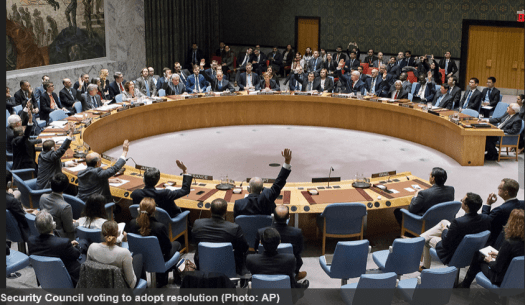
un-resolution2334-vote

By Sarah Robinson
December 31, 2016

[Sarah Robinson is a volunteer with the World Council of Churches who has written about Israel-Palestine since 2012. On Oct 17, 2016, she was refused entry to Israel at Ben Gurion International Airport in Tel Aviv and deported . — Ed.]


In my opinion, [no] solutions are viable without visionary leadership and the willingness to compromise. Recalling the experience of South Africa, bold leadership and compromise brought apartheid to an end, and I believe the same is needed in Israel and Palestine. . . . I believe the appetite of both populations indicates that they are willing to start these talks but the lack of real leadership is restraining any progress.


This week, the Israel-Palestine conflict was nudged into the international spotlight. Last Friday, the United Nations Security Council (UNSC) voted in favor of Resolution 2334 condemning the proliferation of settlement development and expansion in the occupied West Bank and East Jerusalem. Usually, the United States (US) vetoes such resolutions but on Friday they abstained from voting thereby allowing the resolution to pass. Israel was quick to respond with damning language, threatening rhetoric, and victimized aggression. Originally, Egypt put the resolution forward to the UNSC, but after receiving pressure from president-elect Donald Trump, withdrew the application. Thus, a random mix of countries, including New Zealand and Venezuela, resubmitted the resolution which went to a vote. Israel has since accused New Zealand of declaring war in their action to present Resolution 2334 to the UNSC.

On Wednesday, US Secretary of State John Kerry, gave a 1 hour 13-minute speech in Washington DC justifying the US choice to abstain, summarizing the history of US-Israel relations, UN resolutions, and peace negotiations, and outlining five principles to a solution and lasting peace. It was a good speech and it elicited swift condemnation from Israeli Prime Minister Benjamin Netanyahu, however, the speech was about twenty years too late. It rehashed positions and policies that have been ignored or bypassed for decades and although it sounded good, with less than three weeks remaining in the White House, the Obama administration is grasping at proverbial straws. Secretary Kerry pleaded with Israel to not execute the two-state solution but, in my opinion, the death of the two-state solution took place years ago, and this latest activity will not resuscitate it.

Continue reading “One-State, Two-State”